Quick Answer: Where Should You Shop in Yangzhou?
Start at Dongguan Street for traditional gifts and at Pishi Street for stationery and contemporary design. If a lacquer piece is the reason you came, compare several techniques at the dedicated factory experience hall.[1][2][3][4][5]
- Local craft: A small lacquer box or tray is easier to pack than a screen. Ask how the design was made.[3]
- Light gift: Paper cutting and small design items take less room. Request flat protection for a paper cut.[2][6]
- Before paying: Confirm the price for the exact piece, get the maker or seller details and ask what packing is included.
Check the shop or workshop schedule for your date. A demonstration can have separate hours from the venue.[2][4][5]
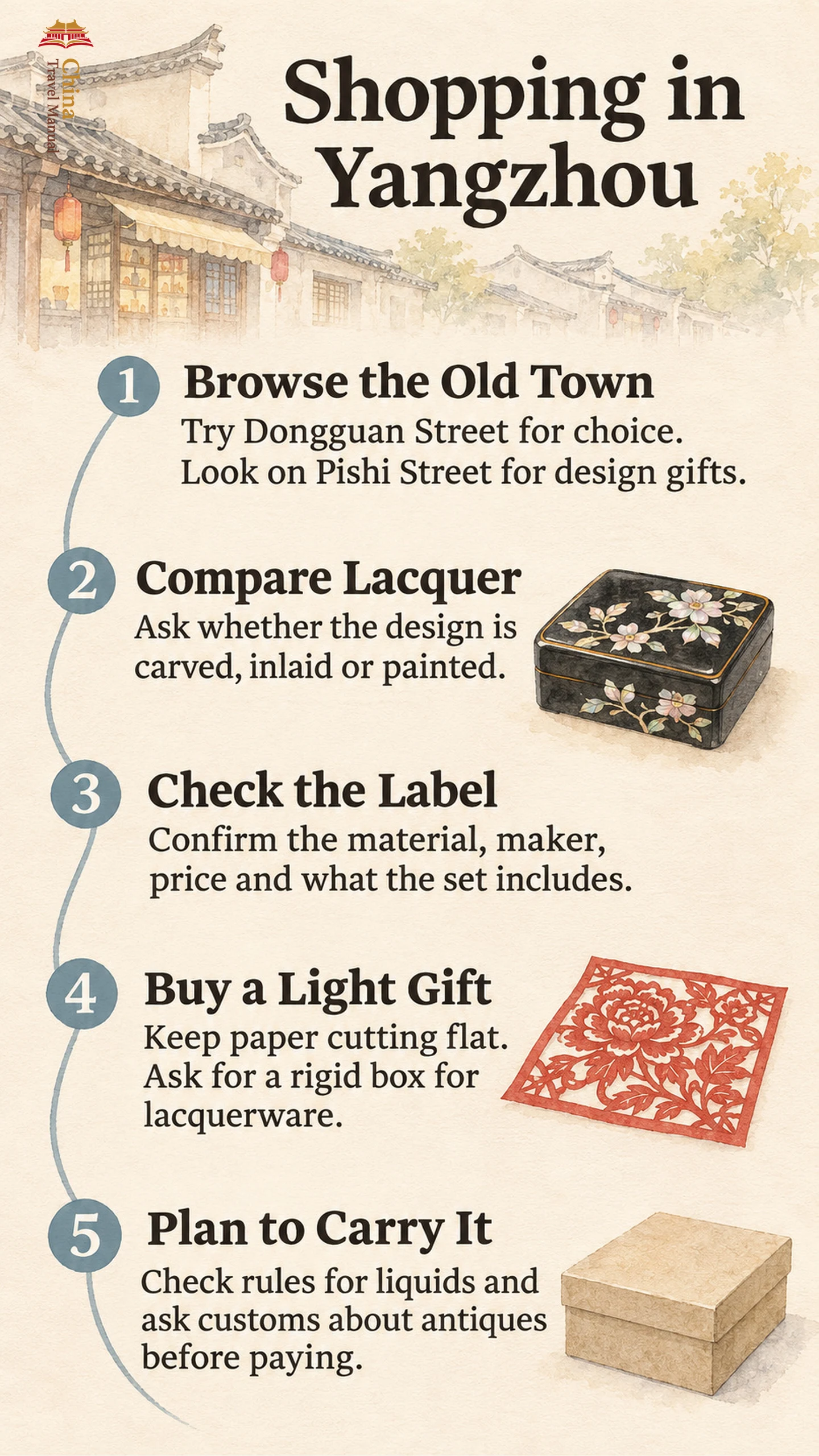
In Yangzhou, a small lacquer box can be a practical gift. Before comparing prices, ask whether the finish is carved, inlaid or painted. Set a size limit first, then use one stop to see how the different finishes look. Compare a second shop if an item is more expensive than you planned.[1][2][3]
Where to Browse and How to Get There
Dongguan Street (东关街) is a good starting point if you are combining shopping with the salt merchants’ quarter. Start near the Ge Garden side and browse toward the canal. Look in more than one craft shop before choosing a decorated box. If you also want to visit Ge Garden, keep its closing time separate from shop hours and check the Ge Garden entrance guide.[1]
Pishi Street (皮市街) makes a useful second stop for bookshops, accessories and compact gifts. Look for a shop’s exact map pin if a particular item matters. A walking link through the old town works best in dry weather. The Yangzhou travel guide shows where the old town fits with the rest of the city. The Dongguan Street and old lanes route provides the neighborhood context.[1][2]
For a closer look at Yangzhou lacquerware (扬州漆器, Yángzhōu qīqì), make a separate stop at the Yangzhou Lacquerware Art Experience Hall (扬州漆器艺术体验馆), 12 Matai Road (马太路12号), to see workshop pieces and contemporary work. Check the current opening notice and ask whether a demonstration or class needs a reservation. Older listings for factory exhibits may refer to different premises. A taxi or ride-hail to the Chinese name and address is a simple option from your railway station. See getting around Yangzhou for station and bus options.[4][5]
Allow about 90 minutes for a comparison browse on Dongguan and Pishi streets. Visit the workshop first if it has a fixed session you want to attend. If you arrive by train with luggage, leave your bags before entering the lanes so you can handle objects and inspect their edges without rushing.
Compare Lacquerware and Other Yangzhou Crafts
The local craft covers several decorative techniques. A glossy finish tells you little about how the pattern was made. Look at the piece in good light and ask about the surface and what is under it.[3][4]
| Piece | What to look at | What to ask |
|---|---|---|
| Carved lacquer | Raised and recessed detail cut into the surface.[3] | How was the decorated layer made? |
| Shell inlay | Pieces of shell, sometimes ground flush with the surface.[3] | Is it shell inlay or another iridescent finish? |
| Painted lacquer | A painted design over the lacquered surface.[3] | Is the decoration painted by hand, transferred or printed? |
| Paper-cut work | A cut paper design that packs flat.[6] | Was the piece cut by hand or reproduced from the design? |
Yangzhou paper cutting (扬州剪纸, Yángzhōu jiǎnzhǐ) is a local craft in its own right. A small paper cut or a contemporary design item can suit someone who wants a gift to frame or use. Choose by what the recipient will use and what you can pack. See the Yangzhou craft route if you want to see more techniques in one outing.[2][3][6]
Read the Price Tag and Ask Who Made the Piece
For a display of differently sized pieces, check whether a starting price applies to the one you want. For a pair or a set, ask what the price includes. To compare two lacquer boxes fairly, note their size, base material and finish before deciding whether the higher price fits your needs.[3]
For a piece you expect to keep, ask for the workshop name, the materials and a receipt describing the object. If something is sold as handmade, ask which part is done by hand. Look inside the box, around the lid and along the edges. Make sure the lid fits before a shop packs it. Ask whether a piece is sold as decorative or is intended to hold food. If the shop offers shipping, ask for the delivered total and written breakage and return terms.
Pack Gifts and Check Carrying Rules
Carry paper cutting between stiff boards. Ask for a fitted box with padding around the corners of a lacquer piece. Check carrying rules before buying brined food or a bottle of fragrance. Liquid screening depends on the journey. Food controls depend on the ingredients and destination. Travelers entering the United States should declare agricultural products and let the inspector determine admissibility.[7][9]
If a seller describes an object as antique or as a cultural relic, get qualified guidance before paying. China requires review and an exit permit for cultural relics allowed to leave the country. Certain objects are prohibited from export. A retail receipt does not replace the required documentation.[8]
FAQs About Shopping in Yangzhou
Where should I buy a small Yangzhou lacquerware gift?
Compare several shops along Dongguan Street or check the factory experience hall on Matai Road. Start with an ornament, box or small tray you can protect in your luggage.[1][3][5]
Can I shop Dongguan Street and Pishi Street in one outing?
Yes. Pick one feature shop in each area and leave time to walk between them. Check those opening hours separately from street access.[1][2]
What happens if a seller describes an item as antique?
Pause the purchase and get a qualified appraisal and current export guidance. A shop label or invoice alone cannot establish that the item can leave China.[8]
Sources
[1] State Council Information Office. Historic streets and trades in Yangzhou
[2] See Yangzhou. Exploring Yangzhou’s streets
[3] China Intangible Cultural Heritage Network. Yangzhou lacquerware finishing techniques
[4] Jiangsu Provincial State-Owned Assets Supervision and Administration Commission. Yangzhou Lacquerware Factory industrial heritage
[5] Yangtze River Delta City Network. Matai Road lacquerware experience hall
[6] China Intangible Cultural Heritage Network. Yangzhou paper cutting
[7] Civil Aviation Administration of China. Air travel and baggage guidance
[8] State Administration for Market Regulation. Cultural Relics Protection Law
[9] USDA Animal and Plant Health Inspection Service. Traveling to the United States with agricultural products