
Quick Answer
Three Lanes and Seven Alleys (三坊七巷, Sānfāng Qīxiàng) is a historic district in central Fuzhou. Its free public lanes branch off Nanhou Street (南后街, Nánhòu Jiē). If you pay to visit one historic interior, choose the Water Pavilion Stage (水榭戏台, Shuǐxiè Xìtái) for its timber stage over a pool.[1][3][4]
- Start at the north entrance: From Dongjiekou metro station, Exit C leads toward the Nanhou Street arch.[7]
- Allow 60–90 minutes for a walk: See one lane on each side of Nanhou Street. Budget two to three hours if you plan to go inside two venues.
- Budget CNY 15–20 for either main stop: The Water Pavilion Stage is CNY 20 and Yan Fu’s former residence is CNY 15.[3]
Check your chosen venue’s last admission before setting off, especially if you plan to arrive late in the afternoon.[5][10]

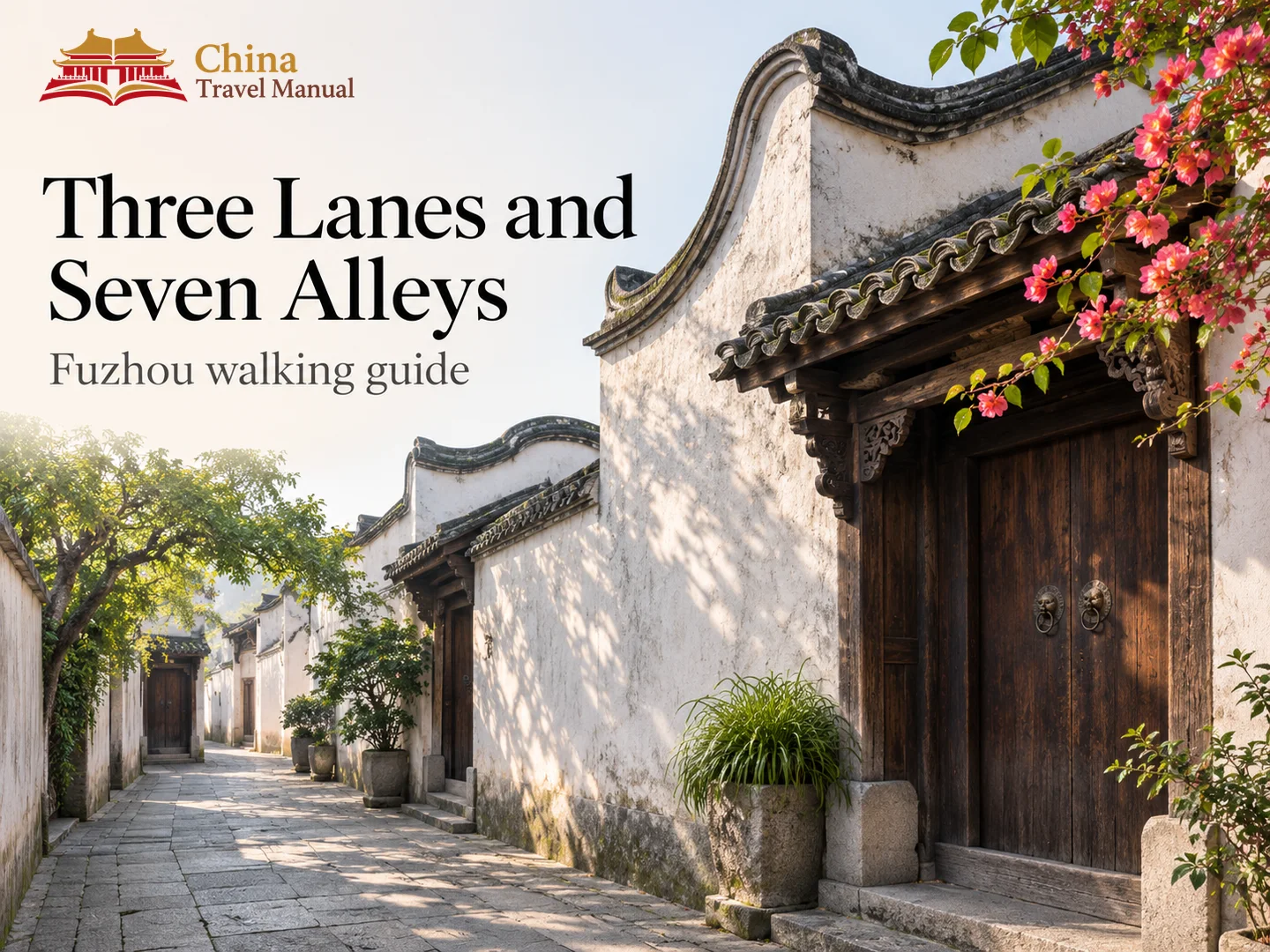
From Nanhou Street, the side lanes look like breaks in a row of white walls. Step through one and the district starts to make sense: a busy north–south street connects smaller residential lanes, and the walls conceal courtyards whose scale you can only see from inside. This walk takes in both sides of the street and helps you pick a house before you reach the ticket counter.
Get to Nanhou Street and Choose an Entrance
Nanhou Street is in Gulou District. For a first visit, take the metro to Dongjiekou (东街口, Dōngjiēkǒu), use Exit C and follow Yangqiao East Road west to the north arch. If you are already on the south side, take Line 1 or 2 to Nanmendou. Exit A1 leads toward Daoshan Road and Aomen Road. The north entrance puts you close to both Langguan Alley (郎官巷, Lángguān Xiàng) and Yijin Lane (衣锦坊, Yījǐn Fāng), so it saves walking if you only want the stage and Yan Fu’s residence.[7][8]
For a taxi or ride-hailing drop-off, show the driver 南后街北口. Save the exact house name as a second pin if you have timed admission. The district name alone can send you to a different edge of the neighborhood. For a transfer elsewhere in the city, use the Fuzhou transportation guide.
Walk One Lane on Each Side of Nanhou Street
The three lanes west of Nanhou Street are Yijin Lane, Wenru Lane (文儒坊, Wénrú Fāng) and Guanglu Lane (光禄坊, Guānglù Fāng). The seven on the east are Yangqiao, Langguan, Ta, Huang, Anmin, Gong and Jibi. Yangqiao and Jibi survive in the present street names Yangqiao Road and Jibi Road. You can see the basic layout without tracing all ten branches.[1][2]
- Start at the north arch: Walk south on Nanhou Street and use it as the point you return to after each detour. Look for the jump from open storefronts on the spine to courtyard walls on the branches.
- Walk east into Langguan Alley: Pass the entrances to Yan Fu’s former residence and Ermei Book House. If you’re stopping at either one, save it for this leg so you can continue west across the central street.[5][6]
- Cross to Yijin Lane: Find the Water Pavilion Stage at No. 4. For a longer walk, return to Nanhou Street and continue south to Wenru Lane and Guanglu Lane before exiting near Aomen Road.[2][4][7]
Look above the doorways as well as through them. The district took shape over centuries and flourished in the Ming and Qing periods. Dark-tiled roofs and white walls give the lanes a coherent look, while each entrance gives you a different view into the arrangement of halls and courtyards.[1][2]
Choose Which Historic Houses to Enter
| Interior | What you can see | Visit details |
|---|---|---|
| Water Pavilion Stage | A timber stage above a pool and a square ceiling panel with carved bats and cranes. The seating hall opposite helps you picture how guests watched performances.[4] | No. 4 Yijin Lane. CNY 20.[3][4] |
| Yan Fu’s former residence | Two adjoining residences associated with the scholar and translator in his later years. This is the better choice if you want a visit centered on a person and his connection to Fuzhou.[1][5] | No. 20 Langguan Alley. CNY 15.[3][5] |
| Ermei Book House | The Fujian Folk Custom Museum occupies this former home. Look for patterned wooden latticework, painted panels and rooms arranged around successive courtyards.[6][9] | No. 25 Langguan Alley. Confirm current admission and last entry before visiting.[6] |
If you came for the architecture, begin with the stage. The pool, stage and facing hall show how a private home accommodated a performance. Treat any live show as a separate event and check its schedule.[4]
Plan Tickets, Hours and Time on Your Feet
For a free indoor alternative, check whether Xie Family Ancestral Hall is open. A city pricing notice also lists the former residences of Lin Congyi and Liu Qixian as free. The same notice lists a CNY 70 two-day combined ticket and requires operators to offer individual tickets. The stage and Yan Fu’s residence together total CNY 35 at the listed standard prices. If you want several interiors, ask which are included and open on your dates before buying the combined ticket.[3]
Published closing times differ. For Yan Fu’s residence, the operator’s listing gives 10 p.m., while a more recent visitor guide lists 5 p.m. Check the current hours and last entry at the north visitor center or with the official ticket platform before counting on an evening visit. The prices in this guide were checked in November 2026.[3][5][7][10]
With about an hour, leave enough time to get back to the metro and focus on the public lanes or a single interior whose entrance you can reach quickly. With two to three hours, allow time to look up at the woodwork and cross the courtyards without rushing. Add time for ticket queues during public holidays.
Fit the District Into a Fuzhou Day
Visit the heritage houses first, then stop for lunch or a snack along the spine. If you have half a day, the south entrance gives you an onward route near Aomen Road instead of retracing the whole walk. The Fuzhou two-day itinerary shows where to put the district in a longer visit, and things to do in Fuzhou offers alternatives for the rest of the day.
For a hotel within walking distance, pair the district map with the Fuzhou accommodation guide. Use the Fuzhou travel guide if you are still deciding how long to spend in the city.
FAQs About Three Lanes and Seven Alleys
Is Three Lanes and Seven Alleys free to enter?
Yes. You can walk Nanhou Street and the public side lanes for free. Some heritage interiors have their own entrance fees.[3][7]
What should I see if I only have an hour?
Start at the north arch, take a short detour into Langguan Alley and cross to Yijin Lane. Choose the Water Pavilion Stage if you have time for one interior, then return to Dongjiekou.[4][7]
Is it worth going after dark?
Yes, for a stroll along Nanhou Street and a food stop. If a named historic house is the reason for your visit, go by day or confirm its last admission in advance.[5][10]
What is the easiest route with a stroller?
Start at the north arch and use Nanhou Street as your main route. The district has stone paving and older houses have separate entrances, so check door thresholds and steps before paying for admission.[1][4][6]
Sources
[1] Fujian Provincial Government. Sanfang Qixiang cluster and historic urban layout
[2] Fuzhou Municipal Government. Historic lane layout and protected houses
[3] Fuzhou Development and Reform Commission via Fuzhou News. Single-venue prices and free house openings
[4] Fuzhou Municipal Government. Water Pavilion Stage address and timber architecture
[5] Three Lanes and Seven Alleys operator. Yan Fu’s former residence
[6] Three Lanes and Seven Alleys operator. Ermei Book House and Fujian Folk Custom Museum
[7] Fuzhou Bendibao. Metro exits and walking approaches to both entrances
[8] Fuzhou Municipal Transport Bureau. Public transport at the district’s north entrance
[9] Fuzhou News. Guide to historic residences and folk-art collections
[10] Qunar Travel News. Daytime venue schedules and evening neighborhood visits





