
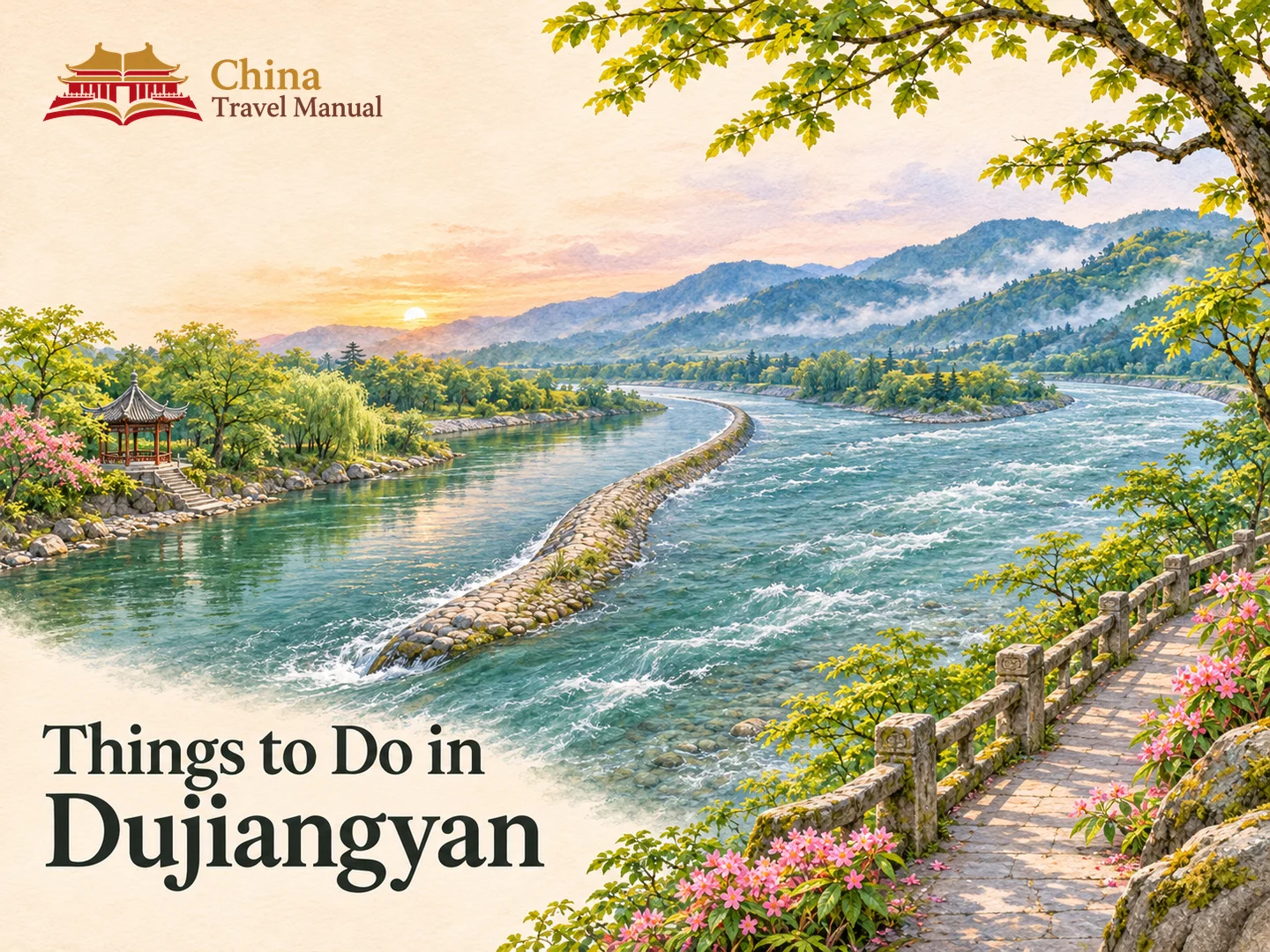
Quick Answer: Start at the irrigation system and add one side trip
On a first visit, pair the irrigation system with Guanxian Old City and South Bridge. If you have a second day, choose the front side of Mount Qingcheng for Taoist temples or one panda facility for a wildlife-led morning.[1][3][5][6][8]
- Essential visit: Walk the irrigation system and see where and why the river divides.
- Easy addition: Lunch in Guanxian Old City and return to South Bridge after dark if you are staying.
- Mountain choice: Choose Qingcheng Front Mountain for temples or reserve more time for the back-mountain trails.
- Panda choice: Book Panda Valley for a visit now. Check for a reopening notice for Dujiangyan Panda Base.
For a Chengdu day trip, lock in your return train before adding a second ticketed site.
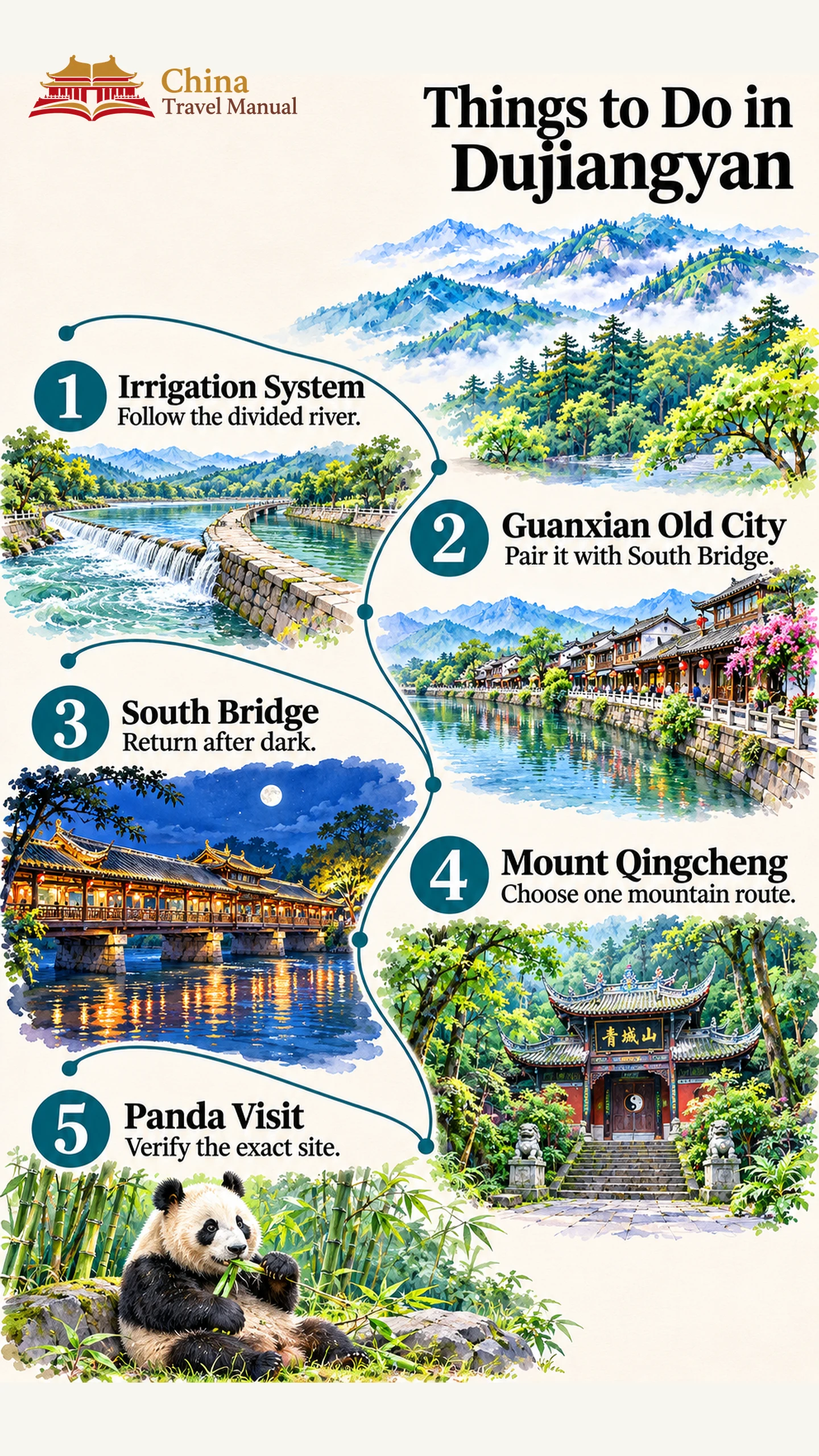
Begin at the historic waterworks, where the Min River splits around the Fish Mouth levee (鱼嘴, yúzuǐ). Walk into Guanxian Old City and stay for South Bridge after dark if your return allows it. With more time, choose a temple walk on Mount Qingcheng or a panda visit. Those stops need their own transport and work best when you give them a separate block.[1][3][4][5][6]
See How the Dujiangyan Irrigation System Works
The Dujiangyan Irrigation System (都江堰水利工程) dates to about 256 BC and is still used to divert water across the Chengdu Plain. The headworks are the part most visitors explore. Their design works by dividing, spilling and channeling the river, which makes it worth stopping at viewpoints to understand where the water goes.[1][2]
- Fish Mouth levee: The pointed structure splits the Min River into inner and outer channels.
- Flying Sand Weir (飞沙堰, fēishāyàn): This spillway helps discharge excess flow and sediment.
- Bottle Neck intake (宝瓶口, bǎopíngkǒu): The narrow opening regulates water entering the irrigation channels.
Use the Dujiangyan Irrigation System visitor guide to choose an entrance and decide whether to include the hillside around Erwang Temple (二王庙). Follow the current route signs if a path, viewpoint or river crossing is closed.[2][3]
Walk Through Guanxian Old City
Guanxian Old City (灌县古城) sits beside the irrigation district. Set aside enough time for the old streets and a meal rather than treating them as the walk to your next train. The waterfront makes an easy place to regroup or end the day, and the city-wall area around Yulei Hill can be a short extra stop if your group still wants to walk.[3][4][5]
Lidui Park Railway Station (离堆公园站) is a useful map pin for the old-city end of a Chengdu rail trip. Look up its departures for your date and use getting around Dujiangyan to compare the station and hotel pickup with the entrance you plan to use.
Return to South Bridge After Dark
South Bridge (南桥) links the old-city walk with the river at the irrigation-area edge. Stop there during the day to see how quickly the water moves and come back after dark if you are spending the night. The blue water people call the Blue Tears comes from lighting reflected in the river. Look from the bridge approaches or another open stretch of waterfront, and allow for crowds on busy evenings.[5]
The open old-city riverfront and the ticketed night experience in the irrigation area are separate plans. Check current ticket and lighting details before building an evening around them. If you want to stay nearby, compare hotels in where to stay in Dujiangyan.
Choose a Route on Mount Qingcheng
Mount Qingcheng (青城山) shares the UNESCO listing with the irrigation system and is in a different part of Dujiangyan. Qingcheng Front Mountain (青城前山) is the starting choice for Taoist temples and forested stone steps. Qingcheng Back Mountain (青城后山) suits a longer walk with valleys and streamside scenery. The two areas have different approaches and call for different transport planning.[1][3]
Give one route a separate morning or longer. Count the trip to the entrance and back alongside the walking time, and use the Mount Qingcheng visitor guide to compare the terrain and current access.
Choose the Right Panda Site
Panda Valley is the practical panda stop while Dujiangyan Panda Base is closed. Panda Valley (熊猫谷) is run by the Chengdu Research Base of Giant Panda Breeding as its Dujiangyan field facility. Book against the Panda Valley page and confirm which identification you need. Its booking instructions accept a passport for verification.[6][7]
Dujiangyan Panda Base (都江堰中华大熊猫苑) is part of the China Conservation and Research Center for the Giant Panda. The center announced a closure for renovation from April 23, 2026, with reopening to be announced separately. Check for a reopening notice before planning a visit. Panda Valley and the main Chengdu Panda Base use different entrances and bookings.[9] Use the Dujiangyan Panda Base visitor guide for that facility and the panda bases near Chengdu comparison if you are still deciding.[6][7][8]
What Fits in One Day
Start with the waterworks and allow time to walk into the Old City for lunch. If you want both the waterworks and the mountain, choose a shorter Front Mountain visit, check your entrances and work backward from the last acceptable train. With two days, use the two-day Dujiangyan itinerary to give the mountain or panda visit enough time without rushing South Bridge and dinner.
FAQs About Things to Do in Dujiangyan
What is the best thing to do in Dujiangyan on a first visit?
Start at the irrigation headworks and see the Fish Mouth levee, the Flying Sand Weir and the Bottle Neck intake. Add Guanxian Old City while you are nearby.[1][2][4]
Are Panda Valley and Dujiangyan Panda Base the same?
They are separate sites with different operators. Book Panda Valley while Dujiangyan Panda Base is closed for renovation.[6][7][8][9]
Which side of Mount Qingcheng should I visit first?
Choose Front Mountain for a first trip focused on Taoist temples. Allow a longer visit for the back-mountain trail experience.[1][3]
Can I visit the irrigation system and Mount Qingcheng in one day?
Yes, if you start early, choose a short Front Mountain visit and leave time to transfer. A two-day trip gives both sites more time.
Sources
[1] UNESCO World Heritage Centre. Mount Qingcheng and the Dujiangyan Irrigation System
[2] Yangquan Water Resources Bureau. The main structures and functions of the Dujiangyan headworks
[3] Sichuan Forestry and Grassland Administration. Dujiangyan and Qingcheng detailed planning document
[4] China Tourism News. Dujiangyan visitor attractions and the Old City
[5] Sina Travel Service. Dujiangyan’s night visits, South Bridge and riverfront lighting
[6] Chengdu Research Base of Giant Panda Breeding. Panda Valley and the affiliated research base
[7] Chengdu Research Base of Giant Panda Breeding. Panda Valley reservations
[8] National Forestry and Grassland Administration. China Conservation and Research Center for the Giant Panda
[9] Sichuan government media, via The Paper. Dujiangyan Panda Base closure from April 23, 2026





