
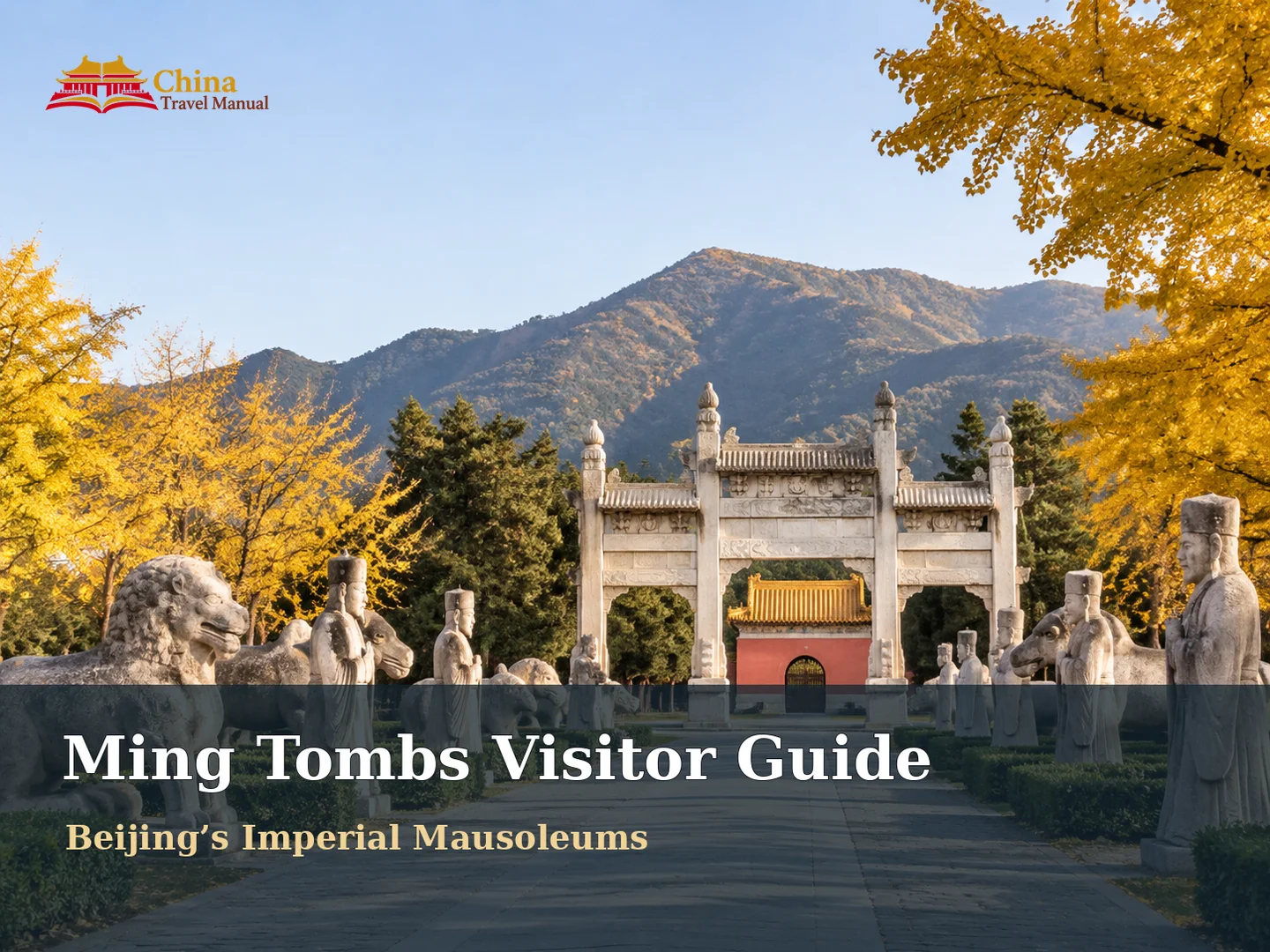
Quick Answer: Planning a Visit to the Ming Tombs
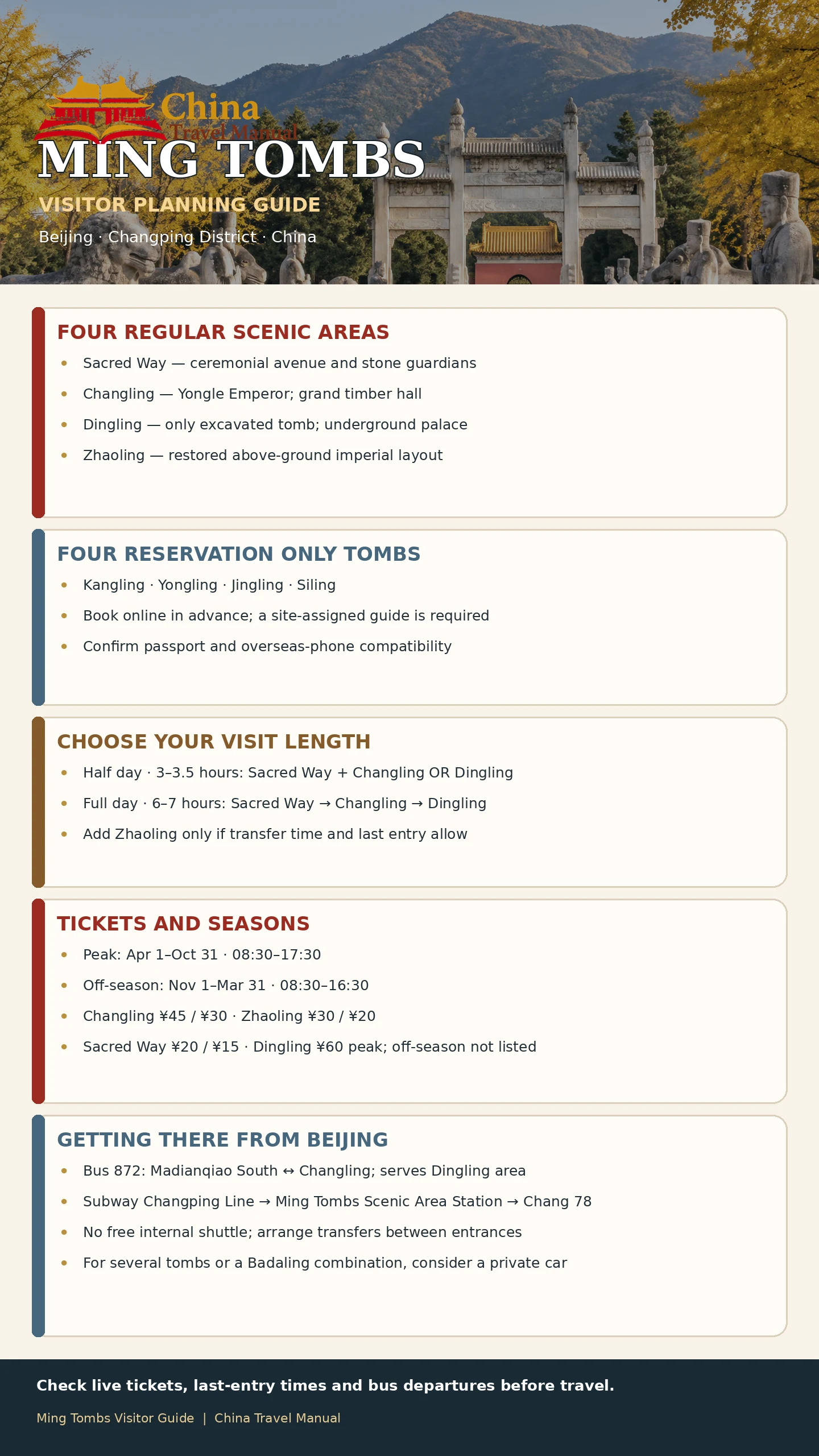
The Ming Tombs are an imperial mausoleum complex in Changping, about 50 km from central Beijing. For a first visit, prioritize the Sacred Way, Changling and Dingling: they show the ceremonial approach, major above-ground architecture and the only excavated underground palace. Four scenic areas are regularly open; Kangling, Yongling, Jingling and Siling require advance reservations and a site-assigned guide.
- Half day: Sacred Way + Changling or Dingling; allow about 3–3.5 hours including transfers.
- Full day: Sacred Way → Changling → Dingling; plan 6–7 hours, with Zhaoling optional.
- Public transport: Bus 872 links Madianqiao South and Changling; Changping Line + Chang 78 connects to the tomb area.
- Key caution: Tombs are 0.5–8 km apart, with no free internal shuttle. Plan transfers and last-entry times.
Check live ticket prices, reservation access and accepted passport details before travelling.
The Ming Tombs (Ming Shisan Ling, 明十三陵, Míng Shísān Líng) are a group of imperial mausoleums at the foot of Tianshou Mountain in Changping District, roughly 50 km from central Beijing. Construction began in 1409 after the Ming court moved its capital to Beijing, and the complex developed over more than two centuries. It is not one compact palace or a single burial courtyard: the individual tombs are separated by distances of roughly 0.5 to 8 km, so visiting more than one requires a transport plan.
For most first-time visitors, the most rewarding combination is the Sacred Way, Changling and Dingling. Together they show the ceremonial approach to the imperial cemetery, the scale of a major Ming timber hall and the underground burial chambers at the only excavated tomb in the complex. The site also forms part of the UNESCO-listed Imperial Tombs of the Ming and Qing Dynasties, a serial property that includes imperial burial sites in several parts of China—not just the Beijing Ming Tombs.[1][2] For broader city planning, see the Beijing travel guide and getting around Beijing.
What Are the Ming Tombs?
The Ming Tombs are the burial complex for 13 emperors of the Ming dynasty who ruled after the capital moved to Beijing. The wider cemetery contains the tombs of 23 empresses and other members of the imperial household. Set at Tianshou Mountain, the complex follows traditional geomantic and fengshui principles, integrating mountains, watercourses, approach roads and individual mausoleums into one imperial landscape.
The layout reflects the belief that the dead continued to need an ordered environment and that imperial status should remain visible after death. Each mausoleum has its own precinct, while shared approach routes, gates, stone sculptures and ritual buildings express a common system of imperial authority.
The UNESCO property is named Imperial Tombs of the Ming and Qing Dynasties. Beijing’s Ming Tombs were added to the inscription in 2003; the wider serial property also includes sites in Jiangsu, Hubei, Hebei and Liaoning. Do not confuse Beijing’s Ming Zhaoling with the Qing Zhaoling in Shenyang, which belongs to a different dynasty and a different tomb complex.[1]
Which Ming Tombs Can You Visit?
As of the 2026 visitor information, eight of the main tomb sites are accessible in some form. Four are regular scenic areas where visitors can buy admission without a compulsory advance reservation. Four others operate by advance online reservation and must be visited with a guide assigned by the scenic area. The remaining five imperial tombs are not listed among the currently accessible sites.
| Access type | Site | Associated ruler | What to know |
|---|---|---|---|
| Regular admission | Sacred Way | Approach to Changling | Independent scenic area; main stone-statue section is the key visit |
| Regular admission | Changling | Emperor Yongle and Empress Xu | Largest tomb complex; major above-ground timber architecture |
| Regular admission | Dingling | Emperor Wanli and two empresses | Only excavated tomb with an underground palace open to visitors |
| Regular admission | Zhaoling | Emperor Muzong | Restored above-ground layout; useful as an additional stop |
| Reservation and guide | Kangling | Emperor Zhengde | Advance online reservation; guided visit only |
| Reservation and guide | Yongling | Emperor Jiajing | Advance online reservation; guided visit only |
| Reservation and guide | Jingling | Emperor Xuande | Opened for reserved visits on December 22, 2025 |
| Reservation and guide | Siling | Emperor Chongzhen | Advance online reservation; guided visit only |
These four tombs are not walk-in alternatives to the regular sites. The official Jingling notice names the Ming Tombs Scenic Area Douyin account and the Changping Cultural Tourism Group WeChat mini-program as booking channels, and requires visitors to follow a site-assigned guide. Confirm passport acceptance and overseas-phone compatibility before relying on a mini-program booking.[3]
What to See at the Ming Tombs
The Sacred Way: Stone Guardians and Imperial Order
The Sacred Way is the ceremonial approach to Changling and the wider tomb landscape. Its best-known visitor section is the stone-statue avenue, which passes the Stone Archway, Great Red Gate, stele pavilion and ornamental columns. The visitor section features 18 pairs of stone figures, including lions, xiezhi, camels, elephants, qilin, horses and civil and military officials. Carved from large stone blocks, they formed an honor guard expressing imperial rank and ritual authority.[4]
Visit the Sacred Way first: it explains the ceremonial order behind the mausoleums. The historic approach is longer than the sculpture section most visitors focus on, so check the open visitor route before setting out.
Changling: The Grand Imperial Hall
Changling is the mausoleum of the Yongle Emperor, Zhu Di, and Empress Xu. It is the largest Ming tomb and the best choice for visitors interested in timber architecture. Its highlight is Ling’en Hall, the main ceremonial building for memorial rites, known for its monumental scale and nanmu columns.[5]
Changling has not been excavated. Visitors see its above-ground architecture, courtyards, gates and the arrangement of the mausoleum precinct, not an underground burial chamber. Choose it over Dingling if historic buildings and architectural proportions matter more to you than an underground visit.
Dingling: The Underground Palace
Dingling is the tomb of the Wanli Emperor, Zhu Yijun, and his two empresses. It is the only Ming Tombs mausoleum formally excavated, and its underground palace is open to visitors. Five stone-vaulted chambers make up the complex; the rear chamber contains the imperial burial arrangements.[6]
The underground visit involves many steps in dim, sometimes damp conditions, with no step-free lift route. Visitors with limited mobility or difficulty using stairs should assess access before buying a ticket. Changling is the stronger alternative for an above-ground visit.
Zhaoling: A Restored Imperial Layout
Zhaoling is the mausoleum of the Muzong Emperor, Zhu Zaihou. Its restored Ling’en Gate and Hall, subsidiary halls, square tower and treasure enclosure make it a useful example of a Ming imperial tomb layout. Add it if you have a full day; it is optional on a first visit.
How Much Time Do You Need at the Ming Tombs?
Because the tombs are spread across the landscape, your total visit time includes transfers as well as time inside each scenic area. A half-day visit is realistic when you choose one major tomb after the Sacred Way. A fuller day gives you time for the three core stops and, if transport and closing times cooperate, Zhaoling.
| Visit length | Suggested route | Planning note |
|---|---|---|
| Half day: about 3–3.5 hours | Sacred Way + Changling or Dingling | Choose architecture at Changling or the underground palace at Dingling; do not try to squeeze in both major tombs |
| Full day: about 6–7 hours | Sacred Way → Changling → Dingling → optional Zhaoling | Start near opening time and include transfers between separate entrances |
For a first visit, the Sacred Way, Changling and Dingling already provide three distinct experiences. Adding more tombs can deepen the comparison, but it also increases transport time and the risk of reaching a site near its last-entry cut-off. Do not build a tight schedule around the full closing time: individual scenic areas may stop ticket sales or entry around 30–40 minutes earlier.
Ming Tombs Tickets, Opening Hours and Reservations
The official Beijing English tourism page lists the regular scenic areas with seasonal hours and separate adult admission prices. Peak season runs from April 1 to October 31; off-season runs from November 1 to March 31. The page lists the following adult prices. Dingling’s off-season fare is not clearly stated on the current English listing, so check the live ticket page or ticket office rather than assuming a price.
| Regular scenic area | Peak season adult ticket | Off-season adult ticket |
|---|---|---|
| Dingling | CNY 60 | Not clearly listed on the current English page |
| Changling | CNY 45 | CNY 30 |
| Zhaoling | CNY 30 | CNY 20 |
| Sacred Way | CNY 20 | CNY 15 |
There is a price discrepancy across public-facing information channels: some Chinese-language listings show a higher Sacred Way fare than the Beijing English page. The table above follows the current English government listing, not a blended price. Treat all prices as subject to change and verify the amount shown for your visit date before paying.[7]
The published general opening hours are 08:30–17:30 in peak season and 08:30–16:30 in the off-season. These are not guaranteed last-entry times. Each scenic area may stop ticket sales or entry earlier, so arrive with a buffer and confirm the individual site’s last admission. The regular four areas do not require compulsory advance reservation according to the government listing; on busy weekends and public holidays, buying online in advance where available can still reduce queue time.
Kangling, Yongling, Jingling and Siling follow a different access process. They require advance online reservation and a guide arranged by the scenic area, and their admission arrangements are separate from the regular ticket system. The official Jingling notice names the Ming Tombs Scenic Area Douyin account and the Changping Cultural Tourism Group WeChat mini-program as booking channels. Foreign visitors should confirm whether passport details and overseas phone numbers are accepted before making plans. Carry the original passport used for booking when visiting; do not rely on a phone photograph as a substitute for the travel document.
The current Beijing English ticket page lists free admission for visitors aged over 60 with valid identification, children under 6 or no taller than 1.2 m, and visitors with valid disability documents. It lists half-price admission for full-time students aged over 6 through 25 at undergraduate level or below, excluding adult education. Because eligibility and accepted documents can be interpreted differently at individual ticket windows, confirm the applicable policy and bring the supporting original document.[7]
How to Get to the Ming Tombs from Beijing
The Ming Tombs are in Changping District, northwest of central Beijing. Public transport is possible, but the separate scenic areas and less frequent buses require planning. A private car is easier for a multi-tomb day. If using public transport, check first and last departures before leaving Beijing.
Bus 872 from Madianqiao South
Bus 872 now runs between Madianqiao South and Changling. Do not follow older guides that describe it as a route from Deshengmen: the Beijing bus adjustment moved the city-side terminal to Madianqiao South. The line serves the tomb area, including the Dingling stop, and is useful for reaching the regular sites along its route. The trip from central Beijing takes roughly an hour or more depending on traffic; actual journey time and departure intervals vary, so use a live Beijing bus app or official route information on the day.[8]
Changping Line and Bus Chang 78
Another option is to take the Beijing Subway Changping Line to Ming Tombs Scenic Area Station and transfer to local bus Chang 78. The route was adjusted in 2025 to connect the station with the tomb area, with Zhaoling as its terminus. It provides a useful rail-to-bus connection for visitors heading toward Zhaoling and nearby scenic areas. The subway station is not next to the tomb entrances: do not assume that you can walk directly from the station to Changling or Dingling. Check the current Chang 78 direction, stop sequence and service times before boarding.[9]
Private Car, Ride-Hailing or a Chartered Driver
A car is most practical for visiting several tombs or combining the Ming Tombs with Badaling Great Wall. Each scenic area has its own entrance and parking, so the vehicle must move between stops. Agree on pick-up points and waiting arrangements in advance.
Getting Between the Tombs
There is no free internal sightseeing shuttle. Use local buses where the route fits, or arrange a car. Walking works within each scenic area, but not as a practical way to transfer between distant tomb entrances. Leave a buffer before last entry.
Can You Combine the Ming Tombs with Badaling Great Wall?
Yes, but it is a packed day. A private car or chartered driver makes the combination more manageable; public-transport transfers and last departures add risk, especially if you want to visit more than one tomb.
Keep the tomb visit focused on the Sacred Way and one major tomb. If you want the full Sacred Way–Changling–Dingling route, give the Ming Tombs a separate day. See the Badaling Great Wall visitor guide for Wall access details and the Beijing day-trip guide for other excursions.
Best Time to Visit the Ming Tombs
Spring and autumn are the most comfortable seasons for the outdoor sections. April and May bring mild weather and fresh greenery; September and October usually offer crisp air and autumn color. Autumn weekends and the National Day holiday can be crowded, so allow extra time for transfers and ticket checks.
Summer can be hot and exposed along the Sacred Way; start early, carry water and watch for afternoon storms. Winter is quieter but cold and windy, with shorter opening hours. Prioritize fewer sites and check the earlier closing schedule.
Practical Tips for Visiting the Ming Tombs
- Carry your original passport: Keep the travel document used for ticketing available for identity checks; confirm accepted foreign-passport booking options in advance.
- Choose Dingling with mobility in mind: The underground palace involves many stairs, dim areas and potentially damp surfaces, with no step-free lift route.
- Bring water: Shops and refreshment points are limited in some scenic areas, especially along the Sacred Way.
- Wear comfortable shoes: Expect outdoor walking, stone paths, steps and transfers between separate entrances.
- Respect the heritage site: Do not touch stone carvings or historic building components; follow posted photography restrictions and local rules on drones.
- Check guide language: Reservation-only visits are guide-led. The supplied visitor information indicates that English guiding is not routinely guaranteed, so contact the scenic area before booking if you need an English-speaking guide.
- Keep transport flexible: Bus intervals and traffic can affect the order of your stops. Do not plan the last transfer close to a ticket-sales cut-off.
FAQs About the Ming Tombs
How many of the Ming Tombs are open to visitors?
Eight main sites are currently accessible in some form: the Sacred Way, Changling, Dingling and Zhaoling are regular scenic areas, while Kangling, Yongling, Jingling and Siling require advance reservation and a guide assigned by the scenic area. The other five tombs are not listed among the currently accessible sites.[3]
Is Dingling the only excavated Ming imperial tomb?
Among the Ming Tombs in Beijing, Dingling is the only imperial mausoleum that has been formally excavated and whose underground palace is open to visitors. Changling and Zhaoling are visited through their above-ground buildings and precincts.
Do you need to book Ming Tombs tickets in advance?
The four regular scenic areas do not require compulsory advance reservation according to the Beijing government ticket page, although advance purchase can be useful on busy dates. Kangling, Yongling, Jingling and Siling require online reservation and a guided visit.
Can you visit the Ming Tombs and Badaling Great Wall in one day?
Yes, with a private car or chartered driver and a focused plan. It is not recommended for a deep visit to several tombs, and public transport makes the combination more complicated.
How long does it take to visit the Ming Tombs?
Allow about 3–3.5 hours for the Sacred Way plus Changling or Dingling. A fuller route covering the Sacred Way, Changling and Dingling takes about 6–7 hours including transfers; adding Zhaoling requires more time.
Sources
[1] UNESCO World Heritage Centre. Imperial Tombs of the Ming and Qing Dynasties
[2] Beijing Municipal Government. Ming Tombs
[3] Beijing Municipal Government. Jingling Tomb of Ming Tombs Opens to Public on December 22
[4] Beijing Municipal Government. Ming Tombs
[5] Beijing Municipal Government. The Ming Tombs: Tickets and Opening Hours
[6] UNESCO World Heritage Centre. Imperial Tombs of the Ming and Qing Dynasties: Nomination Documentation
[7] Beijing Municipal Government. The Ming Tombs: Ticket Prices and Preferential Measures
[8] Beijing Public Transport Group. Bus Route 872 Adjustment: Madianqiao South–Changling
[9] Changping District Transport Bureau. Changping Optimizes Bus Routes and Stops for Scenic-Area Access





