
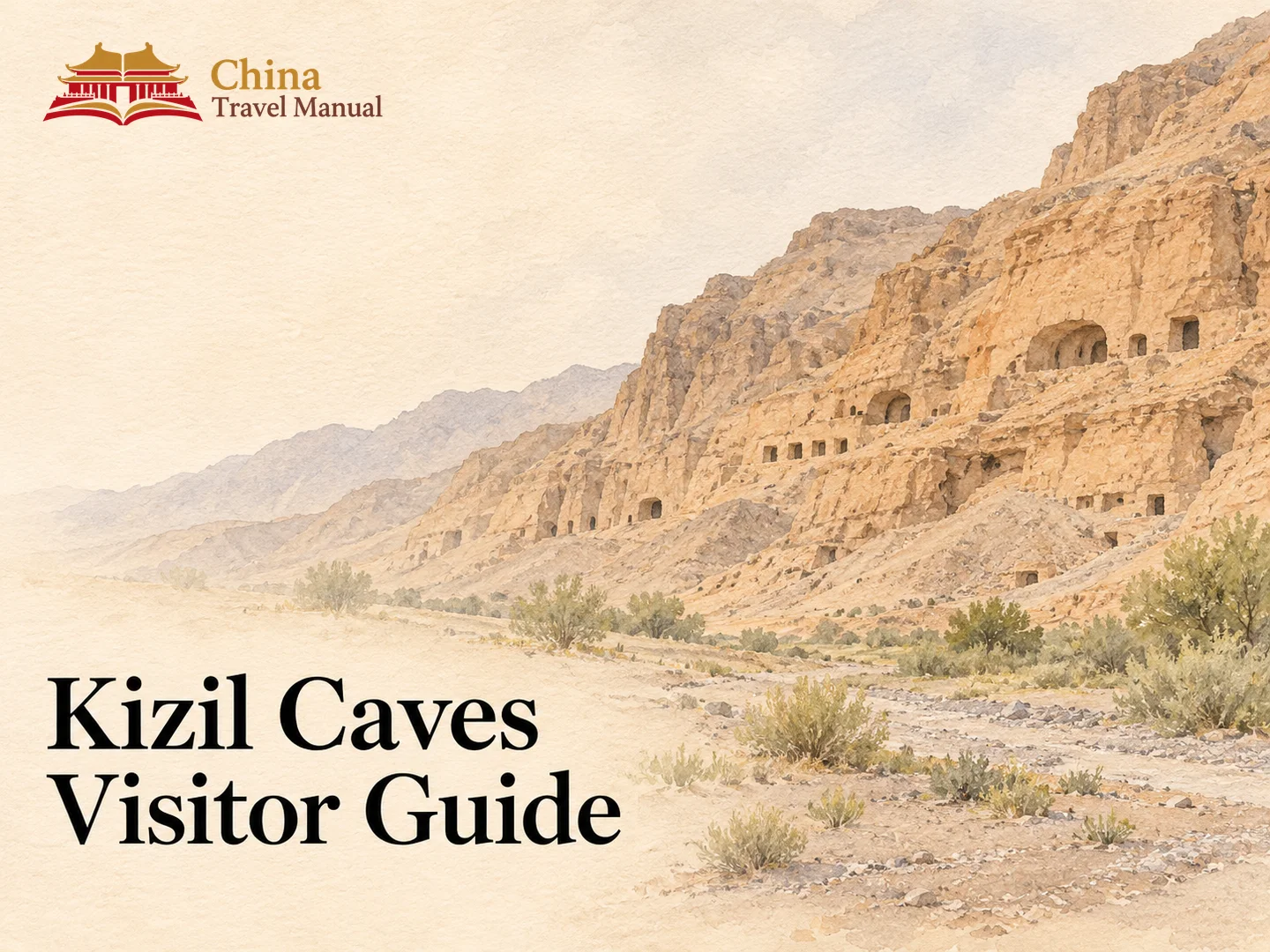
Quick Answer: How Do You Visit the Kizil Caves?
Book a guided visit and a return transfer from Kuqa or Baicheng. Ask which caves and guide languages are available for your date.
- Correct destination: Use 克孜尔石窟 or 克孜尔千佛洞 in Baicheng County.
- Booking: Check the 龟兹研究 account and ask about original passport admission.
- Inside the caves: Follow the guide, leave bags where staff direct you and follow the photography restrictions.
- Allow time: Keep a half-day or longer for the cave visit and both road transfers.
Cave openings can change with preservation and site operations. Ask what you’ll see on the regular guided circuit and whether a special visit needs separate approval.[2][3][4][5][6]

The Kizil Caves (克孜尔石窟, Kèzī’ěr Shíkū) are a Buddhist cave-temple complex in Baicheng County, Xinjiang, reached by road from Kuqa or Baicheng. The site is one component of a UNESCO Silk Roads property. Plan a guided visit to the caves open that day. Give yourself time to look at the painted ceilings and the shape of the chambers, and arrange the return ride before leaving town.[1][2][3][4]
Book the Guided Visit and Road Transfer
The Xinjiang Culture and Tourism Department identifies the Kucha Research Institute’s support center as responsible for visitor operations and interpretation at the site. Visitor instructions have directed people to the 龟兹研究 WeChat account and an appointment menu labeled 点我预约. Check current notices and use the same identification you plan to bring. If the form only accepts a mainland ID, confirm the staffed ticket procedure before leaving town.[3][5][6]
Choose your ride once you know your visit time. The caves are in Baicheng County even though Kuqa is a common base. Show the driver 克孜尔石窟(拜城县)and ask for the visitor entrance. Kizilgaha Beacon Tower and other cave complexes have different access points. Check your ride back and agree on a pickup time or have the driver wait. For the intercity leg, see travel between Kashgar and Kucha.[2][3][6][7]
Understand What the Guide Can Show You
| Visitor step | What to do |
|---|---|
| At the visitor entrance | Confirm the group time, meeting point and which areas your ticket covers. |
| Before the tour | Ask whether any explanation in English is available and where bags or cameras go. |
| On the cliff route | Follow the group and staff directions. Ask about steps if mobility is a concern. |
| Inside a cave | Keep clear of the painted surfaces. Follow current rules on photography and filming. |
Expect to see a fraction of the complex. Rooms can be closed or rotated for conservation and operations. Official reporting describes wall-painting restoration and risks to the site from weathering and rock instability. Confirm which rooms are open and whether there are any separate booking or access rules instead of choosing the trip around a rumored cave number.[3][4][5][6][8]
What to Notice in Kucha Buddhist Art
The paintings reflect Buddhist communities in historic Kucha (龟兹, Qiūcí), an important center on the Silk Road. In some chambers, diamond-shaped fields divide the painted ceiling into scenes. If a guide points out a Jataka scene (本生故事, běnshēng gùshì), look for how the composition tells an episode from a previous life of the Buddha. Ask which figures or gestures identify it.[1][9][10]
Some caves follow a central-pillar plan. Look at how the main space and the passage around the central mass would direct movement and attention. The art you glimpse may be fragmentary, and findings from specific caves also appear in catalogues and museum collections. Look at a documented image before the tour so you can recognize the features the guide describes. See Silk Road travel in China for the larger route.[1][4][9][10]
Fit the Caves into a Kuqa Stay
Give Kizil the earlier share of the day and keep evening transport flexible. On arrival day, verify your booking and spend any spare time in town. For a companion stop, choose one place that works with your return direction and opening time. The Southern Xinjiang itinerary is useful if Kuqa is one of several stops rather than a single excursion.
Bring water for the drive and outdoor waits, and ask what can go into the cave tour. In wet or windy weather, check the official notice and your transport before leaving. If you’re also considering another cave complex, verify its own calendar and entry. The Xinjiang travel guide helps with overall trip timing.[3][4][5][6][8]
FAQs About Kizil Caves Visitor Guide
Can you visit the Kizil Caves without a guide?
Plan on joining the site’s guided circuit. Ask staff about available groups and meeting points for your ticket.[3][5][6]
Are photos allowed inside the caves?
Expect restrictions inside and follow the guide’s instructions. Ask where exterior photography is allowed and whether you must leave your equipment in storage.[5][6][8]
Should you stay in Kuqa or Baicheng for the caves?
Kuqa works well if you are continuing along southern Xinjiang. Baicheng is another base if the rest of your route is in that county. Confirm the road transfer and guide time regardless of where you stay.[2][3][6][7]
Sources
[1] UNESCO World Heritage Centre. Silk Roads: Chang’an–Tianshan Corridor
[2] UNESCO World Heritage Centre. Component maps for Kizil and Kizilgaha
[3] Xinjiang Department of Culture and Tourism. Kucha Research Institute and its visitor responsibilities
[4] Xinjiang Department of Finance. 2026 cave and mural conservation overview
[5] Local public information service. Published Kizil appointment and site rules
[6] Field Guide to China. Current cave visit and road transfer context
[7] China Railway. Ticket search and passenger identification guidance
[8] Xinjiang Regional Government. Kizil Caves historic site protection rules
[9] Metropolitan Museum of Art Journal. Scholarship on Kizil paintings and central-pillar caves
[10] University of Washington Silk Road Seattle. Documented Kizil images and a Jataka example





