
Quick Answer: What Is the Best Way from Guangzhou Airport to Guangzhou South Station?
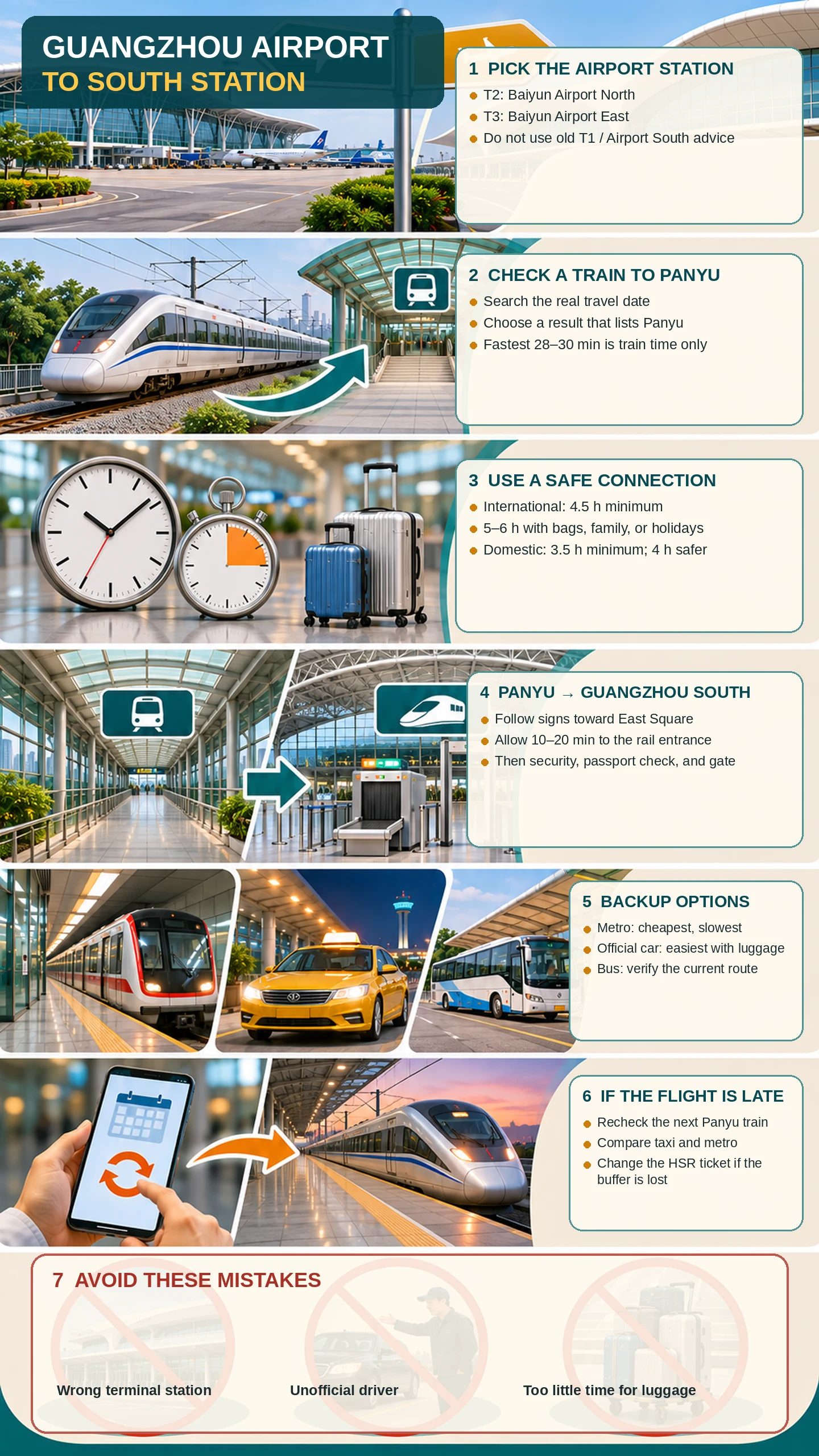
Check the intercity railway first. Terminal 2 uses Baiyun Airport North Station; Terminal 3 uses Baiyun Airport East Station. Choose only a same-day departure whose official result actually shows Panyu Station. The fastest limited-stop trip can take about 28–30 minutes, but many services take longer and not every airport train runs through to Panyu.[1][2]
| Situation | Best first choice | Main caution |
|---|---|---|
| T2 or T3, practical through train to Panyu | Intercity railway | Check the exact date, airport station, and stopping pattern |
| No useful through train, light luggage, ample time | Metro | Cheapest, but slow and crowded with two lines or a shuttle connection |
| Late arrival, family, wheelchair, or several large bags | Official taxi, configured Didi, or prebooked transfer | Traffic can erase the time advantage |
| Rail and metro finished | Official taxi or verified transfer | Do not accept arrivals-hall touts |
Panyu Station is connected to the Guangzhou South complex, but it is not the high-speed-rail waiting hall. After leaving the intercity train, follow signs toward Guangzhou South, then complete railway security, real-name passport verification, and the walk to your gate. As a conservative planning rule, leave at least 4.5 hours from an international flight’s scheduled landing to high-speed-train departure; 5–6 hours is safer with checked bags, children, limited mobility, or holiday crowds. For a domestic arrival, use at least 3.5 hours, with 4 hours safer. These are editorial buffers, not protected-connection guarantees.
Guangzhou Baiyun International Airport (CAN) and Guangzhou South Railway Station sit on opposite sides of a large city. The fastest rail segment can be under 30 minutes, but no passenger walks from an aircraft straight onto a high-speed train. Immigration, baggage collection, terminal walking, waiting, Panyu Station, railway security, passport checks, and the final walk to the departure gate all matter.
This guide is for foreign-passport travelers making a same-day air-to-rail connection. It uses two clocks: book the high-speed train from your flight’s scheduled landing time, but compare ground transport from the moment you enter the public arrivals hall.
How Much Connection Time Do You Need?
Build the connection from the flight’s scheduled landing time because that is the only usable clock when you buy the train ticket. Do not subtract a published 28-minute rail ride and assume the remainder is spare time.
| Stage | Conservative planning allowance |
|---|---|
| International arrival formalities and checked baggage | 60–120 minutes |
| Domestic arrival and checked baggage | 30–60 minutes |
| Public arrivals hall to the correct intercity platform | 15–30 minutes |
| Waiting for a suitable through train | 0–30+ minutes |
| Airport station to Panyu Station | About 28 minutes on the fastest limited-stop train; longer on many services |
| Panyu Station to Guangzhou South entrance | 10–20 minutes with signs, lifts, and luggage |
| Railway security, passport verification, and gate walk | 45–60 minutes; 60–90 minutes at major peaks |
The airport-to-Panyu record time is a best-case train segment, not a normal door-to-gate promise. Guangzhou’s current intercity timetable mixes all-stop, express, and limited-stop patterns, and a convenient through service may not line up with your arrival.[1][3]
For an international arrival, 4.5 hours is the minimum planning floor. Choose 5–6 hours if this is your first transfer in China, you need immigration, you have checked baggage, or anyone in the group walks slowly. For a domestic flight, 3.5 hours is the minimum floor and 4 hours is the more comfortable choice. Add another hour during Spring Festival, the May Day or National Day holiday period, or a season with frequent flight disruption.
Avoid booking the final high-speed train of the day. If the flight, baggage belt, or intercity connection slips, the next usable train may be the following morning. Separate air and rail tickets normally leave the traveler responsible for the missed connection.
Choose the Correct Airport Station
The terminal on your current ticket determines the airport station. Do not use an old airline-terminal list: assignments can change.
T2: Baiyun Airport North Intercity Station
From Terminal 2 public arrivals, follow signs for Intercity Railway and Baiyun Airport North Station (白云机场北站). Do not enter Airport North Metro Station unless you have deliberately chosen the slower metro backup. Metro and intercity rail are separate systems with separate gates and tickets.
Airport North remains the correct intercity station for T2. Allow 15–25 minutes from the public arrivals hall to find the station, complete ticketing or real-name checks, and reach the platform. Add more time if you need a staffed counter, lift, or assistance with large luggage.
T3: Baiyun Airport East Intercity Station
Terminal 3 connects to Baiyun Airport East Station (白云机场东站) in the transport center at basement level B2. Official visitor guidance describes a short signed walk of roughly three to five minutes from the terminal area, but a first-time traveler still needs time to find the correct lift, ticket gate, and platform.[2]
Do not follow the old T1 or Airport South advice. T1 stopped routine passenger operations in May 2026, while Airport South Metro Station and Baiyun Airport South intercity station currently pass trains without boarding passengers.[4] T3 also has no city-metro station directly attached to the terminal. If you choose the metro backup, use the official shuttle to Gaozeng rather than searching for an imaginary T3 metro entrance.
Take the Intercity Train to Panyu Station
The intercity railway is the best first check because it avoids most road congestion and brings you into the Guangzhou South transport complex. Its usefulness depends on the exact departure you can catch.
Check the Train and Stopping Pattern
Search the official Guangdong Intercity journey tool or 12306 for your real travel date. Use Baiyun Airport North for T2 or Baiyun Airport East for T3 as the origin, and Panyu as the destination. Buy only a result that explicitly lists Panyu Station.
Current operations use several stopping patterns. Some trains run through from the airport toward Panyu, while other departures terminate or follow a pattern that is less useful for this connection. The fastest published T3-to-Panyu journey is about 28 minutes, and the broader airport-to-Guangzhou-South corridor is advertised at about 30 minutes on the quickest service.[1][2] A slower stopping train or a wait for the next practical departure can add substantial time.
Check again after entering arrivals. If the flight was late and the booked train has gone, compare the next suitable intercity departure with the metro and road options. Never board simply because the platform sign says “intercity”; verify the destination and stops.
Tickets and Payment
Intercity rail supports 12306 tickets, staffed counters, and local real-name transport methods, but not every tap-and-go option is equally simple for a first-time foreign-passport user. The safest preparation is to book through 12306 after completing passport verification or to use the staffed counter with the original passport.
Every traveler needs an individual ticket or validated travel credential. Keep the original passport used for booking; a photo or photocopy is not a substitute. If 12306 shows identity verification as pending, complete the required check before relying on a tight transfer. For a detailed account setup, use the site’s guide to 12306 for foreign travelers and the broader guide to booking train tickets in China.
Keep a backup payment method. An overseas bank may reject a transaction, and a local transit credential may require prior real-name verification. Do not assume one Guangzhou Metro payment also covers the intercity train.
Transfer from Panyu Station to Guangzhou South Railway Station
Leave Panyu Station by following bilingual signs for Guangzhou South Railway Station (广州南站). Current wayfinding directs passengers toward Exit G and the East Square area; some reports describe the outdoor link as about one minute, but that figure covers only the immediate station-to-square gap.[5] It does not include finding the exit, lift waits, walking into the railway building, security, passport verification, or reaching the gate.
Budget 10–20 minutes from the intercity platform to the railway entrance with normal luggage, then keep the separate station buffer. At the high-speed-rail entrance, present the original passport used to buy the ticket. If the automatic reader does not accept it, use the staffed real-name verification lane.
Guangzhou South is very large. Gates are split across wide waiting areas, and the boarding gate shown in 12306 can change. Check the main screens after security, then move toward the gate rather than stopping for food first.
Compare the Backup Options
| Option | Best for | Typical planning impact | Main risk |
|---|---|---|---|
| Intercity to Panyu | Most travelers with a practical same-day through service | Fastest rail segment and good traffic reliability | Timetable and stopping pattern must match |
| Metro | Light travelers with ample time | Lowest cost, but long journey and transfers | Crowding and missed last train |
| Taxi or Didi | Groups, heavy luggage, limited mobility, late arrival | Door-to-door to the railway drop-off area | Road congestion |
| Airport bus | Only when a current route and timing align | Fewer rail changes | Schedule changes and road traffic |
Metro
From T2, take Metro Line 3 from Airport North to Jiahewanggang, change to Line 2, and continue to Guangzhou South Railway Station. From T3, first take the official shuttle to Gaozeng, enter Line 3, change at Jiahewanggang, and continue on Line 2. The T3 shuttle itself adds finding, waiting, road travel, and another station entrance.
Metro is the cheapest practical backup but is rarely the best choice for a tight air-to-rail connection. Line 3 and Line 2 can be crowded, especially during commuter peaks. Lifts may exist, yet the complete path can still involve long corridors and platform changes. Use metro only with light luggage, a generous train buffer, and enough time before the last service. For system-wide payment and transfer basics, see Getting Around Guangzhou.
Taxi, Didi or Prebooked Transfer
An official taxi or verified car is the simplest route when you have several large bags, a wheelchair, children, or no useful intercity departure. Use the signed taxi queue, the pickup zone shown in a configured Didi account, or a driver booked before the flight. Never accept an unmetered offer from someone approaching you inside arrivals.
Road travel can take around an hour in clear conditions and much longer during rush hour, heavy rain, or an incident. A car removes the Panyu transfer but does not remove Guangzhou South security or passport checks. Ask for Guangzhou South Railway Station East Drop-off Area only if that matches current traffic signs; the driver should follow live station controls.
Set up Didi, data, and payment before flying. Airport ride-hailing pickups use designated parking areas rather than any curb. The site’s Didi guide for tourists covers account and pickup basics.
Airport Bus
Airport bus service to the Guangzhou South area has changed as terminals and rail connections evolved. Older pages may show a T1/T2 route or a timetable that no longer matches T3 operations. Treat the bus as a same-day backup only after confirming the current airport notice, terminal stop, and final drop-off.
The bus is road-dependent and cannot protect a tight high-speed-train connection. It can make sense for a traveler who dislikes metro changes, has manageable luggage, and has a long buffer. It is not the default recommendation when a practical intercity departure to Panyu exists.
Enter Guangzhou South Railway Station and Board Your Train
Keep the original passport and train order ready before joining the entrance line. China Railway accepts eligible foreign passports for ticket purchase, but some documents or readers still require a staffed lane.[6][7] A screenshot helps you find the train number; it does not replace the passport.
Use this sequence:
- Confirm the ticket says Guangzhou South (广州南站), not Guangzhou, Guangzhou East, or Guangzhou Baiyun.
- Enter through the railway security area shown by current signs.
- Present the original passport for real-name verification; use a staffed lane if the automatic reader fails.
- Check the live departure screen for the train number and gate.
- Reach the gate before ticket checking closes. The exact stop-check time is announced by the station and can vary.[6]
For a first visit, arrive at the railway security entrance 45–60 minutes before departure. Use 60–90 minutes during major holidays, with several bags, or when assistance is required. These are conservative travel-planning recommendations, not a statement that every gate remains open until the same minute.
What to Do If Your Flight Is Delayed
Recalculate from the time you are likely to enter public arrivals, not from the updated landing time alone.
- Search the next official airport-to-Panyu intercity result and confirm that it actually serves Panyu.
- Compare its platform time with a taxi’s road risk and the slower metro journey.
- If no route preserves the railway buffer, change or refund the high-speed-train ticket before rushing across the airport.
- If same-day service no longer works, book a later train or stay near Guangzhou South rather than taking an unsafe unofficial car.
China Railway change and refund conditions depend on ticket status and timing. Use the order channel that issued the ticket and read the current rule shown there. Do not assume a flight delay creates a free rail rebooking right, especially when the flight and train were bought separately.
If you miss the intercity last train but the metro still runs, the T2 metro route or T3 shuttle-to-metro route may remain possible. If all rail service has ended, use the official taxi queue or a verified car. Avoid the final high-speed train of the day precisely because these backup options may no longer arrive in time.
Tickets, Payment and Luggage
Keep the flight, intercity, and high-speed-train bookings separate in your planning. A flight itinerary does not create a protected rail connection, and an intercity fare does not include the high-speed train.
- Intercity ticket: Use 12306, an eligible local real-name method, or a staffed counter. Carry the original passport.
- High-speed-train ticket: Buy under the same passport details you will present at Guangzhou South.
- Metro backup: Use an eligible payment method or single-journey ticket; do not assume the intercity ticket opens metro gates.
- Taxi or Didi: Keep the destination in Chinese and maintain cash or another payment backup.
Large luggage is permitted only within the current carrier rules and must not block doors or aisles. Even when the intercity carriage has luggage space, you still need to move the case through Panyu Station and Guangzhou South. Two large checked bags, a stroller, or a wheelchair may justify a direct car despite the higher fare.
Save these Chinese names offline:
- Guangzhou Baiyun International Airport: 广州白云国际机场
- Baiyun Airport North Station: 白云机场北站
- Baiyun Airport East Station: 白云机场东站
- Panyu Station: 番禺站
- Guangzhou South Railway Station: 广州南站
Common Mistakes and Accessibility
- Using the fastest train time as the whole transfer: The 28–30-minute figure excludes immigration, waiting, Panyu transfer, security, and the gate walk.
- Boarding the next intercity train without checking stops: Select a departure that explicitly lists Panyu.
- Confusing Panyu Station with the high-speed waiting hall: They connect, but travelers still change facilities and complete railway checks.
- Following a T1 or Airport South guide: Those are not current routine passenger options.
- Choosing the wrong airport station: T2 uses Airport North; T3 uses Airport East.
- Booking a train only two or three hours after an international landing: That leaves little protection against immigration or baggage delays.
- Accepting an unofficial driver: Use the signed taxi queue, app-assigned pickup, or a verifiable booking.
- Carrying only a passport photo: Railway travel requires the original booking document.
The intercity route removes road traffic but not walking. Lifts and accessible paths may require detours, and queues can be long. Wheelchair users should request airline assistance in advance and arrange railway assistance where available. A direct accessible vehicle may be more reliable for the airport-to-station leg. See the site’s accessible travel guide for China for wider planning principles.
FAQs About the Guangzhou Airport to Guangzhou South Station Transfer
Is There a Direct Train from Guangzhou Airport to Guangzhou South Railway Station?
There are intercity services from the airport corridor to Panyu Station, which connects with the Guangzhou South complex. You still walk from Panyu into the railway-station side and complete high-speed-rail security, passport verification, and gate finding. Check the exact date and choose a train that explicitly lists Panyu.
Is Panyu Station the Same as Guangzhou South Railway Station?
No. They are connected parts of the same transport hub, not the same platform or waiting hall. Leave the intercity system, follow signs to Guangzhou South, and allow time for railway entrance procedures.
How Much Time Should You Leave Between a Flight and a High-Speed Train?
Use at least 4.5 hours from an international flight’s scheduled landing, with 5–6 hours safer for checked bags, first-time visitors, families, limited mobility, or holidays. For a domestic arrival, use at least 3.5 hours and preferably 4 hours. These are conservative planning buffers, not guarantees.
What If You Arrive After the Last Intercity Train?
Check whether the metro is still practical: T2 can use Airport North Metro Station, while T3 requires the official shuttle to Gaozeng. If rail service has ended or the connection is tight, use an official taxi, configured Didi, or verified prebooked transfer.
Can Foreign Travelers Use a Passport for the Intercity and High-Speed Train?
Yes. Eligible foreign passports can be used for booking and travel. Carry the original passport. If an automatic reader cannot process it or verification is pending, use a staffed counter or manual real-name lane.
Sources
[1] Guangzhou Municipal Transportation Bureau. Guangzhou East Ring Intercity Opens and Links the Airport with Panyu
[2] eGuangzhou. Transport Guide for Guangzhou Baiyun International Airport Terminal 3
[3] Guangzhou Metro Group. July 2026 Guangdong Intercity Timetable Adjustment
[4] Guangzhou Metro. Passenger Services Move from T1 and Airport South Stations Stop Boarding
[5] Nanfang Plus, citing the operating authority. Walking Connection from Panyu Station to Guangzhou South East Square
[6] China Railway 12306. Entering and Exiting Railway Stations
[7] China Railway 12306. Online Ticket Booking and Accepted Identity Documents





