
Quick Answer: How Do You Visit the Goguryeo Sites in Ji’an?
Give Ji’an a full day if you want to see the museum, the royal tombs and the mountain fortress. Start with the museum when it is open, group the eastern tomb and stele stops, and allow daylight for Wandu Mountain City (丸都山城, Wándū Shānchéng).[2][3][4]
- Use separate map pins. The mountain fortress, tomb enclosures and museum are in different locations.
- Choose tickets by stop count. The three-site pass has been listed at CNY 70, with the individual sites at CNY 30 each.
- Check the museum first. It has separate entry arrangements and is normally listed as closed on Mondays.
- Allow time uphill. Wandu’s outer entrance, ruins paths and return each take time. Confirm last access before visiting another site.
Stay flexible when you arrive late or rain affects the hill paths. The paired tomb and stele stops can be a shorter visit.[3][4][5]
The Goguryeo sites in Ji’an are spread across the modern city and its surrounding hills. A visit can take you from a stepped royal tomb to an inscribed stone monument and the remains of a fortified mountain city. UNESCO uses the spelling Koguryo for the same kingdom. This guide covers the places to visit in Ji’an, Jilin.[1][2][3]
Tickets, Hours and Getting Between Sites
A notice from the provincial tourism department and later local reporting list the same example prices. Select your sites before choosing a combined ticket. The pass typically covers the three paid stops listed below, with separate checks at each entrance. Ask about current prices, ticket validity and any shuttle fare when you buy.[4][5]
| Visit plan | Reported ticket cost | Visitor implication |
|---|---|---|
| One paid site | CNY 30 | Choose the tomb, stele enclosure or Wandu. |
| Two paid sites | CNY 60 on separate tickets | The eastern tomb and stele pair fits this option. |
| Three paid sites | CNY 70 on the combined ticket | Covers the royal tomb, stele and Wandu under the listed offer. |
The museum is listed as free with its own reservation arrangements. For a short winter day, verify last admission and staff cutoffs at each stop. Local reporting lists the principal heritage sites at 8:30 a.m. to 4:30 p.m. during the winter schedule. The heritage ticket inquiry line is 0435-6262796.[2][4][5][6]
Use a taxi or drive between the eastern sites and Wandu. A sightseeing vehicle advertised inside Wandu serves that site. Arrange city transport separately. From elsewhere in the region, use the Tonghua travel guide to plan the onward leg to Ji’an.[4]
A One-Day Route Through Ji’an’s Goguryeo Sites
| Order | Stop | What to look for |
|---|---|---|
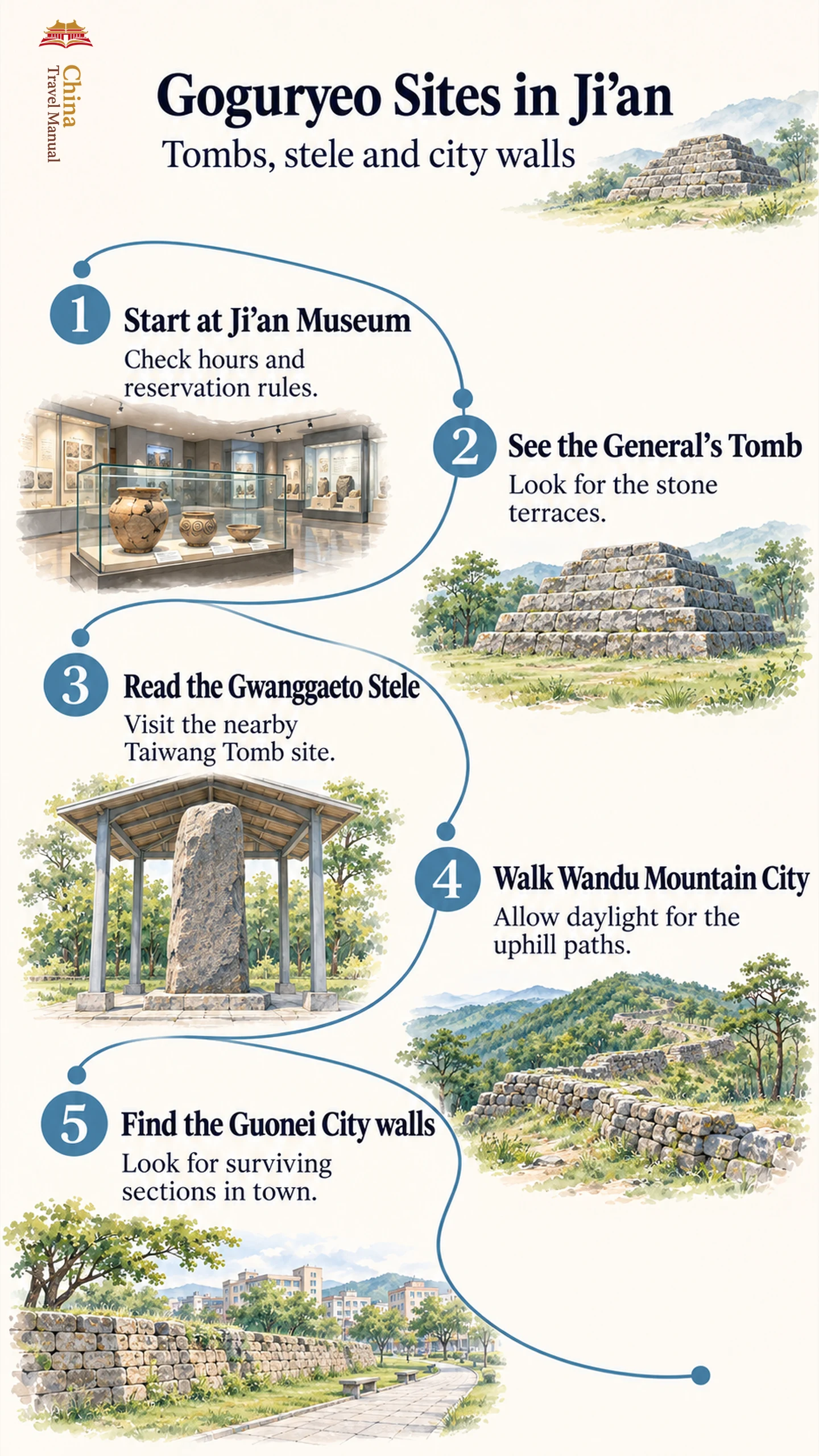
| 1 | Ji’an Museum | Start with artifacts and tomb models for context. Check the opening day and booking window. |
| 2 | General’s Tomb (将军坟, Jiāngjūnfén) | View the stepped granite terraces. The enclosure is also labeled Tomb of King Jangsu. |
| 3 | Gwanggaeto Stele (好太王碑, Hǎotàiwáng Bēi) and Taiwang Tomb (太王陵, Tàiwáng Líng) | Read the stele interpretation and see the nearby burial mound and remains. |
| 4 | Wandu Mountain City | Follow the marked uphill paths and look for surviving stonework and building foundations. |
| 5 | Guonei City (国内城, Guónèi Chéng) | Look for surviving wall sections in the modern city. Add this stop if daylight and access allow. |
In a half day, visit the stele and General’s Tomb, or choose the museum and Wandu if you prefer to focus on how the city worked. On a full day, bring Wandu forward if visibility is better in the morning or daylight is limited. At the museum, look for models and displays that help explain what the stone foundations represent before heading outdoors.[2][3][4]
What the Tombs, Stele and City Walls Show
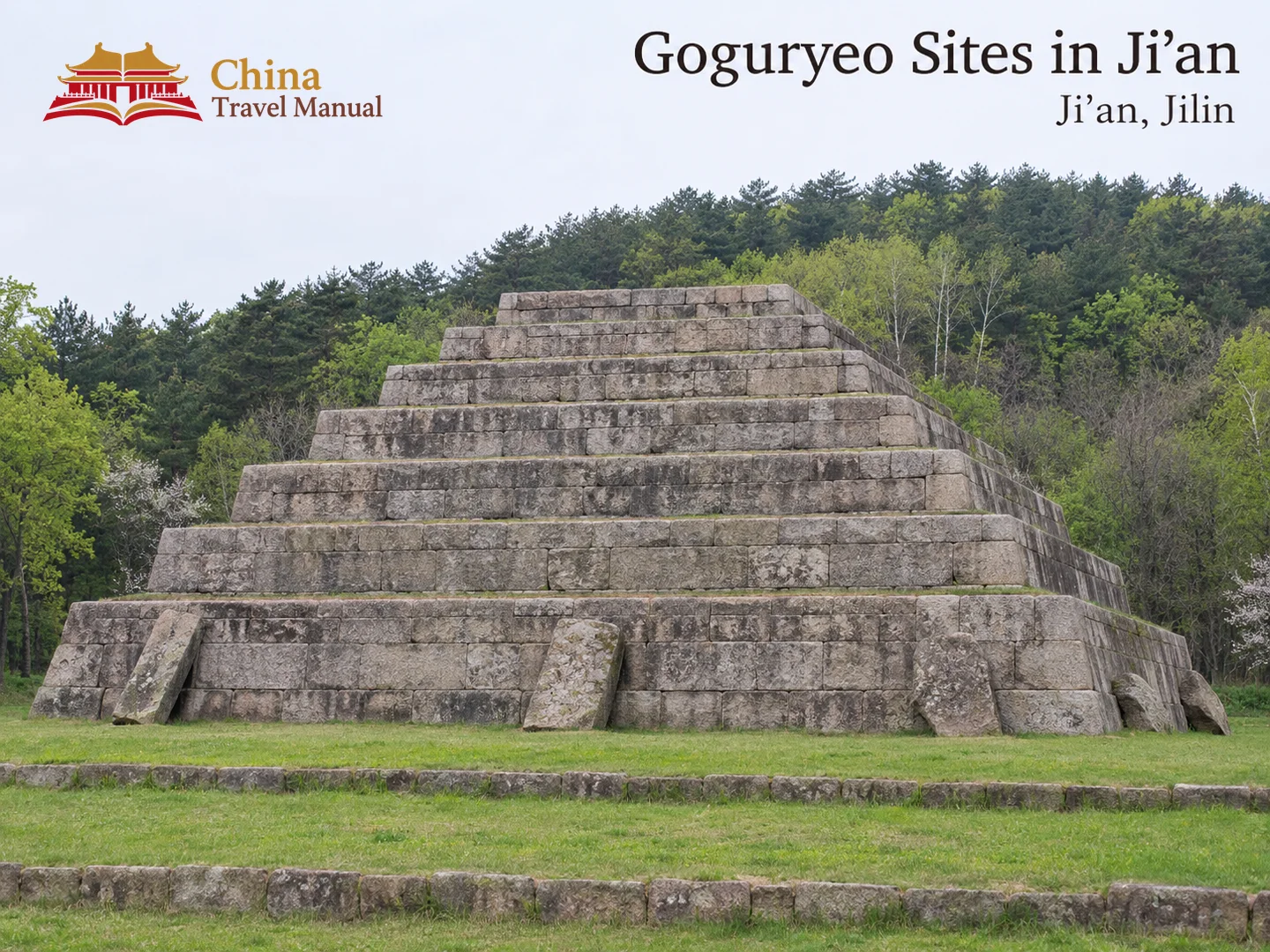
The General’s Tomb is widely presented locally as the tomb of King Jangsu. Its square terraces show the scale of royal stone construction. The stele was erected in 414 and records accounts of Goguryeo’s origins, its king’s achievements and tomb-guarding arrangements. The Taiwang Tomb is part of that stop but is a separate monument from the General’s Tomb.[1][2][7]
Wandu occupies hilly ground, while Guonei occupied the lower city. At Wandu, look for how walls and foundations follow the terrain. In Guonei, the surviving sections sit within the modern streetscape. If you want to visit the related site in Liaoning, allow a separate leg. The wider UNESCO property also includes Wunu Mountain City in Huanren, Liaoning, outside Ji’an. Use the Jilin travel guide for a longer route through the province.[1][2][3]
FAQs About the Goguryeo Sites in Ji’an
Is Koguryo the same as Goguryeo?
Yes. These are two English romanizations for the same kingdom. UNESCO uses Koguryo in its property name.
Can I visit all of the main Ji’an sites on one ticket?
A reported pass covers the General’s Tomb, the Gwanggaeto Stele site and Wandu Mountain City. Confirm the current inclusions. The museum uses separate entry arrangements.
Can visitors enter the tomb chambers and see the murals?
Plan on seeing exterior remains and museum exhibits. Access to tomb chambers is restricted for conservation, and a public site ticket does not guarantee a view inside.
Sources
[1] UNESCO World Heritage Centre. Capital Cities and Tombs of the Ancient Koguryo Kingdom
[2] Ji’an Municipal Government. World Heritage route through the museum, tombs and city remains
[3] Jilin Department of Culture and Tourism. Ji’an heritage routes and the principal sites
[4] Dahuangxian Travel. October 2026 ticket, transfer and seasonal planning information
[5] Jilin Department of Culture and Tourism, via People’s Daily. Ji’an visitor notice with individual and three-site ticket prices
[6] Ctrip. Ji’an Museum listing and regular closing day
[7] Jilin Department of Culture and Tourism. Gwanggaeto Stele date and inscription subjects





