

Quick Answer: How Should You Plan a Trip to Jilin?
Plan Jilin around one main travel theme rather than trying to cover the whole province: choose Changbai Mountain for volcanic landscapes and forests, Central Jilin for city history and winter scenery, Yanbian for Korean Chinese culture, Ji’an for ancient Goguryeo heritage, or Western Jilin for wetlands and Chagan Lake traditions. These areas are widely separated, so a realistic route depends on your season, arrival point, and willingness to make longer transfers.
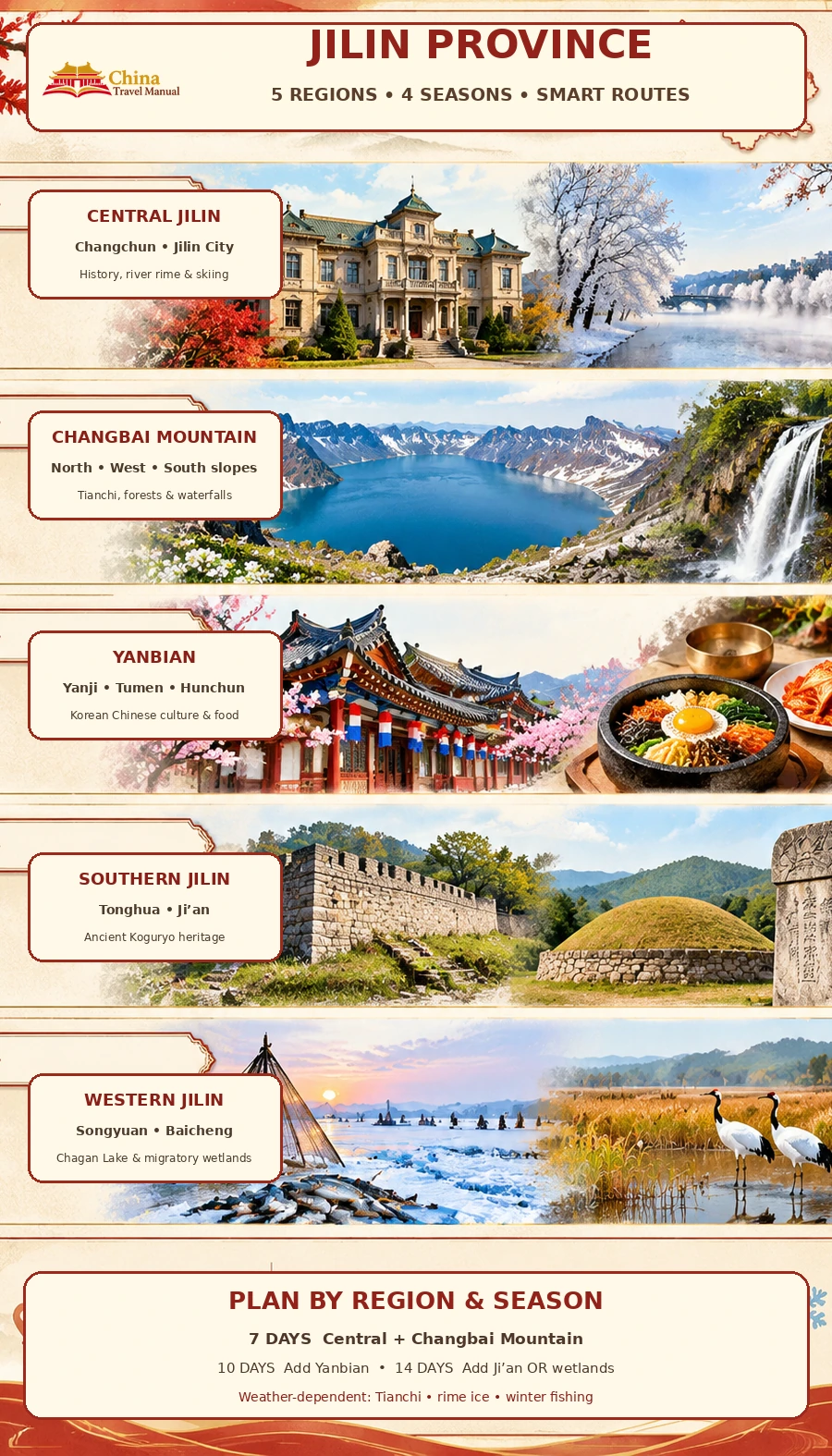
For 7 days, combine Changchun or Jilin City with Changbai Mountain; add Yanji only if the transport connections and available days allow it. With 10 days, a Changchun–Jilin City–Changbai Mountain–Yanji route is more balanced. With 14 days, consider adding either Ji’an or a western wetland extension rather than forcing every region into one trip. Rime ice, Chagan Lake winter fishing, and Changbai Mountain’s Tianchi viewing are weather- or season-dependent. Plan door to door, including station transfers and scenic-area shuttles, and check current operating notices before booking.
Is Jilin Worth Visiting?
Jilin is worth visiting if you want a Northeast China trip that combines volcanic mountain scenery, winter landscapes, Korean Chinese culture, ancient history, and large freshwater wetlands. It is not a province to approach as a checklist of nearby cities. The most rewarding experiences are spread across five broad travel areas, and each area suits a different season and type of traveler.
What Makes Jilin Different from Other Northeast China Provinces?
Jilin offers a distinctive mix. Changbai Mountain is a major volcanic landscape with a crater lake, forests, waterfalls, and hot springs. Jilin City is known for river rime when the weather conditions align. Yanbian Korean Autonomous Prefecture has a visible Korean Chinese cultural identity, especially in Yanji’s food and urban life. Ji’an preserves important remains of the ancient Koguryo Kingdom, while Chagan Lake is associated with traditional winter fishing. These experiences are different enough that the best route depends on your interests rather than on a single province-wide “must-see” list.
Who Should Include Jilin?
Choose Jilin if you enjoy nature, photography, winter sports, regional food, cultural landscapes, or archaeology. It also works well as part of a longer Northeast China itinerary that includes Liaoning or Heilongjiang. First-time visitors with only a few days should choose one main area and avoid long cross-province transfers.
When Should You Choose Another Destination?
If your China trip is short and your priorities are Beijing, Shanghai, Xi’an, or the Yangtze River region, adding Jilin may create too much travel time. Jilin is most rewarding when you can allow at least a week for one or two connected regions, or longer for a deeper journey. Travelers seeking a guaranteed view of Tianchi, daily rime, or a fixed winter-fishing spectacle should also understand that these experiences depend on weather, operations, and annual schedules.
Best Time to Visit Jilin
Jilin has four distinct seasons, and no single month is best for every region. Summer is generally the most flexible season for mountain and cultural travel; autumn is attractive for foliage and heritage visits; winter brings the province’s best-known ice and snow experiences; and spring is a quieter shoulder season with variable conditions during the thaw.
Summer: June to August
Summer is a strong choice for Changbai Mountain’s forests, waterfalls, and cooler mountain air, as well as Yanbian’s cities and Ji’an’s historical sites. Wetland areas in western Jilin can also be visited in warmer months, although access and bird activity vary by site and date. Rain, low cloud, and storms can affect mountain visibility and scenic-area operations, so do not assume that summer guarantees a clear view of Tianchi.
Autumn: September to Early October
Early autumn can combine mountain foliage, comfortable city sightseeing, and visits to Ji’an’s archaeological sites. The timing of peak color varies with elevation and annual weather. Higher mountain areas can turn cold or receive early snow before lower cities, so pack layers and check local conditions rather than relying on a fixed “peak foliage” date.
Winter: Late December to February
Winter is the main window for Jilin City’s rime ice and Chagan Lake’s traditional winter-fishing activities, as well as skiing and snow scenery around Changchun and Changbai Mountain. The Jilin provincial tourism portal identifies late December through February as the main rime period, but rime is a meteorological event, not a scheduled performance. Wind, humidity, river conditions, and temperature determine whether it forms on a particular morning. Chagan Lake festival dates and visitor activities also change by year.
Spring: March to May
Spring is a transition season. Snowmelt, muddy trails, fluctuating temperatures, and changing road conditions can affect mountain travel. Western Jilin’s wetlands are relevant to spring migration, with the Momoge reserve reporting substantial spring and autumn bird-migration periods. Birdwatching access must respect protected-area rules and current site arrangements.
For a month-by-month breakdown, see the Best Time to Visit Jilin. Do not book a non-refundable trip around a single weather-dependent event without a backup plan.
The 5 Travel Regions of Jilin
The five regions below are practical editorial travel zones, not official administrative divisions. They help you understand what can be combined and what should be treated as a separate extension. For a first trip, choose one or two connected zones rather than trying to cover all five.
| Travel region | Main places | Best for | Planning note |
|---|---|---|---|
| Central Jilin | Changchun, Jilin City | Modern history, city culture, rime, skiing | Best entry point for many first-time visitors |
| Eastern Jilin | Changbai Mountain area | Volcanic scenery, Tianchi, forests, waterfalls | Choose the slope and access base before booking |
| Yanbian | Yanji, Tumen, Hunchun | Korean Chinese culture, food, border geography | Border viewing is regulated; do not assume unrestricted access |
| Southern Jilin | Tonghua, Ji’an | Goguryeo history and archaeological heritage | Requires a dedicated transfer and overnight planning |
| Western Jilin | Songyuan, Chagan Lake, Baicheng | Winter fishing, wetlands, birdlife | Seasonal and less convenient for a short first trip |
How to Choose Your Main Region
Choose Central Jilin if you want a practical city base, museums, and winter scenery. Choose Eastern Jilin if the mountain landscape is the main reason for the trip. Choose Yanbian for food, culture, and border geography. Choose Southern Jilin for ancient history, especially the Koguryo remains around Ji’an. Choose Western Jilin if you are specifically interested in Chagan Lake’s fishing traditions or wetland ecology. These zones can be combined, but the map distance and last-mile transport matter more than the number of attractions on a list.
Central Jilin: Changchun & Jilin City
Central Jilin is the easiest place to build a city-based introduction to the province. Changchun is the provincial capital and an important air and rail hub. Jilin City is a separate city on the Songhua River; it is not the provincial capital. Together, they offer a mix of modern history, museums, urban amenities, winter sports, and seasonal rime scenery.
Changchun: Modern History and a Transport Hub
Changchun is a useful arrival or departure base because it has the province’s main international airport and major railway connections. The Museum of the Imperial Palace of Manchukuo is an important site for understanding the Japanese occupation of Northeast China and the puppet state established under Japanese control. It should be interpreted in its historical context, not presented simply as an imperial palace attraction. Other city museums and parks can fill out a stay, but the city’s value for most regional itineraries is also practical: it provides accommodation choice, services, and connections to other parts of Jilin.
For a city-focused visit, use the Changchun Travel Guide and the Museum of the Imperial Palace of Manchukuo Visitor Guide for more detailed planning.
Jilin City: Songhua River Rime and Winter Sports
Jilin City is known for rime ice that forms when moisture from the relatively warmer Songhua River meets suitable cold-air and wind conditions. The best-known viewing period is generally late December to February, but a forecast cannot guarantee that the trees will be covered on a particular morning. Travelers hoping to see rime should allow more than one morning if possible and keep their plans flexible. Rime Island and nearby riverside areas are popular viewing options, but transport, ferry or shuttle arrangements, and visitor access should be checked for the current season.
The city and its surrounding resorts also suit winter-sports visitors. If skiing is a major purpose of your trip, compare resort location and transfer time rather than treating all slopes as being inside the city center. See the Jilin City Travel Guide, Rime Island Visitor Guide, and Ski Travel in China.
Eastern Jilin: Changbai Mountain
Changbai Mountain is Jilin’s best-known natural destination, with a volcanic landscape, the crater lake known as Tianchi or Heaven Lake, waterfalls, forests, hot springs, and alpine vegetation. The mountain is not a single viewpoint reached by one road. The North, West, and South Slope areas have different access routes, visitor facilities, and operating conditions. Select your slope and accommodation base before deciding how many nights to book.
North Slope
The North Slope is a well-developed visitor area with a structured scenic-area transport system and access to features such as the waterfall and hot-spring area. Visitors generally use official shuttle and transfer vehicles inside the scenic area; private cars should not be assumed to reach the main viewing points. Erdaobaihe is a common accommodation base for this side of the mountain. The North Slope is often practical for a first visit, but the precise itinerary and Tianchi access depend on the current operating plan.
West Slope
The West Slope offers a different approach to Tianchi and is associated with a long stairway climb to the viewing area. The number of steps often quoted by travel sources should be reconfirmed against current scenic-area information before publication. Songjianghe and nearby resort areas are commonly used as bases, but check the exact station-to-hotel and hotel-to-entrance transfer before booking. Do not assume the North Slope shuttle arrangement applies to the West Slope.
South Slope
The South Slope is more remote and can have a shorter or more restricted operating window. It should be treated as a conditional option, not a year-round default. Access may depend on seasonal road conditions, weather, conservation management, and the scenic area’s annual opening notice. Do not describe it as having the “best” view in absolute terms; each slope provides a different perspective and the best choice depends on access, visibility, and the visitor’s priorities.
Tianchi Visibility and the 2025 Rail Opening
Tianchi sits in a volcanic crater, and visibility can change quickly. Cloud, wind, rain, snow, and safety restrictions can close the viewing area even when lower elevations look clear. A mountain visit should include a backup plan such as forest walks, waterfalls, hot springs, or a second weather window. Changbaishan Biosphere Reserve is recognized under UNESCO’s Man and the Biosphere Programme; it is not a UNESCO World Heritage property.
A major transport change took place on September 28, 2025, when the Shenyang–Baihe section of the Shenyang–Jiamusi high-speed railway opened and Changbaishan Railway Station began service. This improved rail access to the mountain region, but the station is not the scenic-area entrance. Travelers still need a road transfer to their hotel and the chosen slope. Published launch-day journey examples are not a substitute for checking the train operating on your own date. For slope details, read the Changbaishan Travel Guide, Changbai Mountain Visitor Guide, and Changbai Mountain North vs West Slope.
Yanbian: Yanji, Tumen & Hunchun
Yanbian Korean Autonomous Prefecture offers a different cultural experience from central and southern Jilin. Yanji is the prefectural capital and the most convenient base for food, city walks, and cultural experiences. Korean Chinese identity is visible in local language, architecture, food traditions, and public life. Visitors should approach the region as a living community rather than a themed attraction.
Yanji: Food and Urban Culture
Yanji is especially appealing to travelers interested in regional cuisine. Cold noodles, rice sausage, rice cakes, grilled dishes, kimchi, and other Korean Chinese foods are part of the city’s culinary identity. The city’s bilingual Chinese and Korean signage is also a distinctive part of the urban landscape. A visit to Yanji can be combined with a day trip to nearby destinations, but it is worth allowing time to enjoy the city itself instead of treating it only as a transit stop.
Use the Yanji Travel Guide, Things to Do in Yanji, Where to Stay in Yanji, and Getting Around Yanji for city-level details. For a deeper food overview, see the Jilin Food Travel Guide.
Tumen and Hunchun: Border Geography
Tumen and Hunchun are relevant for travelers interested in the geography of China’s borders with North Korea and Russia. Designated visitor areas and viewpoints may provide a way to understand the border landscape, but access is regulated. Visitors must follow signs, local instructions, photography restrictions, and any applicable border-management rules. Do not approach fences, river crossings, military or restricted areas, or assume that a border-viewing ticket permits unrestricted movement. See the Tumen Travel Guide and Hunchun Travel Guide.
Connecting Yanbian with Changchun and Changbai Mountain
Yanji has an airport and rail connections, and rail services link the prefecture with other Jilin destinations. The direct journey time between cities can vary by train and date; a station-to-station estimate is only one part of the journey. Check services through China Railway 12306 and add hotel transfers and waiting time. See How to Travel Between Changchun and Yanji, How to Travel Between Yanji and Changbaishan, and the Yanji Airport Guide and Transfers.
Southern Jilin: Tonghua & Ji’an
Southern Jilin is most important for travelers interested in the ancient Koguryo Kingdom. Ji’an contains major archaeological remains associated with the kingdom, including Guonei City, Wandu Mountain City, tombs, and the stele of King Gwanggaeto. Tonghua is a useful regional transport and accommodation node, but the heritage sites require their own ground-transfer planning.
Understanding the UNESCO World Heritage Property
The UNESCO property is officially named Capital Cities and Tombs of the Ancient Koguryo Kingdom and was inscribed in 2004. It is a trans-provincial property comprising Wunu Mountain City in Huanren County, Liaoning Province, and Guonei City, Wandu Mountain City, and 40 tombs in Ji’an, Jilin Province. Ji’an is therefore a major component of the property, but it is not a separate standalone UNESCO inscription. This distinction is important when comparing Jilin with Liaoning: Wunu Mountain City belongs to the Liaoning portion, while the principal city remains and tombs described in this section are in Ji’an.
How Much Time to Allow
Allow a dedicated overnight stay if Ji’an is a priority. It is not a simple side trip from Changchun or Yanji, and a long transfer can consume much of a day. Some visitors use Tonghua as a connection point and continue by road, but current bus services, train options, and local transfers should be checked for the travel date. For regional planning, see the Tonghua Travel Guide. Ji’an is best added to a longer historical route rather than squeezed into a seven-day first visit.
Western Jilin: Songyuan, Chagan Lake & Baicheng Wetlands
Western Jilin is a specialist extension for travelers interested in wetlands, migratory birds, lake landscapes, and traditional fishing culture. It is geographically separate from the province’s best-known eastern mountain and Yanbian routes, so it usually deserves its own time allocation.
Chagan Lake and Traditional Winter Fishing
Chagan Lake, near Songyuan, is known for a traditional winter fishing method that involves cutting through lake ice and using large nets. The practice is recognized as a national-level intangible cultural heritage item. The annual festival is a seasonal event, but its opening date, programme, visitor activities, and access arrangements can change from year to year. Do not promise that a visitor will see a major net haul on a particular date, and do not treat the commonly reported festival period as a guaranteed annual schedule. Confirm the current season’s official announcement before arranging travel.
Baicheng: Xianghai and Momoge Wetlands
The Xianghai and Momoge protected areas are important wetland destinations for birdlife. Momoge is noted for migratory waterbirds, including cranes and storks, and official conservation reporting describes spring and autumn migration periods. These are protected natural areas, not unrestricted recreational parks. Check access rules, designated viewing areas, seasonal closures, and whether local guides or transport are needed. Bird activity depends on ecological conditions and should never be guaranteed.
Who Should Make the Detour?
Add western Jilin if traditional winter fishing, wetlands, or bird photography is a major interest and you have enough days to absorb the extra transfers. For a standard seven- to ten-day first visit, the western region is usually less efficient than combining Central Jilin with Changbai Mountain or Yanbian. Do not add Chagan Lake and Baicheng simply to claim that you have visited every part of the province.
How to Get to & Around Jilin: Trains, Flights & Road Travel
Changchun is the main gateway for many visitors, while Yanji and Changbaishan airports can be useful for more focused itineraries when suitable flights operate. High-speed rail has improved access to eastern Jilin, but remote scenic areas and protected wetlands still need local transfers.
Flying into Jilin
Changchun Longjia International Airport is the province’s principal air gateway and is convenient for Changchun and onward rail travel. Yanji Chaoyangchuan Airport can suit a trip focused on Yanbian. Changbaishan Airport is a more specialized option for the mountain region, but flight routes and frequency can be seasonal. Compare the full arrival journey, including airport-to-station or airport-to-hotel transfers, before choosing a flight simply because it appears closer on a map.
For airport planning, see the China Airports Guide and the Changbaishan Airport Guide and Transfers.
Using High-Speed Rail
The September 28, 2025 opening of the Shenyang–Baihe section created a high-speed rail link to Changbaishan Railway Station and improved connections through Tonghua and Baishan. It is a meaningful change for visitors who previously relied more heavily on long road journeys. However, the railway station is a regional arrival point, not the North, West, or South Slope entrance. Check the live timetable, departure station, train number, and ticket availability for your date through the official China Railway 12306 English service.
Door-to-Door Travel Time Matters
Calculate a regional transfer as: hotel to station + security and waiting time + train journey + arrival-station exit + onward road transfer + scenic-area shuttle or local transport. This is especially important for Changbai Mountain, Ji’an, Chagan Lake, and the western wetlands. A train journey that looks short on a timetable may still take most of a sightseeing day once both ends are included.
Driving and Local Transfers
A private car or locally arranged transfer may be practical for some rural attractions, but winter road conditions, mountain weather, and protected-area access rules can change the calculation. Do not assume that a rental car can enter a scenic area or cross a border-control checkpoint. In mountain regions, use official scenic-area transport where required. For general planning, consult Getting Around China and the Northeast China Itinerary.
Changbai Mountain Slopes Comparison: North / West / South
The slope choice is one of the most consequential decisions in a Changbai Mountain visit. The three approaches are not interchangeable, and the best one depends on your base town, travel dates, walking preference, and the current operating notice.
| Approach | Planning character | Typical base | What to verify |
|---|---|---|---|
| North Slope | Established scenic-area transport and a broader set of visitor facilities | Erdaobaihe | Shuttle/transfer system, Tianchi access, waterfall and hot-spring operations |
| West Slope | Different Tianchi viewpoint and a long stairway approach | Songjianghe / resort area | Stair access, entrance transfer, weather and current opening |
| South Slope | More remote and often more restricted by season and operations | Confirm locally for the current season | Whether it is open, road access, reservation and transport restrictions |
Do not choose a slope based only on claims that one has the “best” view. Tianchi visibility is weather-dependent from every approach. If seeing the crater lake is your main goal, allow a flexible day and understand that the scenic area may suspend access for safety reasons. The detailed comparison belongs in the North vs West Slope guide; this province-level page only explains how the choice affects the wider Jilin itinerary.
Winter Experiences in Jilin: Rime, Ice Fishing & Skiing
Winter is a major part of Jilin’s identity, but its experiences are spread across different cities and regions. Rime viewing in Jilin City, skiing around Changchun and Jilin, snow scenery at Changbai Mountain, and Chagan Lake winter fishing are not one compact activity cluster. Choose one or two that fit your route and allow for cold-weather travel delays.
Rime Ice in Jilin City
Rime forms under specific combinations of river moisture, air temperature, wind, and atmospheric conditions. Late December to February is the commonly cited season, but daily visibility is never guaranteed. If rime is essential to your trip, stay close enough to reach the river before sunrise and allow more than one potential viewing morning. The Rime Island Visitor Guide can help with the viewing-area decision.
Chagan Lake Winter Fishing
The Chagan Lake fishing tradition is both a working cultural practice and a seasonal visitor attraction. Festival ceremonies and public activities are scheduled by local organizers and may vary annually. Weather and ice safety determine what can take place. Treat the event as a possible winter extension, not a guaranteed daily show.
Skiing and Snow Resorts
Jilin has several ski areas, including resorts around Changchun and Jilin City, while the Changbai Mountain region offers additional winter resort experiences. The right choice depends on skill level, snow-season dates, accommodation location, and whether you want skiing or sightseeing. Check the actual opening status and lift operations for the season; previous winter’s snow conditions are not a reliable promise for the next season.
Changchun 2027 Winter Universiade
The 33rd FISU Winter World University Games are scheduled for January 15–25, 2027, with Changchun and Jilin City as host cities. The event may increase demand around venues and transport corridors, but visitors should not assume that every hotel will be unavailable or that prices will rise by a fixed amount. If traveling during the event, book suitable accommodation early and check official venue and traffic announcements. For some visitors, the competitions may be an additional reason to visit rather than a reason to avoid the region.
UNESCO Heritage & Nature Protection Facts for Jilin
Ji’an’s Koguryo Remains Are Part of a Trans-Provincial World Heritage Property
The official UNESCO property, Capital Cities and Tombs of the Ancient Koguryo Kingdom, was inscribed in 2004. It includes three ancient cities and 40 tombs: Wunu Mountain City in Liaoning, and Guonei City, Wandu Mountain City, and the 40 tombs in Ji’an, Jilin. The property is shared across the two provinces. The Haotaiwang Stele is an important historical monument associated with the Koguryo kingdom. Visitors should respect conservation rules and must not climb on, touch, or damage protected archaeological structures.
Changbaishan Is a Biosphere Reserve, Not a World Heritage Site
Changbaishan Biosphere Reserve is part of UNESCO’s Man and the Biosphere Programme, which recognizes areas for biodiversity conservation and sustainable relationships between people and ecosystems. This designation is different from inscription on the UNESCO World Heritage List. In the article, describe Changbaishan accurately as a UNESCO biosphere reserve; do not call the mountain a UNESCO World Heritage Site.
Respect Protected Landscapes and Border Rules
Wetlands, mountain reserves, archaeological sites, and border areas all have rules intended to protect people and the environment. Stay on designated paths, follow photography restrictions, avoid disturbing birds or wildlife, and obey closures and local instructions. Border viewpoints do not grant permission to enter restricted zones or cross international boundaries.
Travel Itinerary Ideas for 7, 10 and 14 Days
These are route frameworks, not fixed day-by-day schedules. Treat the number of days as calendar days that include arrival, departure, and transfers. The best route is the one that avoids unnecessary backtracking and leaves enough time for the main experience.
7 Days: Central Jilin and Changbai Mountain
A balanced first route is Changchun plus Changbai Mountain, with Jilin City added only if winter rime or skiing is a priority and the transport schedule supports it. A summer version can focus on Changchun and the mountain, while a winter version can allocate more time to snow activities and weather flexibility. Do not add Ji’an, Chagan Lake, and Yanbian to this short route.
10 Days: Changchun, Jilin City, Changbai Mountain and Yanji
With ten days, a central-to-eastern route can include Changchun, Jilin City, Changbai Mountain, and Yanji. The order should follow available trains and flight options rather than an assumed fixed timetable. Yanji adds a different cultural and food experience, while the mountain section needs flexibility for weather and scenic-area access.
14 Days: Add One Specialist Extension
For a longer trip, keep the central, mountain, and Yanbian route as the backbone, then add either Ji’an for Koguryo heritage or Western Jilin for Chagan Lake and wetlands. Trying to cover both extensions as well as every eastern and central destination creates a high-transfer itinerary. If you insist on visiting all five regions, treat it as a fast-paced deep tour with additional days, not a relaxed two-week first visit.
Combining Jilin with Liaoning or Heilongjiang
Jilin can fit into a broader Northeast China trip, especially when travelers arrive through Shenyang, Harbin, or another regional hub. Cross-province routes should be designed around rail schedules and the number of hotel changes. Use the Northeast China Itinerary to compare a wider regional journey, and use the 5 Days in Jilin itinerary for a more focused short trip.
Practical Tips for Foreign Visitors to Jilin
Choose Accommodation by Scenic-Area Access
In Changchun, choose a hotel based on your planned museums, railway station, and airport transfer. In Jilin City, winter rime visitors may prefer a location that makes early-morning river access practical. For Changbai Mountain, choose Erdaobaihe for a North Slope-oriented trip or a Songjianghe-area base for the West Slope, after confirming current access and transfers. Yanji is the most convenient base for much of the prefecture’s food and city experience. Ji’an and Songyuan are specialist overnight bases when those regions are the purpose of the visit.
Prepare for Winter Conditions
Winter conditions can be severe, especially in exposed mountain areas and during wind or snowfall. Pack thermal base layers, insulated outerwear, warm gloves, a hat, non-slip footwear, and a power bank that can operate in cold conditions. Allow extra time for road travel and do not plan tight same-day connections after a mountain excursion.
Tickets, Passports and Payments
Foreign visitors should keep their passport available for railway travel, hotel check-in, and scenic-area identity checks. Ticketing systems and local mini-programs may not offer a full English interface, and overseas payment-card support can vary. Check the official booking channel and accepted payment methods before travel. For rail ticket booking, passport checks, and train basics, use the site’s China rail guides and the official 12306 service.
Border-Area Etiquette and Photography
In Tumen and Hunchun, visit only designated public viewpoints and follow all signs and instructions. Some border infrastructure, checkpoints, military facilities, and nearby areas may have photography or access restrictions. Never cross barriers, approach restricted installations, or attempt to enter another country outside an authorized port and immigration process.
FAQs About Traveling in Jilin
Is Jilin Worth Visiting for First-Time Travelers?
Yes, if you want mountain scenery, winter landscapes, Korean Chinese culture, or ancient history. For a first trip, choose one or two connected regions rather than trying to see the whole province.
How Many Days Do You Need in Jilin?
Seven days can cover a focused central and Changbai Mountain route. Ten days allow a more balanced combination with Yanji. Fourteen days are better for adding one specialist extension such as Ji’an or Western Jilin.
What Is the Best Place to Visit in Jilin?
Changbai Mountain is the leading natural attraction, while Yanji is a strong choice for Korean Chinese culture and food. Changchun is useful for history and transport, and Ji’an is important for Koguryo heritage.
Is Changbai Mountain a UNESCO World Heritage Site?
No. Changbaishan is a UNESCO biosphere reserve under the Man and the Biosphere Programme. The Koguryo capital cities and tombs, including major sites in Ji’an, are part of a separate UNESCO World Heritage property.
Can You Always See Tianchi at Changbai Mountain?
No. Cloud, wind, rain, snow, and safety restrictions can limit or close access to the viewing area. Allow flexibility and have an alternative activity in case the crater lake is not visible.
When Can You See Rime Ice in Jilin City?
The main season is generally late December through February, but rime depends on specific river and weather conditions. It is not guaranteed on any particular morning.
Is Yanji Worth Visiting?
Yanji is worth considering if you are interested in Korean Chinese culture, local food, bilingual urban life, and the wider Yanbian region. It is a distinct experience from Changchun and Changbai Mountain.
Can You Visit Changchun, Yanji and Changbai Mountain in One Trip?
Yes, with enough time and a sensible rail sequence. Around ten days is more comfortable than trying to fit all three into a short week, and the mountain section should include weather flexibility.
Conclusion: Plan Jilin Around One Main Region
Jilin rewards travelers who choose a clear theme and build the route around geography and season. Start with Central Jilin, Changbai Mountain, Yanbian, Ji’an, or Western Jilin, then add a second region only when the transfer is worthwhile. Keep Tianchi, rime, and winter fishing flexible, use current rail and scenic-area notices, and calculate every journey door to door. A focused itinerary will reveal more of Jilin than a rushed attempt to cover the entire province.
Sources
- UNESCO World Heritage Centre: Capital Cities and Tombs of the Ancient Koguryo Kingdom.
- UNESCO: Changbaishan Biosphere Reserve.
- GoJilin: Jilin opens new rail and highway tourism corridor (September 29, 2025).
- GoJilin: Jilin city’s rime.
- GoJilin: Chagan Lake Winter Fishing.
- GoJilin: Winter comes alive at Chagan Lake festival (January 8, 2026).
- National Forestry and Grassland Administration: Momoge wetland migratory birds.
- Changchun 2027 FISU Winter Universiade official site.
- China Railway 12306 English service.





