

Quick Answer: How Do You Visit a Temple Respectfully?
Dress for a place where people may be worshipping, keep your voice low and follow the signs and staff instructions when you move from a courtyard into a hall.
- Check entry: Confirm whether you need a reservation or admission ticket, even when entry is free.
- Leave room for worship: Wait to one side if people are moving toward an altar or a service is starting.
- Offerings are optional: Follow the posted instructions if you want to offer incense or make a donation.
- Ask about photos: Recheck permission at each indoor space and ask a person before taking a close photograph.
When you are unsure, pause at the doorway, look for a notice and ask an attendant.
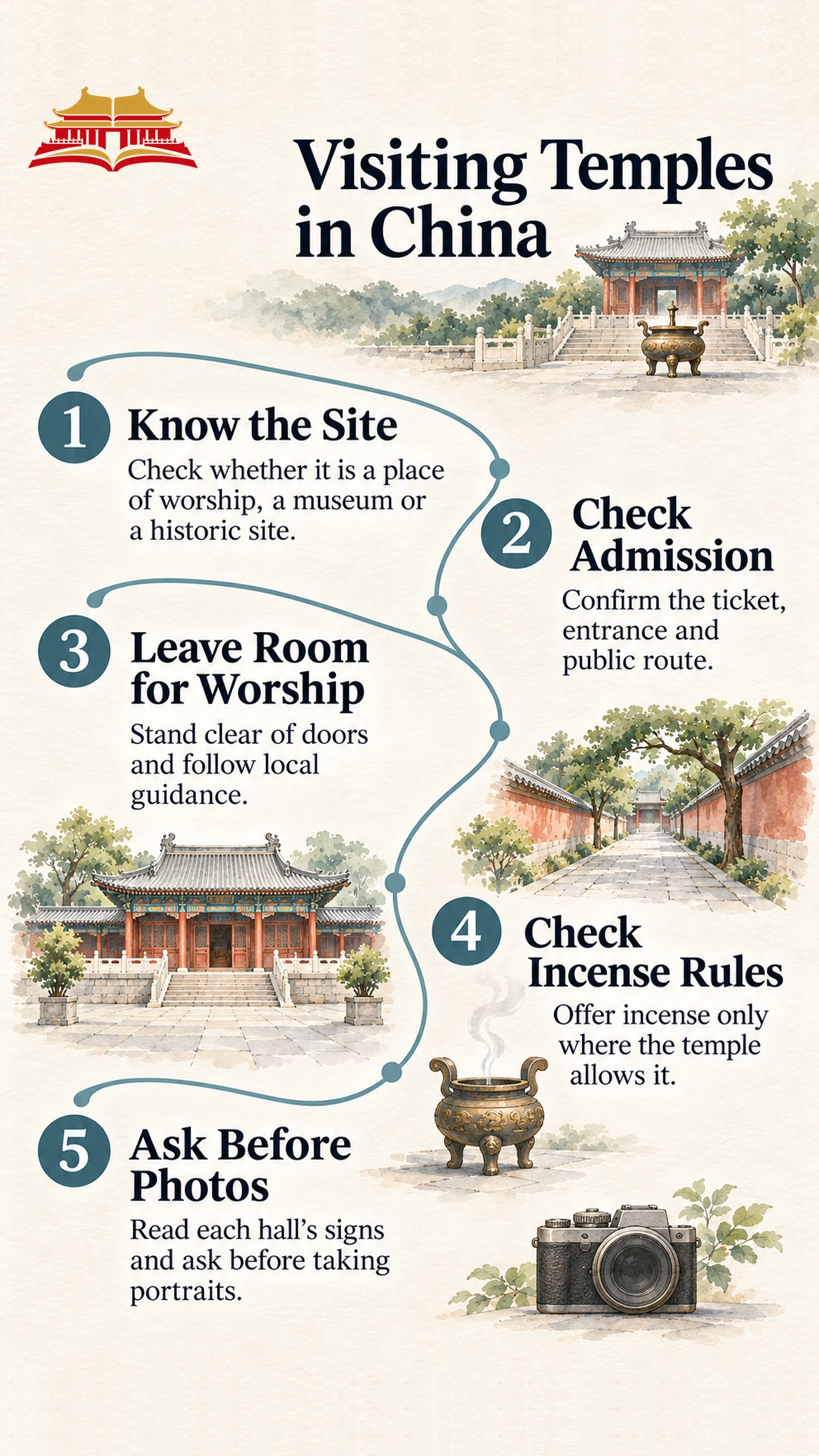
Before you enter a temple in China, look at how people use its courtyards and halls. At a working place of worship, other people may be waiting to make offerings or enter a service. At a former imperial ceremonial site or a building run as a museum, the visit may follow a different set of rules. Identify the type of place, then follow the instructions at each doorway. [1][4][5][7]
Check What Kind of Place You Are Visiting
| Type | Example | What to expect |
|---|---|---|
| Buddhist temple (佛寺, fósì) | Lama Temple, Beijing | A temple complex with Buddhist images, halls and space for worshippers and visitors. The operator’s hall rules include restrictions on incense and photography. [1][7] |
| Taoist temple (道观, dàoguàn) | White Cloud Temple, Beijing | A series of courtyards and halls dedicated to Taoist religious life. Use the visitor route and respect any area set aside for a ritual. [2] |
| Confucius temple (孔庙, Kǒngmiào) | Temple of Confucius in Qufu, Shandong | A commemorative and ceremonial complex for Confucius. Look for explanations of its halls and grounds, and follow directions if an event is taking place. [3] |
| Ancestral hall (祠堂, cítáng) | Chen Clan Ancestral Hall, Guangzhou | A building type associated with clan life. This example now houses the Guangdong Folk Arts Museum, so the visitor experience includes exhibits and historic buildings. [4] |
| Former imperial ritual site | Temple of Heaven, Beijing | Historic ceremonial buildings set in larger grounds. Check the current admission options for the areas you want to enter. [5] |
The gate style alone may tell you little about current use. If your aim is to see several related halls in one landscape, use the guides to Buddhist temples and mountains or Taoist mountains to pick a specific visit.
Plan the Entry and the Route Through the Halls
Check the actual site and entrance before you book. Lingyin Temple is within the Lingyin–Feilai Peak area in Hangzhou. The city’s published policy offers free entry under a timed, real-name reservation system. Follow the current instructions for your document type and date. For other venues, the China attraction tickets guide explains how to find the official channel. [6]
At the gate, look for a map or a posted visitor path. One entrance may serve several courtyards, but a room used by resident clergy or reserved for a service can have its own signs. If you are with a group, gather off to the side of the doorway so people can still pass. If a hall closes while you are there, follow the visitor route into a public part of the complex.
Wear shoes you can walk in on stone steps or uneven paving. Check posted instructions about hats, clothes or access before entering a hall. If steps or tall thresholds are difficult for someone in your group, ask whether there is another public approach. Check the walk from one hall to the next as well as the route to the gate.
What to Do Around Worship and Offerings
- Give people space: If visitors and worshippers use the same gate, pause at one side and let people reach the altar. Keep your voice low near chanting, instructions or an active ceremony. If an attendant closes a hall for a service, continue to another public area.
- Follow the local incense instructions: A temple may designate burners outdoors, give guidance on the number of sticks or suspend burning under certain conditions. Yonghe Temple’s published instructions restrict burning inside the halls. Ask where incense goes if you cannot tell from the signs. [7][8]
- Offer or donate by choice: You can observe without copying another person’s bow or leaving a donation. If you want to participate, follow the attendants’ instructions. Use a posted offering point or an authorized collection box if you choose to contribute.
For a family visit, explain the altar and quiet areas before entering. Keep small children close at doorways and away from burners and offerings. If a courtyard gets crowded, pick a spot outside the line and wait until you can see where it moves.
Read the Signs Before Taking Photos
Check again at an indoor threshold, even when you have just taken pictures outside. Yonghe Temple’s published rules prohibit photography and filming inside halls. Other venues and individual exhibits may have different restrictions. Ask before raising your camera in a room with no clear instructions. [7]
Two signs worth recognizing are 禁止拍照, which means no photography, and 游客止步, which tells visitors to stop at that point. Where photos are allowed, leave space for people to pass and ask before making a recognizable portrait. Pack away a tripod or selfie stick in a narrow passage and check whether the venue allows that equipment at all. [8]
FAQs About Visiting Temples in China
Do I have to pray or burn incense?
No. You can visit the public areas and observe quietly. If you want to take part, use the place and method set out by the temple. Ask staff if you are unsure where to go. [7]
What should I wear to a temple in China?
For a working temple, choose simple, comfortable clothing with covered shoulders and legs around or below the knee if you are unsure. Bring an extra layer if you need it. Follow any posted requirements for that site.
Can I take photos inside a temple?
Check the rule at the individual hall. A temple can allow courtyard photography while asking visitors not to photograph interiors, artworks or worship. At the Lama Temple, use the operator’s instructions and follow what staff say on the day. [7]
Can I visit when a ceremony is taking place?
Where staff allow visitors to stay, stand in the public viewing area and give people taking part room. If the hall or approach is reserved, wait elsewhere or visit another open area. If you want to watch a ceremony, ask where you can stand and whether photography is allowed.
Sources
[1] Beijing Municipal Government. Yonghe Temple, the Lama Temple
[2] Beijing Municipal Government. Baiyun Temple, the White Cloud Temple
[3] State Council Information Office. Temples of Confucius
[4] Guangdong Foreign Affairs Office. Chen Clan Ancestral Hall and Guangdong Folk Arts Museum
[5] UNESCO World Heritage Centre. Temple of Heaven
[6] Hangzhou Municipal Government. Lingyin–Feilai Peak free admission and reservations
[7] Yonghe Temple. Visitor and worship instructions
[8] Guangzhou Municipal Government. English rendering of temple and other public notices





