
Quick Answer
The Three Kong (三孔, Sān Kǒng) in Qufu are the Temple of Confucius (孔庙, Kǒng Miào), the Kong Family Mansion (孔府, Kǒng Fǔ) and the Cemetery of Confucius (孔林, Kǒng Lín). Start with the temple and mansion next to each other in the old city. Save the cemetery for a separate leg north of the center.[1][6]
- Half a day: Walk from the temple’s South Gate to the main hall, then visit the adjoining family mansion.[6]
- A full day: Add the cemetery after lunch so you have time to walk to Confucius’s grave and return to the gate.[1][6]
- For all three sites: The published standard combined ticket is CNY 140. Single-site rates are available.[2]
Confirm opening and last entry for each site. The cemetery has its own gates and published check-in window.[3][4]
Qufu’s three Confucius sites tell a story you can follow in order. The temple shows how later generations honored the teacher. The mansion shows the scale of the Kong family’s household, and the cemetery takes you to the grave of Confucius and the burial ground of his descendants. Give the first two sites a morning and decide whether you have time to go north to the third.
Start With the Temple of Confucius and Kong Family Mansion
Confucius (孔子, Kǒngzǐ) was a teacher and thinker whose influence extended far beyond Qufu. The first temple was established in his honor in 478 BCE, and successive rebuilding and enlargement produced the complex visitors see today. The temple, mansion and cemetery are inscribed together as a World Heritage property.[1]
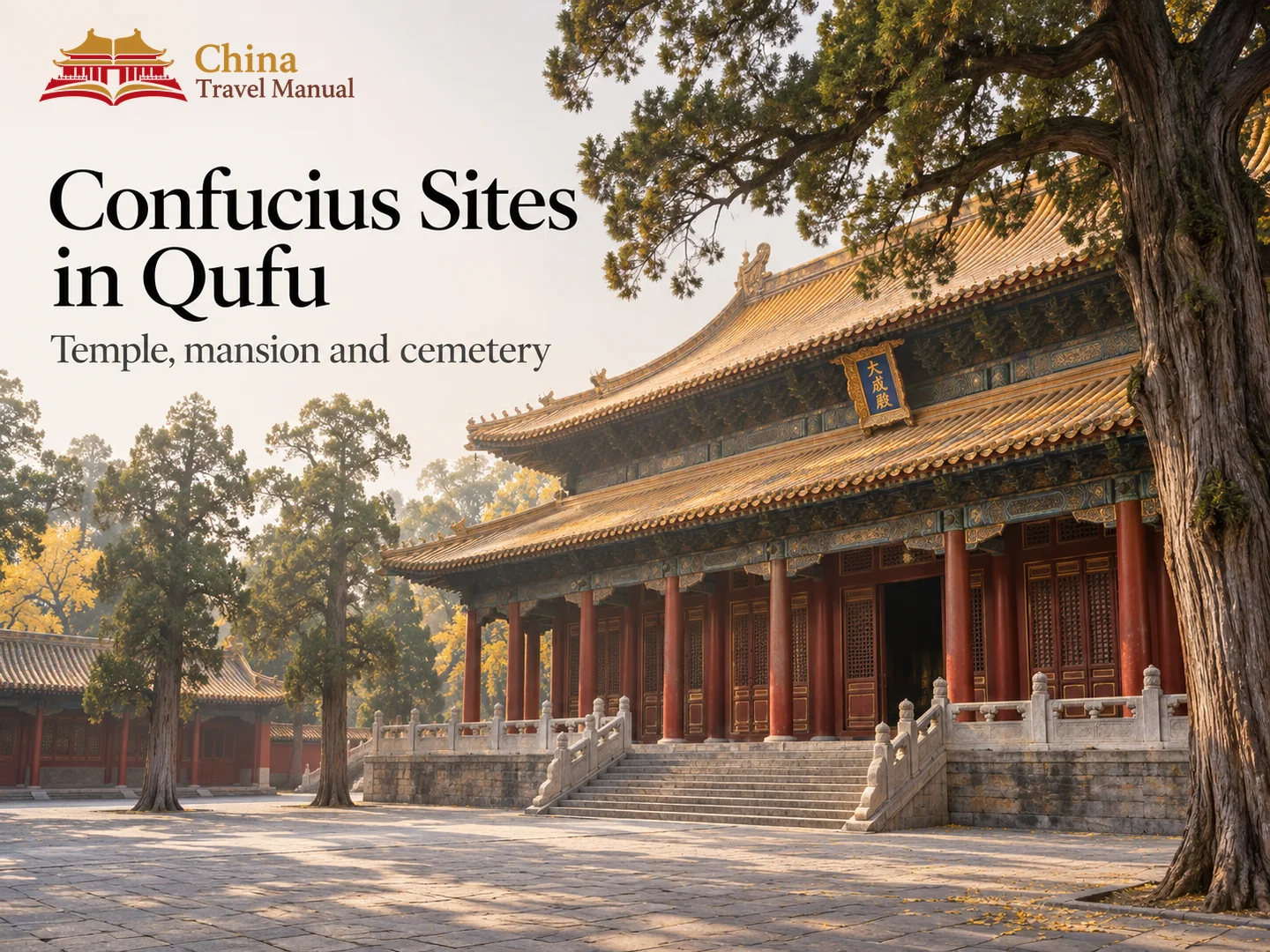
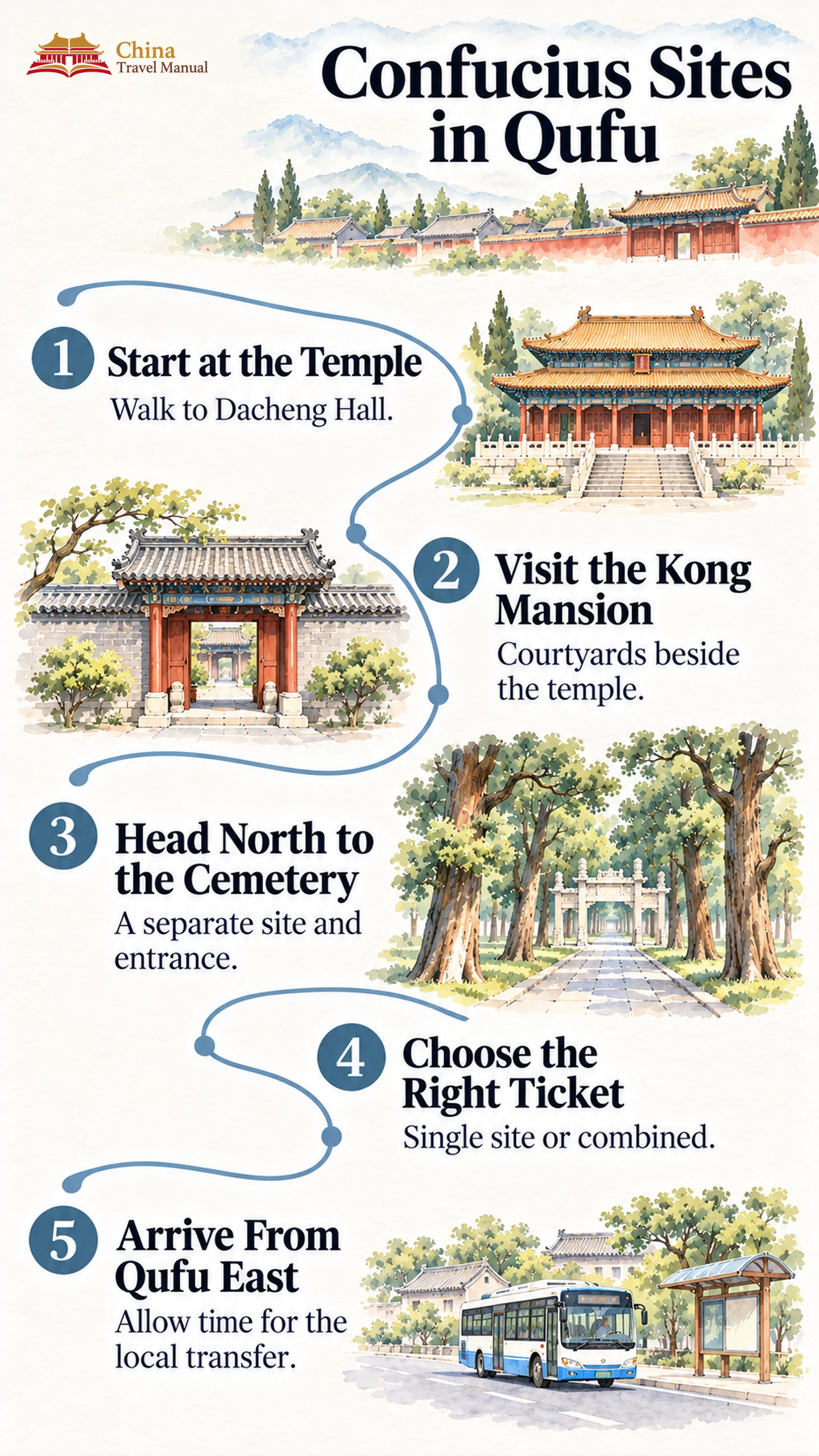
- Enter through the temple’s South Gate: Follow the main axis through gates and courtyards toward Dacheng Hall (大成殿, Dàchéng Diàn). Give the stone inscriptions and stelae a stop along the way. As you approach the hall, notice how each courtyard changes the view of the buildings ahead.[1][6]
- Go next to the mansion: Leave the temple and follow the signs to the neighboring mansion entrance. Follow the sequence from reception and administrative spaces to domestic courtyards and the rear garden. This was a residence of the Kong family that grew over generations.[1][6]
Allow about two to three hours for these two sites at a steady pace, plus extra time for an entry queue or a guided visit. Wear shoes that can handle old paving and thresholds. If you have limited mobility, ask at the gate which courtyards have easier approaches and how far you can go before the next set of steps.[3][6]
Continue to the Cemetery of Confucius
The cemetery is north of the old city and has its own entrance. Follow signs from the cemetery gate through the tree-lined burial ground toward Confucius’s tomb. The focus is the grave and the landscape around it. Leave time to walk back even if you plan to see only the main path.[1][6]
A small sightseeing vehicle is listed at CNY 20 and can reduce the walking if it is operating. Ask where it stops and how much walking remains to reach the tomb. Respect the cemetery’s quiet setting and stay on the visitor paths around graves and protected stonework.[2][3][6]
When you have only a short day, choose the temple and mansion first. If your main reason for visiting Qufu is to pay respects at Confucius’s grave, putting the cemetery first avoids depending on a late transfer.[1][4][6]
Choose a Ticket and Check Last Admission
| Standard adult ticket | Published price |
|---|---|
| Temple of Confucius | CNY 80.[2] |
| Kong Family Mansion | CNY 60.[2] |
| Cemetery of Confucius | CNY 10.[2] |
| Combined admission | CNY 140.[2] |
The combined fare costs the same as the temple and mansion tickets together and CNY 10 less than buying all three individually. Pick one site if you only want one and confirm the scope of any package before you pay. Cemetery vehicle rides and guide services are separate if you choose to add them.[2][7]
The booking notice lists real-name tickets and a two-day validity period. Check the dates and sites covered by your product and use your purchase QR code or the travel document used for booking. Use the official booking channels if your document is supported, or ask the visitor center how to complete the reservation.[3][7]
Regular check-in windows published in 2026 were 8 a.m.–4:30 p.m. for the temple and mansion and 8:30 a.m.–5 p.m. for the cemetery. These are admission windows. Check event notices and leave time after admission to see the site.[3][4]
Get to the Confucius Sites From Qufu East
If you arrive by high-speed rail, use Qufu East Station (曲阜东站). The K01 bus links the station with the temple’s South Gate, with roughly 30 minutes of travel in the published route. A taxi is a straightforward option with luggage or when you need to get straight to the correct gate. Check current bus times and leave room for the wait and the walk to ticketing.[5]
Use the Qufu transportation guide for the local transfer or the Tai’an to Qufu guide for the intercity leg. If you plan to divide the old-city sites and the cemetery across two days, fit them into the Qufu two-day itinerary.
FAQs About the Confucius Sites in Qufu
Can I see the Three Kong in half a day?
For a relaxed half-day, visit the temple and mansion. A quick visit to all three may fit if the transfers and entry queues are short. Adding the cemetery means a separate trip north of the old city and more walking inside.[1][4][6]
Which Confucius site should I visit if I only have time for one?
Start with the Temple of Confucius. Its courtyards, inscriptions and main hall explain why Qufu became a center of commemoration. Choose the cemetery if your priority is Confucius’s grave.[1][6]
Is the Confucius Museum part of the Three Kong?
The Three Kong are the temple, family mansion and cemetery. The museum is a separate site south of the center, with its own visit and booking arrangements.[1][6][7]
Can families reduce the amount of walking?
Yes. Pair the temple and mansion, use a local ride to transfer to the cemetery, and ask about the sightseeing vehicle if you visit the burial ground. Check the distance you’ll need to walk from its stop before buying a vehicle ticket.[2][3][6]
Sources
[1] UNESCO World Heritage Centre. Temple, family mansion and burial ground as one World Heritage property
[2] Jining Bendibao. September 2026 individual and combined tickets
[3] Jining Bendibao. Real-name entry, two-day validity and visitor conditions
[4] Qunar. Published entry windows for each site
[5] China Railway via Xinhua. Qufu East rail station, bus and taxi travel to the Temple South Gate
[6] VisitCN. Monument order on foot, cemetery sights and the separate museum
[7] Three Kong Scenic Area via Sohu. Official booking channels and separate museum booking





