
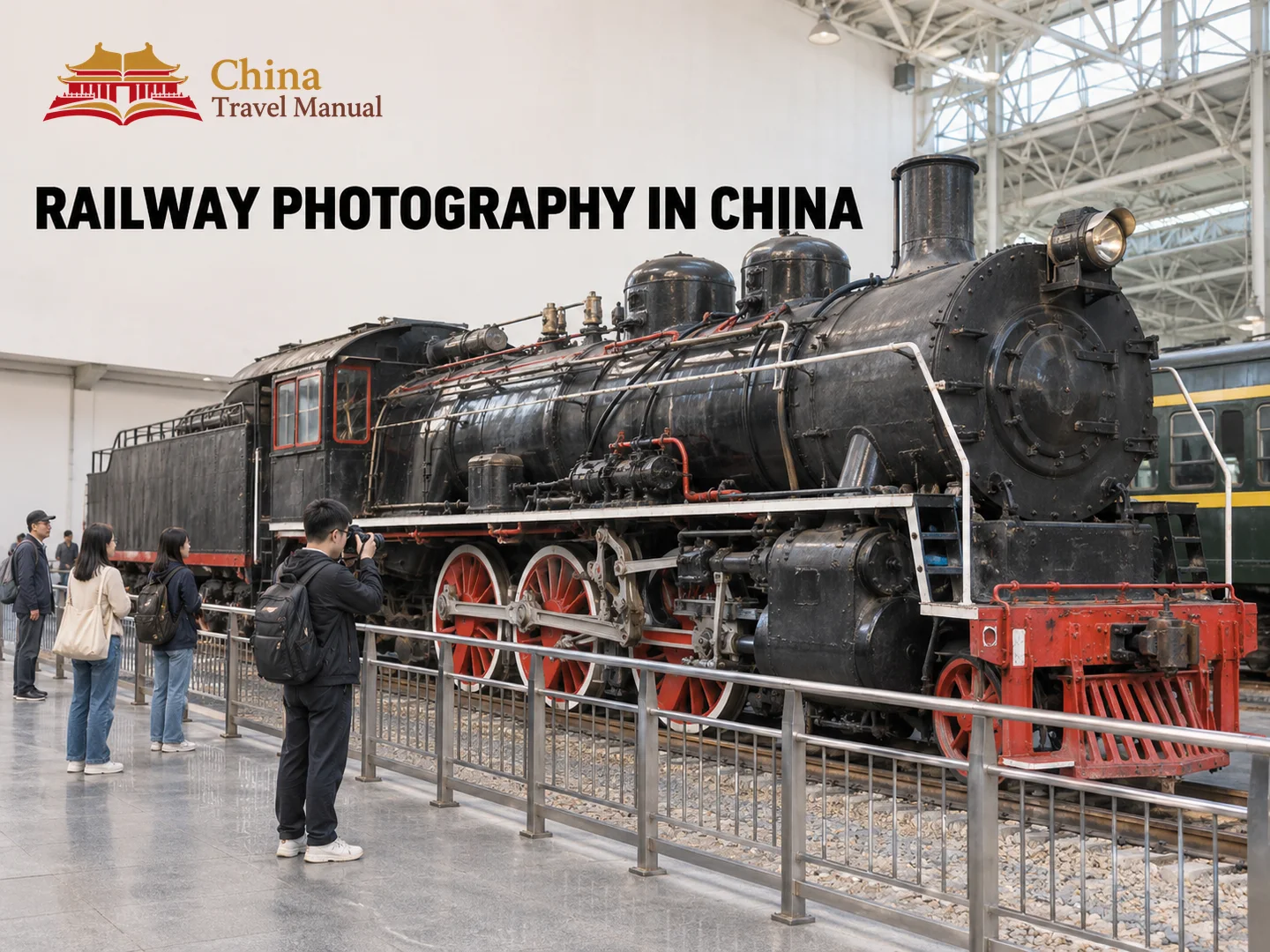
Quick Answer: Where can visitors photograph railways in China?
Choose an open visitor area and check the venue’s photography rules.
- Historic subjects: Visit a railway museum with a public collection. In Beijing, Dongjiao suits locomotive displays, and Zhengyangmen focuses on railway history in a former station.[2][3]
- Working railways: Use public concourses or a permitted platform area you can reach as a passenger. Keep boarding paths clear and stay behind safety markings.[1]
- Drones: Plan to work from the ground. Electrified railway lines, transport hubs and certain surrounding areas fall within China’s controlled-airspace framework.[4]
Ask staff before using large equipment or conducting an organized shoot. Treat a ticket as permission to board under the station’s rules and ask staff separately about an organized shoot.

Start with a subject you can photograph from a visitor area. A railway museum is suitable for historic locomotives and detail shots. If you are already traveling by train, a permitted view from the station concourse or your own train window can show modern rail travel. The safety boundary comes first: stay out of enclosed railway areas, keep behind platform markings and follow staff instructions.[1][2][3]
Compare four places to make railway photographs
| Subject | Visitor setting | What to check |
|---|---|---|
| Historic locomotive | Public railway exhibit | Museum photography, lighting and equipment policy.[2] |
| Historic station building | Museum or another public space in a former station | Exhibition rules and the opening schedule.[3] |
| Modern travel scene | Public concourse or your seat on a train | Signs, passenger privacy and whether you can take a picture without blocking the aisle. |
| Train in a wider landscape | A lawful, clearly open public viewing area separated from the railway | Pedestrian access, safe distance and signs. Choose another composition if people or traffic would have to move around you.[1] |
Go where the subject is visible without leaning around a barrier. A museum offers time to compose and compare details with the exhibit labels.
What the railway safety boundary means in practice
Chinese railway safety rules prohibit unauthorized entry to enclosed railway areas. Keep out of track areas, yards and employee-only spaces. Stay behind station markings and away from platform edges, particularly as a train arrives. Never enter a rail tunnel, use a closed line as a path or move a barrier for a photograph. If you drop something beyond a boundary, tell railway staff.[1]
Leave aerial photography out of routine station and railway visits. The national rules cover electrified railways, public transport hubs and specified surrounding areas, with the exact controlled airspace set through official notices. Check locally applicable restrictions if organizing a permitted production. Check the applicable rules with the civil aviation authority and the venue before making aerial plans.[4]
Keep other travelers’ faces, tickets and passport details out of close shots unless you have their consent. At a station, finish boarding and wayfinding first. The China railway stations guide helps match the station name on your ticket to the correct entrance.
How to plan a visitor-friendly railway photo outing
- Decide what you want to show: Choose a locomotive, the station building or the experience of traveling by train. Pick the corresponding public setting.
- Check the venue and kit: Confirm opening and photography rules. At the China Railway Museum’s Dongjiao branch, the main attraction is its collection of locomotives and rolling stock. Zhengyangmen offers architecture and archival material near Qianmen.[2][3]
- Keep the camera compact: Pack gear you can hold without obstructing anyone. Ask before using a tripod, additional lighting or a larger production setup.
- Allow the site to set the limits: Take your picture only where the signs and staff allow. Move away if the concourse or platform becomes busy.
For an off-train outing, use the Beijing travel guide to fit the museum into the day. For a broader theme, explore industrial heritage travel and choose another site with clearly defined visitor access.
FAQs About Railway Photography in China
Can I go onto a station platform just to take pictures?
Check the station’s entry and photography rules. Use a public concourse, passenger route or museum, depending on what the location allows.[1][2]
Can I photograph a train from a level crossing?
Use crossings for passage and comply with signs and staff. Choose a public vantage that does not require waiting in a traffic path or crossing area.[1]
Which Beijing railway museum branch is better for locomotive photos?
Start with Dongjiao for the rolling stock. Choose Zhengyangmen for the historic station and displays, and ask each branch about equipment and filming before your visit.[2][3]
Sources
[1] National Railway Administration. Railway Safety Management Regulations
[2] Beijing Municipal Government. China Railway Museum, Dongjiao branch
[3] Beijing Municipal Government. China Railway Museum, Zhengyangmen branch
[4] Civil Aviation Administration of China. Interim regulations on unmanned aircraft flight management





