
Quick Answer: Use a Merchant Payment for a Purchase
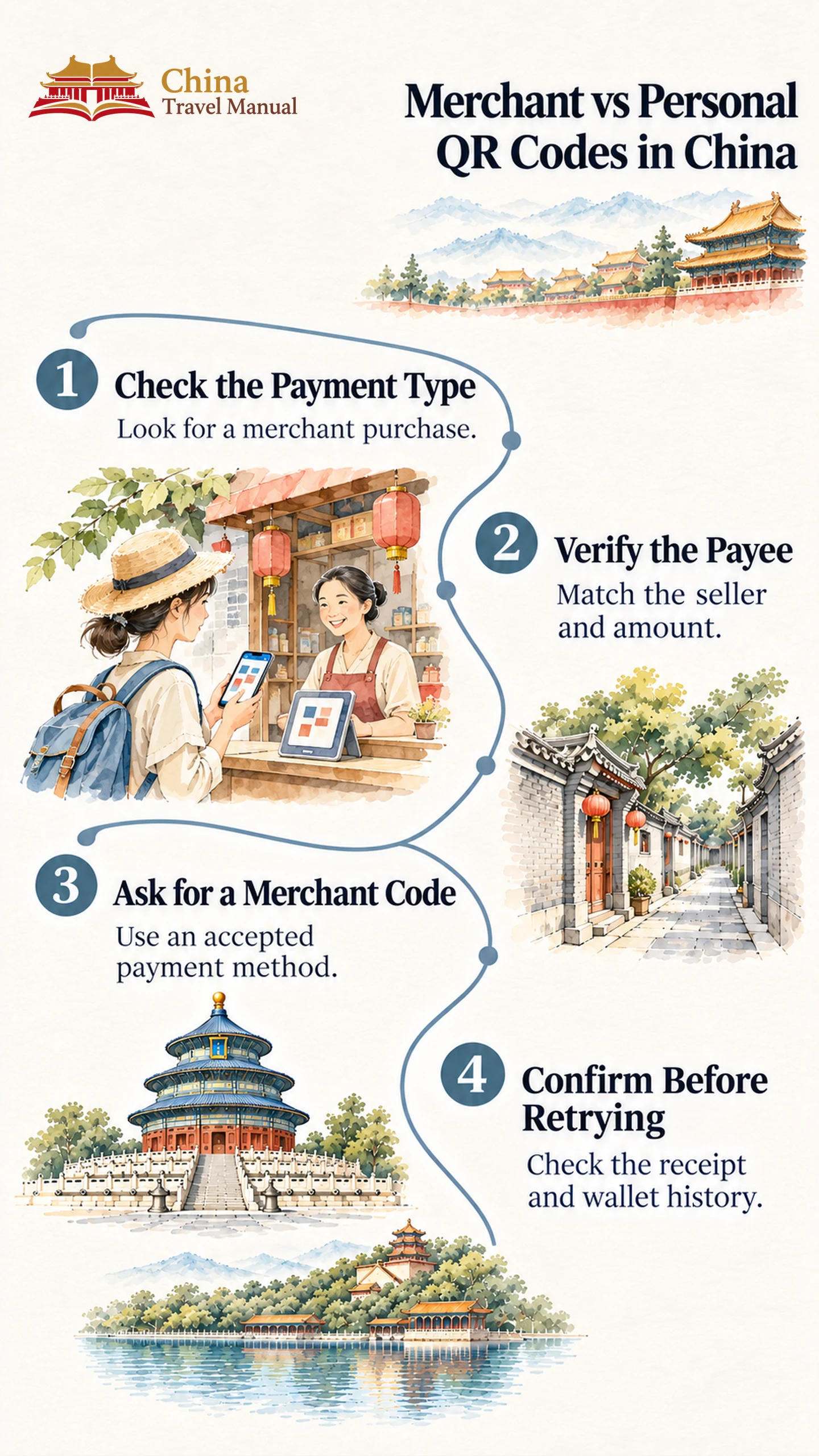
If the screen opens a personal transfer, ask the seller for a merchant code or a checkout terminal. If it opens a merchant payment, verify the payee and amount and check whether your linked card is offered.[1][2][3]
- Merchant purchase: Use an eligible linked card when it appears in the payment options.
- Personal transfer: Ask the seller for an official merchant payment or use another accepted method.
- Failed payment: Check the transaction history before trying again.
The printed code, color and recipient’s display name can look similar. Use the actual payment screen and confirm the recipient with the seller.[4]
Your linked card can work at one checkout in China and disappear from the payment options at the next. One reason is that a QR code may open a person-to-person transfer instead of a merchant purchase. Alipay and WeChat Pay let visitors use eligible overseas cards for merchant payments. Their foreign-card payment features have separate rules from personal transfers and red packets.[1][2][3]
Read what the payment screen is asking for
| What opens | What it means | What to do |
|---|---|---|
| A merchant checkout with the expected payee and purchase amount | An eligible purchase may accept your linked card | Check the funding source before confirming. |
| An individual transfer or red-packet screen | A personal payment flow | Ask for the shop’s merchant option or pay with an accepted alternative. |
| A merchant checkout with no usable card shown | This purchase or card may be ineligible | Ask about a different supported method or use RMB cash. |
A small business may collect through a business code registered in the name of an individual. Likewise, a card printed on a countertop can still link to a personal recipient. Ask whether the cashier can take a merchant payment, and match the recipient and purchase amount to the bill.[1][2][4]
Ask for a usable alternative at the counter
You can show 可以用商家收款码吗? (Kěyǐ yòng shāngjiā shōukuǎnmǎ ma? “Can I use your merchant code?”). If their reader supports your wallet, let the cashier scan your payment code and confirm the amount. Make sure the wallet shows a payment for the right purchase before you authorize it.[1][2][3]
If the wallet refuses the merchant payment, check the error, card choice and any bank verification. If there is a card terminal, ask whether it accepts your card network. Keep small RMB notes for staffed checkouts, and see the China payments guide for your backup options. Use the merchant’s traceable checkout and ask for a receipt.[1][3]
Confirm whether the payment went through
If the app freezes after approval, check the transaction history and ask the cashier to check the order. Save the transaction time, amount and receipt when a charge is visible but the shop says it did not receive the payment. Ask the merchant or official wallet support for help before paying again. If the merchant initiates a refund, use the refund tracking guide to check the status.
For card binding and fees, see the Alipay guide or WeChat Pay guide. Review the amount and any fee shown by the app before authorizing the charge.[1][2]
FAQs About Merchant vs Personal QR Codes in China
Can I use a foreign-linked card to send a personal transfer?
The visitor payment guidance distinguishes overseas card purchases from personal transfers. Ask the seller for a merchant checkout or another payment method.
Can I tell from the shape or color of the QR code?
Those visual details are insufficient. Check the screen that opens, whether it shows a purchase, and the payee and funding method.
Can a shop QR fail even though my card is linked?
Yes. Check the app’s error and offered funding source. If you are unsure whether it went through, verify the order and transaction history before you retry.
Sources
[1] Guangzhou Municipal Government. Overseas visitor payment handbook and Alipay limits
[2] Shanghai Municipal Government. WeChat Pay and overseas card restrictions
[3] State Council. Overseas visitor payment options
[4] Wuhan Financial Administration. Business collection codes registered by individuals





