
Quick Answer: 30 Days Visa-Free for Eligible South Korean Trips
As checked on November 20, 2026, eligible South Korean ordinary passport holders can enter mainland China visa-free through December 31, 2026, for up to 30 days. Covered purposes include tourism, business, visits to family or friends, exchanges and transit. Border officers assess each traveler at the port of entry.[1][2][3]
- Tourism and visits: An ordinary South Korean passport can cover a qualifying round trip, including a direct return to South Korea.
- Work, formal study or a longer stay: Arrange the appropriate visa before travel.
- Separate transit route: The 240-hour arrangement has its own port, area and onward-ticket requirements.[4]
- Arrival paperwork: Prepare the free arrival card and a first-night address.[5]
For entry on or after January 1, 2027, check the Chinese embassy’s latest announcement before relying on the waiver. This guide covers mainland China. Hong Kong and Macau apply their own entry rules.
A South Korean ordinary passport can cover many short trips to mainland China without a visa. The deciding factors are when you enter, what you will do and how long you will stay. A weekend in Shanghai and a semester at a Chinese university call for different preparations, even if both tickets leave from Incheon.
Who Qualifies for the 30-Day Waiver?
China’s unilateral visa waiver (单方面免签, Dānfāngmiàn Miǎnqiān) covers travelers with a valid ordinary South Korean passport whose purpose and stay fit the published conditions. You can use it to visit friends, take a holiday, attend a qualifying business meeting or visit a trade fair. Embassy guidance also lists eligible short exchanges such as certain sports events and study tours. If you will attend classes as an enrolled student, take up employment or carry out reporting, ask the consular authority about the correct visa before booking.[1][2][3]
The exemption applies to eligible arrivals from any country or region at ports open to foreign nationals, subject to applicable exceptions. That includes entry by air, sea or land. A South Korean passport holder departing from Japan can therefore qualify on the same terms as someone flying from Korea. Check the specific crossing or ferry with the operator if traveling on a less common route. For a trip combining mainland China with a special administrative region, see entry planning for mainland China, Hong Kong and Macau.[2][3]
Check the document itself. The consular FAQ says an ordinary passport must remain valid for the intended stay. A temporary or emergency passport or other travel document falls outside this particular waiver. Airlines or countries on your route can require a longer validity period, so check the whole itinerary before departure. Children are assessed under the same waiver conditions, individually on their documents.[2][3]
Count the Stay and Check Your Travel Date
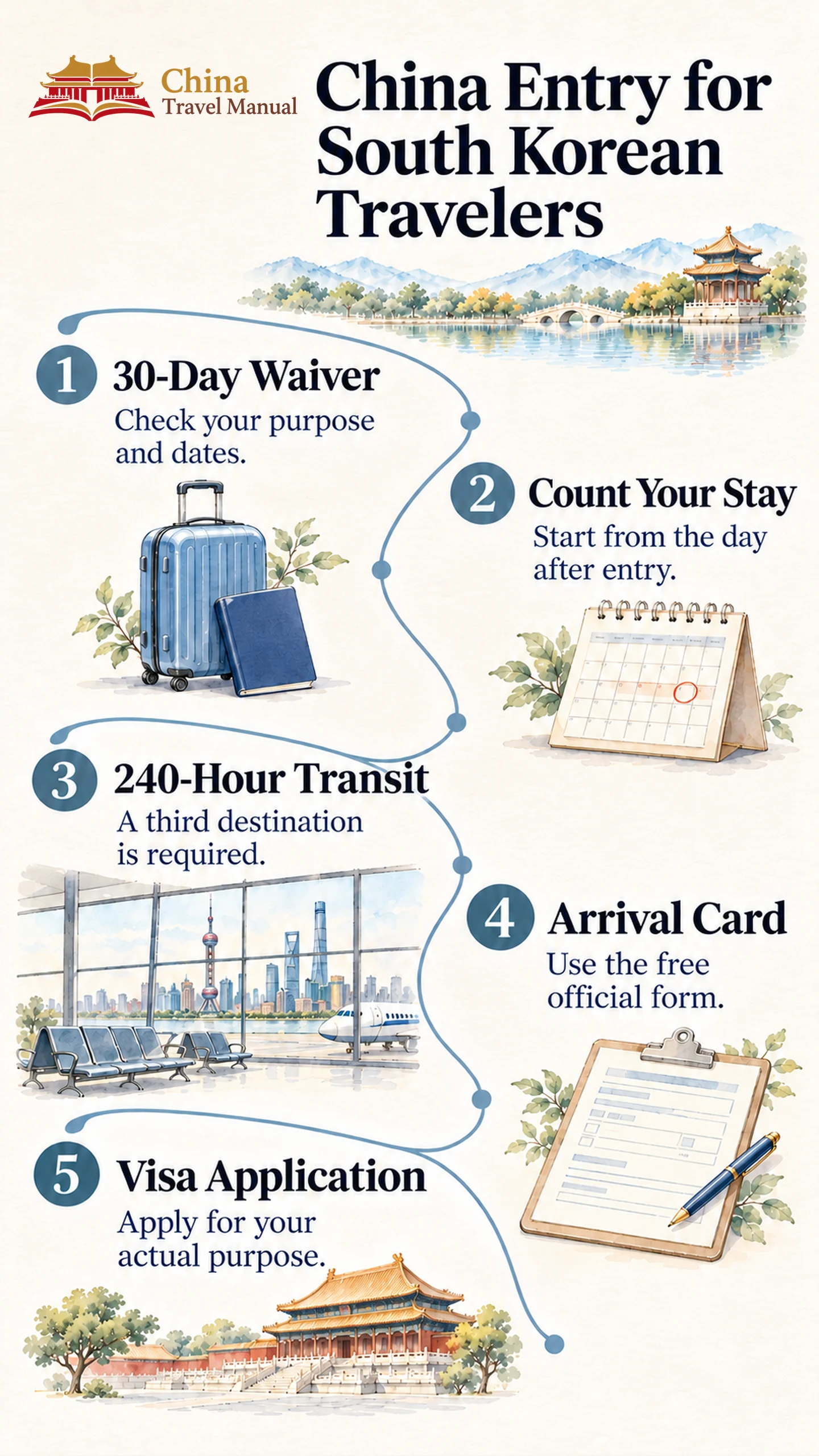
The 30 calendar days start on the day after entry. For example, if you clear mainland immigration on December 1, December 2 is day one and December 31 is day 30. Use the date stamped or recorded by immigration, and check your departure deadline at the port if it is unclear. Avoid booking a departure so late on the last eligible day that a cancellation would put you past the permitted stay.[2][3]
December 31, 2026 is the published policy cutoff for South Korean ordinary passports. It is a separate date from the last day an individual traveler may remain under their admission. If you plan to enter near year-end and depart in January, confirm your admission period with the Chinese mission or immigration authority before committing to the trip. Confirm any later entry separately, including a return to the mainland after visiting Hong Kong or Macau. China’s visa-free travel guide explains where to recheck the general rules.[1][2][3]
Repeat entries can qualify, and the ministry does not list a fixed number of entries or a minimum interval under the waiver. Each new entry still has to fit an eligible purpose and receive approval. If your plans already exceed 30 days, apply for a suitable visa in advance. If an unexpected change gives you a valid reason to stay longer after entry, contact local exit-entry authorities about a stay permit before the deadline. Treat that as an application with an outcome to confirm.[2][3]
When 240-Hour Transit Is Relevant
Visa-free transit (过境免签, Guòjìng Miǎnqiān) is a separate route into mainland China. South Korea appears on the National Immigration Administration’s eligibility list. You generally need an ordinary passport, a confirmed onward trip to a third country or region, entry and exit through allowed ports, and an itinerary within the permitted areas. See 240-hour visa-free transit in China for the route and geographic checks.[4]
An Incheon–Shanghai–Incheon ticket can fit the 30-day waiver for an eligible short holiday. It does not, by itself, satisfy the third-destination rule for 240-hour transit. Incheon–Shanghai–Tokyo is an example of a route that meets the third-destination pattern, but the other transit conditions still matter. An airside connection also has a distinct 24-hour rule. If baggage collection, separate tickets or an airport change requires clearing immigration, verify the entry route before leaving home. The comparison of visa-free entry and visa-free transit explains what each option permits.[3][4]
Prepare for Check-In and Mainland Immigration
Carry the ordinary passport you will use to enter and a copy of your itinerary. Keep your accommodation confirmation and return or onward ticket available offline. For a private visit, save your host’s address and number. For a qualifying business visit or exchange, bring the invitation or event confirmation if it helps show your purpose. The embassy recommends supporting evidence that fits the trip. Border officers may ask about the purpose, duration and plans for leaving.[2][3]
Use the National Immigration Administration’s official arrival card portal or complete the form at the port if needed. The official service is free, with paper cards also available at ports. Keep your name, passport number, arrival details and first address consistent with your bookings. See how to complete the China arrival card for the separate form workflow.[5]
After entry, hotels generally handle accommodation registration during check-in. If you stay in a private home or another non-hotel residence, you or your host should register within 24 hours of arrival at that address. China introduced nationwide online accommodation registration for non-hotel stays on September 21, 2026. The local public security office remains a route when needed. The accommodation registration guide explains what to ask your host.[6]
If You Need a Visa, Apply for Your Actual Purpose
Plan to obtain the appropriate visa if you will work, undertake formal study, report as a journalist, or enter for a stay longer than the waiver permits. Ask the Chinese mission responsible for where you apply if an invitation, enrollment letter or permission is needed. A short business visit and taking up employment can involve different documentation. Give the authority a concrete description of the work or activity if the category is unclear.[2][3][7]
If you apply in South Korea, the Chinese embassy’s ordinary-visa instructions point applicants to an online form and document upload through the Chinese Visa Application Service Center. Follow the center’s current notice for submission, passport validity and any in-person or fingerprint requirements. The embassy’s visa application checklist mentions six months of passport validity, while its waiver FAQ describes a valid ordinary passport for the intended stay. These are different checks. Use the China visa application channel guide to identify the channel for your location.[2][7]
FAQs About China Entry for South Korean Travelers
Do South Koreans need a visa for a weekend trip to China?
An eligible ordinary South Korean passport holder can visit mainland China for tourism for up to 30 days under the waiver currently published through December 31, 2026. A weekend round trip to and from South Korea can qualify.[1][2][3]
Do I need to fly to a third country to use the 30-day waiver?
No. A direct return to South Korea can qualify under the ordinary-passport waiver. The third-country or region requirement applies to 240-hour visa-free transit.[3][4]
Can I use the waiver with a South Korean emergency passport?
The ordinary-passport waiver excludes emergency and temporary travel documents. Ask the Chinese mission and airline for the entry route that applies before departing.[2][3]
Do South Korean children use the same rules?
The eligibility conditions are the same for minors and adults. Check each child’s passport and any separate consent or carriage requirements with the relevant authorities and airline.[2][3]
Sources
[1] Chinese Embassy in the Republic of Korea. Korean-language visa-waiver extension announcement
[2] Chinese Embassy in the Republic of Korea. Current visa-waiver questions, document validity and permitted stay
[3] Chinese Ministry of Foreign Affairs. Consular service questions on unilateral visa-free entry
[4] National Immigration Administration. 24-hour and 240-hour visa-free transit rules
[5] National Immigration Administration. Official arrival card channels and on-arrival options
[6] National Immigration Administration. Nationwide non-hotel accommodation registration service
[7] Chinese Embassy in the Republic of Korea. Ordinary visa application procedures in South Korea





