

Quick Answer: Can You Visit China Without a Visa?
China visa-free travel depends on your passport nationality, the specific exemption policy, your visit purpose, and your route and length of stay. There is no single visa waiver for every foreign traveler.
- Nationwide short visits: Eligible ordinary-passport holders from 50 countries can currently use China’s 30-day unilateral waiver; other travelers may qualify under a separate mutual agreement.
- Visa-free transit: Some travelers, including eligible U.S. passport holders, can enter for up to 240 hours while genuinely transiting to a third country or region through designated ports.
- Hainan-only trips: Ordinary U.S. passports are among the 61 nationalities eligible for Hainan’s separate 30-day policy, but it does not authorize travel onward to other mainland provinces.
- Other cases: A 24-hour airport transit or a qualifying organized cruise or tour group may have its own exemption. If none fits, obtain the appropriate visa before traveling.
Always check the policy for your actual travel dates: most unilateral 30-day waivers are currently scheduled to expire on December 31, 2026. Eligibility is not a guarantee of admission.[1][2][4][5]
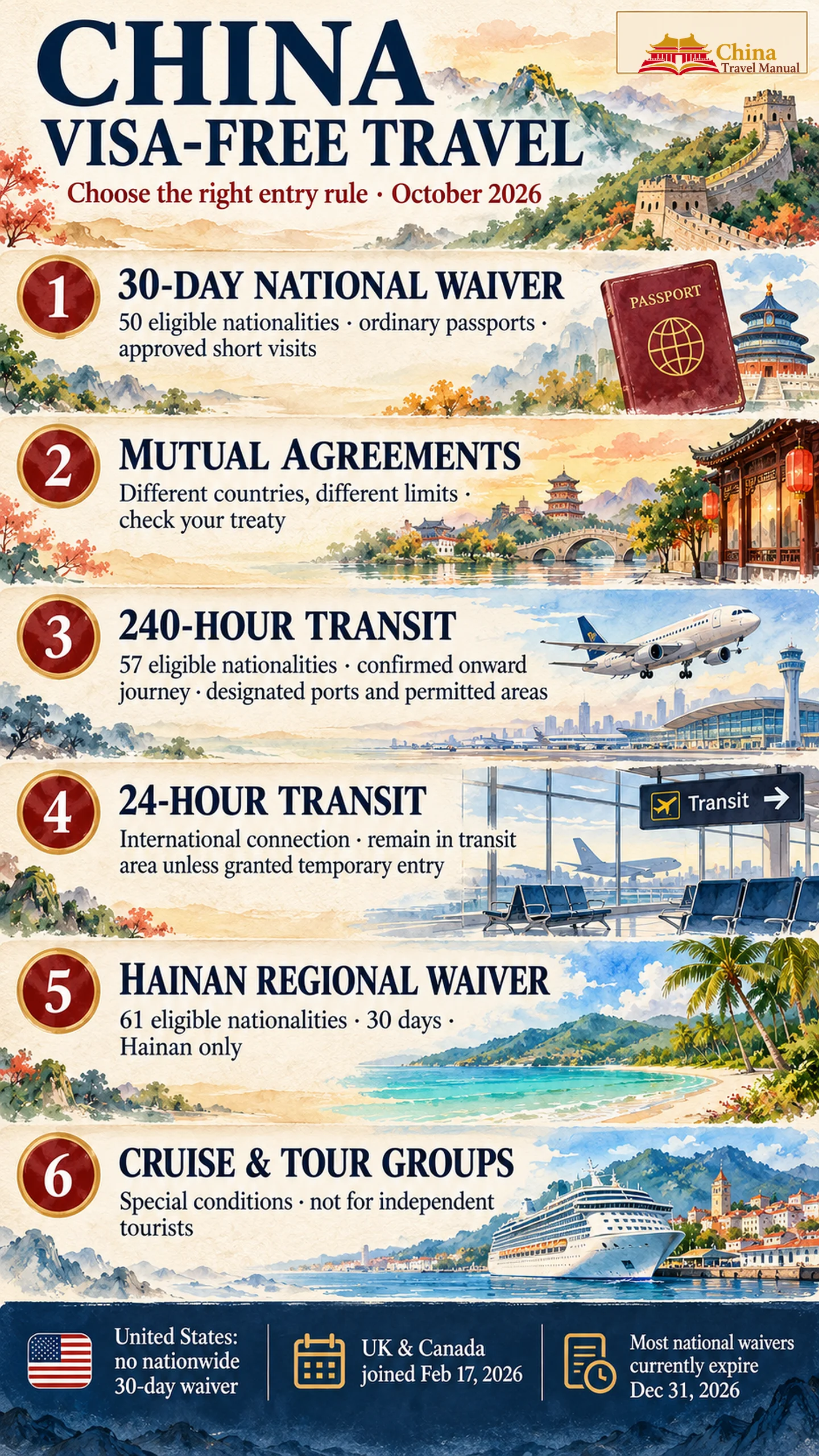
You may encounter several kinds of “visa-free China” in search results, but their requirements are not interchangeable. Start with the policy your passport qualifies for; then test the destination, purpose, dates and onward journey. A British traveler on a two-week Beijing–Xi’an–Shanghai holiday and a U.S. traveler on the same itinerary may need different entry arrangements.
This article is a decision guide. For the full application process, use the China tourist visa guide; for the distinction between the two most confused exemptions, see visa-free entry versus visa-free transit.
China Visa-Free Entry Options at a Glance
| Policy | Who may qualify | Maximum stay | Crucial restriction |
|---|---|---|---|
| Unilateral 30-day waiver | Ordinary passports from the designated 50 countries; eligible short visits | 30 calendar days | Nationality, purpose and current policy dates must match |
| Mutual visa exemption | Passport holders covered by an applicable bilateral agreement | Varies by agreement | Check passport validity, per-entry and cumulative limits |
| 240-hour visa-free transit | Eligible passports from 57 countries, with confirmed onward travel to a third country/region | 240 hours (10 days) | Designated entry/exit ports and permitted travel areas |
| 24-hour visa-free transit | Qualifying international transit passengers of any nationality | 24 hours | Remain in the restricted port area unless granted a temporary entry permit |
| Hainan regional exemption | Eligible ordinary passports from 61 countries | 30 days | Only within Hainan Province; enter through an eligible Hainan port |
| Cruise and organized-tour exemptions | Travelers meeting the specific group and itinerary rules | Depends on program; eligible cruise groups up to 15 days | Group organization, ports, route and area restrictions |
The numbers refer to different eligibility lists. Being among the 57 transit nationalities does not put you on the 50-country nationwide waiver list. Likewise, booking a cruise or arriving in Hainan does not grant unrestricted entry to Beijing or Shanghai.[1][4][5]
Which Countries Qualify for Visa-Free Entry to China?
Countries Covered by the 30-Day Unilateral Visa Waiver
As of October 28, 2026, the official unilateral waiver includes 50 countries whose eligible ordinary-passport holders can visit China for up to 30 days for tourism and other specified short-term purposes. The following groups reproduce the immigration authority’s list, not a mixture of unilateral and bilateral arrangements.[1]
| Region | Countries covered by the unilateral waiver |
|---|---|
| Europe (35) | Andorra, Austria, Belgium, Bulgaria, Croatia, Cyprus, Denmark, Estonia, Finland, France, Germany, Greece, Hungary, Iceland, Ireland, Italy, Latvia, Liechtenstein, Luxembourg, Malta, Monaco, Montenegro, Netherlands, North Macedonia, Norway, Poland, Portugal, Romania, Russia, Slovakia, Slovenia, Spain, Sweden, Switzerland, United Kingdom |
| Asia (7) | Bahrain, Brunei, Japan, Kuwait, Oman, South Korea (Republic of Korea), Saudi Arabia |
| Oceania (2) | Australia, New Zealand |
| Americas (6) | Argentina, Brazil, Canada, Chile, Peru, Uruguay |
Canada and the United Kingdom joined on February 17, 2026. As currently published, the waiver for 48 countries ends December 31, 2026, Russia’s runs through December 31, 2027, and Brunei’s has no specified expiry date. Those dates describe today’s announced policy, not a promise about the future. Recheck before purchasing nonrefundable travel for 2027 or later.[2][3]
The United States is not on this nationwide 50-country list. Also, countries such as Singapore, Malaysia and Thailand can be eligible under mutual agreements without belonging to this unilateral list. Use the matching policy rather than combining country names from unrelated articles.
Countries Covered by Mutual Visa Exemption Agreements
Bilateral agreements are individual arrangements between China and another country. They can specify different eligible passports, purposes, expiry rules, length of each visit and total visa-free days within a rolling period. The fact that someone can visit for 30 days once does not always mean they can repeat that visit without limit.
For example, Singapore’s ordinary-passport agreement generally permits visits of up to 30 days. Malaysia’s agreement, effective July 17, 2025, allows up to 30 days per visit and no more than 90 visa-free days in any 180-day period; Thailand’s agreement also uses a 30-day visit and 90-in-180-day framework.[6][7][11][12]
Passport-validity conditions may differ. The ordinary unilateral waiver generally requires a passport valid throughout the intended stay, but the China–Malaysia agreement guidance specifies at least six months of passport validity. Do not apply one universal “six-month rule” to every category—or assume it never applies.[2][13]
If your nationality is covered by both a unilateral policy and a bilateral agreement, check which rules will actually govern your planned entry. Read the individual agreement or seek current official clarification, particularly for repeated visits. The passport and booking-document guide addresses additional identity checks.
What Can You Do Under China’s Regular Visa-Free Entry Rules?
The unilateral 30-day waiver covers tourism, visits to family or friends, qualifying business activity, exchanges and transit. Eligible travelers can travel independently, visit more than one open mainland destination, and arrive from a country other than their passport-issuing country. They do not need to book an organized tour simply to use the nationwide waiver. Short visits to conferences, exhibitions and certain study-tour activities may also qualify, subject to the official purpose rules.[2]
There is an important boundary between a business visit and taking up employment. Meetings, trade fairs and non-employment exchanges are not the same as moving to China for a paid job. Work, formal study and news reporting require the appropriate prior approval and visa rather than reliance on the ordinary unilateral waiver.[2]
For example, a British tourist visiting Beijing and Guilin for 12 days may fit the nationwide waiver. A U.S. citizen attending a three-day trade exhibition is not automatically eligible for that same nationwide waiver, even if the activity would otherwise count as a permitted short visit for a qualified nationality. That traveler must check a separate entry route or secure the required visa.
Border inspection officers assess eligibility and entry circumstances. A passport from a listed country is a necessary starting point, not an automatic right of admission.
How Long Can You Stay Visa-Free in China?
When the 30-Day Clock Starts
For the unilateral 30-day waiver, the counting starts at 00:00 on the day following entry and runs for 30 calendar days. It is not based on hotel nights or on when the international flight departed home. If you enter November 1, the 30-day period runs November 2 through December 1. If you enter October 10, the 30th day is November 9.[1][2]
Use the calendar date of your actual admission to China, then verify the last permitted day before booking your outbound flight. A flight that is scheduled for after the legal deadline is not a safe interpretation of a “30-day trip.” Hainan’s regional waiver also counts its prescribed stay from the day following entry; bilateral agreements should be checked individually.[4]
Different Stay Limits, Multiple Entries, and Extensions
Under the current unilateral-waiver FAQ, there is no stated blanket limit on the number of visa-free entries or the total days spent using that policy. However, each visit must genuinely meet the allowed purpose; repeatedly leaving and immediately returning is not a guaranteed way to reset your stay, and border officers may scrutinize the circumstances.[2]
Under some mutual agreements, the calculation is very different: a traveler permitted 30 days per entry may still be restricted to 90 days in any rolling 180-day period. The 180-day window can be calculated backward from a relevant day, and previous visa-free stays matter.[7]
If you already know you need longer than the applicable limit, obtain the appropriate visa in advance. If circumstances change after entry, someone with adequate and legitimate reasons may apply for a stay permit from the local exit-entry administration, but approval is not assured. A cancelled flight or medical emergency is a reason to contact the authority promptly—not permission to overstay without action.[2]
What Documents and Arrival Procedures Do You Need?
A traveler using the nationwide unilateral policy needs a valid ordinary passport of an eligible country. Temporary, emergency or other non-ordinary travel documents are not automatically covered. For this particular waiver, the passport must remain valid for at least the intended stay; an additional six months is not a universal rule for all policies. Other exemptions may impose different passport conditions.[2][13]
| Document or step | Status | Why it matters |
|---|---|---|
| Eligible passport and valid entry purpose | Required | These are core conditions of the applicable waiver |
| Confirmed onward ticket to a third country/region | Required for 240-hour transit; not universal for regular unilateral entry | Establishes qualifying onward transit |
| Return/onward itinerary, accommodation reservation or invitation | Recommended supporting evidence for regular waiver; may be requested for assessment | Helps substantiate the stated visit |
| Arrival card, where applicable | Required entry formalities, with exemptions for specified travelers | Online pre-submission is optional, not mandatory |
| Correct passport name across bookings | Strong practical precaution | Prevents avoidable airline, hotel or rail identity problems |
Online arrival-card submission has been available since November 20, 2025 through official free channels. Travelers who cannot submit in advance can use official facilities or a paper arrival card at the port; some traveler categories are exempt from completing one. Beware of sites asking for a fee for this government service.[8] See the China arrival card guide for details.
Immigration officers can ask questions and assess supporting documents. Carry an accessible itinerary and proof relevant to your visit, but do not mistake every recommended hotel printout for a universally prescribed entry document. If travel includes Hong Kong or Macao, remember those places have separate immigration systems: crossing from either into mainland China requires fresh consideration of your mainland admission status. Read the mainland, Hong Kong and Macao entry guide.
Other Visa-Free Routes: Transit, Hainan, and Organized Tours
240-Hour and 24-Hour Visa-Free Transit
China’s 240-hour transit policy currently covers 57 nationalities, including the United States, and uses 65 designated ports across 24 provincial-level regions. It requires a qualifying onward journey to a third country or region, with confirmed seats and dates, and travel within the permitted area. Within that area, qualified visitors may sightsee, meet business contacts and visit family during their transit stay.[5]
A U.S. traveler flying Los Angeles → Shanghai → Tokyo with an eight-day Shanghai-area visit may have a workable 240-hour transit itinerary, subject to the precise port, ticket and geographic rules. Los Angeles → Shanghai → Los Angeles, without a different third country or region in the journey, does not normally satisfy that policy simply because the China stay is ten days or less. Separate itinerary legs and any intervening stops must be checked carefully, rather than relying on a map or a marketing slogan.
The 240-hour visa-free transit guide covers itinerary tests and permitted ports; the China transit visa-free hub covers the wider transit decision.
The 24-hour transit exemption is different: qualifying international transit passengers of all nationalities may remain within the restricted port area for no more than 24 hours with appropriate travel documents and onward tickets. Anyone needing to leave that restricted area must first obtain a temporary entry permit; leaving is not automatic. See the 24-hour transit guide.[5]
Hainan’s Regional Visa-Free Entry
Hainan has a separate 30-day regional visa exemption for ordinary passports from 61 countries, including the United States. Eligible travelers may enter through Hainan’s open ports for permitted short-term activities and remain within Hainan Province. The rule does not authorize someone admitted solely under this exemption to continue independently to Beijing, Xi’an or Shanghai.[4]
A U.S. visitor traveling into Haikou, spending the entire trip in Sanya and elsewhere in Hainan, and then departing China can potentially qualify. But adding a domestic flight from Haikou to Shanghai changes the immigration question. That traveler must secure another lawful basis for entering the rest of the mainland, or revise the itinerary. Do not treat a domestic flight ticket as permission to move outside Hainan’s eligible area.
The separate Hainan visa-free travel guide explains its own ports, entry routes and procedures. Different transit policies may sometimes support a wider itinerary, but eligibility must be checked on their own terms, not assumed from the Hainan waiver.
Cruise and Other Organized-Group Exemptions
Some exemptions depend on participation in an organized group, not merely on holding a ticket. For example, qualifying foreign tourist groups of at least two people, organized and received by a registered Chinese travel agency and arriving by cruise at designated ports, may enter under a scheme allowing up to 15 days in specified coastal areas and Beijing. The group must follow its scheduled cruise route and depart by the same vessel.[4]
Other programs exist for eligible groups traveling from Hong Kong or Macao and for specified regional tours. They have their own organizer, port, nationality, stay-length and geographic conditions. An independent visitor cannot simply claim the group’s waiver after booking a self-guided flight. For cruise-specific decisions, see the cruise arrivals and shore excursions guide.
What Rules Still Apply After Visa-Free Entry?
Visa-free admission does not remove obligations during your stay. Chinese law requires foreign nationals aged 16 or over who stay or reside in the country to carry their passport or another prescribed valid travel, stay or residence document and present it to public security authorities for inspection. A passport photo or photocopy is useful backup information but does not replace the legally required document.[9]
Hotels register foreign guests through the relevant public-security system. If you stay somewhere other than a hotel, such as a friend’s home, you or your host generally must register the accommodation within 24 hours of arrival. Since September 21, 2026, official online registration has been available nationwide, alongside the offline channel; the 24-hour legal deadline has not been removed.[10] See the accommodation registration guide.
The stated visit purpose and permitted stay must continue to match your activities. Visa-free entry does not authorize employment, unauthorized study, or remaining after the permitted period.[9]
What If You Are Not Eligible or Your Travel Plans Change?
A change in destination or travel dates can change the applicable legal basis. The right response is to recheck the policy before modifying the ticket, rather than assuming the original exemption follows you everywhere.
| Situation | Safer next step | Mistake to avoid |
|---|---|---|
| U.S. passport; ordinary holiday in Beijing with no qualifying onward journey | Apply for the relevant tourist visa, or design a genuinely eligible transit itinerary | Treating U.S. nationality alone as a 30-day nationwide waiver |
| A 2027 trip relying on a waiver scheduled to end in 2026 | Verify the newest official extension or apply for a visa | Assuming the waiver renews automatically |
| A Hainan-only trip now includes Shanghai | Establish a lawful entry basis for the additional mainland destination | Flying onward from Hainan solely on the regional exemption |
| Purpose changes from sightseeing to employment or formal study | Check and arrange the appropriate immigration permission | Treating short-visit visa-free status as work authorization |
| Flight cancellation threatens permitted stay | Contact the local exit-entry administration promptly and retain documentation | Waiting until after the stay expires |
| Passport lost while in China | Report the loss, contact your embassy/consulate for replacement documents and confirm exit formalities with the relevant Chinese authority | Assuming a passport photo alone will permit departure |
The border and exit-entry authorities decide matters within their legal powers. A proposed workaround, a travel agent’s assurance or a screenshot of a policy summary is never a substitute for an applicable authorization. If you need to apply, identify the appropriate Chinese embassy or visa application channel.
FAQs About China Visa-Free Travel
Can US Citizens Visit Mainland China Visa-Free?
Yes, in some circumstances, but not under the general 50-country nationwide unilateral waiver. An eligible U.S. passport holder may qualify for 240-hour visa-free transit with a compliant third-country/region onward journey, or for the separate Hainan-only 30-day policy. A normal mainland vacation that fits neither route generally requires the appropriate visa.[1][4][5] For nationality-specific cases, read the U.S. passport China entry guide.
Do UK and Canadian Passport Holders Need a China Visa?
Eligible ordinary-passport holders from both countries can currently use the 30-day nationwide unilateral waiver for permitted short-term visits. It began February 17, 2026 and is currently scheduled through December 31, 2026; recheck before travel beyond that date.[3] Detailed cases appear in the UK entry guide and Canadian entry guide.
Can I Visit Beijing, Xi’an and Shanghai Under the 30-Day Visa Waiver?
Generally yes, if you are admitted under a nationwide waiver, remain within the allowed visit period and use destinations open to foreign visitors. That does not mean Hainan-only regional admission allows onward travel to those cities. A 240-hour transit visitor must instead follow that policy’s permitted port and area rules.
Can I Enter China Visa-Free More Than Once?
The current unilateral-waiver FAQ sets no blanket entry-count or cumulative-stay limit, but each visit must meet its purpose rules and pass border inspection. Some bilateral agreements limit total visa-free days within a 180-day period, so check the treaty applicable to your passport.[2][7]
Is Visa-Free Entry Guaranteed if My Passport Is Eligible?
No. The passport list is only part of the eligibility assessment. Immigration officers may examine the actual visit purpose, documents, travel plan and other legal conditions, and may refuse admission where grounds exist under law.[2]
Sources
[1] National Immigration Administration. List of Countries Covered by Unilateral Visa Exemption Policies
[2] Ministry of Foreign Affairs, China Consular Affairs. FAQs on Visa-free Entry into China
[3] Ministry of Foreign Affairs. Including Canada and the UK in the Visa-Free Program
[4] National Immigration Administration. Regional Visa-Free Entry Policies for Foreign Nationals
[5] National Immigration Administration. Visa-Free Transit Policies
[6] Embassy of China in Malaysia. China–Malaysia Agreement on Mutual Visa Exemption
[7] National Immigration Administration. Q&A on Visa-Free Entry Under Mutual Agreements
[8] National Immigration Administration. Beware of Fraudulent Websites for Arrival Card Filling
[9] National Immigration Administration. Exit and Entry Administration Law of the People’s Republic of China
[10] National Immigration Administration. Nationwide Online Accommodation Registration Notice
[11] Embassy of China in Singapore. How to Apply for a Visa for China (Mainland)
[12] Ministry of Foreign Affairs of Thailand. Thailand–China Mutual Visa Exemption
[13] Consulate General of China in Kuching. FAQs About the China–Malaysia Mutual Visa Exemption Agreement





