
Quick Answer: Can Tourists Bring and Fly Drones in China?
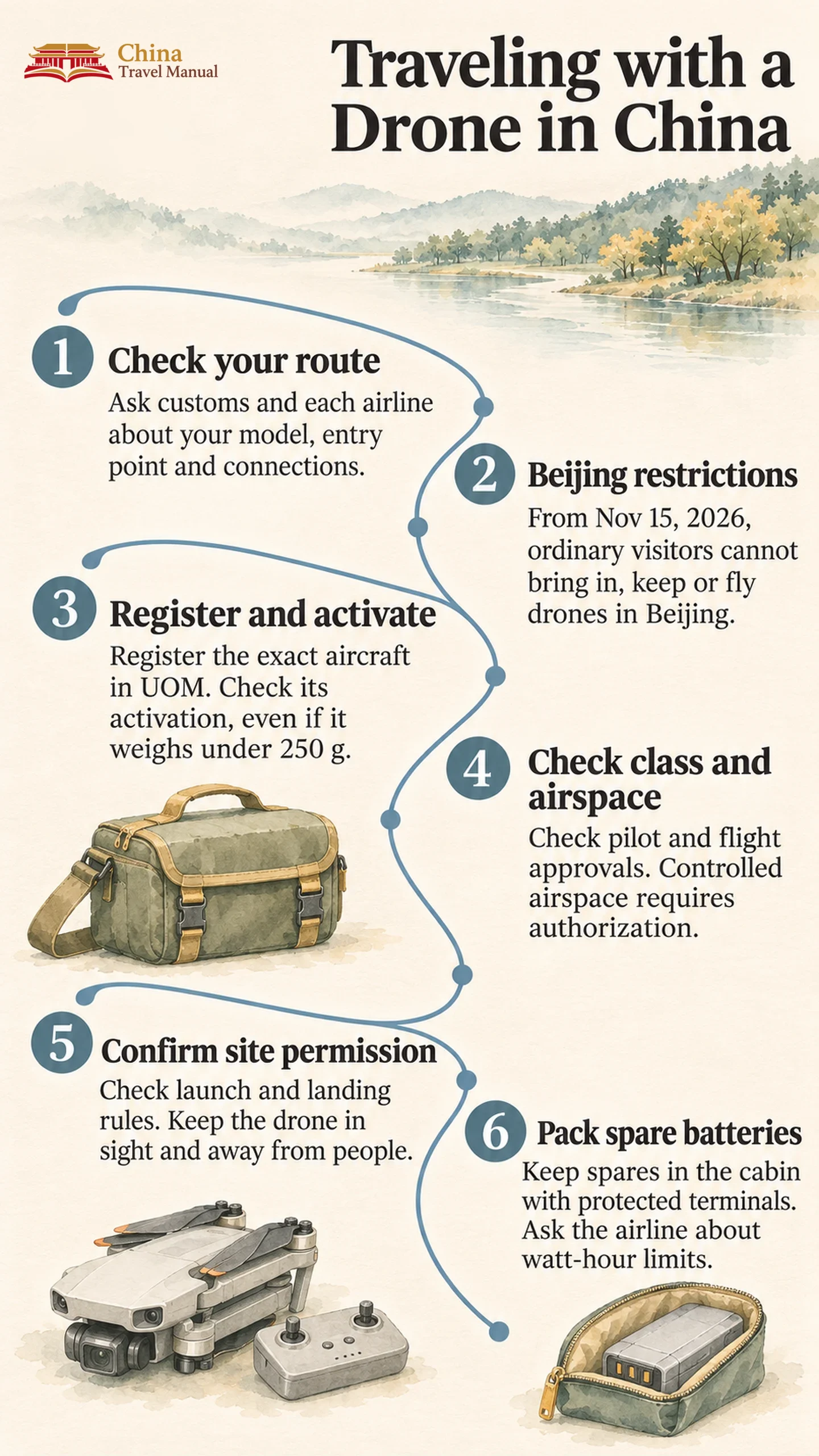
Check whether you can carry your drone on your route and whether you can fly it at the intended location. These decisions depend on different rules.
- Entry and transport: Check the model with your carrier and the relevant border authority before packing.
- Beijing: The revised rules effective November 15, 2026 prohibit ordinary visitors from bringing a drone into the municipality, keeping it there or flying it there.[2]
- Registration: Register a civilian camera drone in China’s UOM system and check its activation status. A weight under 250 grams does not itself provide an exemption.[3][4][5]
- Takeoff: Check the official airspace, any approvals needed for your drone and flight, and the venue’s own permission.
- Batteries: Pack spare lithium batteries in your cabin bag with their terminals protected.[7]
If you cannot confirm the rules for bringing a drone on your route, leave it at home.
Decide whether to pack the drone before leaving for China. Getting it through airline check-in is one step. Local possession rules, aircraft registration and permission for a specific flight each require their own check. This guide covers recreational camera drones and mainland China rules checked on November 18, 2026.
Check Entry Rules Before You Pack
Verify entry with the relevant customs office and carriage with the airline operating each leg. China regulates drone imports, possession and use.[1] Share the drone’s model name, where you bought it, whether the trip includes an onward domestic leg, and which airport or border crossing you will use. Ask whether you need to declare it, carry supporting documentation or leave any components at home.
If you’ll change flights, include the transfer point in the checks. A self-transfer that involves collecting and rechecking a bag can raise different questions from a through connection. The China airports guide helps you work out the route and where those transfers happen. Carry the drone only after confirming that it is allowed at the entry point, in transit and at your destination.
Beijing’s Rules on Bringing, Keeping and Flying a Drone
A revised municipal regulation took effect on November 15, 2026. It designates all of Beijing municipality as controlled drone airspace and prohibits ordinary flight, possession and storage. It also prohibits carrying or transporting drones and listed core components into the municipality. Limited special provisions cover specified purposes, such as rescue or research, following a security assessment. An ordinary sightseeing trip falls outside those provisions.[2]
If Beijing is on your itinerary, leave the drone and its core components at home for that trip. For an itinerary involving a connection through Beijing Capital Airport or Beijing Daxing Airport, confirm the treatment of your specific transfer with the airline and airport authorities before carrying any equipment. The regulation covers entry into the municipality. Avoid relying on older guidance that describes exceptions for already registered and verified drones.
Register the Drone and Confirm Activation
China uses the Civil Unmanned Aircraft Integrated Management Platform, known as UOM, for civilian drone registration. The current procedures include foreign citizens among the owners who must apply. Prepare the owner’s name and identity document number, phone, email and mailing address, plus the manufacturer, model, serial number or product identifier and intended use. Complete the real-name registration for the exact aircraft and follow current instructions for its registration mark and QR code.[3][4]
Check that UOM accepts your identity document and contact details and recognizes the exact variant of your model, especially when you bought it abroad. If the platform can’t match it or you cannot complete verification, contact the manufacturer and the aviation authority. Confirm that the status is valid before planning a flight.
Registration and activation have separate roles. The registration links the drone to its owner. Under the activation standard, the drone can fly once the required system verifies its registration and activates it. It applies to newly manufactured civilian drones from May 1, 2026, with a 12-month transition for aircraft already sold and in use before that date. The transition concerns the technical standard. Check how your manufacturer handles verification and activation for your model, and complete the existing registration requirement regardless.[4][5]
Check the Drone Class, Airspace and Flight Authorization
Start with the official classification of the model. A micro drone under national rules must meet several criteria, including an empty weight below 250 grams, a maximum true flight height of 50 meters, a maximum level speed of 40 km/h, and additional radio and control conditions. The model’s advertised weight alone can’t establish its class. National rules exempt micro and light drones from a pilot licence while imposing licensing requirements for small, medium and large civilian drones, with specific exceptions for some operations.[6]
Use UOM to check the applicable airspace for the proposed location, height and time. National rules designate controlled airspace around airports and other specified sites and at or above 120 meters true height. True height is measured from the terrain immediately below, which matters on hillsides. Controlled airspace can begin much lower than 120 meters. Check published notices and UOM even if the drone’s app shows an available flight area.[3][6]
Micro, light and small drones operating in suitable airspace can generally fly without an individual application, subject to the activity and current restrictions. Flying in controlled airspace requires authorization from air traffic management. Even in otherwise suitable airspace, activities such as flying over a gathering require an application. Check for temporary controls on the day and stay on the ground unless you can verify that the required approvals are in place.[6]
Get Permission at the Takeoff Site
Ask the manager of a park, hotel, attraction or private site whether you may launch and land from that spot. Plan for a clear landing spot and keep the drone in sight and away from people. If the park or viewing area fills up, abandon the takeoff. Leave it packed if you cannot confirm permission or maintain safe separation.[6]
Camera permission also depends on what you film. Avoid filming into private areas or deliberately targeting people without permission. Use the photography rules guide for those checks and responsible travel advice for alternatives at sensitive sites.
Pack Drone Batteries for Your Flight
Read the watt-hour rating on each removable battery and pack batteries separately in cabin baggage with the terminals protected against short circuits. Ask the operating carrier whether the aircraft body may travel in checked baggage after the batteries are removed. If a cabin bag is gate-checked, take the spare packs out and keep them in the cabin.[7]
Lithium-ion batteries up to 100 Wh are generally accepted in cabin baggage within carrier limits. For batteries over 100 Wh and up to 160 Wh, check with the carrier in advance for approval. Batteries over 160 Wh are generally excluded from passenger baggage. Carrying an allowed battery still depends on its condition, the number of packs and the carrier’s rules. See the guide to airline baggage in China for related packing decisions.[7]
FAQs About Traveling with a Drone in China
Do tourists need to register a sub-250-gram drone?
Yes, for a civilian camera drone you plan to fly outdoors. The owner must complete real-name registration. Weight is one factor in the drone class and does not remove that requirement.[3][4][6]
Does my foreign drone registration count in China?
Complete China’s real-name registration before flying a civilian camera drone there. Have the exact model and serial number available and check whether the manufacturer supports the required activation for that variant.[3][4][5]
Can I fly if my drone app lets me take off?
Check UOM and the current rules for the location, drone class and planned activity. The app can help operate the aircraft. You still need any required airspace authorization, and you must follow local takeoff and landing rules.[3][6]
Sources
[1] UK Foreign, Commonwealth & Development Office. China Travel Advice: Safety and Security
[2] Standing Committee of the Beijing Municipal People’s Congress. Beijing Regulations on the Administration of Unmanned Aircraft (Chinese)
[3] Civil Aviation Administration of China. Notice on Civil Unmanned Aircraft Regulatory Services (Chinese)
[4] Civil Aviation Administration of China. Civil Aircraft and Civil Unmanned Aircraft Registration Procedures (Chinese)
[5] Civil Aviation Administration of China. Explanation of the Real-Name Registration and Activation Standard (Chinese)
[6] State Council and Central Military Commission. Interim Regulations on the Administration of Unmanned Aircraft Flights (Chinese)
[7] International Air Transport Association. Safe Travel with Lithium Batteries





