
Quick Answer: Where Should You Go for Desert Travel in China?
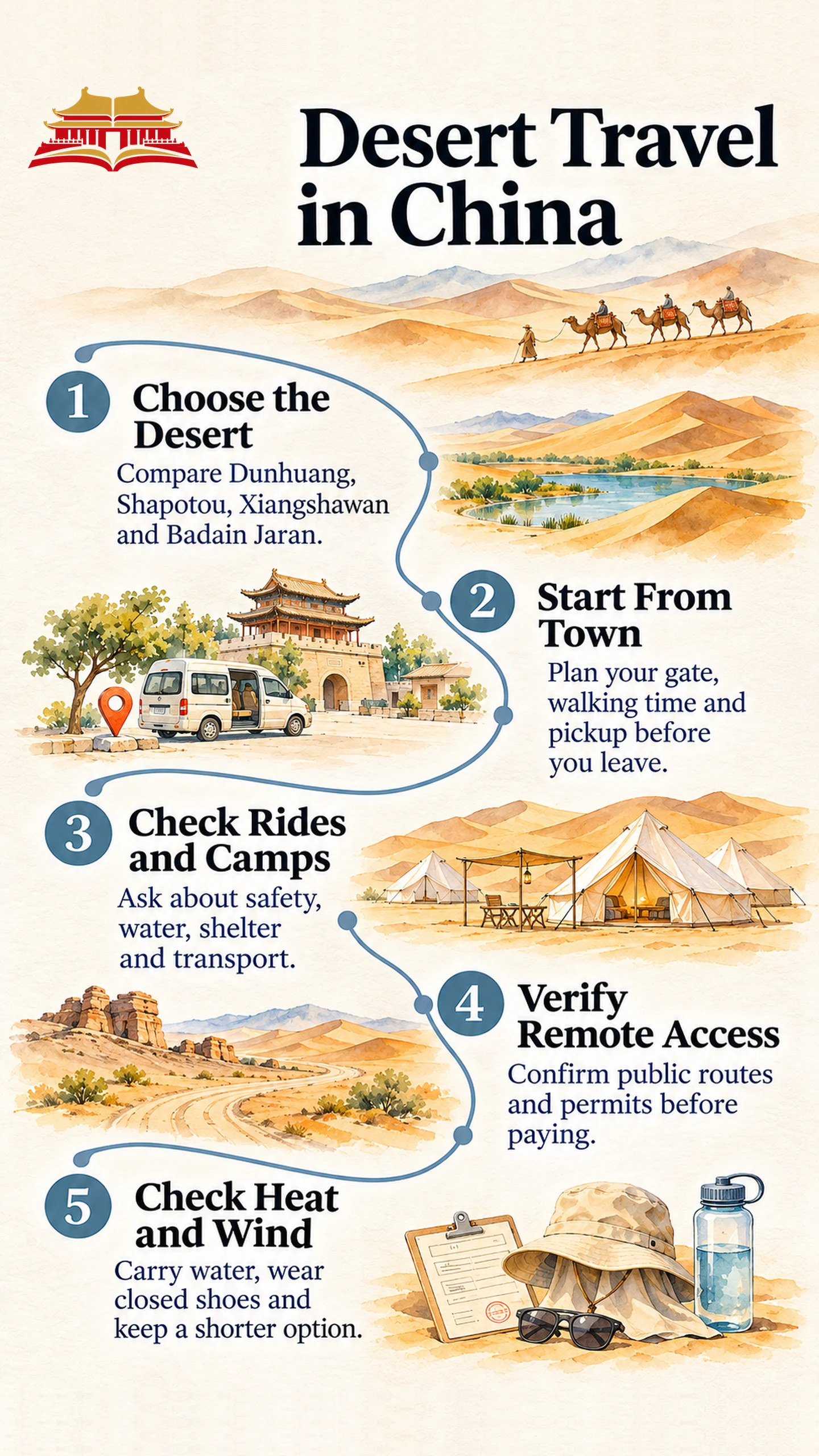
For a first desert visit, choose a managed scenic area with a dependable return to town. Consider a camp or a remote route if you have more time and can confirm the operating arrangements.
- Easy dunes from town: Visit Mingsha Mountain and Crescent Lake in Dunhuang.
- Dunes and river in the same outing: Use Zhongwei as your base for Shapotou.
- Organized activities: Look at Xiangshawan on the eastern edge of the Kubuqi Desert.
- Remote scenery: Research Badain Jaran’s public routes and access before committing to a multi-day trip.
Check heat, wind and the last pickup for the exact place you choose. Keep a shorter outing available if conditions change.
Start with the amount of time you want to spend on the sand. In Dunhuang, you can visit dunes from town and return the same evening. Around Zhongwei, you can combine the Yellow River and dune scenery. Farther into the desert, a trip depends on approved access, a driver and a way back if plans change. If the landscape is the main reason you’re going, give yourself enough time to walk or watch the changing light without filling the visit with activities.
Compare Four Desert Experiences
Choose the location by what you would be happy to do in the time available. A dune field with a marked route is already enough for a first look at the desert if you want to walk, pause and take photographs.
| Where to go | What you can see | What to plan |
|---|---|---|
| Mingsha Mountain and Crescent Lake, Gansu | A dune landscape and a spring near Dunhuang. [1] | Plan a half-day from town. Give yourself time to reach the entrance, walk and meet your return ride. |
| Shapotou, Ningxia | Dunes on the edge of the Tengger Desert and the Yellow River in the same scenic area. [2] | Decide which side of the visit matters most and check how to move between the main areas before buying activities. |
| Xiangshawan, Inner Mongolia | A managed visitor area at the east end of the Kubuqi Desert, with organized recreation. [3] | Choose the part you want to visit and confirm the exact gate and transfers from your hotel or station. |
| Badain Jaran Desert, Inner Mongolia | Very large dunes and lakes between them, in a World Heritage landscape. [4] | Treat this as a separate trip. Confirm the current public route, pickup, guide and exact permitted areas with the local visitor authority and your operator before paying. |
Use the attraction name and its gate when you make a reservation. Check which areas, shuttles or activities the Shapotou ticket covers. If you’re interested in another part of the Tengger Desert, check where that trip starts and ends separately.
Build a Short Dune Visit From a Town Base
For a Dunhuang visit, start with a room in town and a short outing to Mingsha Mountain. The official attraction is south of the city. [1] If you are visiting the Mogao Caves on the same stay, arrange the caves visit around your confirmed slot and leave the dune visit easier to move. Check Dunhuang local transport and save the pickup point before walking up into the sand.
If you want lower light for photos, check when the park stops admitting visitors and which exit will be open. A driver who drops you at the gate may pick you up somewhere different. Ask for the Chinese name of the pickup point, and allow enough time to walk back down to the gate and find the pickup. If you have two free periods in town, hold the less important one as a second chance if strong wind affects your first choice.
Near Zhongwei, compare a town stay with a room closer to Shapotou. Town can work well if you want a dinner out and a known ride back. Check the Yinchuan to Zhongwei route if you’re coming through Ningxia. If your trip continues to Dunhuang or another Gansu base, check how a desert day fits into the China Silk Road itinerary before creating a second long transfer.
For a day from Ordos, confirm which part of the city you will stay in and whether your driver will wait near the gate. A map showing the dunes close to the region’s main road tells you little about getting a ride back. Agree on the meeting point before you set off, especially if you plan to leave around closing.
Decide Whether to Book a Ride or Camp
Pick one main activity that matches what you want to do. A low viewpoint and a walk are enough to see the scale of the dunes. For a camel ride, ask how long the route is, what breaks the animals get and whether the operator will explain how to mount safely. For a vehicle ride, check where it goes, its duration and safety equipment, and whether you can step away from the activity if it feels too rough. The Dunhuang desert experiences guide compares what you can do within a shorter outing.
A camp may suit you if you want to stay for evening and early morning light. Get the basics in writing before choosing a camp.
- Location and permission: Ask for the exact camp name and location, and confirm that overnight stays are allowed there.
- Pickup and departure: Find out which vehicle can reach the camp, when it leaves and who can help if the ride is delayed.
- Water and shelter: Ask about drinking water, washrooms, food, bedding and shelter if wind picks up.
- Changes and communication: Confirm how the operator contacts you, where the group can wait and what happens if travel into the dunes is suspended.
For a route beyond a managed visitor area, confirm public access and any local permits or restrictions. Ask where your guide will take you, who can communicate if there is no mobile signal and how the operator handles an early return. The protected World Heritage area at Badain Jaran has boundaries and a buffer zone. [4] Use local visitor and access information for your specific route.
Plan Around Heat, Wind and the Way Back
Sand can heat up while the air still feels manageable. Strong winds can erase footprints quickly, and exposure increases away from paths and shelter. General dune safety guidance recommends earlier or later walks in hot months, closed-toe footwear and avoiding the dunes when storms or strong winds threaten. [5][6] Use the Dunhuang season guide for its local patterns, and look up the separate local conditions if you are going to Ningxia or Inner Mongolia.
Check local weather alerts on the day. Drink water, carry enough for the walk and return, bring sun protection and an extra layer, and keep the gate and pickup address available offline. If visibility goes down, follow the site’s instructions and use the marked route or a staffed return point. Choose a lower walk or stay in town if wind makes your original route hard to follow.
Leave yourself the option to shorten the visit. For example, if a day in Dunhuang includes a long stop in the morning, you can use a shorter dune walk later and skip the extra activity. For a remote outing, ask who makes the decision to turn back and confirm coverage for organized activities before traveling.
FAQs About Desert Travel in China
Where is the easiest place to see dunes on a Silk Road trip?
Dunhuang is a practical choice. You can stay in town, plan separate time for the Mogao Caves and add Mingsha Mountain for a short outing to the dunes and spring.
Can I visit dunes without a camel ride or vehicle activity?
Yes, where the scenic area has public walking areas. Check where the approved path starts and which viewpoints are reachable on foot. Plan around the daylight and the time you need to walk back.
Can I camp on my own in a desert in China?
Check the rules for the exact site. Use an authorized campsite or an organized stay with a confirmed location and return. An informal track or a social media post is not evidence that overnight use is permitted.
What should I bring for a short dune walk?
Carry water, sun protection, closed-toe shoes, an extra layer and a charged phone. Keep the return route and a meeting point offline. Shorten or postpone the walk if heat, wind or low visibility make it unsuitable. [5][6]
Sources
[1] Ministry of Culture and Tourism. Mingsha Mountain and Crescent Spring Scenic Area
[2] Ministry of Culture and Tourism. Zhongwei Shapotou Tourist Scenic Area
[3] People’s Government of Ordos Municipality. Visitors at Xiangshawan Scenic Area
[4] UNESCO World Heritage Centre. Badain Jaran Desert – Towers of Sand and Lakes
[5] U.S. National Park Service. Safety at Great Sand Dunes National Park and Preserve
[6] U.S. National Park Service. Hiking Safety Tips at White Sands National Park





