
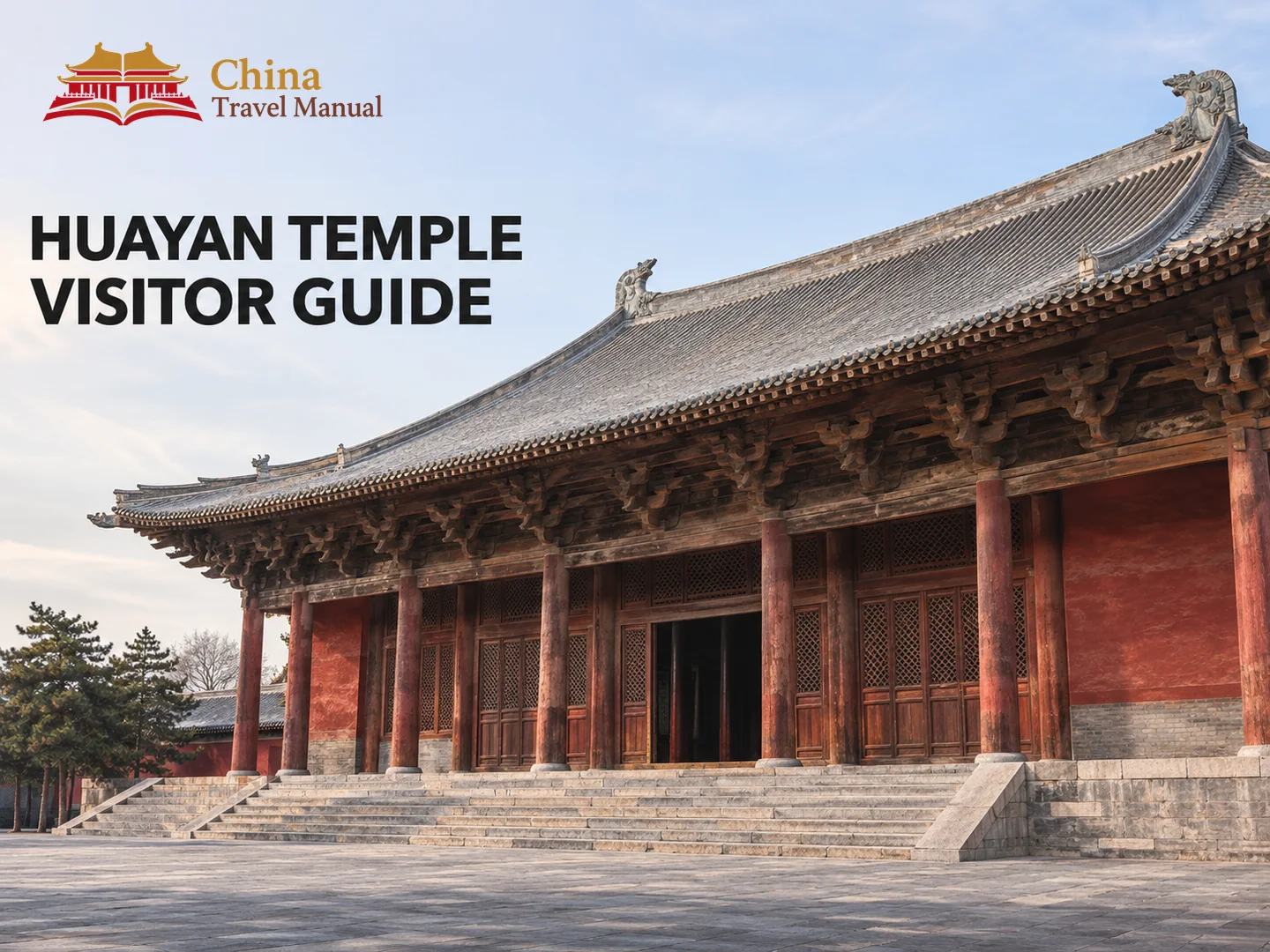
Quick Answer: What Should You See at Huayan Temple?
Allow about ninety minutes for both historic halls and the courtyards between them. Choose the two halls first and add the pagoda area if it is open and you have more time.[1][2][3]
- Upper temple: Stand across the forecourt to take in the scale of the Jin-era rebuilding.[1]
- Lower temple: Look for the smiling bodhisattva with clasped hands among the surviving Liao figures.[2]
- Location: The compound is in the southwest of Datong’s walled old city and pairs well with nearby sights.[1][2]
If you arrive in the late afternoon, ask when the individual halls stop admitting people before choosing the order.

Huayan Temple (华严寺, Huáyán Sì) in Datong’s old city preserves two outstanding Buddhist halls from the Liao and Jin eras. The Great Buddha Hall (大雄宝殿, Dàxióng Bǎodiàn) shows what builders could do with a broad timber span. The smaller Bhagavan Hall (薄伽教藏殿, Bóqié Jiàozàng Diàn) rewards a slower look at individual figures.[1][2]
Compare the Two Main Halls
| Hall | Why it matters | Where to look first |
|---|---|---|
| Great Buddha Hall | The principal upper-temple hall was rebuilt in 1140 in the Jin period.[1] | Start on the forecourt to see the full roof and raised platform. Then look at how the columns divide the frontage. |
| Bhagavan Hall | The lower temple preserves an early hall dated to 1038 and a group of 29 Liao sculptures.[1][2] | Look from the permitted viewing area at the figures and their relationship to the room. Give your eyes time to adjust. |
The smaller hall’s surviving figures are easy to read as a group if you take in the whole scene first. Then look for how the hands, clothing and direction of the gaze vary from one figure to another. Find the figure with clasped hands, then compare its upright pose with the figures nearby. The district profile also describes scripture cabinets set along the walls.[1][2]
Look for a change in what the building asks you to notice. In the broad hall, the bays and roof emphasize how the building frames the worship space. In the smaller hall, figures, cabinet façades and the line of the walls are easier to study together. The two interiors are also useful on a return from Yungang. There the sculptors worked around rock, whereas here the figures sit in spaces made by timber builders.[1][2]
How to See Both Temple Courts
- Get your bearings at the entrance. Find the two historic halls on the visitor map and ask if either has restricted entry. The upper and lower temple areas follow distinct axes.[1][3]
- Give the main hall a long view. Walk far enough back to see the roof, platform and frontage together. Notice that the temple faces east. The district history associates this orientation with Liao-period Khitan practice.[1]
- Leave quiet time for the smaller hall. Look for sculpture and cabinet work from the public side and follow photo signs. If you also want to see the pagoda, check the separate arrangements and leave enough time to return to the exit.[1][3]
Huayan had a connection to the Liao ruling house. It later developed into distinguishable upper and lower precincts with their own layouts. As you move between them, compare the space in front of the two halls. The difference in scale is visible even when interior viewing is limited.[1][2]
Tickets, Opening Hours and the Old-City Route
Datong announced a CNY 50 adult peak-season rate from April 2026. The city’s preceding winter notice listed CNY 40 and 08:30–17:00, and recent local reporting describes the same rates for the following November-to-March season. Check the latest prices, last entry and booking requirements for your date. If buying online, choose a channel that accepts the document you plan to carry.[4][5][6]
Approach from central Datong along Qingyuan Street and follow the signed visitor entrance for the open route. Use the earlier part of the day for Huayan and the Nine-Dragon Wall if you want to see both ticketed sites, or continue south towards Shanhua Temple and the Datong City Wall for a rampart walk. The things to do in Datong guide puts these stops into a longer visit.
Keep the pagoda flexible because one closed upper area can change what you can see. If you have time for one more stop, Shanhua offers another temple compound and the Nine-Dragon Wall is a shorter look at glazed relief.
FAQs About Huayan Temple
How much time do I need at Huayan Temple?
Allow about ninety minutes for the two main halls. Give it up to two hours if you also want to see the pagoda area or spend longer with the sculpture and timber details.
Is Huayan Temple close to the Datong City Wall?
Yes. It is inside the walled part of Datong. After the visit, continue on foot to an operating wall entrance and confirm your preferred rampart exit before going up.[2]
Can I see Huayan Temple and Yungang Grottoes on the same day?
Yes. Reserve a morning at the Yungang Grottoes and leave travel time back to the old city. Reach Huayan well before the last admission if you want to view both halls.
Sources
[1] Pingcheng District Government. Huayan Temple architecture and history
[2] Datong Foreign Affairs Office. Huayan Temple visitor profile
[3] Shanxi Culture and Travel. Huayan Temple compound
[4] Datong Municipal Government. Spring and summer attraction admission rates
[5] Datong Municipal Government. Huayan Temple off-season notice
[6] Datong Heping International Travel Service. Datong autumn and winter attraction rates





