

Quick Answer: How Should You Visit the Datong City Wall?
Start at the south side if it fits your old-city route. Check that you can go up at the gate you choose and come down where you intend. Datong reported zone-wide free access in summer 2026, but current opening and entry arrangements can change.[1][3][4]
- Short walk: Allow about an hour for a gate, stairs and a stretch of rampart with stops.
- Full circuit: Budget roughly 7.24 km before counting the approach, exits or side streets.[1]
- Evening: Confirm the last ascent and descent at your chosen entrance before timing the visit for sunset.
A street-level walk near the gate towers still gives you a view of the walls if the rampart is closed.
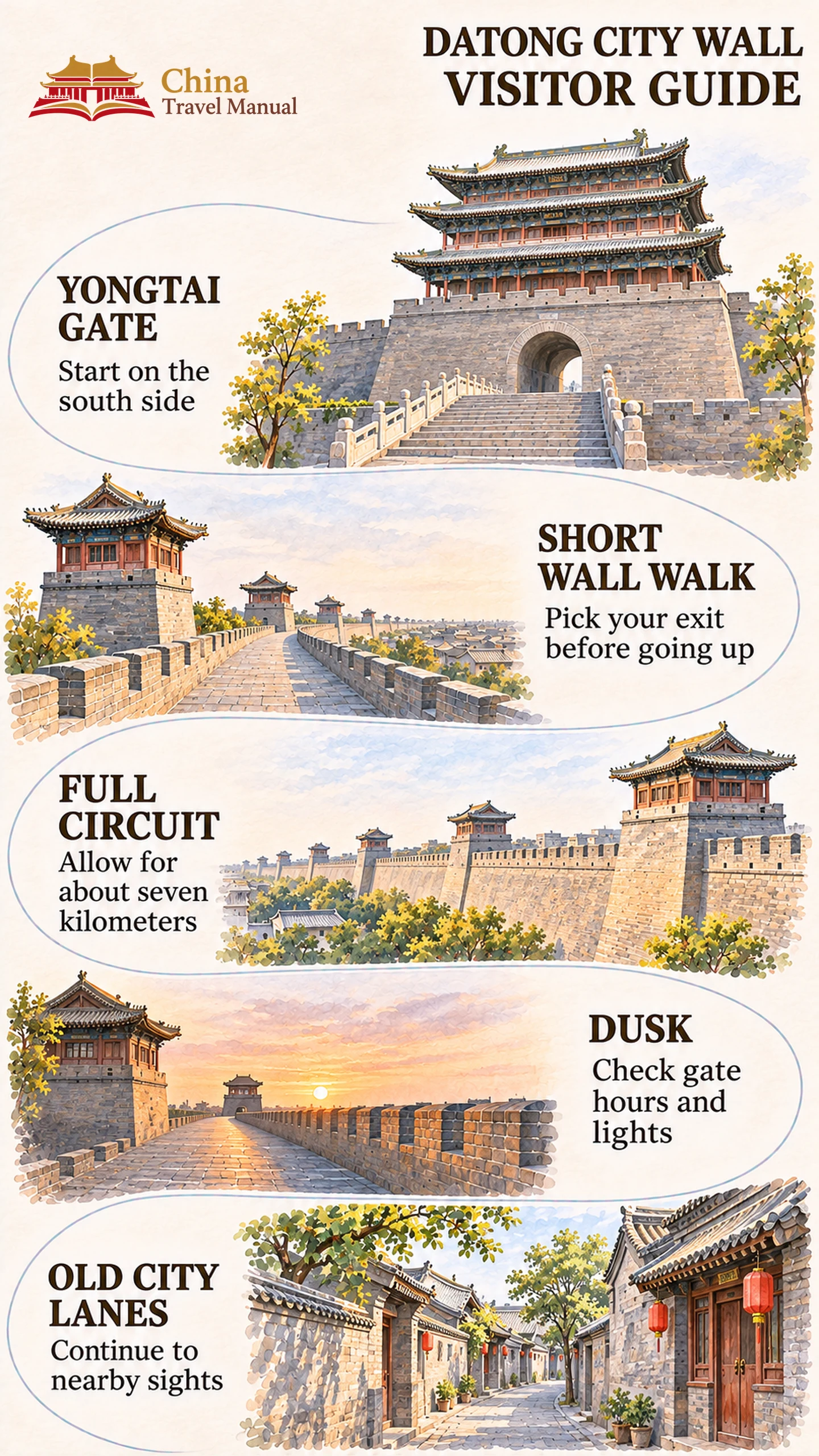
The Datong City Wall (大同古城墙, Dàtóng Gǔchéngqiáng) surrounds the old city in a roughly square circuit of about 7.24 km. The scale and outline reflect a Ming-era fortification. Much of what visitors walk on and see above street level was restored or rebuilt in the modern period. Pick a gate and a stretch of wall to see how the towers and streets fit together.[1][2]
Which Datong City Wall Gate Should You Use?
The four main gates correspond to the old city’s four main streets. Yongtai Gate (永泰门, Yǒngtài Mén) is on the south, Heyang Gate on the east, Qingyuan Gate on the west and Wuding Gate on the north. The streets converge at Sipailou near the center. A gate tower’s name points you to the right side of the wall. Find the signed ascent near that gate, and ask which stairs are still open for the descent when you expect to return.[1][2][4]
| Gate or side | Why choose it | Walking plan |
|---|---|---|
| Yongtai Gate, south | Works well with the southern old-city lanes and Shanhua Temple. | Ascend at an open entrance, walk toward one corner, then descend at an open exit or return the same way. |
| Heyang Gate, east | A useful approach for sights near Heyang Street. | Start with the part of the rampart near the gate and allow time to return to the street. |
| Qingyuan or Wuding, west or north | Useful if you are already approaching from one of those sides or want different views. | Check both ascent and descent before building a longer walk around two gates. |
Short Walk, Full Circuit or Cycling
For a short visit, reach the rampart, walk to an open tower or viewpoint and turn back while you still have time to see the ground-level gate. Look inward for the grid of old-city lanes, then outward toward roads that trace the wall. On the east side, Datong’s planning records describe work on the moat, drawbridge and outer gate enclosures. The approach from below helps show how these defenses fit together.[1][2][5]
For a full walk, plan on at least two hours at a steady pace and add time for stairs and photos. Where rentals or local electric sightseeing vehicles are running, ask which stretches they serve, where you return the rental and when service ends. Choose an out-and-back stretch if rentals are closed or staff confirms you cannot make a full circuit.[4][6]
The city gives the wall a height of about 14 meters and a top width of about 12 meters. Even on a brief walk, look for the difference between the broad patrol surface above and the layers of enclosure around a main gate below. Near a tower you can follow how the entrance was screened from the straight approach across the moat.[1][5]
Admission, Evening Access and What Is Historic
Datong’s July 2026 city report described the wall as freely open across its area. June coverage likewise reported the shift to free admission; evening programs and operating hours have changed over time. Look up the current wall notice and confirm the rampart cutoff. Tickets for any special event or transport service have their own terms. The June report listed 07:00–22:00, while subsequent travel listings describe seasonal variation. Use those times as background and check your particular entrance for the current cutoff. For a family that prefers to avoid stairs, walk at street level around Yongtai Gate first, then decide whether the ascent is worthwhile.[3][4][6]
The Ming general Xu Da enlarged the defenses in 1372 on an older city footprint. The city’s planning and visitor records document the modern restoration and reconstruction of rampart brickwork, gates and towers. The route is a chance to see the Ming enclosure’s scale and shape, with the history of individual built elements varying by location.[1][2][5]
FAQs About the Datong City Wall
How long does it take to walk around the whole wall?
The complete outline is about 7.24 km. Allow at least two hours to walk it, with extra time for photos, stairs and checking which stretches are open.[1]
Is the Datong City Wall free at night?
Datong reported free access across the wall area in summer 2026. Confirm current evening hours at the specific gate and whether you are entering a separately operated event.[3][4]
What can I see near the wall?
The Huayan Temple guide covers the historic halls inside the city. Combine the temple, south-side lanes and a short rampart walk using the things to do in Datong guide for a fuller plan.
Sources
[1] Datong Municipal Government. Datong Ancient City and wall dimensions
[2] Datong Foreign Affairs Office. Datong City Wall history and restoration
[3] Datong Municipal Government. Datong summer visitor operations
[4] Lailvxing. Wall access arrangements introduced in June
[5] Datong Municipal Government. Datong Ancient City commercial and heritage plan
[6] Dahuanxian Travel. Datong wall walking, riding and seasonal access





