
Quick Answer: How Should You Take the Train to Tibet?
Xining is a practical gateway for the plateau section to Lhasa. Compare departures of about 20 to 22 hours, reserve a sleeper if available, and confirm the permit and boarding check with your Tibet tour operator.[1][2][3]
- Pick a berth you can use comfortably: A hard sleeper usually has six bunks in an open bay. A soft sleeper typically has four bunks in a compartment.[2][4]
- Check the actual timetable: A daytime departure does not put every scenic stretch in daylight. Look at the hours after Golmud as well as your departure and arrival.[2][5]
- Know what to show: Use your passport details for the railway ticket. Ask your agency where you will receive your permit and what the departure station checks.[1][3][6]
Give yourself an easy day after arrival. The railway crosses very high terrain and altitude illness remains possible even aboard an oxygen-equipped car.[2][7][8]
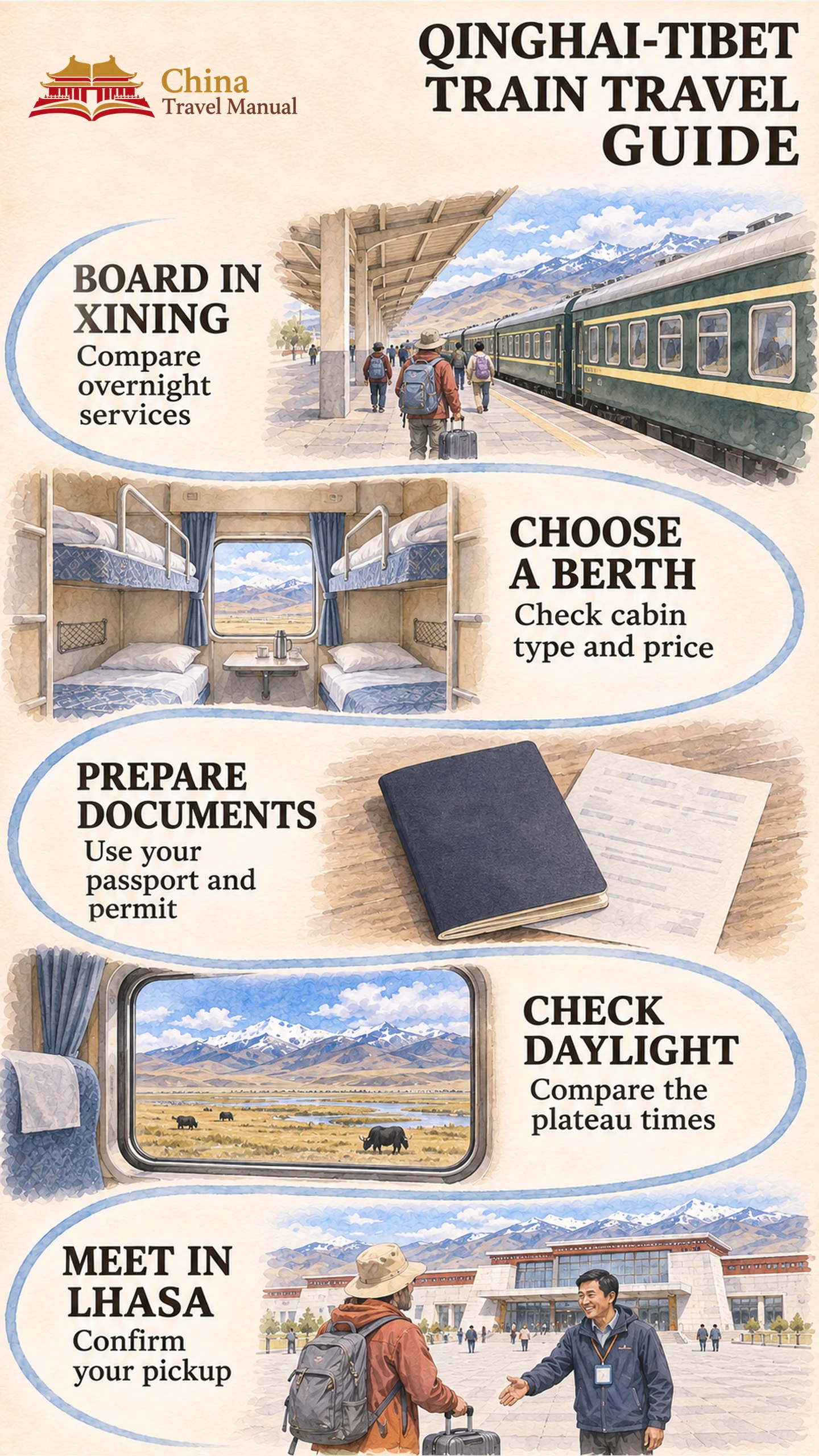
The Qinghai-Tibet train is an overnight journey across a high plateau. Decide where you want to join, then choose a berth and check which sections will fall in daylight. The ticket and the Tibet travel permit are separate parts of the trip. Sort out both before you reach the station.[1][2][3]
Choose Where to Board
| Boarding choice | Why choose it | Time and transfer tradeoff |
|---|---|---|
| Xining | A practical gateway for the high plateau section. | About 20 to 22 hours in current route examples. Leave time for permit delivery if you are connecting.[2][5] |
| A through train from farther east | Useful if your trip starts along a direct service and you prefer to stay aboard. | A through service from Beijing can take around 40 hours. Check how many nights are onboard.[2][4] |
| Lhasa to Xining | A way to ride the railway after spending time in Tibet. | Different daylight hours and arrival logistics. Compare the exact direction and date.[2][5] |
Read the Xining to Lhasa route guide when choosing a connection. If you need a buffer before boarding, look at the Xining travel guide for a place to stay. Check whether an inbound flight uses the same local travel day as your rail departure.
Hard Sleeper, Soft Sleeper or Seat?
A hard sleeper is usually the practical middle option. Expect six stacked berths in an open bay, with more people and less privacy. A lower berth takes less climbing and can be helpful on a long ride. Ask the booking channel whether a lower berth is selectable for your service.[2][4]
A typical soft sleeper has four berths behind a compartment door. The per-person price buys an individual berth and the compartment may be shared. In a published Xining–Lhasa example updated in October 2026, the hard sleeper cost about CNY 520 and the soft sleeper about CNY 810 before any agency charges. Check 12306 for the actual class and fare on your train.[2][6]
A seat can cost less, but it means spending the night upright. Pack a warm layer, a charged power bank for a long journey, food you can eat on board and the documents you may need at the station. Choose a compact day bag with anything you want to reach without opening your main luggage.
Oxygen, Altitude and a Night on Board
Across the plateau the railway rises above 5,000 m. Services use oxygen-equipped cars, with details that can depend on the train. Ask the crew where the supply is available and tell them if you feel ill. Plan for physical effort and changes in altitude using the Tibet altitude planning guide before choosing an onward hike or lake trip.[2][7][8]
Sleep and eat when you can. Pack water and a few snacks and ask the operator what food service the train has. Keep your first arrival block for pickup, check-in and rest. The Lhasa station guide helps you plan where to meet your guide.
How to Book and Board the Qinghai-Tibet Train
- Agree on your Tibet tour dates. Let your operator confirm the itinerary, permit arrangements and whether it can support your chosen departure.[1][3]
- Check a real train. Search China Railway 12306 for the exact date, boarding station, time, berth type and fare. Check the following day’s date for the arrival.[5][6][9]
- Match your name and documents. Use the passport details on the rail ticket and confirm the original permit handoff with your operator before going to the station.[3][6]
- Prepare your departure and arrival. Keep your passport and the required permit accessible for checks. Send your guide the service number and expected arrival time.[1][3][6]
FAQs About the Qinghai-Tibet Train
Which parts of the route can I see in daylight?
Compare the hours after Golmud and near Nagqu with local daylight on your date. Going in the other direction changes the viewing hours. Weather and the season can change what you see from the window.[2][4][5]
Does a rail booking include the Tibet travel permit?
Your ticket is a rail reservation. Coordinate the Tibet travel permit with your specialist agency and confirm how to show it on departure.[1][3][6]
Is it worth taking the train out of Lhasa?
It can suit travelers who want the plateau rail experience after their Tibet stay. Compare daylight and hotel timing with the inbound option. The guide to getting to Tibet can help you decide which leg to fly.[2][5]
Sources
[1] UK Foreign, Commonwealth & Development Office. Regional Tibet travel entry guidance
[2] Rail Addict. Qinghai-Tibet Railway route, berth and fare guide
[3] TravelChinaGuide. Tibet boarding and travel permit guidance
[4] Seat61. Passenger rail in China and the Qinghai-Tibet Railway
[5] TravelChinaGuide. Xining–Lhasa durations and example train times
[6] China Railway 12306. English ticket and passport FAQ
[7] Tibet Autonomous Region Department of Culture and Tourism. Example oxygen-equipped rail service
[8] US Centers for Disease Control and Prevention. High-altitude travel and altitude illness
[9] Tibet Autonomous Region Department of Culture and Tourism. Xining and Lhasa service notice and ticket lookup





