

Quick Answer: What Should You Book First for a China Trip?
Check entry eligibility and decide your travel dates and city order before making expensive, nonrefundable bookings. Then secure workable international flights and important hotels, prepare domestic transport, and purchase train and attraction tickets when their official sales windows open.
- First: Confirm your passport, visa or qualifying visa-free route, entry and exit cities, and major holiday dates.
- Early commitments: Choose international flights with acceptable change terms; reserve cancellable hotels for nights that matter.
- Plan now, purchase later: Map out train legs and complete passport verification; most train tickets only go on sale 15 days ahead.
- Time-sensitive attractions: Note each site’s release date and local time; the Forbidden City’s standard sale opens seven days ahead at 8 p.m. Beijing time.
- Keep flexible: Leave ordinary meals, walks and weather-sensitive optional activities until your fixed bookings are secure.
Priority does not mean availability. A train or museum visit may be crucial to your trip even though you cannot buy its ticket several months in advance.
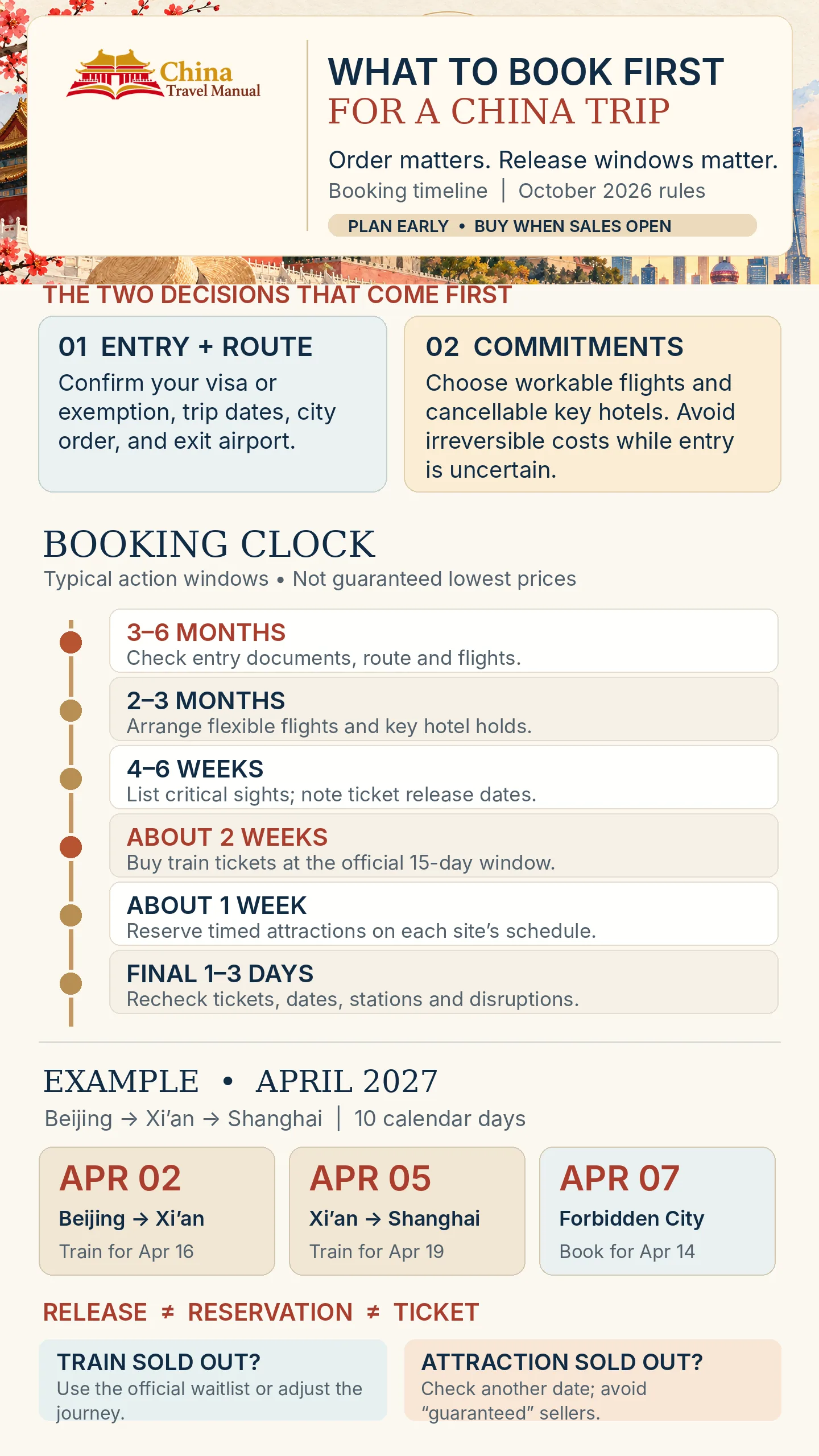
Planning a China trip involves three different clocks: when you research an option, when a provider accepts a reservation, and when a confirmed ticket can actually be issued. Confusing them causes unnecessary spending and missed releases. This guide focuses on booking order and backup decisions; for the larger planning process, see how to plan a trip to China.
China Trip Booking Priorities at a Glance
Start with the decisions that affect everything else. Use the table to choose what deserves attention first, not as a universal payment schedule.
| Item | Priority | Start work | Confirm before paying |
|---|---|---|---|
| Entry eligibility | Essential prerequisite | As soon as you choose China | Passport validity, visa or valid exemption, permitted route |
| International flights | High | Once entry route and dates are workable | Arrival/departure cities; fare-change and refund conditions |
| Key hotels | High when supply is tight | After nights and city order are known | Location, booking status, free-cancellation cutoff |
| Intercity trains | High, but sales open later | Plan months ahead; buy within the release window | Exact station, travel date, passport details, alternatives |
| Major attractions | High only if date-critical | Research admission and release rules early | Closure days, passport requirements, release time |
| Paid experiences | Variable | After essential dates stabilize | Operator, weather risk, refund terms, language support |
| Arrival transfers | Situation-dependent | Check before departure | Arrival hour, luggage, accessible transport options |
The biggest trap is treating every row as something to purchase immediately. A cancellable room can hold a useful location while you wait for train sales; an unrefundable tour cannot provide the same protection. For the full list of pre-departure checks rather than their relative order, use the China travel checklist.
Before Booking Anything: Confirm Entry Rules, Dates, and Your Route
Check Your Entry Eligibility Before Non-Refundable Purchases
For most American tourists, a Chinese L visa is the normal route, although a qualifying visa-free transit itinerary may be possible. Transit exemptions depend on the route to a third country or region, designated ports and other conditions—not merely the length of a holiday. Confirm your eligibility before locking flights whose routing cannot be changed.[1][2]
A persistent misconception says Americans must buy flights and hotels before applying for a Chinese tourist visa. The Chinese Embassy’s current U.S. application guidance says ordinary L-visa applicants in the United States generally do not need round-trip flight reservations, hotel bookings, an itinerary or an invitation letter; additional documents can be requested case by case.[1] Research the China tourist visa requirements early, but do not spend money merely to manufacture booking evidence you may not need.
A visa approval is not an unconditional promise of admission: immigration officers still conduct entry checks. Until your entry route is viable, compare fares and reserve only arrangements whose cancellation exposure you understand. If a refundable ticket is too costly, weigh the actual financial risk of a cheaper restricted fare rather than assuming the lowest displayed price is the best choice.
Fix Your Travel Dates and City Order
Choose an arrival city, a departure city, nights in each base and approximate transfer days. An open-jaw itinerary—Beijing in, Shanghai out, for example—may avoid a long return trip; a round-trip ticket to Beijing might cost less but force you to return before your international departure. Compare the entire journey, not the headline airfare.
Check the China public holidays calendar before committing. In 2026, Labor Day runs May 1–5 and National Day October 1–7, but 2027 dates and observed arrangements should be checked when announced.[7] Once dates are decided, keep the underlying China itinerary stable enough that later train and hotel choices can fit it.
When to Book International Flights and Hotels
Book International Flights Once Your Entry Plan Is Workable
For a U.S.–China journey, begin monitoring international fares roughly three to six months before departure if you have that much lead time. That is a comparison window, not an official booking deadline or a guarantee of the lowest price. Buy when the route is legally workable, the fare is acceptable and the change conditions match your remaining uncertainty.
Check whether connecting flights are on one protected booking, where baggage must be collected, and which airport serves your first city. Do not attach a tight domestic flight or nonrefundable train transfer to the day your transpacific flight lands. Immigration, luggage and airport-to-station travel add uncertainty; even a three- or four-hour gap can be insufficient if your inbound flight is significantly delayed. Compare realistic travel times between China cities before paying for another leg.
Reserve Hotels Early Where Availability Matters
After setting your overnight stops, secure your first night and important city bases. In ordinary periods, beginning the hotel search one or two months ahead is a practical starting point; holiday weeks and rooms with accessibility or family requirements deserve earlier attention. A freely cancellable rate buys flexibility only until its exact cancellation deadline, which may be in the hotel’s local time zone.
You do not need a mythical “foreigner-approved hotel” category. China’s 2024 accommodation measures instruct booking platforms and operators not to impose unlawful foreign-guest restrictions based on purported reception qualifications.[3] Still, check that a property can process your passport, confirm the actual address and keep the reservation confirmation. The hotels for foreigners guide covers accommodation details.
A late-night arrival may justify a convenient first hotel near a workable transfer route; being as close as possible to the airport is not always the best choice if you will spend several nights in the city center. Avoid nonrefundable advance payment for later hotels until the transport connecting them is plausible.
When to Book China Train Tickets, Domestic Flights, and Transfers
Train Tickets: Plan Early, Buy When Sales Open
Most China railway tickets have a normal 15-day presale period including travel day, and China Railway may announce adjustments. Count back 14 calendar days from your travel date to identify the first normal sale date, then check the actual station’s release time on 12306.[4]
Finish the preparation earlier: register on 12306 and learn how to book train tickets, verify each foreign passport, distinguish similarly named stations and select alternate departures. The time shown on a route search is not necessarily the time its tickets go on sale.
One newer exception needs careful wording. As of October 27, 2026, a limited Beijing–Shanghai rail pilot accepts advance reservation requests from day 30 through day 17 before departure. It is not a nationwide 30-day ticket-sale window, and submitting a request is not a confirmed seat.[5] This pilot should not be assumed to cover a Beijing–Xi’an or Xi’an–Shanghai trip.
For busy travel dates, use the official 12306 waitlist where applicable, compare earlier and later trains, and consider an additional night or suitable flight rather than relying on third-party claims of guaranteed seats. Ticket changes and refunds depend on the railway’s actual rules; do not assume a failed purchase can be fixed without cost.
Domestic Flights and Airport Transfers
For a long transfer such as Chengdu to Ürümqi, investigate domestic flights well before the train window. Airlines sell tickets on different schedules, and fares, capacity and change restrictions vary. Once your main dates are secure, weigh the full airport-to-airport and city-transfer cost against a train-versus-flight comparison, not just hours in the air. See booking domestic flights in China for the purchase process.
A prearranged airport transfer is useful for midnight arrivals, heavy luggage or mobility needs. If your flight arrives during regular public-transport hours, it may be sufficient to save the route, the hotel’s Chinese address and a backup ride-hailing option rather than paying for a private car weeks ahead.
When to Reserve Major Attractions, Museums, and Paid Experiences
Check Each Attraction’s Actual Ticket Release Window
There is no universal “book every Chinese sight seven days in advance” rule. The Forbidden City is a useful specific example: its standard tickets open seven days before the visit at 8:00 p.m. China Standard Time (UTC+8), Monday is normally a closure day except for statutory holidays, and it does not sell same-day admission tickets. Passport holders can use their passports for verified booking and entry.[6]
If you have one Beijing day set aside for this museum, record the exact opening date and check that date is not a closure day. Use the Forbidden City ticket guide for the ticketing details, or review the broader China attraction tickets guide for other sites. Do not copy the Forbidden City’s window onto the Terracotta Army, panda bases or provincial museums; each operator can change its own release and admission rules.
Separate Must-Do Attractions from Flexible Experiences
Treat an attraction as a schedule anchor when missing that date would fundamentally change your reason for visiting a city. A museum with limited capacity, a one-night performance or a workshop with few sessions may deserve a calendar reminder well before the ticket can actually be purchased.
Ordinary park visits, food exploration and neighborhood walks usually need no advance commitment. Some museum reservations or private classes need extra lead time, but only the provider’s current rules can settle that. If an overseas card or telephone number causes trouble, investigate ticket booking without a Chinese phone number rather than buying an unverifiable “internal ticket.”
China Trip Booking Timeline: Three to Six Months Before Departure
Use the following as a working schedule, not a rigid series of purchase deadlines. Booking can move earlier for scarce accommodation or later for an easy, short trip.
| Time before departure | Main work | What this actually means |
|---|---|---|
| 3–6 months | Check passport and entry rules; choose dates and route; monitor international fares | Research and possible visa application, not an obligation to pay for everything |
| 2–3 months | Finalize viable international flights; hold cancellable key hotels; start special-permit inquiries | Conditional commitments; review cancellation terms |
| 4–6 weeks | Identify essential attraction release dates; verify train stations and alternatives; review domestic flights | Preparation and reminders; many tickets still unavailable |
| About two weeks | Buy each rail leg as its 15-day window opens; use official waitlisting if necessary | Actual rail purchase attempt, separately dated for each leg |
| About one week | Reserve attractions according to each operator’s own release policy | Not every attraction opens exactly seven days ahead |
| Final 1–3 days | Check confirmations, disruptions, weather, passport details and ground connections | Verification, not a substitute for earlier entry and ticket planning |
Worked example: a 10-day trip in April 2027. A U.S. passport holder plans Beijing (four nights), Xi’an (three nights) and Shanghai (two nights), entering Beijing on Monday, April 12, and departing Shanghai on Wednesday, April 21. This is a planning illustration based on rules checked in October 2026, not a forecast of 2027 availability.
| Booking milestone | Illustrative date | Why it matters |
|---|---|---|
| Forbidden City visit | Wednesday, April 14 | Check closure notices and the exact date of admission |
| Forbidden City standard ticket release | April 7 at 8:00 p.m. Beijing time | Seven days before the proposed visit |
| Beijing → Xi’an train | Friday, April 16 | First normal sale date: April 2 |
| Xi’an → Shanghai train | Monday, April 19 | First normal sale date: April 5 |
| Final verification | April 9–11 | Review flights, nights, tickets, stations and possible changes |
Start the visa and flight decision months earlier; do not assume a 2027 timetable exists today. The two railway releases are calculated from their own travel dates, not from the April 12 international arrival date. The Shanghai leg ends at a railway station, so plan an appropriate station-to-hotel transfer rather than an invented airport pickup.
If the April 14 museum ticket sells out, check an alternative eligible day before changing a nonrefundable booking. If a train waitlist does not clear, compare another departure, another night’s accommodation or a suitable domestic flight. Preserve only alternatives that still connect safely with your April 21 international departure.
When Should You Change the Normal Booking Order?
Chinese Public Holidays and School Vacations
Around Spring Festival, Labor Day and National Day, reserving a scarce refundable room may become more urgent than finishing every optional activity decision. The 2026 official schedule includes February 15–23 for Spring Festival, May 1–5 for Labor Day and October 1–7 for National Day; use the relevant year’s announcement for later travel.[7]
The rail presale window does not automatically become six months just because demand is high. Keep hotel cancellations available until enough transport is confirmed, and avoid planning a crucial transfer on the assumption you will definitely win a seat. Summer school vacations can similarly affect popular family destinations even without a single nationwide statutory holiday.
Families, Limited-Mobility Travelers, and Special-Access Areas
Travelers needing an accessible room, child-friendly sleeping arrangement or suitable station transfer may sensibly secure those limited options before optional attractions. Check actual accessibility features with the provider rather than relying on a generic booking-site icon.
Some restricted-access regions also involve advance permissions for foreign travelers. If your route includes the Tibet Autonomous Region, confirm the current Tibet travel permit process and likely approval before committing to unrefundable associated transport and services. A permit application is not a guarantee of issuance.
What Can You Leave Flexible, and What If a Booking Fails?
A flexible plan is not an unprepared plan. Download and test essential China travel apps before arrival, retain offline hotel addresses, and know your alternatives. Then leave ordinary city walks, most casual dining and weather-dependent nonessential outings open until the forecasts and fixed bookings are clearer.
| Booking problem | Practical next action |
|---|---|
| Key train sold out | Try official waitlisting, alternate departures or another travel day; reassess flight options |
| Essential attraction unavailable | Check another valid admission day or a genuinely different activity; avoid unverified resellers |
| Hotel reservation not confirmed | Contact the property and booking provider; move to a comparable cancellable room if needed |
| Passenger name or passport mismatch | Contact the issuing operator before travel; a corrected booking or new ticket may be necessary |
| Inbound flight disrupted | Recheck onward tickets, transfer feasibility and each provider’s refund deadlines |
| Visa denied or route no longer qualifies | Stop nonessential purchases; use lawful alternatives and the actual cancellation terms |
For a detailed look at modification costs, consult China booking cancellations and ticket-name errors. An official train waitlist is a request for available inventory, not a promise of fulfillment; travel insurance likewise only pays for events covered by its actual policy.
The best booking order is the one that protects your nonnegotiable travel dates while keeping the rest reversible. Confirm that each reservation is actually ticketed, not merely requested, before building the next costly purchase around it.
FAQs About Booking a China Trip
Should I Book Flights Before Applying for a China Visa?
Not necessarily. U.S.-based applicants for a regular Chinese L tourist visa generally do not have to submit flight or hotel reservations, though additional documents can be requested. Resolve entry eligibility first and manage the risk of a nonrefundable fare.[1]
How Far in Advance Can You Book China Train Tickets?
The usual 12306 formal sale window is 15 days including departure day. A restricted Beijing–Shanghai pilot allows certain earlier reservation requests, but a request is not a confirmed ticket and the trial is not nationwide.[4][5]
Should I Book Hotels Before Train Tickets in China?
Yes, if a cancellable hotel protects a scarce room or useful location. Check when that free cancellation ends, because your desired train may not be on sale until 15 days before the travel date.
Do I Need to Book the Forbidden City Before Arriving in China?
Plan for advance booking. Regular admission opens seven days ahead at 8 p.m. Beijing time, and same-day tickets are not sold. Reserve with the correct passport details and verify any changes before travel.[6]
Can I Plan a China Trip Only Two or Three Weeks Before Departure?
Sometimes—especially for a simple off-peak route with confirmed entry eligibility and flexible attractions. A new visa application, holiday travel, several limited-capacity sights or difficult hotel needs may make that lead time inadequate. Do not mistake a quick research timetable for confirmed availability.
Sources
[1] Embassy of the People’s Republic of China in the United States. Requirements and Procedures for Chinese Visa Application (Updated September 2025)
[2] National Immigration Administration. Visa-Free Transit Policies (August 2026)
[3] State Council of the People’s Republic of China. China to Facilitate Accommodation for Foreign Travelers
[4] China Railway 12306. Passenger Transport and Ticket Presale Rules
[5] China Academy of Railway Sciences. Adjustment to Advance Ticket Reservation Pilot Period (September 2026)
[6] Palace Museum. Visitor Regulations and Ticket Reservation Rules
[7] General Office of the State Council. 2026 Public Holiday Arrangements





