
Quick Answer: Walk Dajie and pick two interiors
Allow two to three hours for the main street, a couple of interiors and a snack. Walk Dajie first, then pick a dyehouse or banking display according to your interest and the current ticket. [1][3][4]
- Map search: Use 周村古商城 or 大街290号 in 周村区. [1]
- Free core: Zibo’s tourism bureau confirms free access to the main street district. [2]
- Paid interiors: The Great Dyehouse and the remittance house exhibit have been listed as separate or bundled entries. Check today’s prices and access at the desk. [3][4]
A street walk and an exhibition visit have different hours. Go during the day if the interiors matter, then leave the public lanes and snack shops for later.

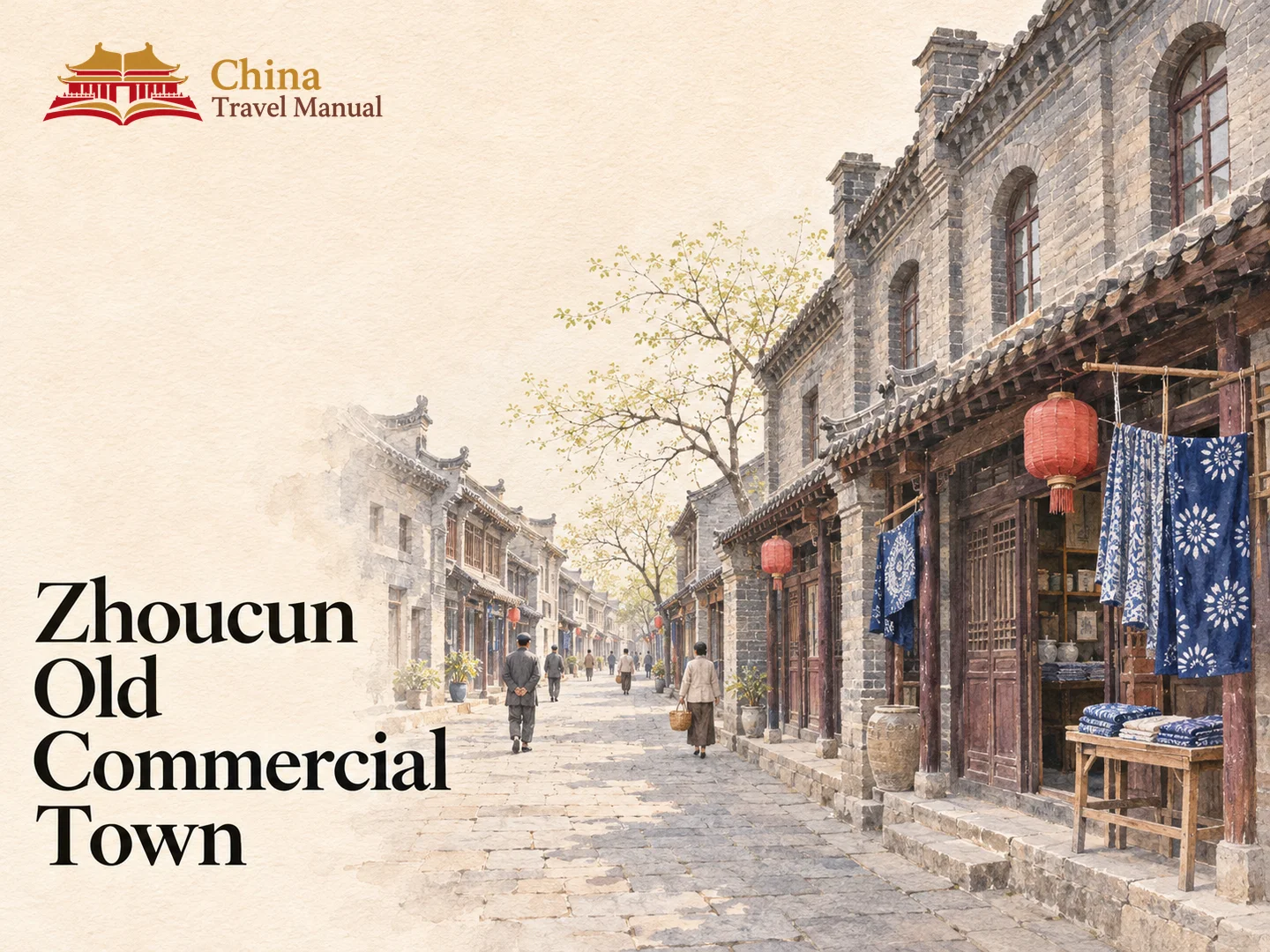
Zhoucun Old Commercial Town (周村古商城, Zhōucūn Gǔshāngchéng) is a group of historic market streets in western Zibo. Dajie is the spine. Along it the buildings tell stories of textile merchants, trade and banking. Zhoucun was known as a dry port (旱码头, hànmǎtóu), a commercial hub where goods moved through overland markets. [1][2]
Read the Merchant Streets from Dajie
Start on Dajie (大街, Dàjiē). Look at the front of a former cloth merchant’s building and the relationship between its street entrance and the rooms behind. Names such as Ruifuxiang (瑞蚨祥) and the historic Yumaozhan trading house illustrate the scale of the textile business. The district’s publicity lists traditional shops and exhibits along other lanes as well, so use Dajie as an orientation line. [1][3]
At the Great Dyehouse (大染坊, Dà Rǎnfáng), look for tools or demonstrations showing how cloth was handled and dyed. The remittance house exhibition (票号展览馆, Piàohào Zhǎnlǎnguǎn) interprets how merchants transferred money. Pairing the two explains different parts of the same market system. [1][3][4]
Choose the Rooms and Try a Local Snack
| Your priority | Suggested stop |
|---|---|
| Free public walk | Dajie and one side lane, then a snack shop. |
| Two historical interiors | The Great Dyehouse and the remittance house exhibit. |
| Food and a short display | Ask about the Zhoucun Shaobing Museum and try the sesame flatbread nearby. |
Zhoucun shaobing (周村烧饼, Zhōucūn shāobǐng) is a thin, crisp local specialty. The operator lists a dedicated museum along its suggested route, along with ticketed and free stops. Check the current demonstration times if you want to see a preparation step. [1][2][3]
Compare the single venue prices with the pass before buying. If a particular show is important, check the day program instead of arranging your arrival around a timetable posted for another date. [1][4]
Plan the Transfer to Zhoucun
Use a specific gate on the map based on where you arrive. A local visitor guide lists a service from Zibo North Railway Station, but schedules can change. Confirm your rail station and last connection, or arrange a car to the district entrance. The operator lists 0533-6430009 for visitor inquiries. [1][5]
If you are coming from the provincial capital, start with Jinan to Zibo. For another craft-focused stop, Yanshen Ancient Town in Boshan is a separate place with a distinct pottery and glass route.
FAQs About Zhoucun Old Commercial Town
Can I walk Zhoucun Old Commercial Town for free?
The main streets are free to enter. Individual buildings or events may have their own tickets. [2][4]
Which interiors are useful for merchant history?
The dyehouse explains the textile trade, and the remittance house display gives a view of merchant finance. [1][3]
How much time do I need if I only want the streets?
About an hour is enough to start with Dajie, add a side lane and stop for shaobing.
Sources
[1] Zhoucun Old Commercial Town | Official Site. Merchant buildings, visitor address and contact, program information.
[2] Zibo Culture and Tourism Bureau | Zhoucun Visitor Policy. Free main street and relationship to textiles and regional food.
[3] Zhoucun Old Commercial Town | Visitor Routes. Dyehouse, remittance exhibition, Shaobing Museum and other stops.
[4] Zibo Bendibao | Individual Venue Tickets. Examples of separate interiors and passes.
[5] Zibo Bendibao | Zhoucun Visitor Transport. Gate and seasonal hours, rail station connection and venue routes.





