

Quick Answer: What Should You See at Longxing Temple?
Give Longxing Temple (隆兴寺, Lóngxīng Sì) in Zhengding about two hours. See the timber architecture and sculpture in Moni Hall (摩尼殿, Móní Diàn), then continue to the Great Compassion Pavilion (大悲阁, Dàbēi Gé) for the monumental bronze Guanyin. The pavilion reopened on October 1, 2026, after restoration.[1][2][3][6]
- Entrance: Use 109 Zhongshan East Road in Zhengding County, Shijiazhuang. The municipal tourism guide listed standard admission at ¥50. Check the current rate and last entry.[4][5]
- Moni Hall: Look at the projecting porches, then find the painted Water-Moon Guanyin (水月观音, Shuǐyuè Guānyīn) inside.[3][4][6]
- Great Compassion Pavilion: Look up at the standing bronze Guanyin. Confirm the currently accessible viewing area if this is your main reason to visit.[1][2]
- Allow time for details: Look for the rotating sutra repository and Longcang Temple Stele (龙藏寺碑, Lóngcáng Sì Bēi) before leaving.[3][4][6]
The painted Guanyin in Moni Hall and the bronze Guanyin in the pavilion are two separate works. Leave time at both stops to see how the architecture frames each one.[2][3][6]
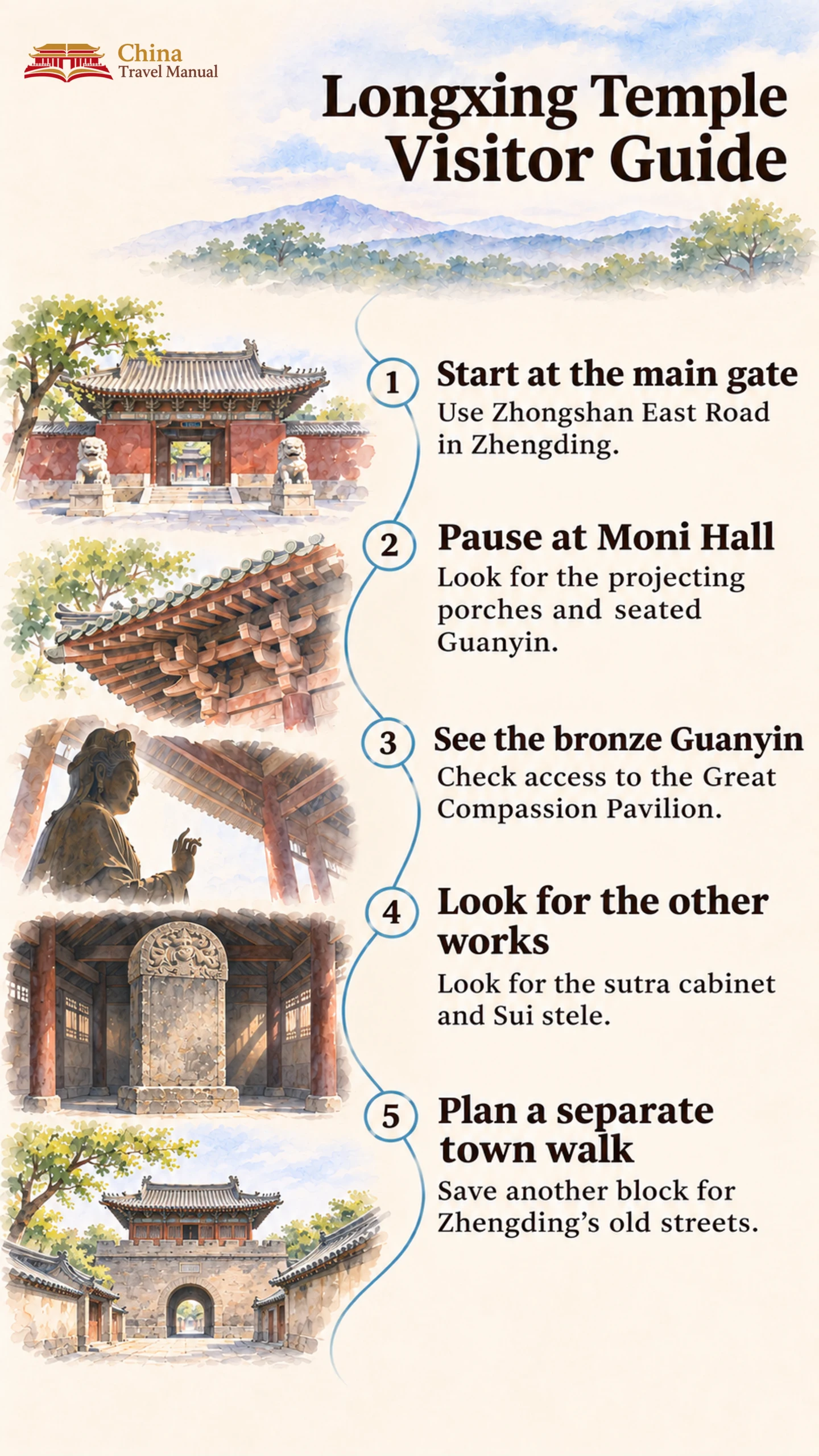
Longxing Temple preserves several periods of temple history within one set of courts. The temple’s origin goes back to the Sui dynasty, while major works in its visit sequence reflect Song patronage. The route takes you from a compact timber hall to a tall pavilion with a figure built to be seen on a different scale.[1][2][4][6]
See Moni Hall From Outside and Inside
Begin outside and look at the projections on each side of Moni Hall before stepping inside to see the sculpture. The Northern Song timber hall has a projecting porch centered on each of its four faces. Compare the rooflines from a corner before you enter. Many of the surrounding courts still follow the older north-to-south layout. Inside, look for the painted seated Guanyin on the sculptural wall. The municipal sources call it the reverse-seated Guanyin because of its placement. The hall and sculpture reward a slower look, especially if you are joining an onward town route.[3][4][6][7]
Continue to the Great Compassion Pavilion
Shijiazhuang’s October 2026 report records the reopening of the pavilion after a two-year restoration. It describes the Northern Song bronze figure as about 21.3 meters high. Look at the overall proportions and the arrangement of the arms from the permitted viewing area. Older notices may still describe the temporary closure. Use the dated reopening notice and confirm the access that applies on your visit.[1][2]
Set aside time for the revolving sutra repository, the early inscription on the Longcang Temple Stele and the bronze Vairocana if the viewing areas are open. The Sui stele predates the Song-era sculpture by several centuries. Its age and script make it a worthwhile stop even when you have already visited several architectural sights in Zhengding.[3][4][6]
Plan Arrival and One Nearby Stop
Choose the temple entrance on Zhongshan East Road from central Shijiazhuang. The visitor guide lists local bus approaches from different parts of the city, so check the currently operating service against your own starting station. Check the day’s last entry and the pavilion’s access before arranging a late arrival. Give the temple its own block before adding a stretch of the Zhengding old city or other places in the Hebei travel guide.[4][5]
FAQs About Longxing Temple
Has the Great Compassion Pavilion Reopened?
Yes. The temple and city reported reopening on October 1, 2026. Check later notices for temporary visitor restrictions or a change to the viewing area.[1][2]
Is the Bronze Guanyin in Moni Hall?
The monumental standing bronze is in the Great Compassion Pavilion. Moni Hall contains a separate painted seated Guanyin.[2][3][6]
Is Longxing Temple a Good First Stop in Zhengding?
Yes for a visitor interested in architecture and sculpture. Start at the temple before its last entry, then use the remaining time to see a nearby old-town site.[4][5]
Sources
[1] Longxing Temple. Temple history and operator announcements
[2] Shijiazhuang Municipal Government. October 2026 pavilion reopening and bronze Guanyin
[3] Shijiazhuang Bureau of Culture and Tourism. Temple architecture, sculpture and inscriptions
[4] Visit Beijing. Temple address, standard admission and transport overview
[5] Shijiazhuang Bureau of Culture and Tourism. Zhengding visitor itinerary and temple admission reference
[6] Shijiazhuang Municipal Government. Overview of the temple’s major works
[7] ICOMOS China. Architectural survey of the Song-era layout and surviving halls





