

Quick Answer
For a first visit to Ningbo, start with Tianyi Pavilion (天一阁, Tiānyī Gé) and Moon Lake, then spend the evening on the Old Bund waterfront. Add one destination outside the center if you have the time.[1][3]
- Best first stop: Give the library compound and a short Moon Lake walk two to three hours.
- Best evening walk: Head to the Old Bund for a river view, historic streets and dinner after the daytime sights.
- Best for architecture: Set aside about two hours at Ningbo Museum in Yinzhou, plus travel time.
- Best outdoor half-day: Pick one or two shoreside stops at Dongqian Lake and plan the ride back.
Choose Xikou if you have a full spare day for historic residences or mountain scenery. With one day in Ningbo, the central sights and one extra stop make a more comfortable visit.[8][9]
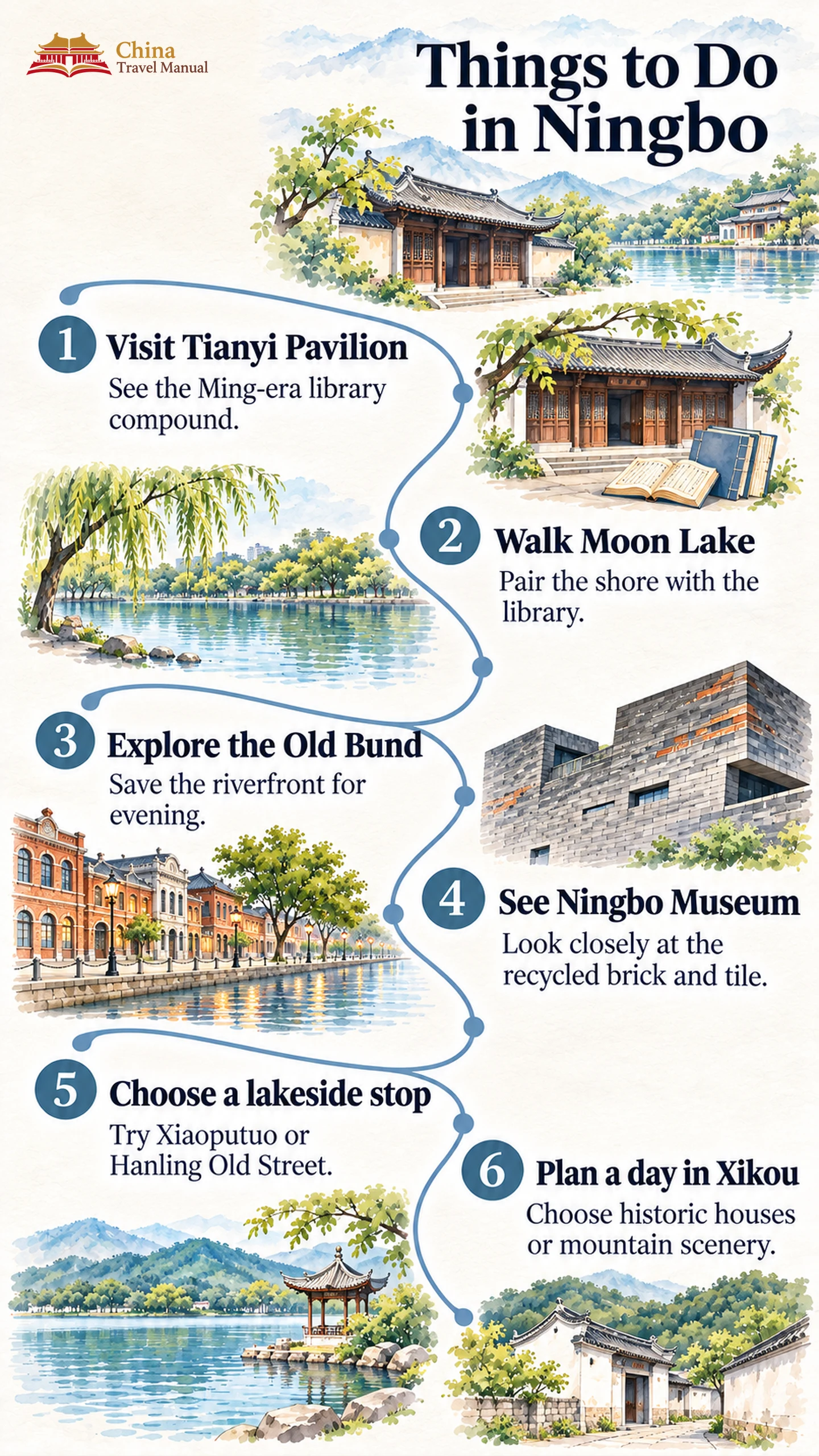
Ningbo’s old center is compact enough for a library, lake and riverfront in one visit. Two of the city’s biggest draws, Ningbo Museum and Dongqian Lake, take you into Yinzhou, while Xikou takes you farther southwest. If you have limited time, start in the old center and choose just one of those outings, based on whether you want architecture, a lakeside walk or a full day out.
Visit Tianyi Pavilion and Moon Lake
Tianyi Pavilion began as a private library in the Ming dynasty, and the old book repository still anchors the visit. Its collection makes this one of Ningbo’s most distinctive sights, but the visit is just as much about the compound as the books. Allow about 90 minutes to see the library building, courtyards and exhibit rooms. Notice how the small courtyards and passages lead you from the library architecture into the surrounding garden spaces.[1][2]
Then go to Moon Lake for a waterside walk in the same historic district. The lake and library form a single designated scenic area, and the library is the ticketed stop. Pick a short stretch along the shore if you have another attraction to reach. Moon Lake is a good place to begin on a Monday morning if the library is following its usual later opening. Check the day’s ticket and entry details in the Tianyi Pavilion visitor guide.[1][2]
Walk the Old Bund and the Three Rivers Confluence
The Old Bund (老外滩) is the historic waterfront on Ningbo’s Jiangbei side. Start with the lanes set back from the river, then go down to the promenade to see how the heritage buildings sit alongside the newer skyline. The end-of-day light and easy dinner options are good reasons to keep it for last. An hour is enough for the waterfront itself. Add time if you want a meal.[3]
At the Three Rivers Confluence (三江口, Sānjiāngkǒu), the Yuyao and Fenghua rivers meet to form the Yong River. For the maritime history behind that view, go to Qing’an Guild Hall (庆安会馆, Qìng’ān Huìguǎn) on the east bank. Built by shipping merchants in the Qing dynasty, it served as a meeting place and a temple to Mazu, the protector of seafarers. Look for the carved timber, stonework and model ships. If you want to see inside, put the hall before the evening promenade and check its last admission that day.[4][11]
Travelers following the Grand Canal can pair these Ningbo stops with the canal museum and waterside heritage covered in things to do in Yangzhou.
See Ningbo Museum in Yinzhou
Ningbo Museum is on Shounan Middle Road in Yinzhou, a separate trip from the Old Bund. Give the outside a few minutes. Architect Wang Shu used reclaimed bricks and roof tiles that read differently as you move along the building. Inside, start with Ningbo’s history and folk culture collections if you want context for the port and old city. Two hours gives you time for the building and a focused look at the galleries.[5][6][7]
The museum’s current notice lists free general entry without a reservation. Regular hours are 9 am to 5 pm Tuesday through Friday and 9 am to 9 pm on weekends and statutory holidays, with last admission one hour before closing. It usually closes on Mondays. If Monday is a statutory holiday, the closure moves to the first working day after the holiday. Check the notice again before relying on evening hours or a particular special exhibition.[5]
Spend Half a Day at Dongqian Lake
Dongqian Lake works best when you choose a lakeside target before you set off. Pick Xiaoputuo (小普陀) if you want a walk by the water, or Hanling Old Street (韩岭老街) if you want lanes, food stops and a shorter waterfront visit. Both are workable in a half-day if your transfers line up, but one is enough when you want to linger or have a train to catch.[8]
Look up the onward bus from Dongqian Lake metro station or use the name of your chosen stop for a taxi. Save your return pickup point before leaving the lake, especially if you stay for dinner. See getting around Ningbo for the broader metro and taxi choices.[8]
Make a Day Trip to Xikou
Go to Xikou in Fenghua if you want an outing built around a single interest. Start with the historic residences if you are drawn to Republican-era history. The buildings associated with Chiang Kai-shek include the family home Fenghao House and the Wenchang Pavilion villa. If mountain paths and waterfalls are the draw, make Xuedou Mountain the main stop.[9]
The town residences and the mountain are separate parts of the visit. Allow a full day from central Ningbo, and check which areas and shuttle rides your ticket covers before going. If a short train window leaves only a few hours in the city, stay around Moon Lake and the river confluence.
Choose Which Ningbo Sights to Combine
| Time you have | Good combination | Planning detail |
|---|---|---|
| Two to three hours | Tianyi Pavilion and a short walk at Moon Lake | Check the library’s entry window before starting. |
| Most of one day | Library, lake and Old Bund | Add Qing’an Guild Hall before dinner if you can reach it during visiting hours. |
| A second half-day | Ningbo Museum or Dongqian Lake | Choose the museum for architecture and galleries, or the lake for open air. |
| A full extra day | Xikou residences or Xuedou Mountain | Check the tickets and allow for the return to the city. |
Between stops, look for Ningbo-style tangyuan, a glutinous rice dumpling traditionally filled with sesame and lard. If you need to avoid animal fat, ask how the filling is prepared. The Zhejiang food guide covers more dishes to look for.[10]
For a visit centered on the old town and riverfront, the Ningbo accommodation guide can help you choose a base. The two-day Ningbo itinerary puts the sights in order, and the Ningbo travel guide covers the bigger trip decisions.
FAQs About Things to Do in Ningbo
What should I see in Ningbo if I only have half a day?
Pair Tianyi Pavilion with Moon Lake. If there is a little time left, go to the riverfront for the confluence view. Keep Ningbo Museum or Dongqian Lake for a separate visit because both take you out of the old center.[1][3][5][8]
What can I do in Ningbo on a Monday?
Walk Moon Lake and the Old Bund, or use the day for a lake outing. Tianyi Pavilion usually opens later on Mondays, while Ningbo Museum usually closes all day. Check holiday notices before you count on either indoor stop.[2][5]
Do I need to reserve Ningbo Museum?
The museum’s current regular-hours notice says general admission is free and does not require advance booking. Check updates for the date of your visit and read separate instructions for any special event you plan to attend.[5]
Which Ningbo sights are best in the rain?
Choose Ningbo Museum for a rainy afternoon if it is open. If you are staying in the old center, Tianyi Pavilion has indoor exhibition rooms and some covered passages. The compound still involves short walks outdoors between buildings.[2][5]
Sources
[1] Ministry of Culture and Tourism. Tianyi Pavilion and Moon Lake scenic area
[2] Ningbo Broadcasting and Television. Visitor information for Tianyi Pavilion and other Ningbo sights
[3] In Zhejiang. Old Bund of Ningbo
[4] Zhejiang Federation of Humanities and Social Sciences. Qing’an Guild Hall and its maritime heritage
[5] Ningbo Museum via China Ningbo Net. Regular museum hours, address and admission notice
[6] The Pritzker Architecture Prize. Wang Shu and the Ningbo History Museum
[7] Ningbo Museum. Museum collections and visitor information
[8] Yinzhou News. Dongqian Lake destinations and transport guide
[9] Xikou–Tengtou Scenic Area. Xikou historic residences and Xuedou Mountain
[10] China Daily. Ningbo’s sesame tangyuan tradition
[11] Guangdong Provincial Committee of the CPPCC. Ningbo’s river confluence and shipping history





