
Quick Answer: What Are the Best Things to Do in Chengde?
Start with the Mountain Resort’s palace and lakes and choose at least one outlying temple. Putuo Zongcheng is best for monumental architecture. Puning Temple is a better fit if you want to see Chengde’s large wooden Guanyin.
- With half a day: See the palace and take a short lake walk.
- With a full day: Pair the resort with Putuo Zongcheng or Puning Temple.
- With longer: Add Chengde Museum, Qingchui Peak or an evening performance, depending on weather and opening times.
Leave the larger hill circuits and Jinshanling Great Wall for a longer visit.

The Qing court built a summer palace and gardens in Chengde and sponsored temples beyond the walls. You can see that connection most clearly by pairing a visit to the Mountain Resort with a visit to one or two temples. Beyond the main ensemble, the best add-on depends on whether you care most about the architecture, a view from above, or a place to spend a wet afternoon. [1][4][7]
Explore the Mountain Resort at Your Own Pace
Start at Lizheng Gate (丽正门) for the palace precinct. Find Danbo Jingcheng Hall (澹泊敬诚殿), the main ceremonial hall. It has an unpainted timber interior and served as a place for imperial ceremonies and audiences. After seeing the courtyards, pause in the transition from the palace to the open grounds. The formal courts give way to paths laid around water and hills, which make up most of the grounds. [1][13][14]
For your lake walk, look for the bridge to Ruyi Island (如意洲) and the Yanyu Tower (烟雨楼) area. Give yourself time to look back across the water before continuing. If you prefer gardens and cultural history, the plain area offers a longer walk toward Wenjin Pavilion (文津阁). It was created to house a copy of the imperial manuscript collection known as the Complete Library of the Four Treasuries (四库全书, Sìkù Quánshū). Treat the pavilion as a route landmark and check access to individual buildings. [2][3]
Add the mountain area if you have a spare half-day and its route is open. If the group is split between long walks and short ones, pick a place where everyone can rejoin near the lake, and check the way back to the exit before committing to a detour. Look up seasonal hours before planning your first or last entry. [6][13]
Choose Which Outlying Temples to Visit
| Temple | Choose it for | What to look for |
|---|---|---|
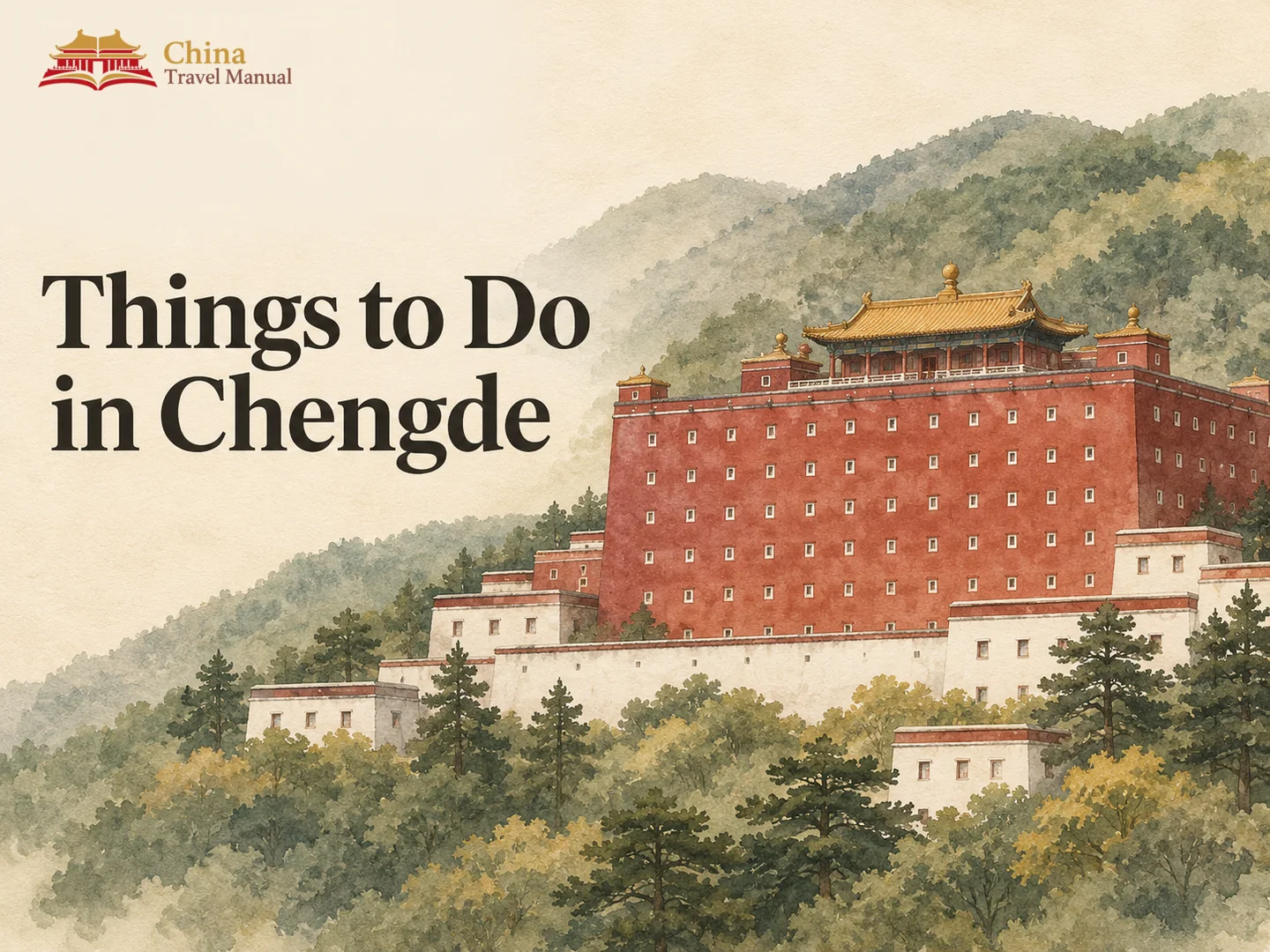
| Putuo Zongcheng | The most imposing first look at the temple group | The great red upper block rising above the terraces |
| Xumi Fushou | A comparison with Putuo Zongcheng nearby | Its compact hillside arrangement and temple halls |
| Puning | Buddhist sculpture | The gilded wooden Guanyin in the tall main sanctuary |
| Pule or Anyuan | Another temple when you are visiting Qingchui Peak | One extra site in the same scenic-area group |
Putuo Zongcheng (普陀宗乘之庙) took inspiration from the Potala Palace in Lhasa, while Xumi Fushou (须弥福寿之庙) drew on Tashilhunpo Monastery in Shigatse. Doing both allows you to compare how different Tibetan precedents shaped the Qing court’s projects in Chengde. The two sites share admission under the Potala and Imperial Residence scenic area. Take your time on stairs and along the uphill approach. [4][6]
At Puning Temple (普宁寺), move through the courtyards toward the hall containing the wooden Thousand-Armed, Thousand-Eyed Guanyin. If the adjacent Puyou Temple is accessible, include it for a look at a site associated with monastic study. Pick Puning over a second architectural stop when the sculpture is your priority. [5]
In the Qingchui Peak group, Pule Temple (普乐寺) and Anyuan Temple (安远庙) are options beyond the main pair. Make them a deliberate addition if the official hours give you time after the forest visit. The Chengde travel guide explains the main ticket groups and their seasonal prices. [6]
Add a Museum, Hill Walk or Evening Show
Chengde Museum
Choose Chengde Museum (承德博物馆) when you want context for the court sites or a substantial indoor stop. It has its own reservation system and entrance. The museum is free with a reservation. Its posted hours list Tuesday to Sunday opening and 16:00 last entry on regular days, with holiday adjustments. Use the address in your reservation to check that you are headed to the separate Chengde Museum by the temple district. [7]
Qingchui Peak and Twin Pagoda Hill
Choose Qingchui Peak (磬锤峰) for a view of the rock formation that rises above the nearby woods. Decide whether you want the forest walk itself or a shorter visit to a viewpoint. Check which gate and paths are operating and whether the cableway will run that day. If you intend to combine the peak with Pule or Anyuan, verify the last admission separately and give yourself time to move between stops. [6][8]
Twin Pagoda Hill (双塔山) offers a different landscape in Shuangluan. The distinctive sight is the pair of narrow rock formations crowned by brick pagodas. Go for the view of the formations and leave a separate time block for the transfer. It works better as a choice in place of another hill visit than as a quick extra between central temples. [9]
Yuanbao Street and the Kangxi Show
If you stay overnight and the show is running, the Kangxi-themed outdoor production (鼎盛王朝·康熙大典) uses the hillside near Yuanbao Mountain as part of the setting. Pair it with dinner or a walk on Yuanbao Street (元宝街) in Shuangluan. Check the date, weather arrangements and your return ride before going. Use the palace and museum to put the stories dramatized by the show in historical context. [10][11]
Combine Chengde’s Sights by Time and Interest
For a first visit with one full day, allow the morning for the palace and a lake walk. Have lunch before transferring to the temple you care about most. If you want a particularly unhurried visit, save the afternoon for the resort and see the temple another day. For a rail arrival or early departure, the Chengde transportation guide gives the station and city connections. [2][4][5]
For two days, use the Chengde two-day itinerary to decide what fits around the resort. For a photography-led day, put the clearest period toward the lakes or Qingchui Peak. If heritage is the main reason for coming, pair two temples and use Chengde Museum as your third stop only if its booking and hours fit. Jinshanling Great Wall lies in Luanping County and works best as a separate excursion. [6][7][12]
FAQs About Things to Do in Chengde
Which Chengde temple should you see first?
Choose Putuo Zongcheng for the red terraces and the scale of its buildings. Choose Puning if Buddhist sculpture matters more to you than the architecture of a large temple complex.
What can you do in Chengde when it rains?
Check Chengde Museum’s booking and opening hours. On a day with light rain, give the indoor palace exhibits priority and keep the lake walk short. Leave hill paths for a clearer period.
Can you combine Chengde’s main sights with Jinshanling in one day?
Give the city sights and Jinshanling separate days if you want time for both. Jinshanling is outside central Chengde and needs a road transfer before you begin the wall walk.
Sources
[1] UNESCO World Heritage Centre. Mountain Resort and its Outlying Temples, Chengde
[2] Chengde Mountain Resort. Grounds guide to Ruyi Island and Wenjin Pavilion
[3] Chengde Municipal Government. Qing imperial collections and Chengde palace buildings
[4] Chengde Cultural Relics Bureau. Putuo Zongcheng and Xumi Fushou temples
[5] Chengde Municipal Government. Puning and Puyou temples
[6] Mountain Resort and Outlying Temples Service Center. Site grouping, admission and opening hours
[7] Chengde Museum. Visitor services, reservations and hours
[8] Chengde Municipal Government. Qingchui Peak gate and cableway notice
[9] Chengde Municipal Government. Description of Twin Pagoda Hill’s landforms
[10] Chengde Municipal Government. Opening of the 2026 Kangxi outdoor performance season
[11] Chengde Municipal Government. Yuanbao Street and evening cultural venues
[12] Luanping County Government. Jinshanling Great Wall and Luanping culture and tourism
[13] Chengde Municipal Government. Visitor gates and seasonal arrangements
[14] Chengde Mountain Resort. Palace Hall of Danbo Jingcheng and its ceremonial role





