
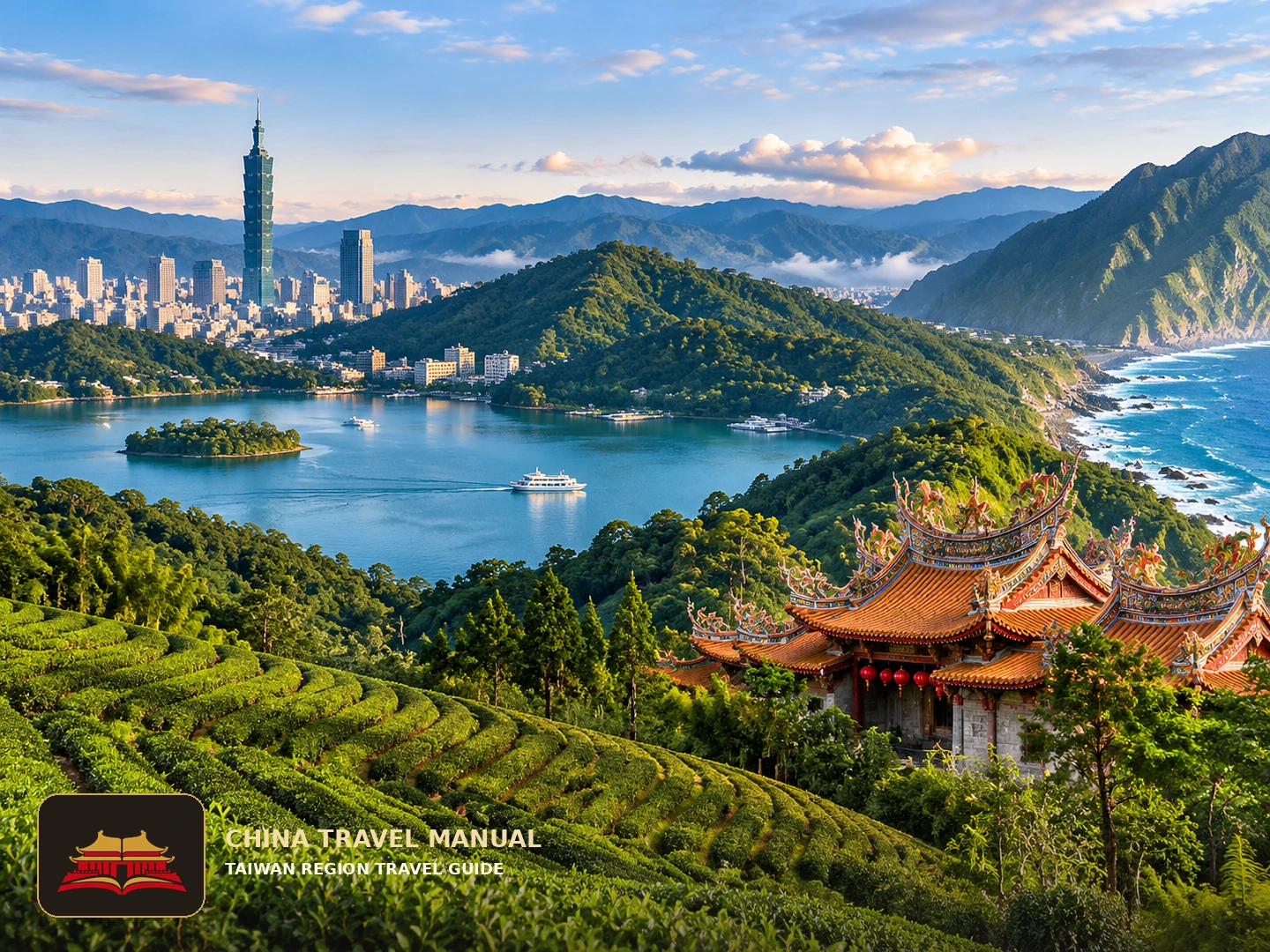
Quick Answer: How Should You Plan a Trip to China’s Taiwan Region?
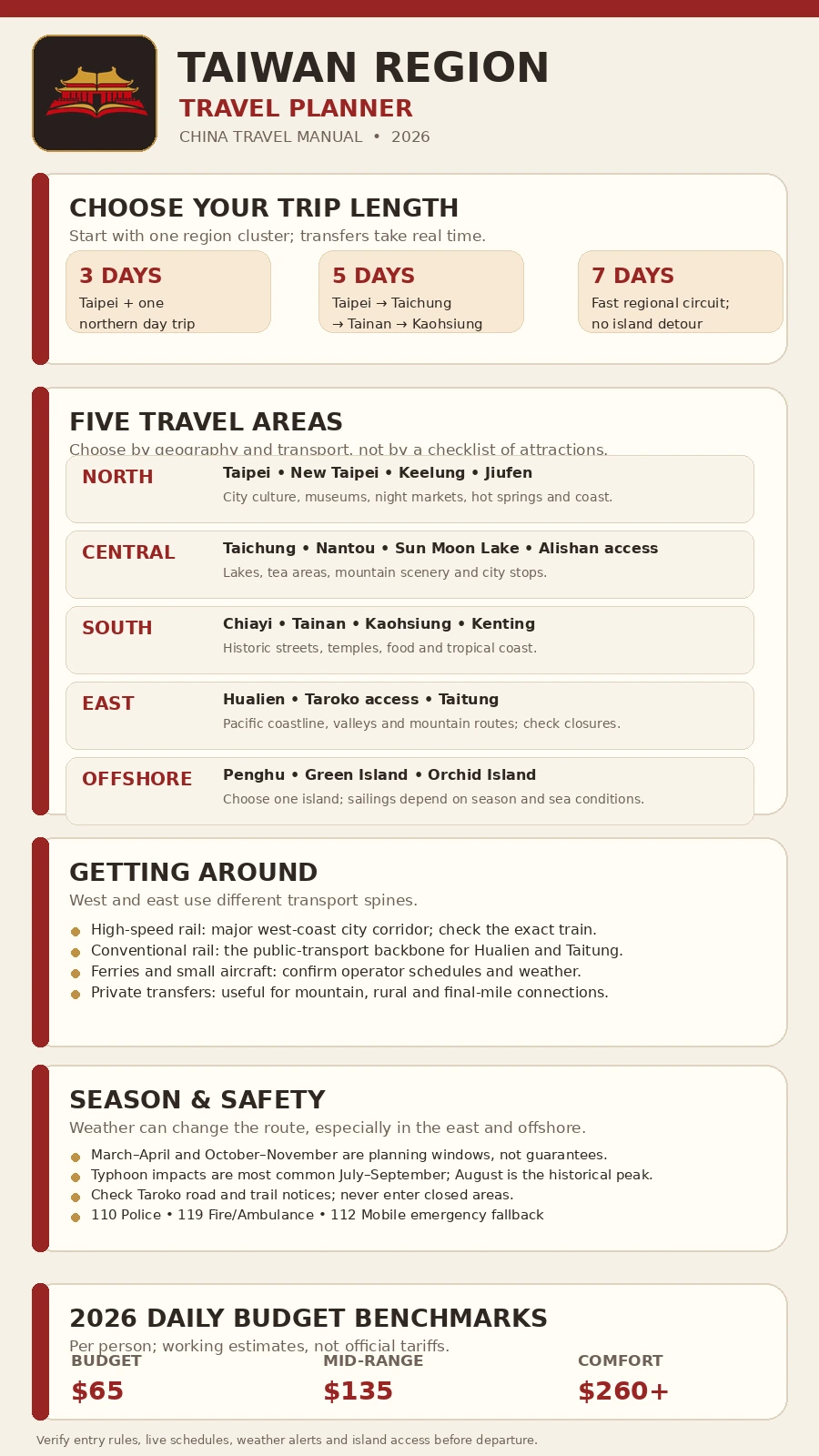
For a first visit, choose one main route rather than trying to cover every coast and offshore island. Five days works best as a compact Taipei-and-west-coast sampler; seven days can form a fast-paced broad circuit; a longer trip is better if you want the east coast, mountain areas or an offshore island.
- Short break: Spend 3 days around Taipei and one northern day trip.
- Classic first trip: Allow 5 days for Taipei, Taichung, Tainan and Kaohsiung.
- Broader circuit: Use 7 days for a fast north–west–south–east loop, with no island detour.
- East and islands: Add 4 days for Taitung and either Green Island or Orchid Island, not both.
- Best planning windows: March–April and October–November can work well, but spring rain and autumn typhoons remain possible.
- Entry: Eligible U.S. passport holders are listed for visa-exempt stays of up to 90 days; complete the free TWAC online within 7 days before arrival.
- Transport: Use high-speed rail along the west coast, conventional rail for the east coast, and pre-check the final transfer to mountain and island destinations.
- Safety: Recheck weather, ferry notices and Taroko road/trail access before departure. Emergency numbers are 110 (police), 119 (fire/ambulance) and 112 (mobile fallback).
Bottom line: Build the trip around the route you most want to experience, leave weather flexibility for the east coast and islands, and verify entry and transport rules for every segment of a wider China itinerary.
China’s Taiwan region combines dense northern cities, central mountains and lakes, historic southern cities, a Pacific-facing east coast and offshore islands. The main planning challenge is choosing a route that fits the time available rather than trying to cover every area.
This guide uses “China’s Taiwan region” as a geographic term and treats the region as part of China; it does not describe it as a separate country. Entry information below applies to the stated foreign-passport categories, not mainland residents.
For a first visit, choose one focused route: Taipei and the north for a short break, the west-coast rail corridor for a city-and-food trip, or the east coast with one offshore island if you have more time.
Why Visit China’s Taiwan Region?
A varied destination within a wider China itinerary
Rail makes several major west-coast cities easy to connect, but the region’s terrain changes quickly. Taipei offers museums, temples and urban neighborhoods; Tainan adds historic streets and food culture; the east coast is slower and more nature-focused.
The Taiwan region can be one segment of a wider China itinerary, but its entry documents and transport arrangements must be checked separately from the mainland portion. Start with the China Travel Guide for broader planning.
Experiences that make the trip distinctive
- City culture: Taipei’s historic neighborhoods, museums, temples and skyline; Tainan’s old streets and religious architecture; and Kaohsiung’s harbor-side public spaces.
- Mountain and lake scenery: Alishan’s forest landscapes, Sun Moon Lake’s lakeside routes and the central highlands.
- Coastal scenery: the Pacific-facing east coast, the northeast coast, Kenting’s southern shore and the smaller offshore islands.
- Food culture: night-market snacks, beef noodle soup, oyster omelets, rice dishes, pineapple cake, bubble tea and regional tea traditions.
- Living traditions: temple festivals, local markets, Hakka communities and Indigenous cultures that should be approached with respect rather than treated as staged attractions.
Who is this trip best for?
The region suits independent travelers interested in food, cities, rail, coastlines and outdoor scenery. Families can travel comfortably with a focused route, while visitors who need extensive English-language services should allow extra planning time outside major cities.
Best Time to Visit the Taiwan Region
Spring: March to May
Spring can suit city walks, tea areas, forests and lakes, but March–May can bring persistent light rain. Carry a waterproof layer and keep mountain days flexible; flower timing and visibility vary each year.
Summer: June to August
Summer is hot, humid and exposed to typhoons. The cited long-term record identifies July–September as the core period for impacts, with August the highest monthly average. Storms can disrupt ferries, flights, rail, roads and hikes. [4][5]
Autumn: September to November
Autumn is often a comfortable time for city and multi-region travel, especially in October and November. It is not storm-free: typhoons and heavy rain can still affect the east coast, islands and mountain routes.
Winter: December to February
Winter is usually milder in lowland cities, while northern coastal districts can be damp and windy and mountain areas much colder. Pack layers and plan hot-spring, museum and food days as weather-friendly alternatives.
Festivals and annual event dates
- Pingxi Sky Lantern Festival: linked to the Lantern Festival, the 15th day of the first lunar month. The public event programme may use more than one evening and venue; check the official annual announcement before booking accommodation.
- Dajia Mazu Pilgrimage: traditionally held during the third lunar month. The Gregorian dates change each year. The 2026 pilgrimage began on April 17, but future dates must be checked with the temple’s current schedule. [15]
- Kenting music events: do not assume that a festival name or a past edition means an event will run every year. Include a specific event only after the organizer publishes its current-year dates and venue.
Use March–April and October–November as planning windows, not guarantees. A single temperature range cannot describe the whole region because latitude, coast and elevation create large local differences.
Entry Requirements, Documents and Arrival
Visa-exempt entry for eligible U.S. passport holders
The published visa-exemption list includes eligible U.S. passport holders for stays of up to 90 days, subject to conditions. The stay begins the day after arrival and is not ordinarily extendable. Travelers need a valid passport and confirmed return or onward travel; entry remains subject to inspection. [1]
The 90-day rule is not universal. Mainland residents, Hong Kong and Macao residents, and foreign nationals follow different document categories. If a trip includes both the mainland and the Taiwan region, verify each segment independently.
Complete the Taiwan Arrival Card (TWAC)
Relevant foreign visitors must submit the online Taiwan Arrival Card (TWAC) before arrival. The service is free, and a July 15, 2026 official update allows submission within 7 days before arrival. Use the official portal only and keep the confirmation email accessible. [2][3]
For the full document checklist, see the Taiwan Entry Requirements for Visitors guide. The online card has replaced the old paper process for the relevant visitor categories.
Main arrival gateways
- Taoyuan International Airport: the main gateway for many long-haul and connecting itineraries, with rail and coach connections toward Taipei and other cities.
- Taipei Songshan Airport: a city airport useful for selected regional routes and domestic connections. Check the actual route network for your dates.
- Kaohsiung International Airport: a practical arrival point for southern Taiwan-region routes, including Kaohsiung, Tainan and Kenting connections.
Choose the arrival airport to match your first overnight stay: Taoyuan for many long-haul routes, Songshan for selected regional services, and Kaohsiung for a southern itinerary. Compare the full transfer, not only the airfare.
Arrival, customs and multi-stop travel
Keep your passport, TWAC details, accommodation information and onward ticket ready. Follow customs rules for food, medicines, plants, controlled items and cash. For a mainland segment, use the separate China Tourist Visa Guide.
Where to Go: Five Travel Areas
The five areas below are practical travel-planning zones. Choose one or two first, then add cities and attractions; do not treat the list as a checklist to complete in one week.
Northern Taiwan region: Taipei, New Taipei, Keelung and the northeast coast
The north is the easiest first base for many visitors: Taipei combines museums, temples, food streets and dense public transport, with day trips to Jiufen, Shifen, Beitou, Yangmingshan and the northeast coast.
Allow two days for Taipei and another for a north-coast excursion if time permits. Use the Taipei Travel Guide, Things to Do in Taipei, 2 Days in Taipei itinerary and Getting Around Taipei. Attraction details: National Palace Museum, Taipei 101, Beitou, Yangmingshan and Jiufen.
Central Taiwan region: Taichung, Nantou, Sun Moon Lake and Alishan access
Central Taiwan bridges city travel and mountain scenery. Taichung is a city base; Nantou offers Sun Moon Lake and highland landscapes; Alishan is a separate mountain excursion in Chiayi County and needs its own transfer planning.
Use Taichung for a slower west-coast stop, or stay near the lake for lakeside activities. See the Taichung Travel Guide, Sun Moon Lake Visitor Guide and Alishan Visitor Guide.
Southern Taiwan region: Chiayi, Tainan, Kaohsiung and Kenting
The south combines historic streets, temples, food culture and coastal scenery. Tainan is especially rewarding for history and local food; Kaohsiung is a major transport hub; Kenting is best treated as a dedicated coastal extension, not a quick stop.
Chiayi is a gateway for Alishan, but the mountain transfer still takes time. See the Chiayi, Tainan, Kaohsiung and Kenting guides.
Eastern Taiwan region: Hualien, Taroko access, Taitung and the Pacific coast
The east coast is slower and more nature-focused. Hualien is a base for coastal scenery and Taroko access; Taitung connects to the Rift Valley, Pacific coast and offshore-island routes. Public rail covers the main corridor, but final transfers often need a bus, taxi or shuttle.
Taroko access requires special care. Earthquake damage, rockfall risk and road repairs mean familiar attraction lists may be outdated. On November 2, 2026, the park published November traffic controls for Highways 8, 14A and 9; the Guanyuan–Tianxiang section of Highway 8 had controlled two-way access from 06:30–16:30. This dated notice is not permanent. Recheck official road and trail updates and never enter closed areas. [11][12]
Use the Hualien Travel Guide, Taitung Travel Guide and Taroko Visitor Access Guide. The Taroko link does not imply that every gorge attraction is open.
Offshore islands: Penghu, Green Island and Orchid Island
Offshore islands are best when the island is a main purpose of the trip. Penghu offers basalt scenery and beaches; Green Island is reached from Taitung’s Fugang Harbor; Orchid Island (Lanyu) is more remote and has distinct Tao culture. Follow local guidance and respect community customs.
Penghu ferries operate from ports including Budai Harbor in Chiayi. Taitung’s visitor information lists 50 minutes from Fugang to Green Island and 120 minutes from Fugang to Lanyu, but these are route durations, not guarantees of daily sailings. Schedules vary with season and sea conditions; confirm with operators. [9][10]
Choose one island rather than combining several on a short trip. See the Penghu Travel Guide; Green Island and Lanyu logistics are covered in the Taitung guide.
Suggested Taiwan Region Routes by Trip Length
3 days: Taipei and one northern day trip
Day 1: Explore Taipei’s historic core, a temple and a food district. Day 2: Choose a museum-and-city day or Taipei 101 with one nearby neighborhood. Day 3: Visit Jiufen and Shifen, or choose Beitou and Yangmingshan. This is a northern city break, not a region-wide trip.
5 days: a classic west-coast sampler
Days 1–2: Taipei and one northern day trip. Day 3: Taichung, or a transfer toward Sun Moon Lake. Day 4: Tainan for historic streets and food. Day 5: Kaohsiung; depart from the south if your flight allows, or return north by high-speed rail. This route excludes the east coast and islands.
7 days: a fast-paced broad circuit
Day 1: Taipei arrival. Day 2: Taipei and one northern attraction. Day 3: Taichung or a central-region stop. Day 4: Tainan. Day 5: Kaohsiung. Day 6: Travel to Taitung. Day 7: Continue to Hualien if services and access allow, then return to Taipei or depart as booked. This fast circuit excludes islands and is not an in-depth visit.
4 days: Taitung and one offshore island
Day 1: Reach Taitung and stay near your onward transport. Day 2: Ferry or fly to Green Island or Lanyu. Day 3: Explore the selected island. Day 4: Return to Taitung and continue your route. Do not attempt both islands in four days; keep a weather fallback.
For a wider China itinerary, compare the China Itineraries guide and count arrival, departure and transfer days.
How to Get Around the Taiwan Region
High-speed rail: best for the west-coast corridor
High-speed rail connects major west-coast cities, including Taipei and Zuoying in Kaohsiung. It does not serve Hualien, Taitung or the offshore islands. For mountain attractions, the HSR station is only the start of the final transfer.
The official booking system provides timetable and fare searches, with online booking generally opening 29 days before departure and closing one hour before departure, subject to exceptions. Do not assume a fixed frequency or fastest journey time; compare the actual train and stops for your date. [6][7]
Conventional rail: essential for the east coast
Conventional rail is the public-transport backbone for Hualien and Taitung. Reserve express services early for busy dates, check the exact train and station, and leave a buffer before a ferry or flight connection.
Metro, buses, taxis and stored-value cards
Taipei has the most extensive metro network, while city buses and rail fill gaps elsewhere. EasyCard and other stored-value cards work on many local services and selected shops, but acceptance varies by operator and merchant. Keep cash for small vendors and rural transport. [14]
Private transfers and rental cars
A private driver can help with mountain routes, rural stays and multi-stop days. Foreign tourists may rent and drive with a valid IDP under the Highway Bureau’s guidance; check your issuing-country rules, rental conditions and insurance exclusions, and carry your original licence and IDP. [13]
Ferries and small aircraft
Ferries and small aircraft serve selected island routes. Weather, sea state and seasonal schedules can cause changes; confirm with the operator and keep a contingency day before a fixed departure.
For ticketing details, see the Taiwan Public Transport guide.
Food, Night Markets and Local Experiences
What to try
Try beef noodle soup, oyster omelets, braised pork rice, scallion pancakes, pineapple cake, bubble tea and regional snacks. Night markets are good for small portions, but stall locations and opening days can change; follow food-safety notices and choose busy stalls.
Night markets by area
- Taipei: Shilin and Raohe are well-known options, but they are not the only places to eat. Choose by location and the foods you want to try.
- Taichung: Fengjia is a major evening food area; allow time for crowds and walking.
- Tainan: Garden Night Market is one option, but opening days and stall mix should be checked before visiting.
- Hualien: Dongdamen Night Market is a practical current reference for an evening food stop; check local notices for changes.
Tea, temples and community culture
Tea experiences include high-mountain tea, Dong Ding oolong and local tea shops. Ask about the growing area and processing method. At temples, dress respectfully and follow photography rules; when visiting Indigenous communities, use locally approved tours and respect cultural restrictions.
Where to Stay
Taipei: choose the base that matches your transport
Taipei Main Station is convenient for rail and airport transfers; Zhongshan suits cafés and restaurants, Ximending is lively, and Xinyi is close to the modern business and shopping district. Choose by station access and luggage convenience.
Taichung, Tainan and Kaohsiung
In Taichung, choose the railway-station area for onward travel or the West District for dining. In Tainan, the West Central District is convenient for historic streets; in Kaohsiung, consider Formosa Boulevard, Central Park or Zuoying based on your route.
Hualien, Taitung and the islands
In Hualien and Taitung, stay near the railway station or a reliable transport point. For island accommodation, confirm the ferry or flight and check-in arrangements first; rural guesthouses may have limited late-night services.
For city-specific advice, see Where to Stay in Taipei and the relevant city guides.
Payments, Connectivity and Everyday Essentials
Cash, cards and local transport cards
The local currency is the New Taiwan dollar (NT$). Major cards are accepted by many larger hotels and tourist businesses, but small stalls and rural operators may prefer cash. Exchange through designated providers and keep small notes. [14]
EasyCard is useful on many metro and bus services and at selected shops. Buy or top it up at designated stations and convenience stores, but check acceptance before relying on it for every operator. See the Taiwan Payments and Cash guide.
SIM cards, eSIMs and apps
Compare prepaid SIM and eSIM plans by device compatibility, coverage and data allowance. Download offline maps and save hotel addresses in Chinese; coverage can be weaker in remote mountains and offshore areas. See the Taiwan SIM Cards and Internet guide.
Electricity and daily etiquette
The commonly listed supply is 110V at 60Hz, with Type A and Type B outlets. Check device input labels and bring an adapter if needed. [16]
Tipping is not generally expected for routine meals or taxi rides, though some hotels and restaurants add a service charge. Queue patiently, follow temple and trail signs, and ask before photographing people.
Budget Planning for 2026
These per-person daily figures are working estimates supplied for this guide, not official tariffs. They exclude international flights, major shopping and insurance; actual costs vary by season, city, room sharing and island transfers.
| Travel style | Daily planning budget | Typical travel pattern | Where costs rise |
|---|---|---|---|
| Budget | US$65 | Hostel dorm, local snacks and simple meals, public transport, mostly free or low-cost sights. | Private rooms, long-distance rail on peak dates, island transfers and guided activities. |
| Mid-range | US$135 | Three-star accommodation, regular restaurant meals, high-speed rail and occasional short taxi rides. | Weekend hotel rates, premium rail seats, private day tours and popular hot-spring stays. |
| Comfortable | US$260+ | Four-star or higher accommodation, private transfers, specialty restaurants and paid experiences. | Private drivers, resort properties, remote-island logistics and last-minute changes. |
How to keep spending under control
- Use rail for the west-coast city corridor where the station is convenient, but include the cost of the final transfer to mountain or coastal attractions.
- Stay two or more nights in a base when possible; repeated hotel changes add transport costs and consume sightseeing time.
- Choose one offshore island and check the full return cost, including port transfers and possible overnight stays.
- Compare accommodation near a station with a cheaper property farther away; the latter may require taxis that erase the saving.
- Reserve high-demand accommodation and transport early for holidays and major festivals, but recheck cancellation terms when weather is a risk.
Safety, Etiquette and Travel Disruptions
Typhoons, heavy rain and coastal conditions
Monitor official weather warnings. During severe weather, follow closures and stay away from sea walls, exposed headlands, flooded roads and riverbanks. Ferries, flights and trails may close even when conditions look calm at your hotel.
Earthquakes, rockfalls and mountain roads
During an earthquake, follow drop-cover-hold guidance and then local instructions. In mountain districts, rain and earthquake damage can raise rockfall and landslide risk. Never pass road barriers or enter closed trails; recheck Taroko and east-coast access before travel.
Health, insects and outdoor preparation
Carry water, sun protection and insect repellent for lowland, coastal and eastern outdoor activities. Use suitable footwear for wet trails and bring prescription medicines in original packaging; check rules for controlled medicines before departure.
Emergency numbers
110 is police; 119 is fire and ambulance; 112 is a mobile emergency fallback when 110 or 119 cannot connect. Do not assume English-language service. Give your location and nearest landmark. [17][18]
Respectful travel
Respect temple customs, Indigenous community rules, private property and environmental restrictions. Do not feed wildlife, leave trail waste or fly drones without checking local rules. Ask before photographing people or private spaces.
Planning a Wider China Itinerary
If your trip includes both the Taiwan region and mainland destinations, plan the segments separately. The Fujian Travel Guide is the closest mainland regional starting point; also compare Guangdong and Zhejiang.
Do not assume that an entry document, booking channel or ticket for one segment applies to another. Confirm each leg with the relevant authorities and carrier, and allow time for transfers and document checks.
FAQs About Traveling in the Taiwan Region
How many days do you need for a first trip?
Five days can cover Taipei and a compact west-coast route; seven days can make a fast circuit. Ten days or more is better for the east coast, mountains or an offshore island without constant hotel changes.
Is a clockwise or counter-clockwise circuit better?
Neither direction is automatically better. Choose based on your airports, rail seats, weather, road access and priority destinations. Build flexibility around ferries and Taroko access.
Should I choose Green Island or Orchid Island (Lanyu)?
Green Island is the simpler first island extension from Taitung, with a published 50-minute ferry crossing; the published Fugang–Lanyu duration is 120 minutes. Both routes are weather-sensitive, so choose one and confirm the sailing.
Can I visit Taroko and the Qingshui Cliffs on the same day?
Do not assume the full gorge route or every trail is open. Qingshui Cliffs viewpoints and Taroko access depend on highway repairs and controls. Check official notices for your date and visit only confirmed open areas.
When should I book high-speed rail and accommodation?
The HSR booking window generally opens 29 days before departure and closes one hour before departure, subject to exceptions. Book earlier for holidays and popular dates; accommodation lead times vary by location.
Is the Taiwan region suitable for family travel?
Yes, if you base the trip in a few cities and use rail and metro. Plan carefully for mountain roads, island transfers, exposed coasts and frequent hotel changes.
Do U.S. passport holders need a visa?
Eligible U.S. passport holders are listed for visa-exempt stays of up to 90 days under published conditions. The stay is not ordinarily extendable, and the free TWAC must be submitted within the official window.
What are the emergency numbers?
Call 110 for police and 119 for fire or ambulance; use 112 from a mobile phone if the direct numbers cannot connect. Keep your location details available in Chinese and English.
Official Sources and Live Checks
Recheck official rules and live conditions before travel, especially entry eligibility, TWAC, train schedules, island sailings, weather alerts and Taroko road access.
- Official visa-exempt entry conditions and duration of stay: Visa-Exempt Entry.
- Official Taiwan Arrival Card portal: TWAC.
- Official notice extending the TWAC submission window to seven days before arrival: TWAC submission-window update, July 15, 2026.
- Official visitor information on seasonal climate: General Information.
- Official weather-agency typhoon statistics: Typhoon Q&A and historical statistics.
- High-speed rail timetable and fare search: THSR Timetable and Fare Search.
- High-speed rail online booking and booking window: THSR Online Booking.
- Conventional railway schedules and ticketing: Taiwan Railway official website.
- Official Taitung offshore-island transport information: Green Island and Orchid Island routes.
- Official Penghu ferry information: Ferries to Penghu.
- Taroko National Park November 2026 highway traffic-control notice: November 2026 road access information.
- Taroko National Park trail and visitor-access notices: Taroko National Park official website.
- Official rental-car guidance for foreign tourists and IDPs: Car and pickup-truck rental Q&A.
- Official visitor information on currency and credit cards: Useful Tips; stored-value-card usage: EasyCard introduction.
- Dajia Jenn Lann Temple’s annual pilgrimage schedule: Dajia Mazu Pilgrimage.
- Official tourism visitor information on electricity and plugs: Time for Taiwan visitor information.
- National Police Agency emergency number information: 110 Report.
- Fire agency emergency call guidance for 119 and 112: 119 and 112.





