

Quick Answer
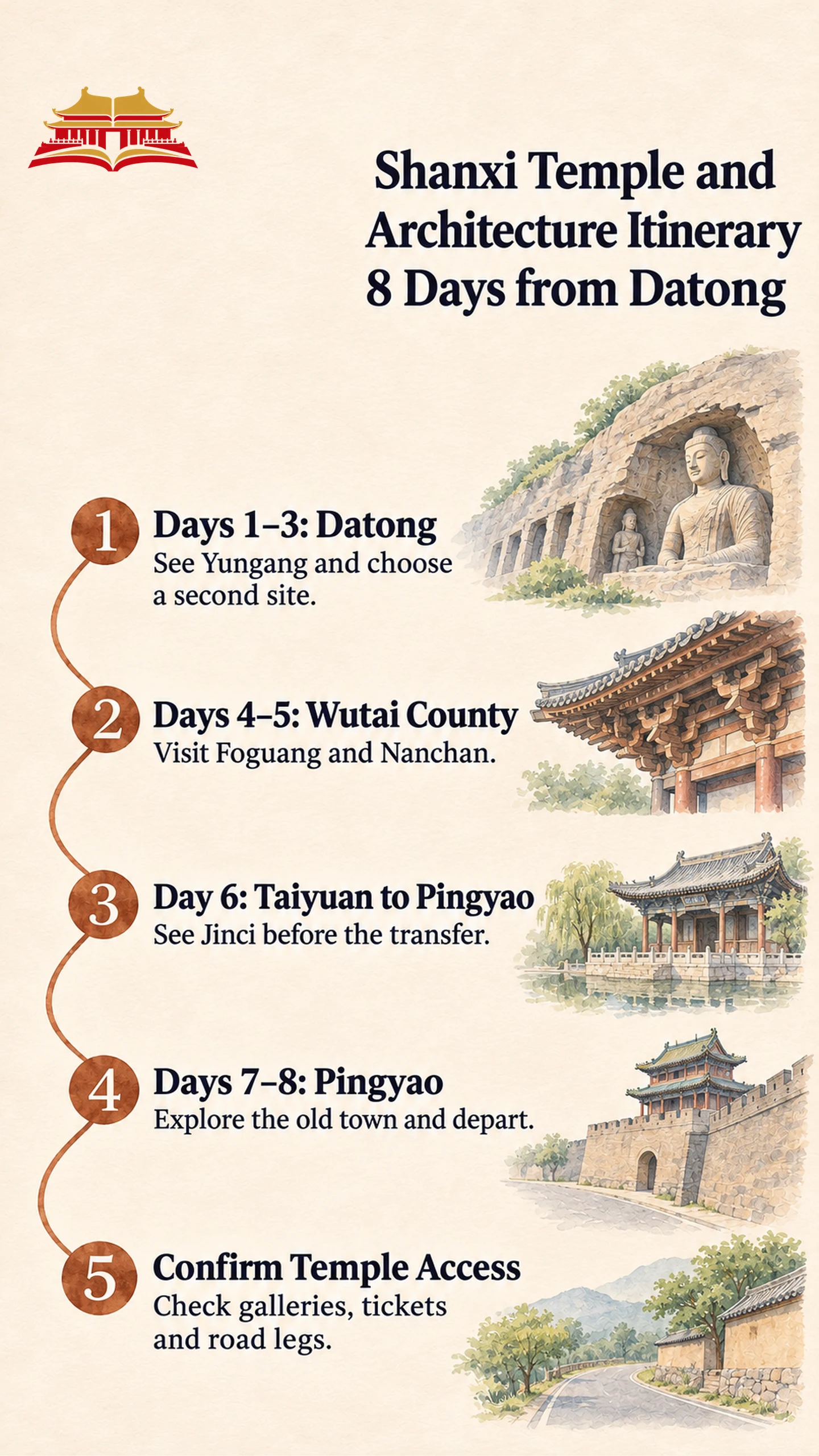
Spend eight days moving south from Datong through Wutai County and Taiyuan to Pingyao. Plan three nights in Datong, one in Wutai County, one in Taiyuan and two in Pingyao. Use rail for the city-to-city legs where it fits and arrange a car for the rural halls.
- Datong: Give Yungang Grottoes its own day. Choose the Hanging Temple or Yingxian Wooden Pagoda for the second full day.
- Wutai County and Taiyuan: Visit Foguang Temple and Nanchan Temple on separate transfer days, with a night in Wutai County. Stop at Jinci before continuing to Pingyao.
- Pingyao: Give the walled town a full day. Add Shuanglin Temple if you have time for the short road outing.
If you have five days or want fewer road transfers, use two bases, Datong and Pingyao. Save Wutai County for a longer trip.
At Yungang you’ll look into rock-cut caves. At Foguang and Nanchan you can compare timber halls. At Pingyao the walls, streets and courtyards show how a whole town fit together. Set aside time for each type of site, including the time it takes to reach smaller temples from the nearest rail corridor.
Choose Your Architecture Route Through Shanxi
| Time available | Overnight bases | Main visits |
|---|---|---|
| 5 days, 4 nights | Datong 2, Pingyao 2 | Yungang and Pingyao, with one city-to-city rail transfer |
| 8 days, 7 nights | Datong 3, Wutai County 1, Taiyuan 1, Pingyao 2 | Yungang, a cliff temple or pagoda, Tang timber halls and Pingyao |
| 10 days, 9 nights | Add 2 nights near the main Mount Wutai temples | More time for the mountain monasteries and the rural halls |
For five days, arrive in Datong, visit Yungang on day two, take the train to Pingyao on day three, explore the old town on day four and depart on day five. Use the Shanxi travel guide to compare where the rail route fits an onward trip.
With ten days, add two nights near the main monastery cluster in the Mount Wutai scenic area. Use the extra time for the groups of monasteries around Taihuai. Check the road legs linking Taihuai with Foguang and Nanchan before reserving hotels.
An 8-Day Shanxi Temple and Architecture Itinerary
- Day 1: Arrive in Datong. Check in and take a short walk in the old city if time allows. The Datong travel guide can help you choose a nearby temple or wall walk without taking time from tomorrow’s grotto visit.
- Day 2: Visit Yungang Grottoes. Set aside the main part of the day for the Yungang Grottoes. UNESCO dates their outstanding Buddhist cave art to the fifth and sixth centuries.[1] Check which caves can be visited and take time to look at the relationship between each carved chamber and its sculpture.
- Day 3: Choose the Hanging Temple or Yingxian Wooden Pagoda. If you visit the cliffside Hanging Temple in Hunyuan, check the site admission and access to the elevated galleries separately. Datong’s published instructions distinguish these tickets.[2] For a timber focus, choose the Wooden Pagoda in Yingxian’s Fogong Temple. The site has previously suspended climbing for preservation.[3] Plan to study the exterior and add a second stop only if your road timing and admission work. If Hunyuan is your first choice and the cliff galleries are unavailable, decide before leaving whether the exterior visit alone is worth the drive. Use Yingxian for a different building rather than a second attempt at the same ticket.
- Day 4: Drive to Wutai County via Foguang Temple. Ask the driver to confirm the route and temple visit before leaving Datong. The East Main Hall of Foguang dates to the Tang dynasty and is part of UNESCO’s Mount Wutai listing.[4] Sleep in Wutai County and confirm the next morning’s pickup. Check transport from Datong to Wutai and give your driver the temple’s and hotel’s exact map pins.
- Day 5: Visit Nanchan Temple and continue to Taiyuan. Nanchan’s main hall is another surviving Tang timber building in Wutai County.[5] Compare its more compact scale with Foguang. Ask which areas are accessible, then continue to your Taiyuan hotel.
- Day 6: See Jinci and transfer to Pingyao. Make Jinci in Taiyuan your main visit, with time for the Hall of the Holy Mother and the surrounding buildings.[6] Confirm whether you’ll continue by car or use the Taiyuan to Pingyao transport guide to plan rail and station transfers.
- Day 7: Explore Pingyao and Shuanglin Temple. Start with the streets and courtyards of Pingyao. The World Heritage property includes the area within the walls and two separate temples outside it.[7] Choose Shuanglin Temple in the afternoon if you have time for its painted sculpture and the round trip.
- Day 8: Depart from Pingyao. Check the name of the station on your ticket and leave time to reach it from the old town. Confirm where a vehicle can pick you up if you are staying inside the walls. Use the Pingyao railway stations guide to distinguish Pingyao Gucheng from the other station.
How to Book the Rural Legs and Temple Visits
At the Hanging Temple, a June 2026 operator notice directed passport holders to the ticket window for the gallery climb.[8] Check the current arrangements for your date and keep the ground-level view as a fallback. For a trip centered on the pagoda, confirm whether areas inside the complex are open and plan around the view from the ground.
Use one clear road plan for days four and five, or arrange separate cars with both hotels. Share the exact temple names, your hotel map pins and the time you need to reach Taiyuan. Ask whether the price includes waiting while you visit, and what happens if a small temple closes or the road takes longer. Aim to reach the rural halls in daylight. A late departure from Datong leaves less time to see the wooden details around Foguang’s eaves, even if you make it before last admission. If your inbound train arrives late, begin with a night in Datong and keep the rural leg on a separate day. If the rural halls are inaccessible, return to the rail corridor and spend that time at Jinci or another confirmed Taiyuan sight.
What to Look For at the Sites
Stand back long enough to see how the hall is put together. At Foguang, dougong (斗拱, dǒugǒng) are the bracket sets that project beneath the eaves and help carry the weight of the roof.[9] Look at how far the eaves extend and how the brackets meet the columns. Compare the proportions with those of the smaller Nanchan hall the next day.
At Yungang, compare how the figures fill a cave as you approach from the entrance. In Pingyao, look at how gates, main streets and smaller lanes control the way you move through the town. At a temple with restricted interiors, look from the permitted area and follow posted photography rules.
FAQs About Visiting Shanxi for Architecture
Can I do the route entirely by train?
Use rail between the main cities, then arrange local road access for the caves, rural temples and pagoda. If you prefer one simple rail transfer, spend two nights each in Datong and Pingyao.
Is Mount Wutai the same stop as Foguang Temple?
Foguang is part of the wider Mount Wutai World Heritage property. It has its own location and road approach. Search for the temple by name when arranging a driver or a place to stay in Wutai County.
Should I book a Hanging Temple climb in advance?
Check the operator’s latest ticket instructions before leaving for Hunyuan. Site entry and the gallery climb have separate requirements, and passport holders may need the ticket window. Plan some time for the ground-level visit if climb places are unavailable.
Sources
[1] UNESCO World Heritage Centre. Yungang Grottoes
[2] Datong Municipal Government. Hanging Temple Gallery Ticket Instructions
[3] Digital China Summit. Yingxian Wooden Pagoda Preservation and Visitor Access
[4] UNESCO World Heritage Centre. Mount Wutai
[5] Jincheng Municipal Government. Conservation of Foguang and Nanchan Temples
[6] Ministry of Culture and Tourism. Jinci and Tianlong Mountain Scenic Area
[7] UNESCO World Heritage Centre. Ancient City of Ping Yao
[8] Datong Municipal Government. Hanging Temple Gallery Ticket Verification Update
[9] Pingliang Municipal Culture and Tourism Bureau. Foguang Temple East Main Hall and Its Brackets





