
Quick Answer: Which Qianshan Mountain Route Should You Choose?
Enter at the North Area’s Main Gate and choose by how much steep walking your group wants. The classic temple route takes around three to four hours on foot. Allow more time for the Wufoding ridge route and leave a margin for the return to the gate.[2]
- For a shorter visit. Head to the lower temple area, then return by the approach route.
- For rock passages. Start the classic route at the Daoist Wuliang Temple (无量观, Wúliàng Guàn), then follow the signed route toward Tianshangtian.
- For a longer hike. Follow the ridge toward Wufoding, checking whether its cableway is operating before counting on it for the descent.
- For the North Area ticket. Budget CNY 80 from April through October or CNY 60 from November through March.
Set a turnaround time based on the last ride down and the walk to your exit, especially in cold weather.[2][3][4][5]

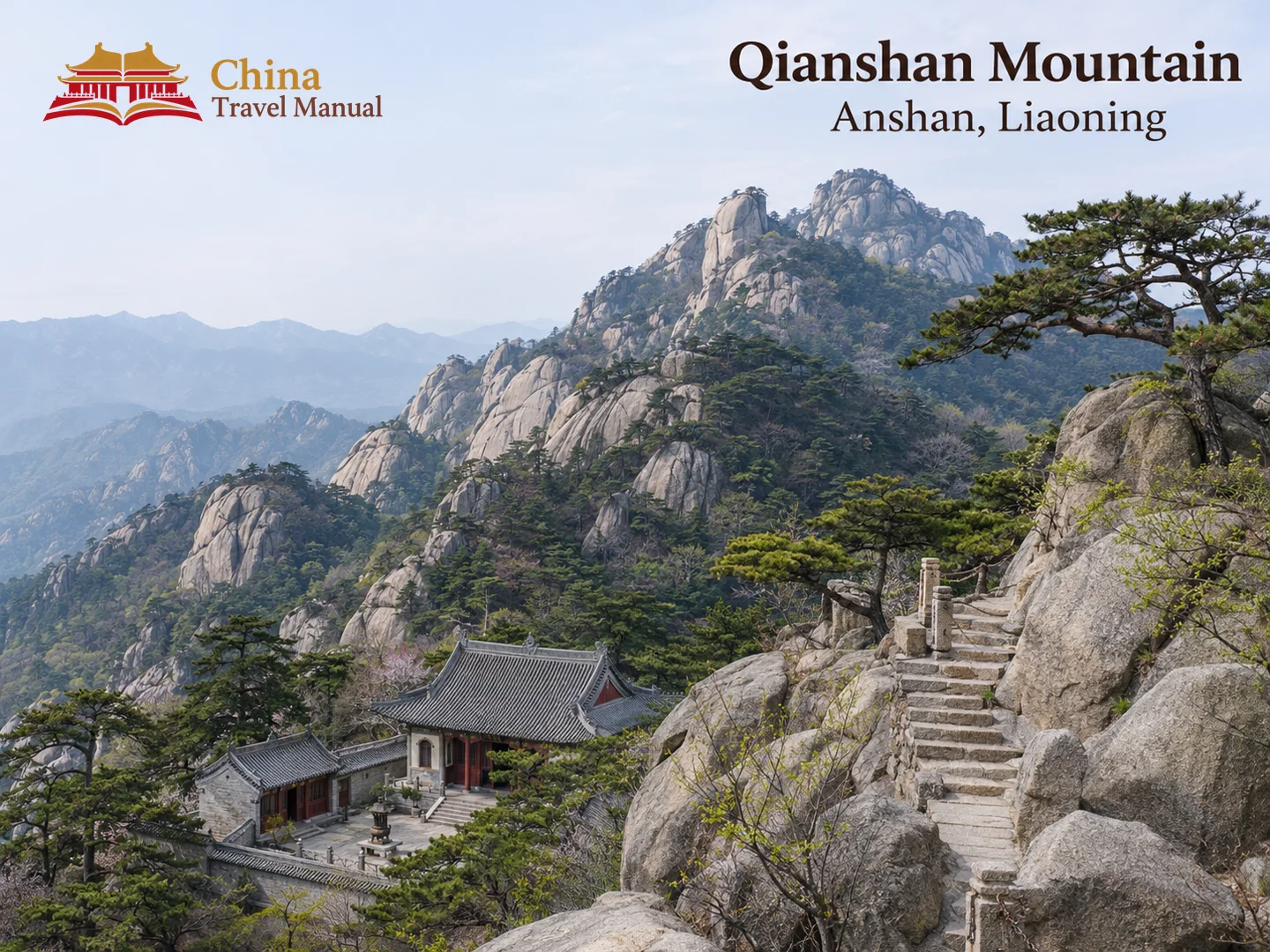
Qianshan Mountain in eastern Anshan has granite ridges, pine-covered slopes and temples built into the valleys below. The North Area suits a first visit. From the Main Gate you can plan a lower temple stop, a classic walk through narrow rock passages, or a longer ridge hike ending at Wufoding. The cableways cover different parts of the mountain, so choose a route before buying a ride.[1][2][3]
Getting to Qianshan’s Main Gate From Anshan
Search for 千山正门 or 千山风景名胜区北部景区 and verify the map pin near Qianshan East Road. The wider mountain area has separate sites and access points. Use the Main Gate for the North Area routes below. City buses 8 and 8A serve the mountain corridor. Check the branch and nearest stop in your map app, or take a taxi if you are arriving by rail and want to preserve hiking time.[2][6][7]
For station and hotel planning, see the Anshan travel guide. If combining the mountain with the Jade Buddha Temple, keep a separate block for the temple in town. An extended ridge hike is best given the day on its own.
Qianshan North Area Tickets and Cableway Hours
The park has different hours and standard prices for peak and off-peak seasons. Confirm last admission separately from the closing time, and check the cost and hours of any sightseeing vehicle or cableway when you arrive.[3][4][5][7]
| North Area season | Dates | Standard admission | Reported park hours |
|---|---|---|---|
| Peak | April 1 to October 31 | CNY 80 | 6 a.m.–6 p.m. |
| Off-peak | November 1 to March 31 | CNY 60 | 8 a.m.–5 p.m. |
The three cableways are Tianshangtian (天上天索道), Big Buddha (大佛索道) and Wufoding (五佛顶索道). Seasonal reporting lists a typical 9 a.m. to 3:30 p.m. window for the lifts. Check the one you need before setting out, as weather and maintenance can affect operations. Park buses also finish before the park closes in the published schedule. The park’s inquiries line is 0412-5081116.[3][4][5]
Compare North Area Walking Routes
| Route | Best for | Main commitment |
|---|---|---|
| Lower-temple out and back | A flexible visit with an early turnaround | Visit Wuliang Temple and assess the steps before continuing higher. |
| Classic temple and rock-path walk | Temples, granite passages and a half-day on steep stone steps | About three to four hours on foot along the park’s published circuit. |
| Wufoding ridge | A longer hike and wider mountain views | About five to six hours on foot, with separate descent planning. |
The Classic Temple and Rock-Path Walk
Begin at Wuliang Temple, where halls and courts rise in tiers along the hillside. Follow the park’s classic route through the east and west pavilions and the narrow Jia Bian Shi passage (夹扁石), then toward Tianshangtian. The published walk continues via the Yixiantian cleft (一线天) and descends toward Zuyue Temple. Paid transport can shorten parts of the approach, while the rock passages themselves involve steps and narrow stretches. Turn back from the lower temple if those sections are a poor fit for your group.[1][2][8]
The Longer Ridge to Wufoding
Follow the dedicated ridge route from the Tianshangtian side via Tianwaitian, then toward Wufoding (五佛顶). Use the route boards at junctions. The park’s published variants include descending by the Wufoding cableway or taking the earlier branch toward the Buddhist Longquan Temple (龙泉寺, Lóngquán Sì) from the Tianwaitian area. Ask which route is open, especially after snow or rain. Wufoding is the target for this hike. Xianrentai is the highest point of the wider Qianshan area and belongs to a different outing.[1][2][9]
Keep the hike as its own block in a Liaoning itinerary. If continuing south, check the Shenyang–Dalian rail corridor when choosing an onward train and verify whether the service stops at your current station.
FAQs About Qianshan Mountain
Is Qianshan suitable for visitors who want to avoid the steepest trails?
Yes. Choose a lower-temple visit with an early turnaround. Ask at the visitor center how much walking and how many stairs each stop requires.
Is the Wufoding cableway the same as the Tianshangtian cableway?
They are separate lifts that serve different parts of the North Area. Check the line name and its last departure before setting out.
Can you visit Qianshan in winter?
Yes, subject to day-of access. The North Area normally switches to off-peak operation from November through March, and winter weather may affect paths and vehicles.
Sources
[1] Liaoning Department of Culture and Tourism. Qianshan Scenic Area and its named rock features
[2] Anshan News. Park-recommended routes, durations and descent choices
[3] Anshan News. Peak-season ticket and operating information
[4] Anshan News. Recurring winter hours and North Area admission
[5] Sohu. November 2026 schedule adjustment and cableway information
[6] Anshan News. Bus 8 and 8A service on the Qianshan corridor
[7] Qunar Travel. Main approach address and admission information
[8] Global Daoism Archive. Wuliang Temple in Qianshan
[9] Liaoning Department of Culture and Tourism. Qianshan’s historic building complex and Longquan Temple





