

Quick Answer: Give the Hao River Your First Day
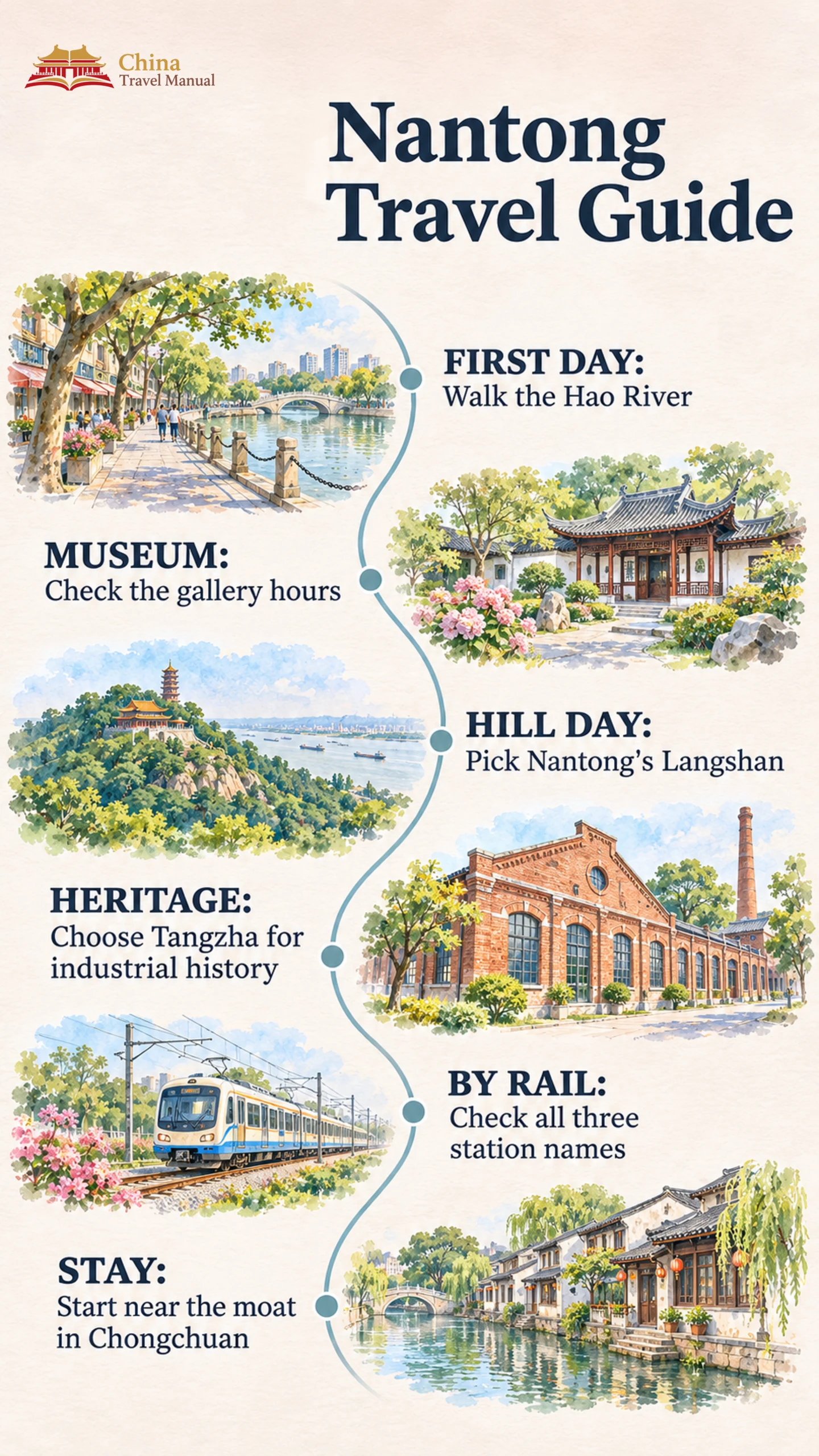
For a first visit to Nantong, start in central Chongchuan with the Hao River and Nantong Museum. You can see a useful stretch of the old moat and visit the museum in a day. With two days, add Langshan for a view toward the Yangtze or Tangzha for the city’s industrial history.[1][2][7]
- One day: Pair a museum visit with a walk along the Hao River.
- Second day: Choose Langshan for stairs and a river view, or Tangzha for former industrial sites.
- By train: Read the full station name. Nantong, Nantong West and Nantong East all handle passengers.
Nantong East began passenger service in October 2026. Confirm the station on your own ticket, especially if following an older itinerary.[4][5][6]
Central Nantong was laid out around a moat whose banks still work as an everyday walking route. The Yangtze waterfront and low hills are a separate part of the visit, farther south. Start with the central loop and add one area according to what you want to see. That gives the city a clearer shape than trying to get to the moat, the hills and the outlying heritage sites in one day.[1][7]
Make the Hao River and Museum One Walk
Start near Nantong Museum (南通博物苑), on the south side of the Hao River (濠河). The museum grounds and displays give context for Zhang Jian, a local industrialist and educator associated with many of Nantong’s institutions. Look up the gallery and garden hours separately. If you are visiting primarily for the exhibits, secure the museum slot and use the riverside walk to fill the time around it.[1][2][3]
Spend the rest of the visit on one or two river bends. The Hao River visitor guide helps you pick a start and decide whether a cruise is worth adding. To spend more time with local material culture, look for blue calico (蓝印花布, lányìn huābù), a patterned indigo textile, at the Blue Calico Museum. Go only if you have confirmed that museum’s own opening hours.[1][2]
Choose Langshan or Tangzha for Day Two
| Area | What brings you there | Practical choice |
|---|---|---|
| Hao River and the museum | Old moat, walkable bridges and museum grounds | Best for a day trip or a late arrival |
| Langshan (狼山) | Low wooded slopes, temple sights and broad views toward the Yangtze | Take a separate ride south. Ask about steps, gates and open temple areas |
| Tangzha (唐闸) | Nantong’s industrial past and Zhang Jian’s legacy beyond the museum | Pick a specific neighborhood or exhibition and confirm you can enter |
Langshan is the hill in Nantong spelled 狼山 in Chinese. Show that name with 南通 when mapping it. Give the hill its own half day if a climb and a waterfront walk are your priorities. Tangzha is useful if you enjoyed the museum’s local history and want to see how industry shaped a neighborhood. It can work in overcast weather if your chosen indoor venue is open.[1][7]
Read the Full Name of Your Nantong Station
Nantong Station (南通站) has a Line 2 metro connection. Nantong West (南通西站) is on Line 1, and the newer Nantong East (南通东站) is also on Line 2. Check the railway booking screen instead of relying on a city-level map pin. If you are changing trains across stations, leave room to reach the metro, transfer if needed and clear rail security at the second station.[4][5][6]
The October 28, 2026 rail change also moved Nantong Station access to its temporary North Square building. Use current railway and station directions for your departure. Agree on a pickup point rather than relying on an old South Square pin. For a late arrival, check the metro’s final departures for the station and direction you need.[4][5][6]
Stay in Chongchuan for a Short Visit
Near the old moat in Chongchuan, you can walk out for dinner or return to the museum without another long transfer. If you have an early train, check your hotel’s actual drive time to the departing station before booking. Map the hotel to the actual station entrance you plan to use.
Use the Jiangsu travel guide to place Nantong in a regional trip. Taizhou in Jiangsu offers another quieter stop if you are continuing west. The Shanghai travel guide is useful if you’re starting from Shanghai and deciding whether to spend a night in Nantong or make the visit part of an onward rail trip.
FAQs About Visiting Nantong
How many days do you need in Nantong?
One day works for the museum and a central Hao River walk. Two days let you add Langshan or Tangzha without rushing between districts.
What is the difference between Nantong, Nantong West and Nantong East stations?
They are distinct stations with different train schedules. Nantong and Nantong East are on Metro Line 2, and Nantong West is on Line 1. Confirm the full station name on your rail ticket.[4][5][6]
Is Nantong’s Langshan the same as the Hunan Danxia site?
Nantong’s 狼山 is a wooded hill by the Yangtze in Jiangsu. Hunan’s Danxia area is a different destination written 崀山. Add the city name to your map search.[1]
Can you visit the Hao River without taking a cruise?
Yes. Walk the public riverbanks and bridges. Cruises and paid venues have separate access and are optional.[1][2]
Sources
[1] Nantong Municipal Government. Hao River and Langshan visitor areas
[2] Nantong Municipal Government. Hao River museums and heritage route
[3] Shanghai Municipal Government. Nantong Museum and riverfront opening details
[4] People’s Daily Online. Nantong East opening and temporary North Square station building
[5] Nantong Rail Transit. Official metro service and station list
[6] Nantong Fabu. October 2026 metro connections to the three railway stations
[7] HeTuZhi. Old moat, Langshan and Tangzha choices





