

Quick Answer
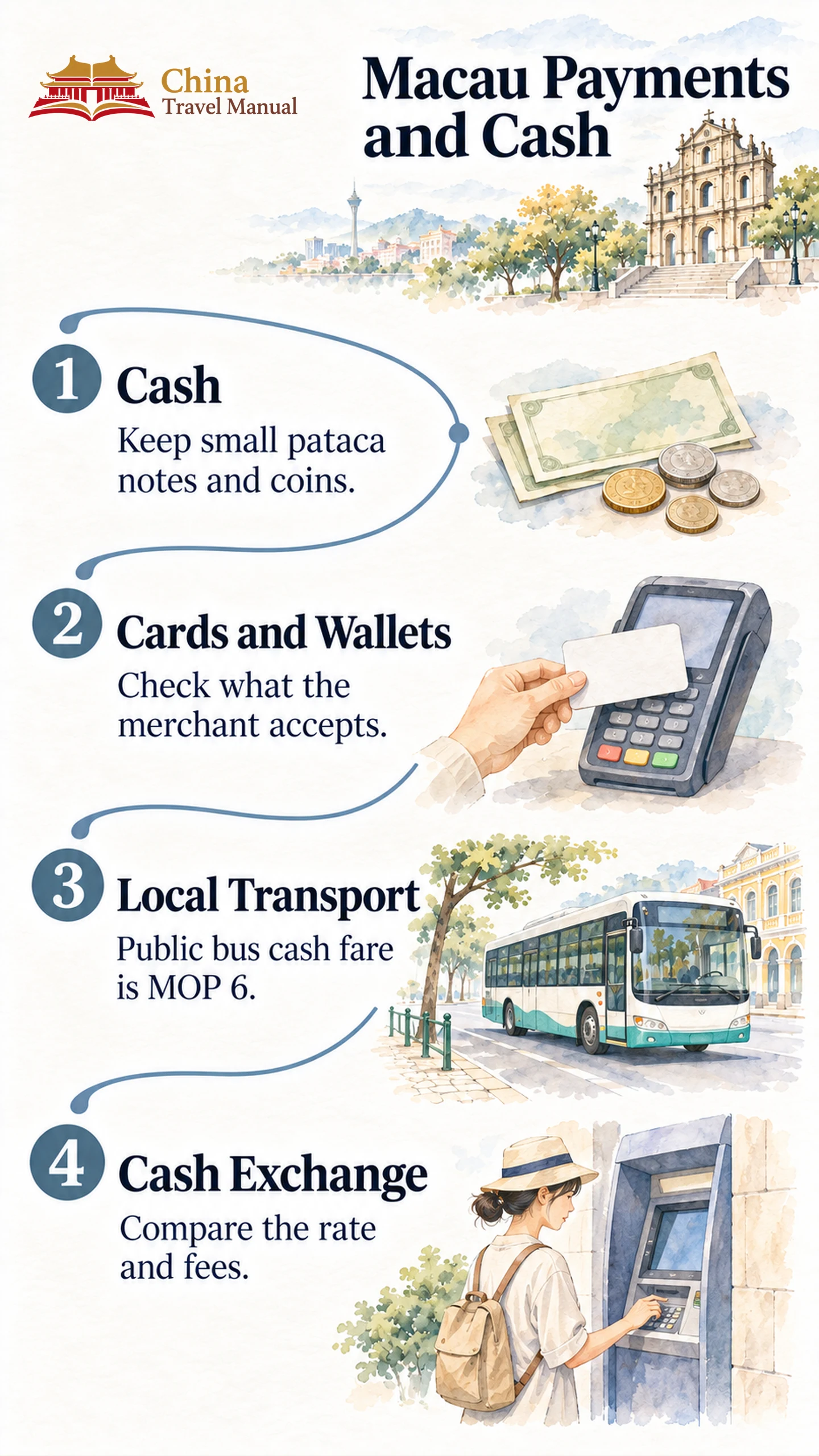
Carry small Macanese pataca notes and coins plus a physical international bank card. Macau’s official currency is the pataca (MOP). International cards and several overseas wallets are widely used, with acceptance depending on the business and the payment method. [1] Keep these options ready before leaving your hotel.
- For small purchases: Use patacas at food stalls and shops where card or QR acceptance is unclear.
- For larger bills: Use your physical card or phone at a terminal that supports the network.
- For local buses: Keep exact fare in coins or use Macau Pass or an approved ride code.
If you arrive with Hong Kong dollars, check what a shop will charge and whether you will get change in patacas.
The payment choice that works at a resort reception desk may fail at a bus door. It helps to set aside transport money first, then use your card or wallet for the rest of the day. A short stay and a visit with several daily bus rides also call for different amounts of cash.
Patacas, Hong Kong Dollars and Cash
The pataca is linked to the Hong Kong dollar. The tourism office quotes a reference of MOP 103.20 for HKD 100. [1] That figure is a currency reference. A shop may accept HKD at a different rate, including one-for-one, and may give change in MOP. Many visitor-facing businesses take HKD notes. Yuan is accepted in some places, with terms set by the business. [2] Ask before you order if HKD or yuan is all you have.
Get coins if you plan to use local buses. A MOP 5 coin plus a MOP 1 coin covers the standard cash fare for one rider. Small notes are useful at bakeries and market counters. Break a large note at a staffed business if you can, and keep your remaining HKD separate from patacas if you are returning to Hong Kong. The Hong Kong to Macau transport guide covers the separate crossing fare options.
Using International Cards and Mobile Wallets
At hotels, malls and established restaurants you will often see Visa, Mastercard, UnionPay and other international card networks. Look for the network symbol or ask at the counter. If you plan to tap with Apple Pay or another phone wallet, check that your card can be used abroad and that the terminal accepts that card network. [1] Bring the physical card for a terminal where tapping does not work.
A QR wallet works under a different set of rules. Some Macau merchants accept versions of Alipay and WeChat Pay from Hong Kong and mainland China. The tourism office also lists services such as GCash, Touch ’n Go eWallet and KakaoPay. Acceptance depends on the merchant and app. [1] Check that your particular account supports paying in Macau and look for your wallet’s symbol before trying a QR code. The Macau mobile internet guide can help you arrange data for apps that need it.
How to Pay for Buses, Light Rail and Taxis
| Local trip | What to have ready |
|---|---|
| Public bus with cash | MOP 6 per ride in exact change |
| Public bus with a transit card | A physical Macau Pass with enough value |
| Public bus with a QR wallet | A supported ride code generated in your payment app |
| Light rail | Macau Pass or a single-journey ticket from the counter or machine |
| Taxi | Patacas for the fare and any applicable extra charges unless the driver confirms another method |
The tourism office lists a MOP 6 public bus cash fare with no change given. [3] For QR payment, the Transport Bureau lists specific ride codes for mainland and Hong Kong versions of Alipay and WeChat Pay and eligible UnionPay QR accounts. Its listed fare for these visitors’ options is MOP 6 per ride without a transfer discount. [4] Check for the ride code in the app before you queue. Bring coins as a backup for the bus and ask a taxi driver about payment before setting off if you need to use a card.
Macau Pass lists the regular stored-value card at MOP 130, which includes MOP 100 to spend and a MOP 30 card charge. [5] The issuer can refund the unused balance of a regular retail card at a customer service center, while the card charge stays paid. [8] Compare the up-front cost with your planned rides and how easily you can use or refund the balance.
On the LRT, the staffed station counter lists cash, credit cards and selected QR choices. Vending machines accept MOP cash or an LRT card, while a compatible Macau Pass taps directly at the gates. If you only have Hong Kong dollars or yuan, use the staffed counter and ask whether it accepts the particular notes or coins you have. [6] See getting around Macau for when to choose a bus, taxi or train.
Where to Exchange Money or Use an ATM
You can exchange money at Macau airport, piers, banks and licensed money changers. Bring a card with overseas withdrawals enabled and check the ATM’s network symbol. If offered several currencies, choose the cash you can use for the trip and check the actual amount on the screen. An ATM may also offer to bill the withdrawal in your home currency. Look at its exchange rate and any markup before accepting. [7] Your own card issuer may charge a separate fee.
For a day trip, get enough small cash for your expected transport and purchases before leaving a busy arrival area. If you are staying longer, start with one day’s spending in cash and use the next day to see where you actually need it.
FAQs About Macau Payments and Cash
Can I use Hong Kong dollars in Macau?
Many tourist-facing businesses accept HKD notes. Ask what rate applies, whether the note is accepted and whether change comes back in patacas. Keep patacas for local transport and small purchases.
Do I need to buy a Macau Pass for a day trip?
Exact cash or an approved ride code can be simpler for one or two rides. Consider a Macau Pass if you plan to take several buses and the LRT or expect to use the credit at participating shops.
Can I use Alipay or WeChat Pay in Macau?
Many merchants support eligible mainland China or Hong Kong wallet versions. Check the app’s cross-border settings and the merchant’s logo. For a local bus, look for the dedicated ride code.
Sources
[1] Macao Government Tourism Office. Currency, card networks and visitor payment options
[2] AirAsia MOVE. Hong Kong dollar and yuan use at Macau merchants
[3] Macao Government Tourism Office. Macao local transportation and cash bus fare
[4] Macao Transport Bureau. Approved bus payment methods and ride codes
[5] Macau Pass. Standard retail card fee and top-up
[6] Macao Light Rapid Transit. Ticket, gate and station payment options
[7] Visa. Dynamic currency conversion at merchants and ATMs
[8] Macau Pass. Retail card balance refunds





