
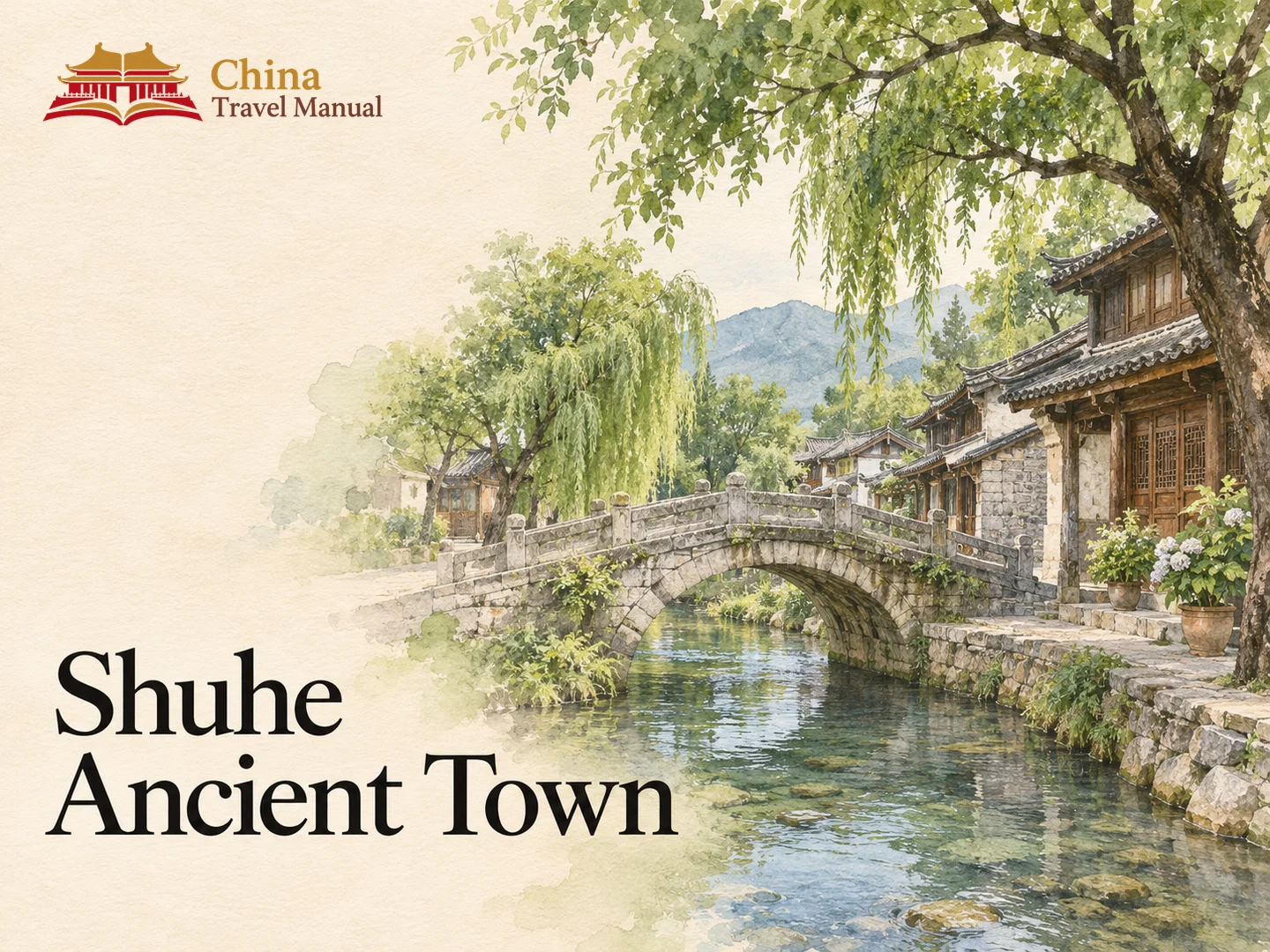
Quick Answer: How to Visit Shuhe Ancient Town
Shuhe Ancient Town (束河古镇, Shùhé Gǔzhèn) is one of the three parts of UNESCO’s Old Town of Lijiang, with its own streets and visitor approaches.[1]
- Time: Allow two to three hours for the main walk. Add time for lunch or a museum.
- Route: Walk from Sifang Street (四方街, Sìfāng Jiē) west across Qinglong Bridge (青龙桥, Qīnglóng Qiáo), then follow the stream north to Jiuding Pool (九鼎龙潭, Jiǔdǐng Lóngtán).[2][3]
- Tickets: Ask about current entry and reservation arrangements. The old-town maintenance regulation includes the Shuhe heritage component.[5]
- Transport: Use the exact entrance you want and save a car pickup or bus stop for the return.[6]
Visit in daylight if the springs and bridge are your priorities. Leave more time if you want to add the village murals in Baisha.
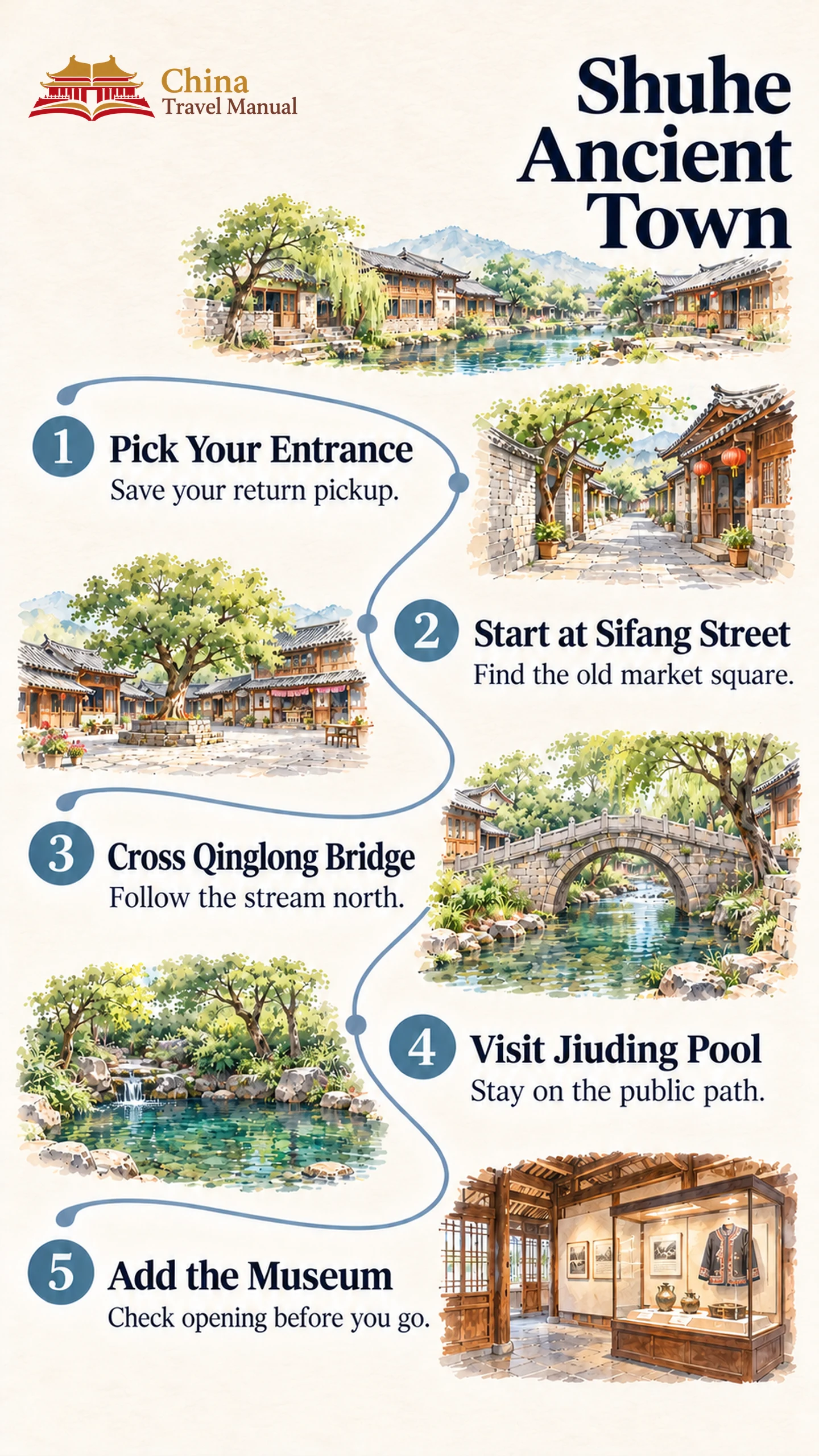
Give Shuhe a few hours if you want a walk through historic lanes and beside running water. Start at its market square and head west across the stone bridge. Follow the stream toward the springs, then add a museum or lunch if you have the time. This route works as a half-day trip from central Lijiang.
Pick an Entrance and Check Access
From Dayan’s old town, take a taxi or ride-hail to the Shuhe entrance nearest the part you want to walk. Ask your driver whether the meeting point can be reached by car later. A local 2025 bus announcement describes a loop from Shuhe’s south entrance via the snow mountain sightseeing train station and Baisha. Verify the current service or use the Lijiang transport guide to compare options.[6]
The 2025 municipal rule provides for a CNY 50 conservation payment per liable visitor, with one payment valid for 365 days. That applies to the covered heritage components and is separate from any individual venue admission. Check current collection and reservation requirements and carry proof if you have already paid. Use the Lijiang travel budget guide to track the fee separately.[5]
Walk From Sifang Street to Qinglong Bridge and Jiuding Pool
Use the market square as your first landmark. Walk west to the old stone bridge and look at how the stone crossing connects the square with the lanes beyond. The bridge and square form part of a surviving historic route identified in local heritage reporting. If you have time, take one side lane near the square before continuing.[3]
After the bridge, follow public paths north along the water toward the spring pools. The local newspaper describes the approach from the square through the smaller settlement across the bridge. Look for the signed pool rather than assuming every channel leads there. Stay by the edges open to visitors and respect places where residents use the water.[2]
Use the same route in reverse if you want a simple return. Stone paving and bridge steps can be uneven. If those are a problem, ask staff or your host which approach has fewer steps and stay around the square if needed.
Add the Tea Horse Road Museum if Open
Check the Tea Horse Road Museum (茶马古道博物馆, Chámǎ Gǔdào Bówùguǎn) if you’d like context for Shuhe’s role on trading routes. Yunnan Daily identifies the museum as a Shuhe stop with exhibits about the route’s history and trade. Confirm that it’s open and check admission before you plan your walk around it.[4]
When to Choose Shuhe Over Dayan or Baisha
Choose Shuhe for the bridge, spring water and a manageable half-day walk. Dayan gives you a larger network of lanes and more options for an evening visit. Visit Baisha Village if the mural halls are a main priority. To visit both villages, allow time for a transfer between them and schedule the mural complex during its open hours. The day trips from Lijiang comparison covers other outings.[1][6]
FAQs About Visiting Shuhe Ancient Town
How long do you need in Shuhe?
Two to three hours works for the square, the bridge and the springs. Give yourself a half day if you want a museum stop or an unhurried lunch.
How do you get to Shuhe from Dayan?
A taxi or ride-hail can save time if you want a particular entrance. If using a bus, check the live outbound and return stops.[6]
Is there a ticket for Shuhe Ancient Town?
Check the current town arrangements. The municipal conservation payment can apply to Shuhe’s heritage area, and individual venues may have their own admission.[5]
Can you combine Shuhe and Baisha?
Yes. Allow for separate visits and the transfer between them. Put the mural halls first if their last admission is the tightest part of the plan.
Sources
[1] UNESCO World Heritage Centre. Old Town of Lijiang and the Shuhe housing cluster
[2] Lijiang Daily. Walking description from Sifang Street to Jiuding Pool
[3] Lijiang Media. Historic road and bridge among Lijiang’s documented heritage sites
[4] Yunnan Daily. Regional museum guide including the Shuhe Tea Horse Road Museum
[5] Lijiang Municipal Government. Old-town maintenance fee regulation reproduced by Red Star News
[6] Lijiang Daily. Local sightseeing bus route connecting Shuhe and Baisha





