

Quick Answer: How to Spend 3 Days in Lijiang
Use Day 1 for Black Dragon Pool and Dayan Old Town, Day 2 for one Jade Dragon Snow Mountain cableway plus Blue Moon Valley, and Day 3 for Baisha and Shuhe. Stay near the vehicle-accessible edge of Dayan Old Town for all three nights.
| Day | Default plan | Effort | Hotel base |
|---|---|---|---|
| Day 1 | Black Dragon Pool, Dayan Old Town, optional Mu Residence | Light to moderate | Edge of Dayan Old Town |
| Day 2 | One mountain cableway and Blue Moon Valley | Moderate; high altitude possible | Return to the same hotel |
| Day 3 | Baisha in the morning and Shuhe in the afternoon | Light to moderate | Same hotel or prepare to depart |
Do not add Tiger Leaping Gorge after Baisha and Shuhe. If the gorge matters more, replace all of Day 3. These are three full sightseeing days; arrive the previous evening and ideally leave the following morning.
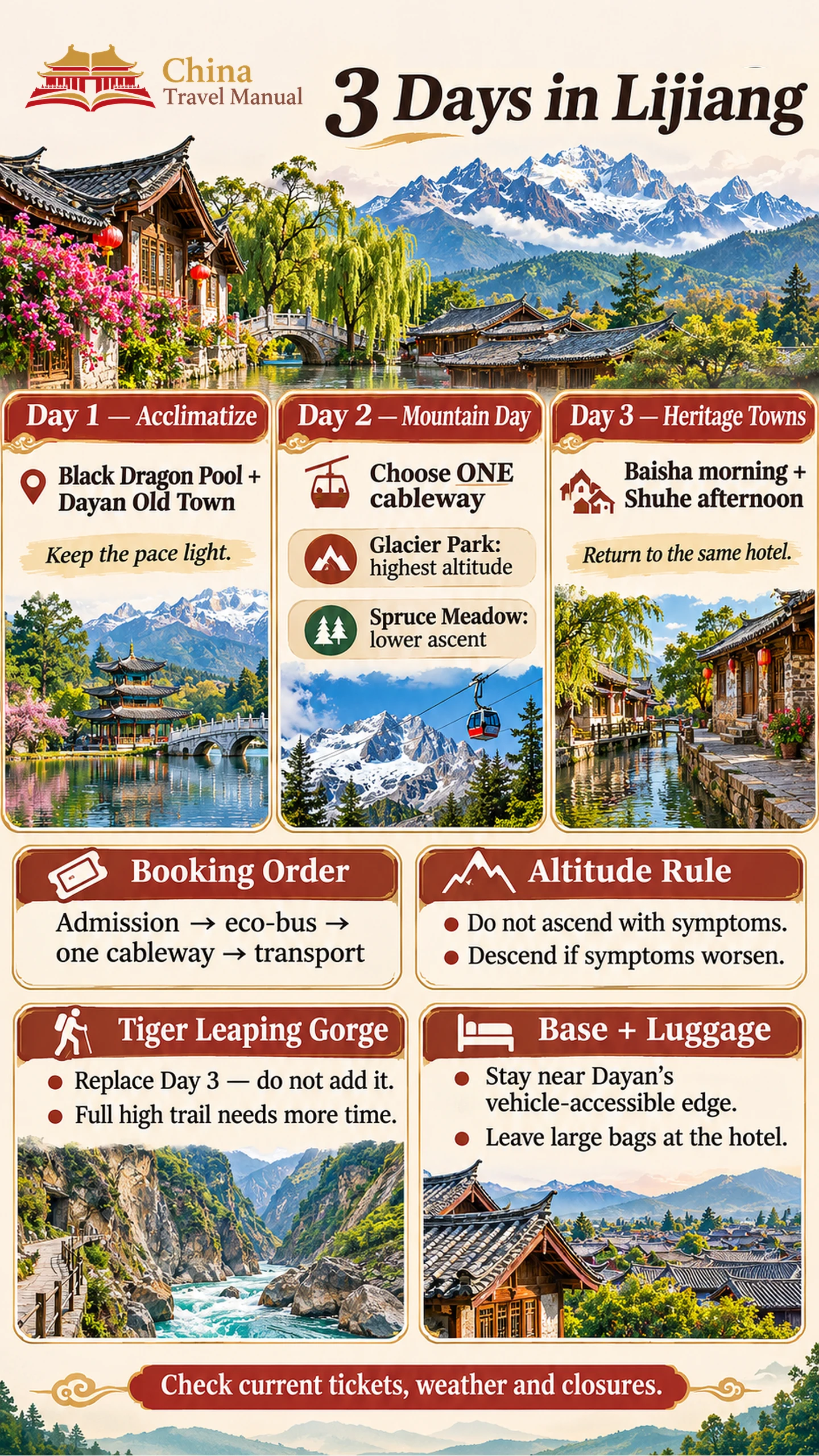
Three full sightseeing days are enough for Lijiang’s essential first visit: one gentle heritage day, one complete mountain day, and one day in the quieter northern settlements. They are not enough for every distant lake, village, and gorge around northwest Yunnan.
This itinerary keeps one hotel base, gives your body time to adjust before a rapid ascent, and treats tickets, transfers, queues, and weather as real parts of the day. For wider destination context, start with the Lijiang travel guide.
Set Up the Trip Before Day 1
Count Three Full Sightseeing Days
A late arrival followed by a short walk through the Old Town is not Day 1. The reliable plan is to reach Lijiang the night before, sleep, complete three full days, and leave on a fourth morning. A late departure after Day 3 can work, but only with a generous buffer.
Plan from your hotel door, not from a map’s driving estimate. Add the airport or railway transfer, the walk from a vehicle drop-off point, check-in, and the slow movement of luggage over stone lanes. If your train or flight arrives after dark, keep that evening free instead of forcing Mu Residence or a timed performance into it.
Avoid a tight flight or train after Jade Dragon Snow Mountain. Cableway suspensions, queues, internal buses, and city traffic make the return time unpredictable. If you must depart on Day 3, Baisha and Shuhe are easier to shorten than the mountain day.
Choose One Practical Hotel Base
The best base for this itinerary is usually just outside Dayan Old Town, close enough to walk in but near a road where a taxi can stop. You get evening access without dragging a suitcase deep into the pedestrian lanes.
| Location | Best for | Main trade-off |
|---|---|---|
| Inside Dayan | Light luggage and maximum evening atmosphere | Uneven lanes, steps, difficult vehicle access, possible bar noise |
| Edge of Dayan | Most first-time visitors | Less romantic than a deep-lane guesthouse, but far easier for transfers |
| Shuhe or Baisha | A quiet, slow stay focused on the north | Less convenient for this three-day sequence and departure transport |
Travelers with large bags, older relatives, or an early departure should favor a north- or south-edge property with a confirmed drop-off point. Ask for the hotel’s full Chinese name and exact vehicle meeting point. Do not move hotels for Day 3. The time lost to packing and check-in is greater than the small transport saving. See where to stay in Lijiang for a fuller area comparison.
Book Jade Dragon Snow Mountain First
The mountain is the least flexible part of the trip. Lock it before paying for optional Old Town attractions. The current official system separates the scenic-area ticket and eco-bus from cableways, sightseeing transport, and performances; key products can be released up to seven days ahead, while the current on-site scenic-ticket location is the new visitor center near Baisha. [2]
Use this order:
- Choose the mountain date.
- Reserve the scenic-area admission and required eco-bus product.
- Choose and reserve one main cableway.
- Arrange transport from Lijiang to the correct visitor center or pickup point.
- Add flexible tickets such as Mu Residence or the Baisha murals only afterward.
Foreign-passport fields and payment options can change. Complete account and identity checks before the release time, carry the original passport used for the reservation, and recheck the official notice one day before travel. Do not rely on a guesthouse or private seller claiming a guaranteed Glacier Park ticket. The separate Jade Dragon Snow Mountain ticket guide explains the booking workflow in more detail.
Day 1: Black Dragon Pool and Lijiang Old Town
Keep Day 1 deliberately easy. Lijiang sits around 2,400 meters above sea level, so a gentle walking day is more useful than an immediate high-altitude ascent.
Start at Black Dragon Pool in the morning. If the sky is clear, the park offers a classic view toward Jade Dragon Snow Mountain, but the route still works in cloud because the water system and garden are the main experience. From the park, follow the waterways south into Dayan instead of taking a vehicle to a second entrance.
Spend late morning and early afternoon in the northern lanes, then continue toward Sifang Street. Eat before the busiest lunch period if you prefer a calmer stop. Dayan is an open historic district, not a single gated attraction, so there is no one correct entrance or mandatory loop.
Add Mu Residence only if you want an architectural visit and still have energy. It requires a separate ticket and more walking. Lion Hill is the first item to remove for sore knees: the climb is short on a map but involves sustained uphill lanes and steps. Leave time for an unhurried dinner and an evening walk rather than chasing every named viewpoint.
The UNESCO property called the Old Town of Lijiang has three components: Dayan, which includes Black Dragon Pool, plus Baisha and Shuhe. Jade Dragon Snow Mountain is not part of that World Heritage property. [1] This is why Day 3 is more than a pair of random suburban stops.
Practical Day 1 rhythm:
| Time block | Plan | Remove first if tired |
|---|---|---|
| Morning | Black Dragon Pool and waterway walk | Extra garden loops |
| Midday | Northern Dayan lanes and lunch | Shopping detours |
| Afternoon | Sifang Street and optional Mu Residence | Mu Residence |
| Evening | Dinner and Old Town lights | Lion Hill or a late show |
Wear shoes with grip. Dayan’s polished stone becomes slick in rain, and wheeled luggage is awkward even in dry weather. Keep the day low intensity, drink normally, avoid excessive alcohol, and note any headache, nausea, dizziness, or unusual fatigue before deciding whether to ascend on Day 2.
Day 2: Jade Dragon Snow Mountain and Blue Moon Valley
Give the mountain a full day. Leave early, but calculate from the hotel door: walking to the pickup point, road travel, ticket checks, eco-bus queues, the cableway line, and the return to Lijiang all count. Do not schedule a fixed evening departure.
At the visitor center, confirm that your reserved cableway is operating before boarding the internal bus. Choose one main ascent:
| Cableway | Choose it when | Main limitation |
|---|---|---|
| Glacier Park | High elevation is the priority, conditions are open, and everyone feels well | Fast ascent, strongest altitude exposure, weather-sensitive operations |
| Spruce Meadow | You prefer forest, meadow, and mountain views with a lower ascent | It does not reach the high Glacier Park platform |
| Yak Meadow | Only when the current official notice confirms reopening, tickets, and transport | Operating status and total travel time are less predictable |
Do not attempt all three. Separate boarding points and internal transport make that plan exhausting, while the views become less rewarding when hurried. If Glacier Park is sold out, Spruce Meadow is a valid mountain day, not a failed substitute.
Keep the day in four broad stages rather than assigning a fixed minute to every stop. Use the first stage for hotel pickup, admission checks, and the eco-bus; the second for your reserved cableway; the third for lunch and Blue Moon Valley; and the fourth for the full return to your hotel. This structure gives you somewhere to absorb a queue without sacrificing the return vehicle. If the cableway is delayed, remove an optional valley cart or shorten photo stops before changing your confirmed ride back to Lijiang.
Pack for two climates. Carry the passport, reservation records, water, sun protection, a warm windproof layer, and any personal medication in a small day bag. Large bags slow every transfer and may not be accepted on all internal services. Buy snacks before the busiest transfer period, but do not treat eating quickly as a substitute for a real rest after the rapid ascent.
After the cableway, eat and rest before Blue Moon Valley. Its water color changes with light, rainfall, sediment, and season, so it may not match saturated promotional photos. Use the eco-bus stops strategically and pay separately only for optional sightseeing transport you actually need. The base scenic ticket does not automatically include every cableway, train, electric cart, or performance. [2]
Altitude is the non-negotiable decision. Headache with nausea, dizziness, loss of appetite, or unusual fatigue can signal acute mountain sickness. Do not go higher while symptoms remain. If symptoms worsen, descend and seek help; supplemental oxygen is not a reason to continue ascending. Gradual ascent and light activity during the first 48 hours reduce risk, but fitness does not protect a traveler from altitude illness. [4]
Anyone with significant heart or lung disease, severe anemia, pregnancy, or a previous serious altitude reaction should seek individual medical advice before this trip. This article cannot determine personal fitness for rapid ascent.
Use this decision order on the day:
- All well and the cableway is open: Follow the reserved route, move slowly, and keep the Blue Moon Valley visit flexible.
- Mild symptoms in Lijiang before departure: Do not ascend merely because the ticket is expensive; ask the official service point about your options.
- Symptoms during ascent: Stop climbing, tell staff, and descend if symptoms do not resolve or become worse.
- Strong wind, lightning, or snow closure: Follow the official suspension. Never seek an unmarked path around a closed route.
Return to the same hotel. A warm meal and early night are more useful than adding a second attraction after a long mountain day.
Day 3: Baisha and Shuhe Ancient Towns
Use the final day to complete the other two historic components without changing hotels. Begin in Baisha, then move to Shuhe after lunch or in early afternoon.
Baisha is the better morning stop. Its compact historic core, Naxi residential fabric, and mountain backdrop reward slow walking. The Baisha murals are a separate, optional ticketed visit; check current opening hours before building the morning around them. People still live beyond the commercial streets, so treat residential courtyards as private unless an entrance is clearly open to visitors.
Do not describe Baisha as an untouched village with no tourists. It has cafés, shops, and busy periods. Its value is the different scale and settlement pattern, not a promise of solitude.
Shuhe works well for lunch, an afternoon rest, and a longer wander. It is quieter in many lanes than Dayan, but it is not simply a miniature version of Dayan. Waterways, residential pockets, commercial streets, and access routes form a different walking experience. Weekends and holidays can still be crowded.
| Stop | Best use | Optional paid item | Main caution |
|---|---|---|---|
| Baisha | Morning heritage walk and mountain backdrop | Baisha murals | Private homes are not visitor attractions |
| Shuhe | Lunch, afternoon lanes, relaxed final walk | Individual venues only | Crowds still build on weekends and holidays |
Tourist bus routes and customized passenger services connect Lijiang with Jade Dragon Snow Mountain, Baisha, Shuhe, and other major sights, but schedules and capacity can change during peaks. [3] A taxi or ride-hailing car is easier when two or more people share the fare. Count the walk to the pickup point and the final walk inside each pedestrian area.
Before leaving Baisha, decide whether you still want a full Shuhe walk or only lunch and one short loop. This is especially useful when Day 2 was tiring. Set the return pickup on a vehicle-accessible road outside the pedestrian core, and allow time to find the correct car. If you are leaving Lijiang that evening, retrieve luggage before the rush and treat Shuhe as the flexible part of the day.
Do not add Yuhu Village or Lashihai merely because it looks close on a map. If Yuhu is a priority, replace Shuhe. Keeping two stops preserves time for lunch, weather delays, and a calm return. Ideas for the evening are covered in the Lijiang food guide.
Tickets, Transport and Booking Order
There is no single pass that automatically covers this itinerary. Treat every product as a separate line until the official checkout page explicitly shows a bundle.
| Item | When to arrange it | Included automatically? |
|---|---|---|
| Jade Dragon Snow Mountain admission | First | No; confirm the current admission product |
| Scenic eco-bus | With mountain admission when required | Separate product under current rules |
| One main cableway | Immediately after choosing the date | No |
| Lijiang–mountain transport | After the ticket time is fixed | No |
| Blue Moon Valley sightseeing train or cart | Only if useful on the day | No |
| Mu Residence and Baisha murals | Later; these are flexible | No |
| Tiger Leaping Gorge day trip | Only if replacing Day 3 | No |
Official 2026 guidance says mountain admission and eco-bus are required base products, while cableways, performances, electric transport, and the sightseeing train are optional purchases. It also directs general on-site scenic-ticket sales to the new visitor center rather than the former southwest-gate sales point. [2]
Carry the original passport used in every booking. Save confirmations offline, but remember that a screenshot is only a record; staff may need the actual document and live reservation. Recheck refund deadlines, boarding windows, and weather notices before paying. If a foreign-passport field fails, use the official service channel rather than an unverified resale offer.
For ground transport, use official tourist buses, licensed taxis, a correctly configured ride-hailing app, or a prearranged licensed vehicle. A driver is not automatically an English-speaking guide. Exact pickup points and schedules belong in the getting around Lijiang guide.
Getting Around, Luggage and Departure Planning
Dayan’s inner lanes are pedestrian territory. Leave large luggage at the hotel and carry only a day bag. Confirm whether the property can receive a car at its door; many cannot, even when the booking page says “Old Town.”
Use these rules:
- Mountain day: Take no large suitcase. You need free hands for buses, stairs, queues, and changing weather.
- Baisha and Shuhe day: Keep the same hotel. Moving luggage between settlements creates no useful sightseeing advantage.
- Taxi or ride-hailing pickup: Save the Chinese place name and a map pin. Meet the driver on a road where stopping is legal.
- Airport or railway departure: Add the Old Town walk, vehicle wait, road traffic, terminal entry, and check-in or railway security.
- Late arrival or early departure: Confirm the vehicle-accessible meeting point with the hotel before travel.
If Day 3 ends with a flight or train, remove Shuhe first and return to collect bags early. Do not plan from the fastest quoted drive. The Lijiang airport transfer guide provides the full terminal-to-city decision framework.
Weather, Altitude and Physical Effort
Lijiang has a marked wet season, broadly from May through October, and a drier season from November through April. Mountain conditions can still change quickly in any month. [5] Do not promise yourself snow, sunrise color, a clear summit, or blue water on a fixed date.
| Condition | Best adjustment |
|---|---|
| Clear with good visibility | Keep the reserved mountain route and Blue Moon Valley |
| Low cloud or light rain; area remains open | Accept limited peak views and shorten exposed high-altitude walking |
| Strong wind, lightning, or heavy snow | Follow cableway and trail closures; use a lower town day instead |
| Persistent heavy rain | Favor sheltered Old Town visits and reassess Tiger Leaping Gorge |
| Altitude symptoms | Stop ascent, rest, descend if worse, and seek medical help when needed |
None of the three historic settlements is fully barrier-free. Stone slopes, thresholds, drains, steps, and crowds affect wheelchairs and strollers. Cableways reduce vertical climbing but do not remove station stairs, queues, or walking at altitude.
Older travelers, young children, and anyone with knee problems should skip Lion Hill, limit steep lanes, and choose the lower mountain option if medically appropriate. Waterproof shoes with grip matter more than fashionable hard soles. Keep dry layers in the day bag even when Lijiang city feels warm.
Should You Replace Day 3 with Tiger Leaping Gorge?
Replace Day 3 only when canyon scenery matters more than completing Baisha and Shuhe. A standard viewpoint-focused excursion can fit a long day from Lijiang. The full high trail or a demanding Middle Gorge route does not belong in this relaxed three-day plan.
| Priority | Best choice |
|---|---|
| Complete the core Lijiang heritage sequence | Keep Baisha and Shuhe |
| See the gorge without a multi-day trek | Replace all of Day 3 with an official, transport-secured day trip |
| Hike the full high trail | Add at least one more sightseeing day and plan overnight logistics |
| Keep both the settlements and gorge | Extend the trip to four days or more |
Choose the gorge only after confirming the road, scenic-area access, return transport, and weather. Heavy rain can raise river levels, trigger rockfall or debris-flow risks, and temporarily block paths; a July 2026 incident closed part of a trail after a sudden rise in water. [6] Never bypass a closure or follow an unofficial detour.
This replacement is unsuitable for travelers with limited mobility, young children, unstable weather, or a fixed same-evening departure. It is also a poor place to improvise transport: arrange the return before leaving Lijiang.
FAQs About a 3-Day Lijiang Itinerary
Is Three Days Enough for Lijiang?
Yes, if they are three full sightseeing days. You can cover Dayan, Jade Dragon Snow Mountain, Blue Moon Valley, Baisha, and Shuhe at a sensible pace. Three days are not enough for those places plus Lugu Lake, a full Tiger Leaping Gorge trek, and several remote villages.
Should You Visit Jade Dragon Snow Mountain on Day 1?
Not after arriving from low elevation. Use Day 1 for gentle walking in Lijiang, then assess how everyone feels before the rapid ascent. A reserved ticket does not make it safe to continue higher when symptoms appear.
Should You Stay Inside Lijiang Old Town?
Stay inside only if atmosphere matters more than easy vehicle access and your luggage is light. For most first-time visitors, a hotel at Dayan’s edge offers the best balance of evening access, quieter sleep, and simpler mountain and departure pickups.
Can You Visit Lijiang Without a Private Guide?
Yes. Independent travel is practical if you reserve the mountain admission and one cableway, carry your passport, confirm pickup points, and keep a weather backup. A hired driver provides transport unless guiding is explicitly included.
Can You Visit Tiger Leaping Gorge in the Same Three Days?
Yes, but only by replacing Baisha and Shuhe on Day 3. Do not add the gorge after those towns. A full high-trail hike needs more time, overnight planning, and a separate safety review.
Sources
[1] UNESCO World Heritage Centre. Old Town of Lijiang
[2] Jade Dragon Snow Mountain Scenic Area. 2026 Visitor and Ticket Guidance
[3] Yunnan Department of Transport. Lijiang Tourism Passenger Services
[4] U.S. Centers for Disease Control and Prevention. High-Altitude Travel and Altitude Illness
[5] Yunnan Department of Natural Resources. Climate Profile for Lijiang
[6] Yunnan Emergency Management Department. Rain, Flash-Flood, and Debris-Flow Travel Safety





