
Quick Answer: How Should You Visit Kumbum Monastery?
From central Xining, allow about three hours at the monastery. Start at the visitor entrance to Kumbum Monastery (塔尔寺, Tǎ’ěr Sì), then see the Great Golden Tile Hall (大金瓦殿, Dà Jīnwǎ Diàn) and any of the three traditional arts on view that day.[1][2][3]
- Where to go: Use 56 Jinta Road, Huangzhong District. Show 塔尔寺 to a driver and check the drop-off for the visitor entrance.[3]
- Standard admission: Published regular fares are ¥70 from April through October and ¥40 from November through March. Check dated discounts, tickets and last admission.[3][4][5]
- What to prioritize: See the main hall connected to Tsongkhapa (宗喀巴, Zōngkābā), then look for the three traditional arts.[1][2]
- Inside the complex: Follow route, photography and worship instructions at each hall. Allow space for people who came to pray.[1][3]
The temple remains a working religious site. You can see the courtyards and open visitor halls while respecting restrictions on worship and residential areas.[1][3]

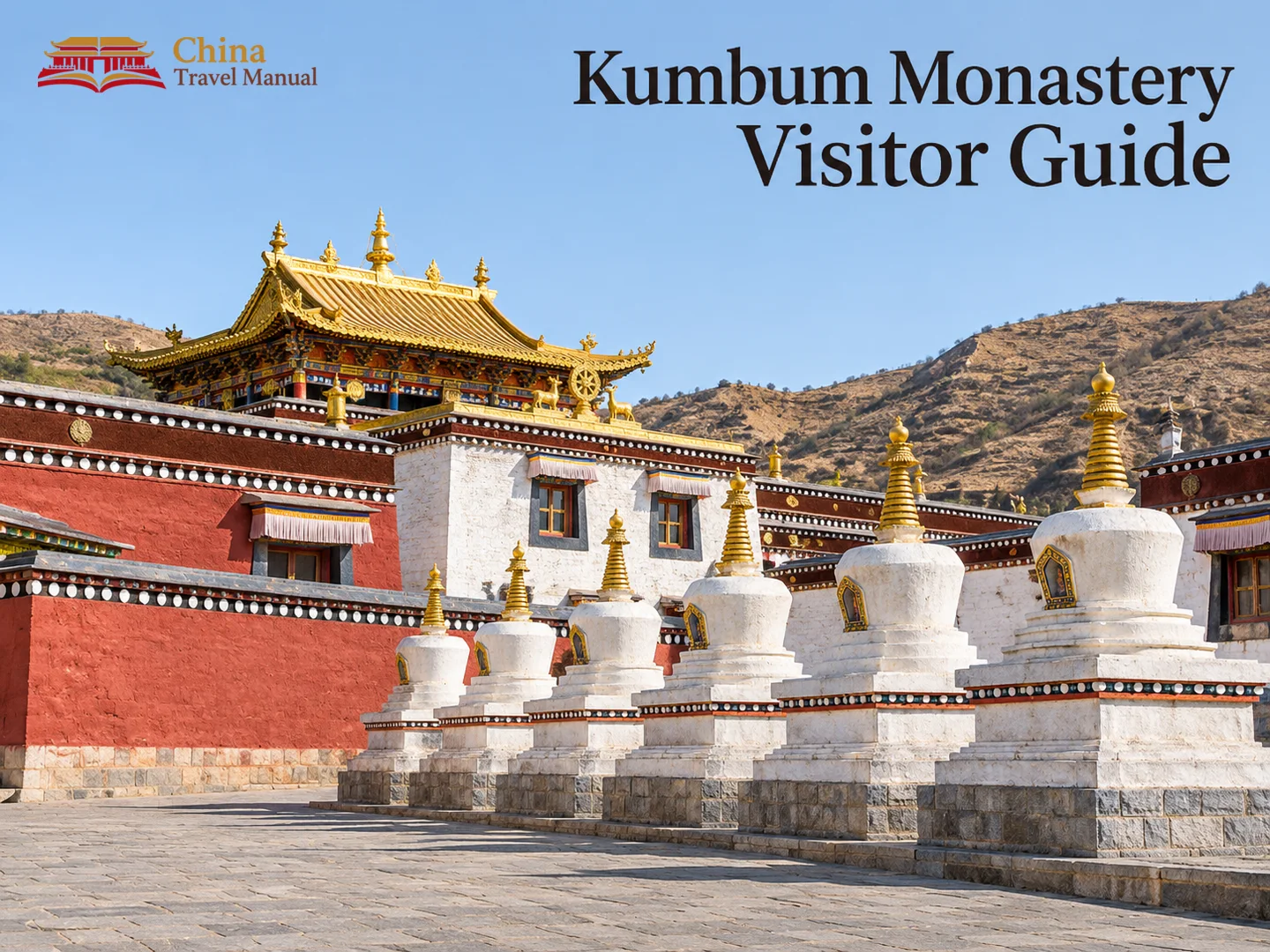
Kumbum Monastery, also called Ta’er Temple, developed at the birthplace of Tsongkhapa, the founder of the Gelug school of Tibetan Buddhism. The monastery’s mix of courtyards, stupas and assembly buildings takes time to read. Pick a few interiors you want to see instead of racing through every building.[1][2]
Start With the Great Golden Tile Hall
Make the golden-roofed hall the first priority on your visitor map. It is central to the monastery’s association with Tsongkhapa. The gilded roof and surrounding courtyards are worthwhile even if visitor flow or a ceremony limits time inside.[1][2]
Walk through public courtyards between stops. Step out of processional and prayer routes and use signs or staff instructions if you are unsure what direction visitors should follow. Dress to cover your shoulders and knees, speak quietly and ask before taking close photos of people.[1][3]
Spot the Three Arts in the Halls and Displays
| Art form | What to look for |
|---|---|
| Butter sculpture (酥油花, Sūyóuhuā) | Colored, three-dimensional figures and floral details shaped from butter |
| Murals | Painted figures and scenes on the walls of religious buildings |
| Appliqué embroidery (堆绣, Duīxiù) | Layers of stitched fabric that give the design a raised surface |
Ask which accessible halls or displays have examples of the three arts. Butter sculpture may appear in a protected display. Murals belong to particular rooms and buildings, so their visibility depends on which doors are open. Apply photography rules to each display, especially in halls where worship continues.[1][2][6]
Book for Your Date and Plan the Xining Transfer
Use the dated attraction listing to check the ticket, the visitor entrance and the last entry. Opening patterns have seasonal differences. If online booking does not accept your passport, ask the counter at 0971-2210188 about the current procedure and bring the original document.[3][4][5]
Kumbum is in Huangzhong, away from downtown Xining. Allow for travel in both directions. Bus 909 is listed from Xining Railway Station to Ta’er Temple. Check the departure stop and the last return for the day before relying on it.[7] The Xining transportation guide covers how to connect from your hotel or station. The Xining two-day itinerary and things to do in Xining give options for the rest of the day.
FAQs About Kumbum Monastery
Are Ta’er Temple and Kumbum Monastery the same place?
Yes. In Xining, both names refer to the Tibetan Buddhist monastery in Huangzhong. Use 塔尔寺 for a local map search.[1][3][6]
Can you photograph inside the halls?
Follow the notices for each hall or ask staff. If photography is restricted, keep the camera away and spend the time looking at the displays.[3]
How long should you allow for a visit?
Set aside about three hours for the main hall, several courtyards and any arts displays on view. Allow extra time for the ride from central Xining and for queues during busy periods.[1][3][4]
Sources
[1] Huangzhong District Government. Monastery history, Great Golden Tile Hall and three arts
[2] Xinhua via People’s Daily. The monastery’s religious role and traditional artworks
[3] Qunar. Visitor address, seasonal hours and contact
[4] Xining Bendibao. Published seasonal adult ticket prices and visitor information
[5] Huangzhong District Culture, Sports and Tourism Bureau. 2026 announcement on return to the regular low-season price
[6] China Intangible Cultural Heritage Digital Museum. Kumbum butter sculpture and names of the monastery
[7] Modiauto. Route 909 stops between Xining Railway Station and Ta’er Temple





