

Quick Answer: Where to See and Try Textiles Around Kaili
Go to the city’s craft market for a short session, then use a confirmed village visit to learn about one textile tradition in more depth.
- For a one-stop visit: Browse the Xiulitao market and the prefecture’s heritage exhibition center.
- For hands-on time: Ask about a small piece of stitching or a wax-resist sample.
- For a village visit: Choose one destination and confirm the maker or exhibition before booking transport.
- For buying: Ask who made the piece, where it was produced and which steps were done by hand.
The park, its exhibition center and the individual studios have separate arrangements. Confirm the activity before making a trip around a particular class.[1][2][3]
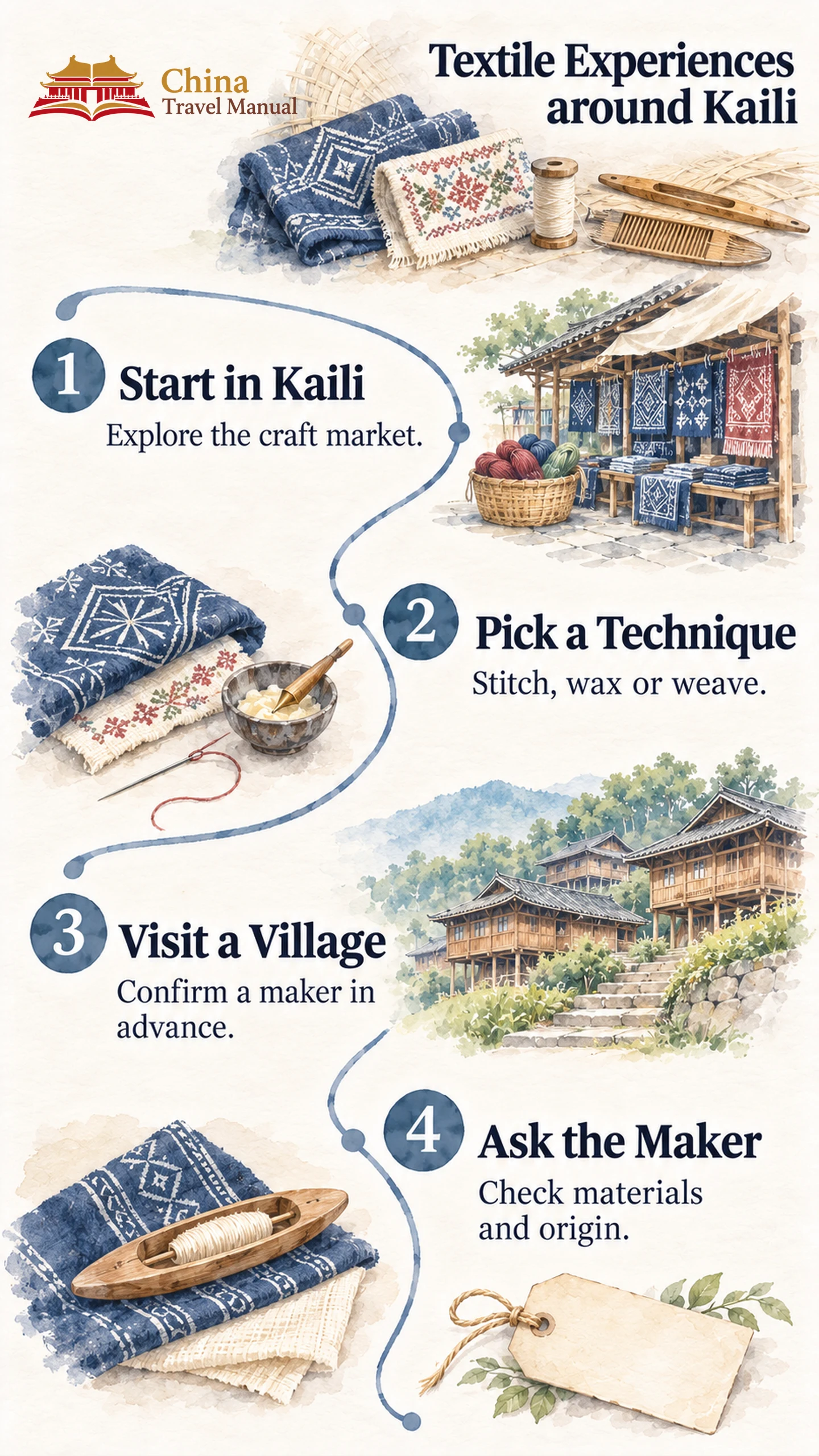
Start in Kaili if you want to see how embroidery, wax-resist dyeing and weaving differ. The craft market in the Miao and Dong Folk Culture Park brings several kinds of work together, while nearby villages offer a closer look at a particular community. For a first visit, spend a half-day at the market and exhibition center. Add one village only when you know what you want to see and have arranged the visit.[1][2][3][4][5][6]
Start at the Textile Market in Kaili
Head to the Miao and Dong Folk Culture Park (苗侗风情园, Miáo Dòng Fēngqíng Yuán) on Fengqing Avenue in Yatang. Within the park, look for Xiulitao Market (绣里淘集市, Xiùlǐtáo Jíshì), where local reporting identifies embroidery workshops, wax-resist activities and textile vendors. Park admission is free according to the prefectural tourism guide. Individual experiences and purchases are arranged with each business. If you are looking for a specific shop, carry its Chinese name as well as the park pin.[2][3]
Across from the Guizhou Village T stage is the Qiandongnan Intangible Cultural Heritage Exhibition Center (黔东南州非遗展示中心, Qiándōngnán Zhōu Fēiyí Zhǎnshì Zhōngxīn). An August 2026 notice listed opening windows of 9 am to noon and 2 pm to 5:30 pm, with Monday maintenance except for public holidays. Check the center’s official WeChat account to confirm admission and book if needed. Visit the displays first if you want context before asking market vendors about a particular cloth.[1]
The Kaili travel guide and Kaili transportation guide can help you fit this visit around the station and your accommodation.
Choose Embroidery, Batik or Weaving
| Technique | What you can observe | What to ask to do |
|---|---|---|
| Miao embroidery (苗绣, Miáoxiù) | Look for stitches that build up texture on an existing cloth. Where a maker permits it, compare the front and reverse of a sample. | Try a few stitches on a small prepared panel and ask about the design. |
| Batik (蜡染, làrǎn) | Ask to see a waxed sample beside a dyed one. Waxed parts resist the dye and reveal the pattern when the wax is removed. | Ask whether you will apply wax, watch the dyeing or complete the sample in one visit. |
| Brocade weaving (织锦, zhījǐn) | Follow the threads on the loom to see how the colored pattern forms as the cloth is woven. | Ask if there is a demonstration or an opportunity to try a few passes on a prepared loom. |
Shops may carry items from several communities. Ask for the name of the village or maker when comparing pieces. For a trip focused on wax-resist dyeing, see the Guizhou batik experiences guide.[2][3][4][5][6]
Visit a Village with a Different Textile Tradition
Leishan and Taijiang are useful directions for learning about different traditions. The national heritage inventory describes several clothing and embroidery styles within Leishan and identifies Shidong in Taijiang as a center for a different Miao embroidery tradition. Heritage reporting also identifies work in villages such as Maomaohe in Leishan and Hongyang and Changtan in Taijiang. Those sources document the practice and its places. Ask your host what is available on your date before driving to a particular village.[4][5][6]
The Langde village guide is useful if you want a village visit with flexibility to walk and observe. For a hands-on session, arrange a host in advance or keep the lesson at the market in Kaili. A Guizhou craft and village itinerary can help if you are linking multiple counties.
Book with a Maker and Ask About the Piece
- Start with the activity: Say whether you want to observe, take a short lesson or buy a finished piece. Ask about teaching language, tools, materials and duration.
- Arrange the meeting point: Confirm the maker’s name, address in Chinese and pickup or return plan. If a shop will dry or finish your sample, ask whether you can collect it later the same day.
- Ask about origin: For a purchase, ask who stitched or wove it, where the work was done and which parts were made by hand. Ask permission to take close-up photos.
Allow half a day for the center and market together. Use a separate half-day or day for a confirmed village visit, depending on where it is. Check travel from Guiyang to Kaili before scheduling a lesson on arrival day.
FAQs About Textile Experiences Around Kaili
Can I try embroidery or batik without leaving Kaili?
Yes. The prefectural tourism bureau and the city describe workshops with both at the Miao and Dong Folk Culture Park. Availability and fees depend on the studio.[2][3]
Is Langde a good place to book a lesson?
Use Langde for a village visit if that fits your day. Arrange a lesson with a named host in advance, or reserve hands-on time with a studio in Kaili.
What should I ask when buying an embroidered panel?
Ask who made it, what cloth and thread were used, which steps were done by hand and whether the panel is a new piece or older work. If it was cut from a garment, ask the seller to tell you what part it came from and how to care for it.
Sources
[1] Guizhou Daily. Qiandongnan heritage center location and visitor information
[2] Qiandongnan Culture and Tourism Bureau. Miao and Dong Folk Culture Park visitor route
[3] Kaili Municipal Information Office. Xiulitao market and working craft studios
[4] China Intangible Cultural Heritage Network. Miao embroidery in Shidong, Taijiang
[5] China Intangible Cultural Heritage Network. Leishan Miao embroidery
[6] China Intangible Cultural Heritage Network. Heritage workshops in Qiandongnan





