Quick Answer: How to Visit Jingzhou
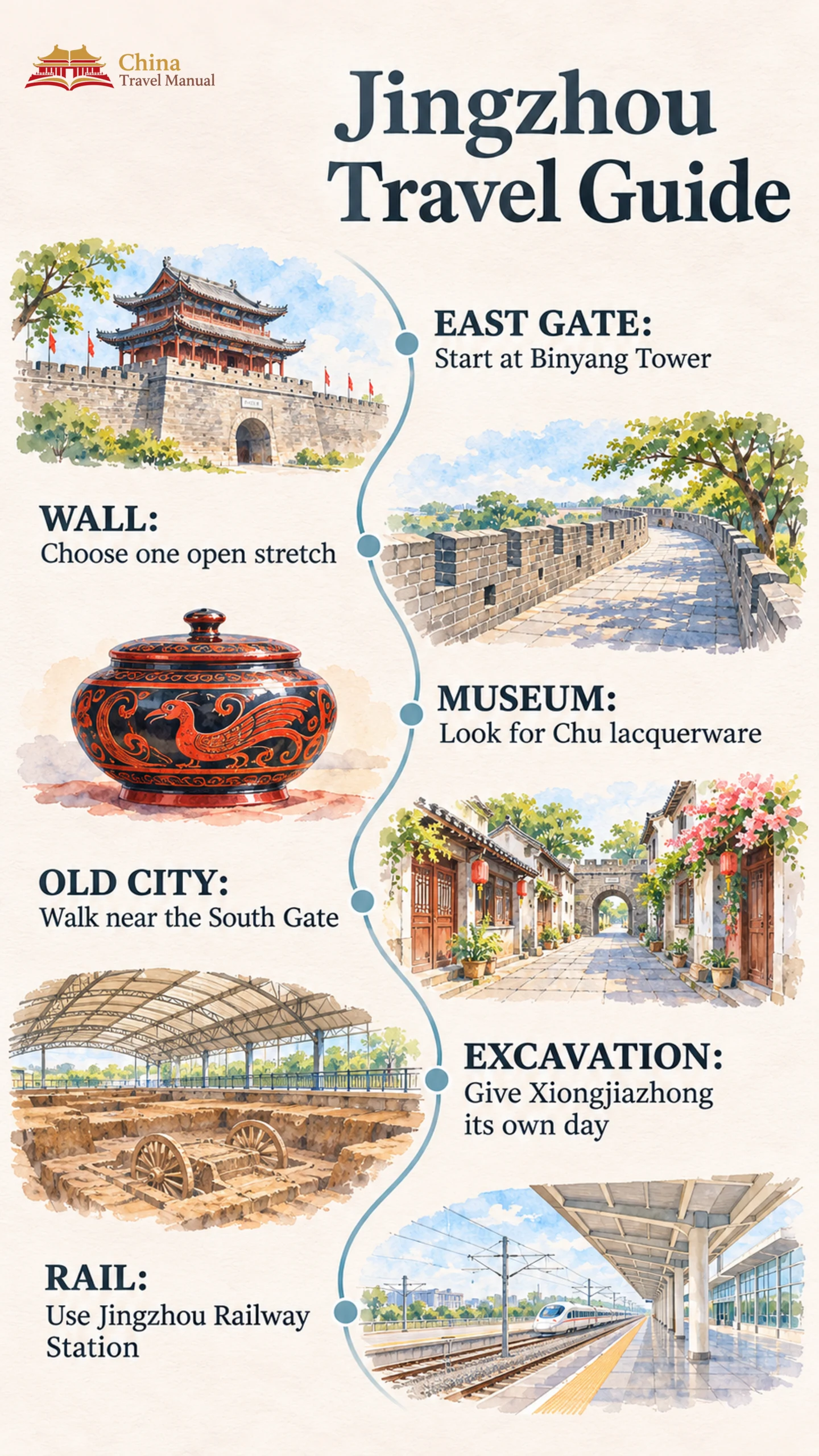
Spend one full day in Jingzhou for Binyang Tower, the old wall and Jingzhou Museum. Start at the East Gate or the museum according to the opening times. Give the Chu chariot and horse site at Xiongjiazhong another day or a separate half day with transport arranged.[1][2][3][4][5]
- For the wall: Pick an open stretch near the East Gate.[1]
- For Chu artifacts: Start with the lacquerware or bronze galleries at Jingzhou Museum.[3]
- For archaeology: Choose Xiongjiazhong for the excavated site and chariot pits.[4][5]
Check how you will get back to the railway station before adding the outlying site.
Jingzhou is a good place to connect a walled city walk with objects from the ancient State of Chu. The old town gives you walls, gates and streets, while Jingzhou Museum gives context for the things found in local excavations. The archaeology park outside the city is a separate visit.
Start at the East Gate and City Wall
Start at the East Gate (东门, Dōngmén) and its Binyang Tower (宾阳楼, Bīnyáng Lóu). The tower stands above the gate and makes a useful starting point for a wall visit. Check which gate stairs and wall sections visitors can use. Set aside time for the views from one stretch and decide where you want to leave the wall before continuing.[1][2]
If you want a shorter walk, see the gate from below and continue through the old city at street level. The old city wall attractions and Jingzhou Museum are separate destinations, so use the museum’s own name when organizing the next ride.[2][3]
Give Jingzhou Museum a Separate Visit
Jingzhou Museum (荆州博物馆, Jīngzhōu Bówùguǎn) is near the Old South Gate area. Check the museum’s current opening and entry instructions. Go first to the Chu lacquerware if you want to see color, painted motifs and the shapes used for daily or ceremonial objects. The museum also interprets bronzes, jades and writing on bamboo and wood.[2][3]
If you arrive too late to see more than one gallery, choose the collection that interests you most and plan a walk along the city streets after closing. Confirm any temporary exhibition changes before traveling specifically for an object.
Visit the Chu Chariot and Horse Site Outside the City
Xiongjiazhong (熊家冢, Xióngjiāzhǒng) in Chuandian is the archaeology park with the Chu chariot and horse site. Allow enough time for the road transfer and whichever parts of the pits and burial area are open to visitors. Start with the display that explains the excavation; it makes the site layout easier to follow.[4][5]
Choose this outing if you have already planned enough time for the wall and museum. Confirm transport back into town before committing to a train departure. Keep the road visit separate if you have luggage or limited time.
Plan Your Railway Arrival and Hotel
Search for Jingzhou Railway Station (荆州站, Jīngzhōu Zhàn) and plan a local ride after arrival. The Wuhan to Jingzhou transport guide covers the rail and road options. Stay near the old city if you want to arrive for the museum or see the East Gate before the crowds. Stay nearer the railway station if your first priority is an early departure.[6]
Use the Hubei travel guide if Jingzhou is part of a longer trip between Wuhan and western Hubei.
FAQs About Visiting Jingzhou
Can You Visit Jingzhou in One Day?
Yes. Choose the East Gate and one part of the wall, then spend part of the day at Jingzhou Museum. Add another day if you want to visit Xiongjiazhong.[1][3][5]
Where Can You See Chu Objects in Jingzhou?
Start with Jingzhou Museum’s lacquerware, bronze and jade displays. Travel to Xiongjiazhong on a separate outing to see the setting of a major excavation.[3][4]
Can You Walk the Entire Wall?
Check which sections are open on the day. A short segment near an open entrance is sufficient if you want time for the museum or old streets afterward.[1][2]
Sources
[1] Jingzhou Ancient City Tourism Area. Jingzhou ancient wall and Binyang Tower
[2] Jingzhou Ancient City Tourism Area. Official visitor map
[3] Hubei Daily Network. Jingzhou Museum visitor profile and permanent collections
[4] Hubei Culture and Tourism Department. Xiongjiazhong and the Chu chariot and horse site
[5] Hubei Daily. Chuandian and the Xiongjiazhong archaeological park
[6] ChinaMile. Jingzhou visitor areas and railway arrival