
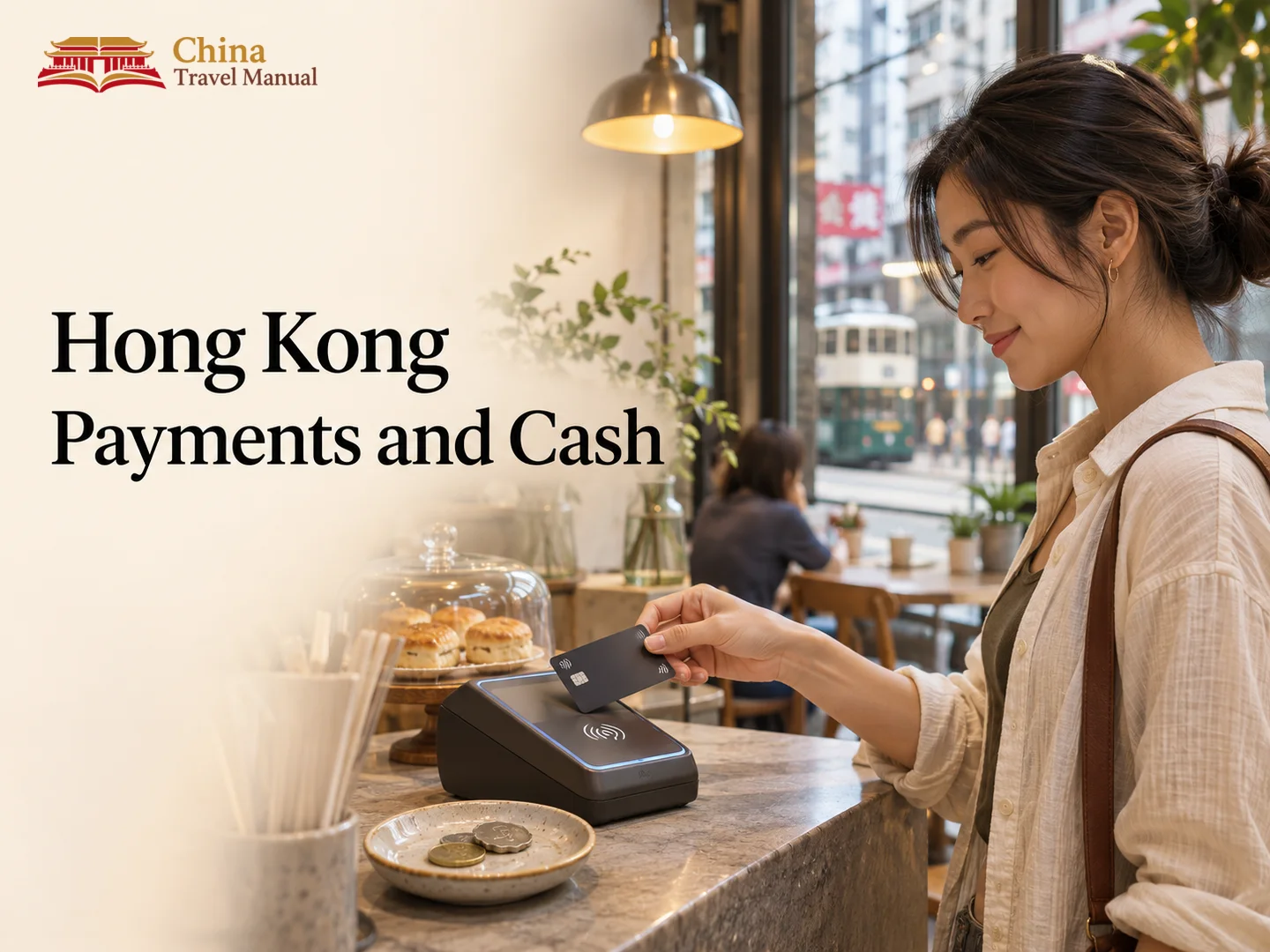
Quick Answer: How Should You Pay in Hong Kong?
Carry a bank card and some small Hong Kong dollar notes. Add an Octopus if you expect to take buses, trams or ferries regularly. [1][2][5]
- Bank card: Use a card for hotels, larger stores and restaurants that accept your network.[1]
- Cash: Keep small HKD notes for market stalls, small cafés and anywhere your preferred method is unavailable.[1][3]
- Octopus: Use it for transit and at participating shops. Check whether the reader or cashier accepts it before tapping.[2]
- Taxis: Confirm the options before boarding. Drivers must offer a QR payment method and a non-QR electronic method, but the particular methods vary.[6]
Check the accepted card network or wallet at the point of payment.

Hong Kong uses the Hong Kong dollar (HKD). In a single afternoon you might tap a bank card at an MTR gate, pay with Octopus on a tram and need cash for dinner. Choose payment by the place you are going and keep a second way to pay if your first choice fails.[1][2][5]
Payment Methods by Place
| Where you are paying | Good first option | What to check |
|---|---|---|
| Hotel or large retailer | Bank card | Confirm the card network and any temporary authorization for a hotel deposit |
| Restaurant or café | Bank card or Octopus where displayed | Ask before ordering at a small shop, and check whether service is added |
| Market or small stall | Small Hong Kong dollar notes | Ask if the vendor takes your card or exact wallet before committing |
| MTR and Airport Express | Octopus or eligible contactless bank card | Use the designated reader and the same card or device for the ride |
| Tram, bus or ferry | Octopus where accepted | Check operator payment options, particularly when using cash |
| Taxi | An electronic method the driver accepts or HKD cash | Check the window sticker or ask the driver before boarding |
Many restaurants add 10% service. Check the bill before deciding whether to leave anything extra. If a stall at Temple Street Night Market has no payment sign, ask before they prepare your food.[1][6]
How Much Hong Kong Cash to Carry and Where to Get It
If you mostly use cards, HK$200–300 in small notes is a reasonable first-day backup. Increase it if you expect cash-only meals, market purchases or an early or late taxi. Bills in HK$20, HK$50 and HK$100 are more practical for small payments than one large note. A merchant can refuse a large denomination even though it is legal tender.[1][3]
Withdraw HKD from an ATM that accepts your card network, or use an authorized money exchanger. Compare the amount you receive with the full cost, including any ATM charge or fee your own bank applies. Ask a money exchanger for the final amount before you hand over your currency. Use your Hong Kong travel budget to decide how much you are likely to spend in cash.[4][8]
Using Bank Cards and Mobile Wallets
International bank cards are widely useful, but acceptance varies by merchant and card network. A payment terminal may accept a contactless bank card or the same bank card in a phone wallet. Keep the physical card available if you need to insert it or present it at check-in.[1]
QR payment is a separate check. A sticker for a local wallet tells you which service the shop accepts, while a bank card in a phone wallet uses a different route. Some merchants support Alipay or WeChat Pay. Check whether the store accepts your version of the wallet and whether its funding is active. A November 2026 rollout added certain overseas wallets at participating Octopus QR merchants. That change does not make every Octopus-branded reader accept every QR wallet.[1][7]
A Faster Payment System (FPS) sign indicates payment through that network. It relies on participating bank or wallet services, which may not be set up on your phone. Keep a card and cash for shops where you cannot use the displayed app.[9]
Paying for Public Transport and Taxis
For several days of local rides, an Octopus card gives you one balance for many buses, trams and ferries. If you only need adult MTR trips, eligible contactless bank cards work at designated gates, including Airport Express. The contactless fare matches the adult Octopus fare, but concessions are excluded and the Tsim Sha Tsui/East Tsim Sha Tsui interchange is treated as two journeys. See the Hong Kong MTR guide for how to use the right gate.[2][5]
Since 1 April 2026, taxi drivers have had to offer at least one QR and one non-QR electronic payment method. One taxi might accept an Octopus payment and a QR wallet, while another may offer a different combination. Ask about your exact method and carry small notes as a fallback. If you are arriving late, compare your options in the Hong Kong airport transfer guide.[6]
FAQs About Hong Kong Payments
Can You Visit Hong Kong Without Cash?
You can often pay without cash in hotels, malls and on major transport routes. Carry some small notes if you want to eat at local cafés, shop at markets or avoid having to find a working ATM when a payment fails.[1][2][5]
Can You Pay With Mainland Chinese Yuan?
Plan to pay in HKD. An individual merchant may choose to accept another currency, but even within the same district you cannot count on it. Check the price and change in the currency you agree to use.[1][3]
What If the Card Terminal Offers a Home-Currency Price?
That offer is dynamic currency conversion. Compare the exchange rate, markup and fee. You can decline the conversion and pay in HKD, leaving any conversion to your card issuer. Check your issuer’s own fees as well.[4]
Sources
[1] Hong Kong Tourism Board. Traveller Essentials, Money and Payments
[2] Octopus Cards Limited. Use of Octopus
[3] Hong Kong Monetary Authority. Notes and Coins FAQ
[4] Visa. Dynamic Currency Conversion
[5] MTR. Contactless Bank Cards for MTR Rides
[6] Hong Kong Transport Department. Taxis and Electronic Payment
[7] Octopus Cards Limited. International QR Acceptance Rollout
[8] Hong Kong Tourism Board. Travel Guide, Currency and Payment
[9] Hong Kong Monetary Authority. Faster Payment System





