
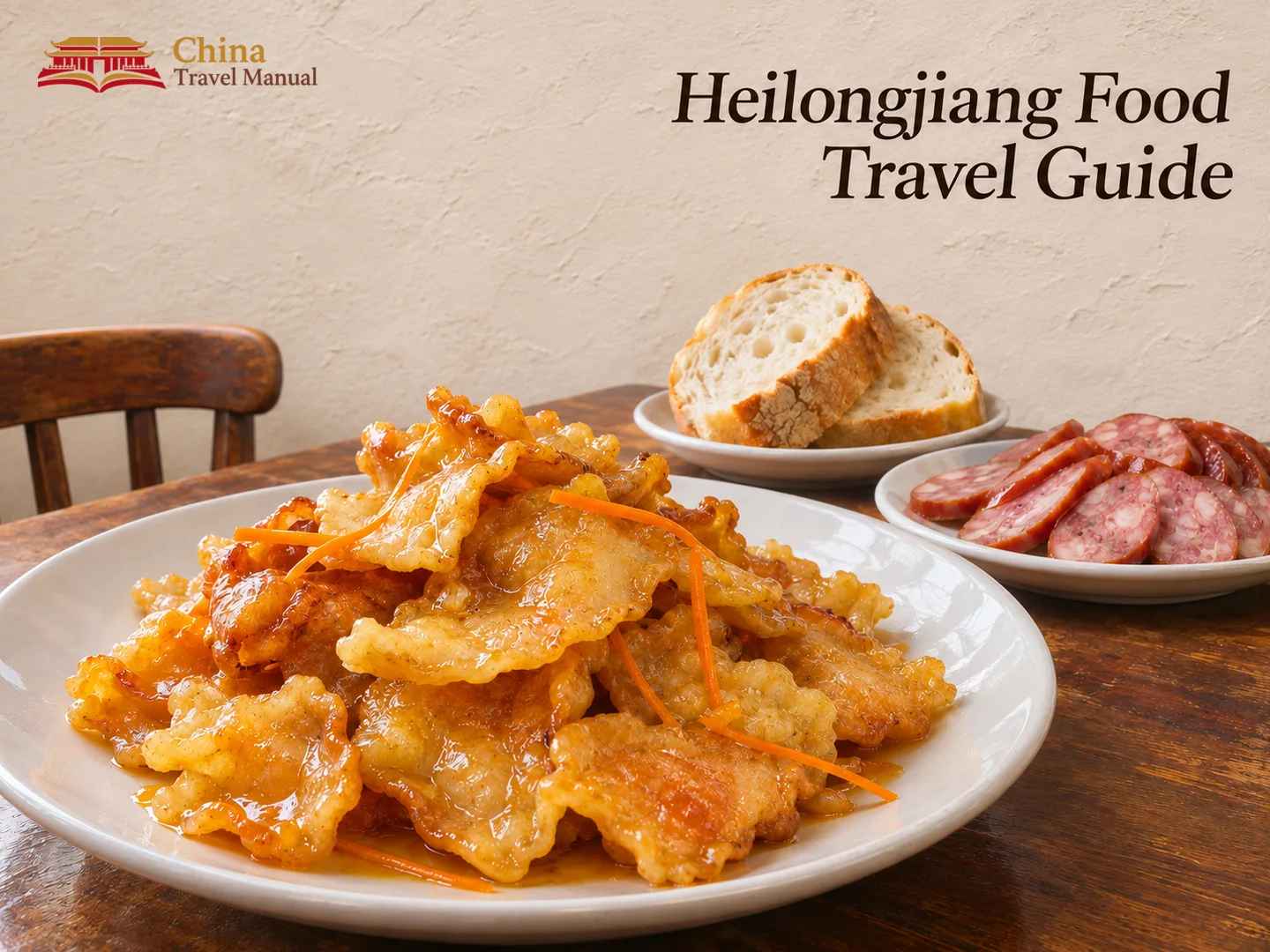
Quick Answer: What Should You Eat in Heilongjiang?
Start with guo bao rou (锅包肉, guōbāoròu), Harbin’s crisp sweet-sour pork, and share an iron-pot stew (铁锅炖, tiěguōdùn) if you’re eating with others. Outside Harbin, Qiqihar is a good stop for grilled beef and the Jingpo Lake area for fish.[1][3][7][8][10]
- In Harbin: Pair a sit-down pork dish with a walk for bread, sausage or an ice cream bar.[1][5]
- For a shared pot: Choose fish, chicken or ribs and ask whether the kitchen serves corn cakes with the stew.[3][10]
- In Qiqihar: Try the local style of grilling beef on a hot plate, with vegetables and dips on the side.[8]
- In Mudanjiang: Try a Korean-Chinese chicken or tofu soup in town, or fit a fish lunch around a Jingpo Lake visit.[9][10]
If Harbin is your only base, choose one shared meal and one walk for snacks.
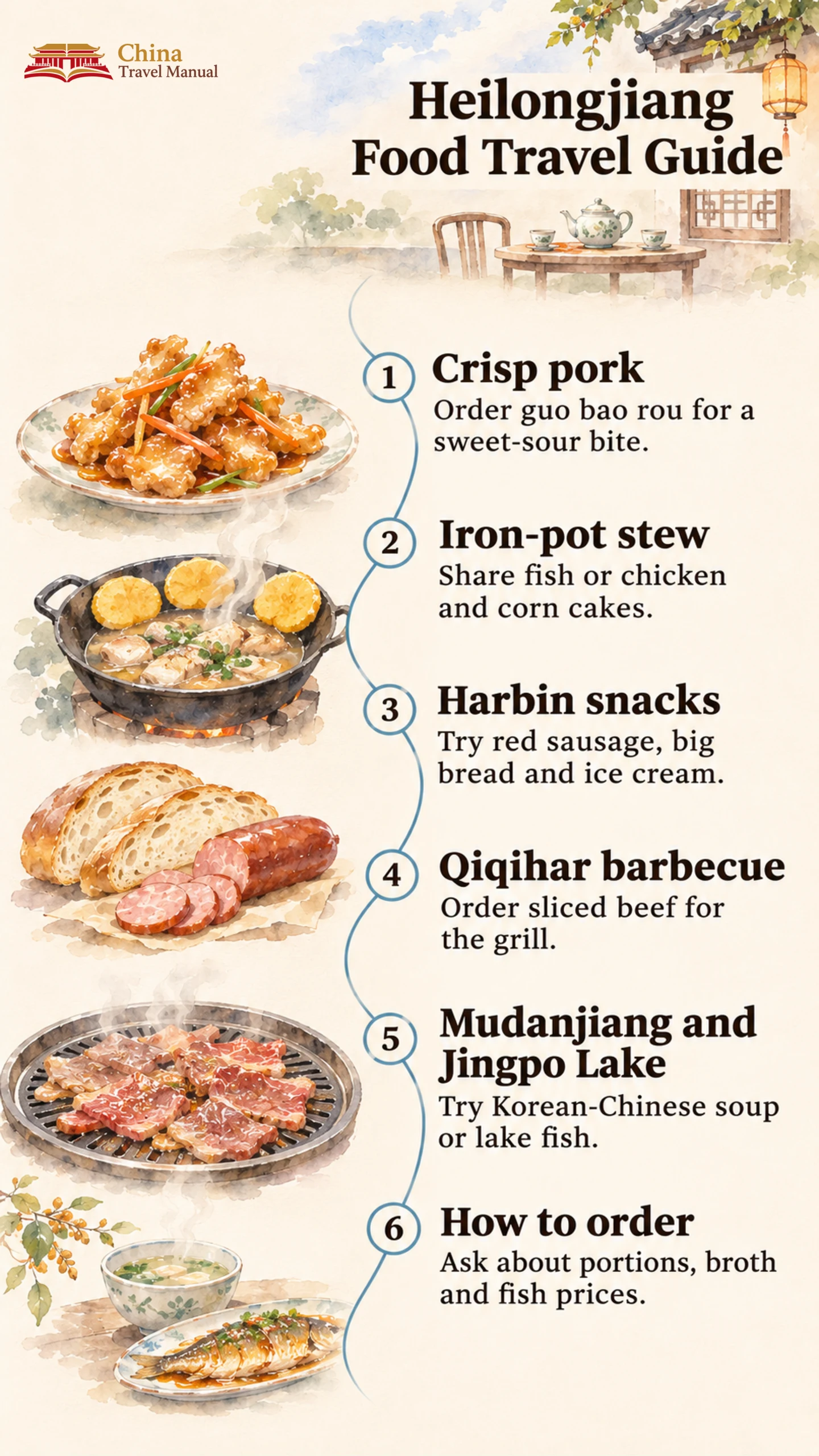
A food trip in Heilongjiang can start on Harbin Central Street and change character once you leave the city. Regional staples are easy to try in Harbin, while a short list of local specialties helps you choose destinations for the rest of the trip.
What to Order at a Northeastern Restaurant
| Dish | What to expect | When to order it |
|---|---|---|
| Guo bao rou | Crisp pieces of pork tenderloin with a sugar-and-vinegar glaze | Choose it when you want a plated dish you can share straight away |
| Iron-pot stew | Fish, chicken or another main ingredient cooked in a large pot, often with vegetables | Share at a longer meal and ask whether the corn cakes come with the pot |
| Sha zhu cai (杀猪菜, shāzhūcài) | A pork dish that can include blood sausage and suan cai (酸菜, suāncài), fermented cabbage | Ask what is in the restaurant’s version if you avoid offal or blood products |
The Harbin guo bao rou technique uses a thin starch coating and two rounds of frying before the pieces are tossed in the glaze. The local origin story associates its sweet-sour style with chef Zheng Xingwen and a late Qing-era official kitchen in Harbin.[1][2] Sha zhu cai has a more savory, tart profile from the fermented cabbage.[4]
Harbin Street Snacks and Winter Treats
- Hongchang (红肠, hóngcháng): Try Harbin red sausage in a small portion if your next stop is a full meal. Grilled sausage and bread are both easy to sample on a Central Street snack walk.[5]
- Dalieba (大列巴, dàlièbā): The large loaf is convenient for breakfast if you’re sharing it or will be staying several days. Ask whether the shop sells smaller portions before buying a whole loaf.[5]
- Ice cream bars and frozen fruit: The Madier shop is a long-running Central Street stop for ice cream. In winter, a frozen pear (冻梨, dònglí) is a separate seasonal snack with soft, icy pulp once it has thawed partway.[5][6][11]
Use the Harbin food guide to plan a food walk built around your hotel or sightseeing route.
Where to Eat Beyond Harbin
Go to Qiqihar if the meal you want is table-grilled beef. Start with one or two cuts and an order of vegetables. Order more beef once you see how large the first plates are.[7][8]
Use Mudanjiang as a city base for Korean-Chinese food, including chicken soup or beef-and-tofu soup. At Jingpo Lake, restaurant options can include stewed or grilled fish and multi-dish fish meals. Ask what fish is available and how it is sold before you choose a full banquet.[7][9][10]
The seven-day Heilongjiang itinerary shows how to make room for lake outings without moving hotels every night.
How to Order for One or for a Group
For two people, start with one main dish and one vegetable dish. Add rice or corn cakes after checking the size of the main order. An iron-pot stew is a meal in itself, so ask how many diners the smallest pot serves.[3]
For a fish meal, ask whether the menu price is for a dish, a whole fish or a unit of weight. If you are avoiding an ingredient, ask what is in the stock or sauce and ask about shared preparation equipment when cross-contact matters. The food allergy guide for China has wording you can prepare before the trip.
FAQs About Heilongjiang Food
What makes Harbin guo bao rou distinctive?
Its thin fried coating stays crisp when the pork is quickly tossed in a light sweet-sour glaze and brought to the table. Ask for the restaurant’s Harbin-style version if it offers several sauces.[1]
How is Qiqihar barbecue different from iron-pot stew?
Qiqihar barbecue cooks beef on a grill plate, with dips and vegetables on the side. An iron-pot stew simmers its main ingredients together in broth or sauce, sometimes with corn cakes around the rim.[3][8]
Can I order a meal without pork?
Yes. Try grilled beef in Qiqihar, a fish meal near Jingpo Lake or a chicken soup in Mudanjiang. Ask what is in the cooking fat, stock and sauce if you need to avoid pork entirely.[8][9][10]
Sources
[1] Heilongjiang Department of Culture and Tourism. Harbin-style guo bao rou ingredients and preparation
[2] Heilongjiang Department of Culture and Tourism. The Harbin origin story associated with Zheng Xingwen
[3] Heilongjiang Provincial People’s Government. Iron-pot stews and corn cakes
[4] Heilongjiang Department of Culture and Tourism. Northeastern pork, blood sausage and fermented cabbage dishes
[5] Heilongjiang Provincial People’s Government. Central Street food, red sausage, bread and ice cream
[6] Heilongjiang Provincial People’s Government. Winter frozen pears and persimmons
[7] Heilongjiang Provincial People’s Government. Heilongjiang regional food specialties, 2026
[8] Heilongjiang Department of Agriculture and Rural Affairs. Qiqihar beef cooked on a grill plate with sauces and vegetables
[9] Heilongjiang Department of Culture and Tourism. Mudanjiang’s Korean-Chinese restaurants and local dishes
[10] Heilongjiang Provincial People’s Government. Fish dishes in the Jingpo Lake area
[11] Heilongjiang Department of Culture and Tourism. Central Street’s historic ice cream shop





