
Quick Answer: Where Can You Learn About Silk in Hangzhou?
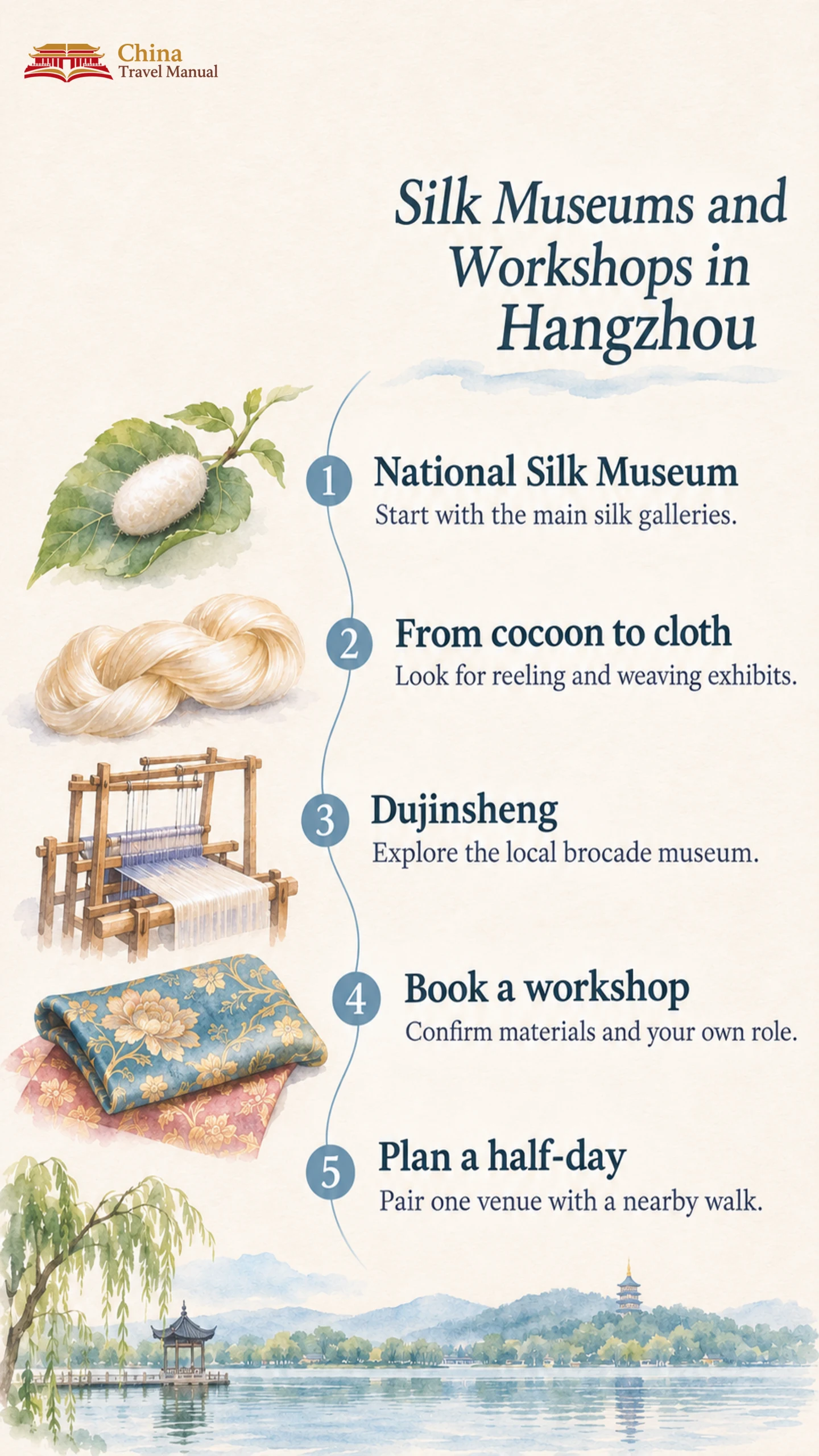
Start at the China National Silk Museum for the full story, from silkworms and cocoons to textiles and their conservation. Choose the Dujinsheng Silk Brocade Museum if you want to focus on Hangzhou’s local brocade production. For hands-on work, check what a class covers and book it separately.
- For a first visit: Use the China National Silk Museum at 73-1 Yuhuangshan Road, south of West Lake.
- For the process: Look for the sericulture and weaving displays, and then compare them with an example of finished fabric.
- For a smaller local museum: Save the Dujinsheng Silk Brocade Museum at 519 Fengqi Road and check current visitor access.
- For an actual workshop: Confirm the date, technique, materials and what you will be able to make.
General museum admission and a workshop place are separate. Leave time for both if you want two different experiences.
Silk is easiest to understand when you follow what happens to the material. The museum lets you compare tools and fibers with the finished objects they helped produce. A workshop can give you time to notice how a dye pattern is made or how a loom works. Choose the place that matches what you most want to see.
Start at the China National Silk Museum
The national museum at 73-1 Yuhuangshan Road is a strong first stop. Its permanent offerings include displays on silk and the Silk Roads, Chinese sericulture and silk-weaving techniques, and textile conservation. Start with one collection and then choose a second that answers a question you still have, such as how thread is extracted or how researchers care for an old garment.[1]
Sericulture includes raising silkworms before the silk thread is reeled from the cocoon. Weaving turns thread into fabric, while dyeing, embroidery and other work can give the cloth its appearance and finish. UNESCO inscribed China’s sericulture and silk craftsmanship on its intangible heritage list in 2009. In the galleries, look for how tools and finished textiles connect those stages.[1][6]
The museum’s own notices list 09:00–17:00 Tuesday to Sunday, last entry at 16:30 and holiday exceptions. Individual admission no longer requires an advance reservation. Foreign visitors can use a passport for entry. General admission is free, while some temporary exhibits or guided services can have separate charges.[2][3][7]
See a Local Brocade Story at Dujinsheng
The Dujinsheng Silk Brocade Museum at 519 Fengqi Road focuses on a Hangzhou maker and the making of brocade. The visitor description lists displays of raw materials, production and finished products. This is a different experience from the national collection, because it lets you concentrate on how one workshop tradition turned threads into patterns and woven pictures.[5]
Check current opening, public access and what is on view before planning a dedicated visit. Production exhibits do not guarantee an active loom or a demonstration. Make this one stop near your other central sightseeing if you only have a short time.
How to Choose a Hands-On Silk Workshop
- Pick the activity before choosing a time. A dyeing session, a weaving demonstration and an embroidery class teach different techniques. Confirm whether the program involves practice or observation.
- Ask which materials you will use. A textile session at a silk museum may focus on a technique using an easier sample fabric. Ask about the fiber and tools if they matter to you.
- Confirm the cost and what you can take home. Check whether the fee includes the materials and a piece you make yourself.
- Check timing and language. Ask about the meeting point, suitability for children and whether the instructor can guide you in a language you understand.
The museum’s workshop center describes education in dyeing, weaving, embroidery and related skills. Use its current notices for availability instead of treating a past event as a repeatable daily program.[4]
Fit Silk Into a Hangzhou Half-Day
Give the national museum at least about two hours if you want to see more than one gallery and pick two subjects before you start. Its south-lake location pairs well with a short walk from the West Lake visitor guide. For a longer afternoon, keep a museum visit and a workshop as distinct blocks so one does not cut the other short.
If your group would rather spend time around historic workshops and crafts, the Hangzhou Grand Canal guide compares several Qiaoxi museums. For other free general-entry options, see free things to do in Hangzhou for choices by area.
FAQs About Silk Museums and Workshops in Hangzhou
Is the China National Silk Museum free?
General admission is free. A temporary exhibit, a guided service or a separately arranged activity can have its own terms.[3][7]
Can you do a silk workshop without booking?
Check the current program before arriving. Ordinary museum admission does not secure a spot in a workshop, and individual events may require booking.[3][4]
Which silk museum is best for a first visit?
Start at the China National Silk Museum for silk production and a broader textile collection. Choose Dujinsheng if local brocade is the focus of your visit.[1][5]
Sources
[1] China National Silk Museum. Permanent collections and current exhibition notices
[2] China National Silk Museum. Hours and access with a passport
[3] China National Silk Museum. Individual admission and registration
[4] China National Silk Museum. Workshop center and courses in textile skills
[5] Hangzhou City Visitor Information. Dujinsheng Silk Brocade Museum address and exhibitions
[6] UNESCO Intangible Cultural Heritage. Sericulture and silk craftsmanship of China
[7] China National Silk Museum. General admission and separate paid services





