
Quick Answer: How to Get Around Guilin
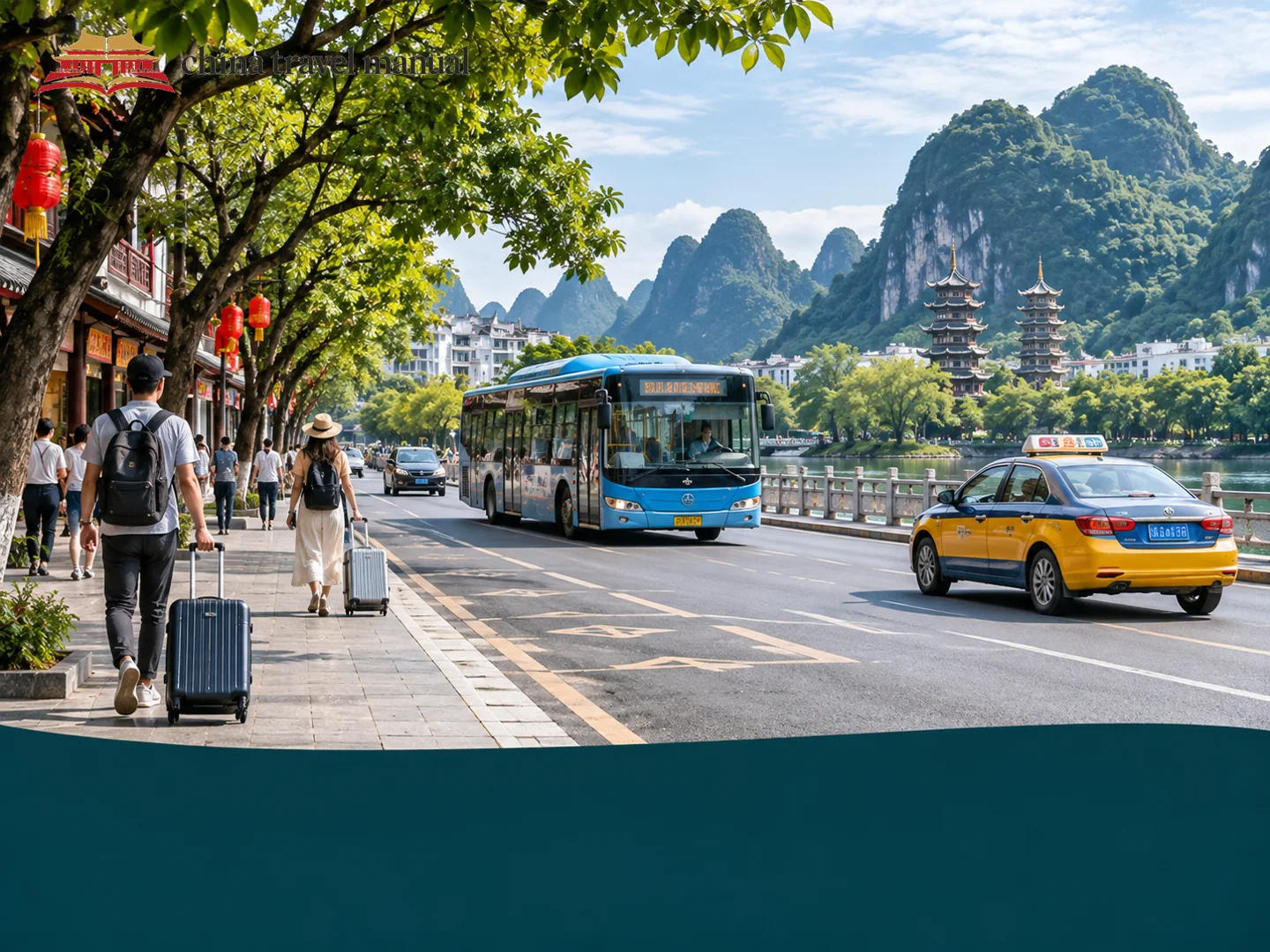
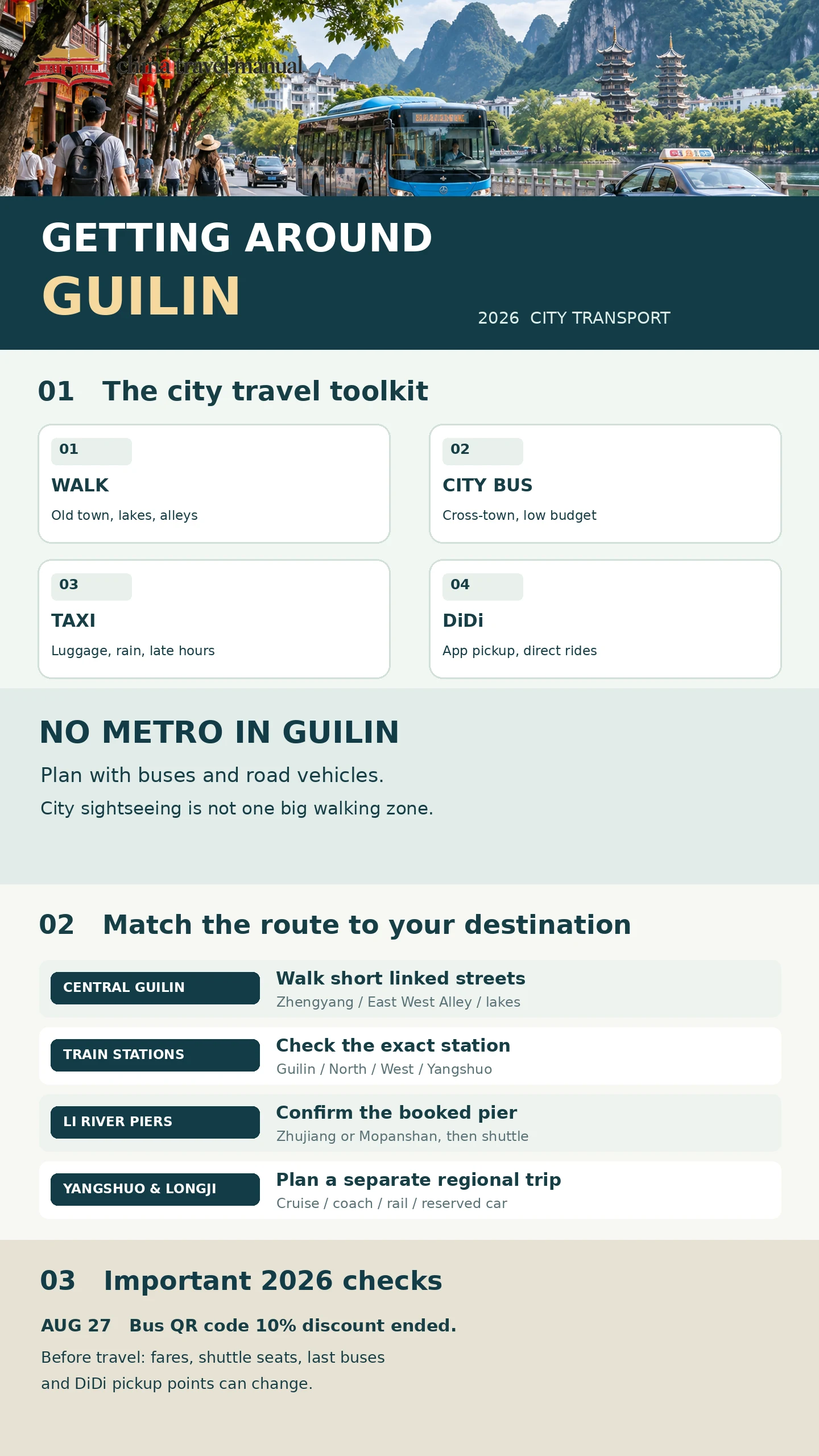
Guilin has no operating urban metro. For most first-time visitors, the simplest combination is walking in the compact central sightseeing area, city buses for low-cost cross-town trips, and licensed taxis or DiDi for luggage, rain or late arrivals. Getting to airports, railway stations, Li River cruise piers or regional destinations takes a separate transport plan.
- Old-town lakes and streets: Walk between Zhengyang Pedestrian Street, East-West Alley and the Shanhu and Ronghu lakefronts where the route is convenient.
- Across Guilin city: Use a public bus when the stop and route are clear; choose a licensed taxi or DiDi when time or comfort matters more.
- Railway stations and airport: Check the exact station or terminal and add time for the final walk, pickup and security.
- Li River cruise piers: Confirm Mopanshan or Zhujiang on your booking, then reserve a suitable shuttle or vehicle.
- Yangshuo and Longji: Treat them as separate regional trips, not short city-bus rides.
The former 10% Alipay and Guilin Dingrui mini-program discount on regular buses ended on August 27, 2026. Check current fares and the payment methods supported by your chosen route. [1]
Guilin is easier to navigate once you separate the walkable old-town core from longer journeys across the city and the surrounding countryside. There is no operating metro network, so a practical visit uses walking, buses, licensed taxis and app-based ride-hailing. Beyond the center, railway terminals, Li River cruise piers, Yangshuo and the Longji Rice Terraces each require different planning. For what to see and how many days to spend, start with the Guilin Travel Guide; this guide focuses on choosing and using transport rather than sightseeing itineraries.
Understanding Transportation in Guilin
Does Guilin Have a Metro?
No. As of November 2026, Guilin does not have a metro or subway open for ordinary city travel. Do not look for metro cards, station exits or lines that may appear in guides for larger Chinese cities. Walking, city buses and road vehicles are the main ways to cross the urban area. A bus journey may still require a final walk, especially near the banks of the Li River or a fenced scenic entrance.
Guilin City vs. the Greater Guilin Travel Region
The built-up city around Xiangshan, Xiufeng and Qixing districts is not the same as the wider Guilin travel region. Yangshuo, Xingping and the Longji Rice Terraces belong to longer regional itineraries, with separate transport arrangements. A hotel in Guilin city is useful for a short visit, but not necessarily the best base for every day of countryside sightseeing. The Where to Stay in Guilin guide explains how to match accommodation with these transport choices.
Choosing Transport by Distance, Luggage and Time
Before setting off, ask three questions: Is the whole route genuinely walkable, will you carry more than a daypack, and are you travelling during daylight and normal service hours? Walking is sensible for closely grouped central sights. A bus is good when both stops are clear and you have time to spare. A taxi or DiDi can be more practical for rain, several suitcases, a small group or a departure that cannot be missed.
| Situation | Usually the best starting choice | Check before leaving |
|---|---|---|
| Compact downtown sightseeing | Walking | Actual scenic entrance and weather |
| Cross-town visit without luggage | City bus | Stop, direction and live route |
| Late or rainy trip with luggage | Licensed taxi or DiDi | Pickup pin and vehicle size |
| Airport, train or cruise deadline | Dedicated shuttle or vehicle | Booking, terminal or pier and buffer |
| Yangshuo or Longji | Regional coach, cruise or arranged road transport | Actual arrival point and last connection |
Taking Public Buses in Guilin
How Guilin’s City Bus System Works
Guilin has ordinary local buses, sightseeing or theme services, and special bookable connections such as Li River pier shuttles. They are not interchangeable. Regular routes connect residential districts, railway stations and urban landmarks. Theme routes focus on selected sights and may vary by season. Cruise-pier shuttles typically use designated stops and booking rules instead of allowing passengers to flag down the vehicle anywhere.
Finding Bus Routes and Stops
Check a current Chinese-language map app for the route number, direction, stop name and next service before setting out. Similar-looking stop names can appear on opposite sides of a major road, and a stop near a scenic spot may still be some distance from its actual entrance. If the app and stop board disagree, ask at the stop or take a taxi. Public holidays, roadworks and heavy rain can also cause diversions.
Save the Chinese stop name and the location of the stop for your return trip. Many central attractions have more than one entrance, so a route that brings you near the attraction is not always the best choice for the gate printed on your ticket.
How to Pay for a Guilin Bus
Common ways to pay include small-denomination renminbi cash, eligible local transit cards and supported Alipay transit QR codes. Activate the correct city transit service before boarding and check the displayed fare. Do not assume an overseas bank card can be tapped directly on every bus reader. Cash may require exact change, so avoid depending on large notes.
A Guilin Public Transport Group announcement stated that the previous 10% discount for regular bus trips paid through Alipay and the Guilin Dingrui transport-card mini-program ended on August 27, 2026. Those channels now use the applicable base fare; concession policies and special-service fares are governed separately. Old articles advertising an automatic discount are outdated. [1]
Tourist Buses and Special Shuttle Services
Sightseeing buses may link the old town, the riverside and key parks, but seasonal schedules or promotional offers should never be treated as permanent. A Guilin osmanthus-themed sightseeing service was announced in September 2026; verify that it operates on the day you travel rather than assuming year-round service. A separate tourist bus free-ride promotion during the May 2026 holiday was time-limited, not an ongoing citywide benefit.
A Li River cruise pier shuttle is different again. Some services require advance reservation and operate to specific piers at set times. Do not try to use a regular city-bus QR code as proof of a custom-shuttle booking.
Taking Taxis and Ride-Hailing Services
Using Licensed Taxis
Licensed taxis can be useful for moving between districts, reaching a farther attraction or travelling with luggage. Use an official taxi queue at stations and the airport, and follow the applicable meter rules rather than negotiating with an unsolicited driver. Show the driver the destination name and address in Chinese. Around pedestrian streets, the closest legal vehicle stopping point may be at the edge of the car-free zone.
Booking a Ride with DiDi
DiDi is a practical app-based alternative. Eligible international visitors may be able to register using an overseas mobile number and use supported international payment cards, but the exact registration, verification and payment options depend on the account and service. Set up the app and test the payment method before your first urgent ride. Use the quoted in-app estimate as an estimate, not a fixed fare or a guaranteed arrival time. [4]
Finding the Correct Pickup Point
At a railway station, an airport, a scenic gateway or a popular shopping street, the driver may only be allowed to stop in a designated zone. Check the pickup pin and any level, exit or road name displayed in the app. Do not send a hotel name alone if the property has a pedestrian-only entrance. A screenshot of the Chinese address can make the final approach easier.
Traffic, Fares and Luggage Considerations
Travel time and fares vary with the route, traffic, vehicle type and any applicable surcharges. The central streets can slow down during commuting hours and holidays. If you have multiple large suitcases, choose a suitable vehicle category instead of assuming every standard sedan can accommodate the group and luggage. For a cruise or train departure, add time to find the driver and complete the final walk after drop-off.
Walking and Cycling Around Guilin
The Best Areas to Explore on Foot
A compact outing can combine Zhengyang Pedestrian Street, East-West Alley, parts of the Ronghu and Shanhu lake paths, and the Sun and Moon Pagodas viewing area. These are better grouped together than visited in repeated taxi trips. Riverside walks near Jiefang Bridge can also fit a central afternoon when conditions are comfortable.
When Walking Is Less Practical
Do not extend that downtown walking rule to the whole city. Qixing Park, Reed Flute Cave, Guilin North Railway Station and other outlying destinations may require buses or vehicles. Bridges, traffic barriers and gated park entrances can turn a short map distance into a longer walk. In summer heat or heavy rain, save energy for the attraction rather than walking between distant districts.
Cycling and Road Safety
City cycling is possible in suitable low-traffic streets, but dedicated cycle facilities are not continuous and busy urban junctions can be intimidating. Obey local traffic rules and avoid riding through pedestrian-only areas. Yangshuo’s rural cycling and e-bike routes are different experiences; use the separate Getting Around Yangshuo guide rather than treating a countryside rental plan as the default way to cross Guilin city.
Getting Between Guilin’s Main Attractions
Zhengyang Street, East-West Alley and the Lakes
Combine the old-town commercial streets with a nearby evening walk around Shanhu or Ronghu. Staying within this central cluster limits transfers and works especially well after a travel day. Make a quick route check before walking: the lake system covers a sizeable area and the nearest bridge or crossing may be more useful than the shortest straight line.
Elephant Trunk Hill and Central Guilin
Elephant Trunk Hill lies within the central sightseeing area, but its visitor entrance matters. A route to the riverbank is not necessarily a route into the scenic area. From a central hotel, walking can be sensible if the weather and entrance align; from a railway station or the east bank, a short vehicle trip may be more comfortable.
Seven Star Park and Reed Flute Cave
These places should be treated as separate travel legs instead of assumed walking extensions of the old town. Compare a direct bus with a ride-hailing journey for your actual departure point. If you plan to visit both on one day, order the stops to minimize cross-town backtracking rather than repeatedly returning to the lakes.
Planning Your Day Without Unnecessary Backtracking
Group central old-town sights first, then add one outlying attraction on the same side of the city when possible. If you have only three complete days for Guilin, the 3 Days in Guilin itinerary sets out which experiences deserve a full day and which are short city stops.
Transportation from Guilin Railway Stations
Guilin Railway Station, Guilin North, Guilin West and Yangshuo are four different railway stops. The correct pickup depends on the station written on your ticket. The Guilin Railway Stations and Transfers guide covers station facilities and more detailed connections.
Guilin Railway Station
Guilin Railway Station (桂林站) is the closest of the three main Guilin city railway stations to the traditional downtown area. Public buses and licensed road vehicles connect it with the central lakes and hotels. Even if the journey appears short, allow time for the station exit, road crossing and pickup area, particularly during busy arrivals.
Guilin North Railway Station
Guilin North (桂林北站) is farther north of the city center. There are bus and taxi connections, but it is not interchangeable with Guilin Railway Station. Choose the exact train arrival and your hotel address when planning the onward journey. More specific access details belong in the Guilin North Railway Station Guide
Guilin West Railway Station
Guilin West (桂林西站) is farther from the old-town sights and needs an additional city transfer. Before choosing a ticket for price alone, compare the door-to-door time and pickup effort with a train using another station. Check the Guilin West Railway Station Guide if your service arrives or departs there.
Why Yangshuo Railway Station Is Different
Yangshuo Railway Station (阳朔站) is near Xingping, not beside West Street or central Yangshuo town. A train stopping there does not place you at your hotel or rafting area. Allow for a separate road shuttle or booked vehicle, and check its actual departure point and timing rather than relying only on the train journey duration. The official Li River tourism site lists a connecting service to Xingping that varies with train arrivals and demand. [2]
Getting from Guilin Airport to the City
Airport Shuttle Bus
Guilin Liangjiang International Airport (KWL) is approximately 28 kilometers from the city center. Airport shuttle buses serve designated stops, while some intercity services connect the airport with destinations such as Yangshuo. Confirm the current route, boarding point and last departure before flying; do not assume your hotel or Yangshuo guesthouse is served by a downtown airport bus. [2]
Taxi and Ride-Hailing
A licensed taxi or ride-hailing vehicle is often simpler when arriving with several bags, travelling as a group or reaching a hotel away from a shuttle stop. Confirm the official pickup area after collecting baggage and show the driver the address in Chinese. For routes and terminal-side details, use the Guilin Airport Guide and Transfers rather than relying on a generic city bus map.
Late-Night Arrivals and Hotel Transfers
Check airport bus operating hours against your expected baggage-claim completion time, not merely the flight’s landing time. After public services end, use official taxis or app-based vehicles as available. Some hotels can organize paid pickup, but it must be confirmed individually; do not assume every booking includes free airport transfer.
Getting to the Li River Cruise Piers
Mopanshan and Zhujiang Piers
Guilin’s main Li River cruise departures use specific piers outside the old-town walking area, especially Mopanshan Pier (磨盘山码头) and Zhujiang Pier (竹江码头). Before choosing a bus or taxi, match the pier printed on the cruise booking. The official scenic-area transport guidance lists Route 9 to Zhujiang Pier and custom tourist services serving the pier corridor. [2]
Shuttle Buses and Private Transfers
Official pier shuttles operate from designated city stops; booking requirements and departure times vary by product. One official custom-bus guide requires advance purchase for its listed service and notes that arrival times are estimates, not guarantees. A hotel transfer or ride-hailing car may be more suitable with large bags, but the hotel must confirm that it actually provides the service. [3]
Planning the Trip to Your Boarding Pier
- Check the precise cruise pier in your ticket confirmation before booking a transfer.
- Find the current shuttle stop or assign a reliable pickup pin and allow for traffic.
- Include time for pier check-in and boarding rather than arriving at the scheduled departure minute.
- If ending in Yangshuo, plan luggage handling and subsequent travel separately; a cruise booking does not automatically include baggage transfer or a ride back to Guilin.
The Li River Cruise Visitor Guide explains the cruise experience, ticket choices and pier-specific arrangements in more detail.
Getting from Guilin to Yangshuo and Longji
Guilin to Yangshuo: Cruise, Bus or High-Speed Rail?
Choose a Li River cruise when the journey itself is the attraction: it uses a dedicated pier and generally runs one way toward Yangshuo. Choose an intercity coach when direct road access to Yangshuo town matters more than scenery. High-speed rail is quick onboard, but you must account for the journey to your departure station and the road transfer from Yangshuo Railway Station near Xingping into town. A booked private car can reduce changes but generally costs more.
The Yangshuo Travel Guide helps you decide whether Yangshuo deserves an overnight stay instead of an exhausting out-and-back. Airport-to-Yangshuo intercity bus services, where available, should not be confused with a downtown Guilin coach.
Guilin to Longji Rice Terraces
The Longji Rice Terraces are in the Longsheng area to the north; Yangshuo lies south of Guilin. Longji needs a separate road transfer by an appropriate coach, shuttle or booked car. Confirm whether the itinerary reaches Ping’an, Jinkeng or another access point and whether additional local transport and stairs follow. Do not plan to finish a full Longji visit with an unrelated urban bus ride.
Why These Trips Need Separate Planning
Both Yangshuo and Longji can occupy much of a day, even before activities. Different destinations, luggage plans and accommodation bases can make the same nominal journey feel very different. For a multi-day sequence, use the Guilin, Yangshuo and Longji Itinerary rather than trying to fit both areas around a few city sightseeing stops.
Practical Transport Tips for International Visitors
Maps, Chinese Addresses and Translation
Save your hotel and destination names in Chinese, including the precise pier or railway station. Amap or another current local map service can help resolve the correct bus stop and vehicle entrance. Keep a translated address screenshot for a driver if a spoken English place name is not recognized.
Mobile Payments and Cash
Test mobile payment and ride-hailing account access while you still have a reliable internet connection. If paying a bus fare in cash, carry small RMB notes or coins. Do not assume that international credit cards will work directly on local transport readers; requirements differ by operator and payment channel.
Rain, Traffic and Last Departures
Heavy rain can slow road transport and make lakeside paths slippery. The last airport bus, custom cruise shuttle and regional coach can differ from regular city routes; verify the service you actually need. When a departure is time-sensitive, compare actual pickup and terminal access, not only the map’s driving estimate.
Traveling with Luggage or Limited Mobility
With wheeled suitcases, a stroller or mobility limitations, prioritize direct vehicle access and elevators where available. A low-cost bus may involve a long walk to the stop and another walk after alighting. Ask the hotel or operator about accessible entrances and allow extra time for interchanges.
FAQs About Getting Around Guilin
Does Guilin have a metro or subway?
No. As of November 2026, Guilin has no operating urban metro. Most visitors use walking, buses, licensed taxis and app-based ride-hailing in the city.
What is the best way to get around Guilin city?
Walk between the central pedestrian streets and lakes where practical. Use city buses for budget cross-town trips and a taxi or DiDi for rain, luggage, late hours or hard-to-reach stops.
Can foreign visitors use DiDi in Guilin?
Eligible international visitors can use DiDi, including registration with an overseas number and supported payment methods. Set up and test your account before relying on it for an urgent journey.
How do tourists pay for public buses in Guilin?
Common methods include RMB cash, supported transit cards and local Alipay bus codes. The former 10% Alipay and Guilin Dingrui mini-program discount ended on August 27, 2026, so check the current base fare.
Can I get from central Guilin to the Li River cruise pier by public transport?
Yes, some public buses and custom tourist shuttles serve the pier area, but neither Mopanshan nor Zhujiang is within walking distance of the downtown tourist core. Confirm your booked pier and any advance shuttle reservation.
Sources
[1] Guilin Public Transport Group. Announcement on regular bus payment discounts ending August 27, 2026
[2] Guilin Li River Scenic Area. Official transportation information for railway stations, airport, cruise piers and Yangshuo
[3] Guilin Li River Scenic Area. Customized bus guide for river cruise piers
[4] State Council of the People’s Republic of China. Guide to living and traveling in China for international visitors





