

Quick Answer: Where to See Fujian Tulou Rammed-Earth Building
At the Fujian Tulou (福建土楼, Fújiàn Tǔlóu), a craft exhibit or demonstration helps you read the thick walls of these communal homes. Rammed earth (夯土, Hāngtǔ) is earth compacted in a temporary form. For a hands-on sample, start by asking about the craft venue in Yunshuiyao (云水谣, Yúnshuǐyáo), Nanjing (南靖, Nánjìng) County. Yongding (永定, Yǒngdìng) also has documented demonstrations.[1][2][3][4]
- Best pairing: Watch an artisan or see the sample wall before touring a residential courtyard.
- Before booking: Confirm whether you will watch a demonstration or take part in one.
- At the building: Look for the stone base, the layers in the earth wall and the timber facing the courtyard.
- Allow time: Use one cluster for the building and craft experience if you have a short day.
A hands-on session usually uses a training sample. Keep clear of historic walls, occupied rooms and any repair work unless a guide has expressly opened the area.[1][3][5]
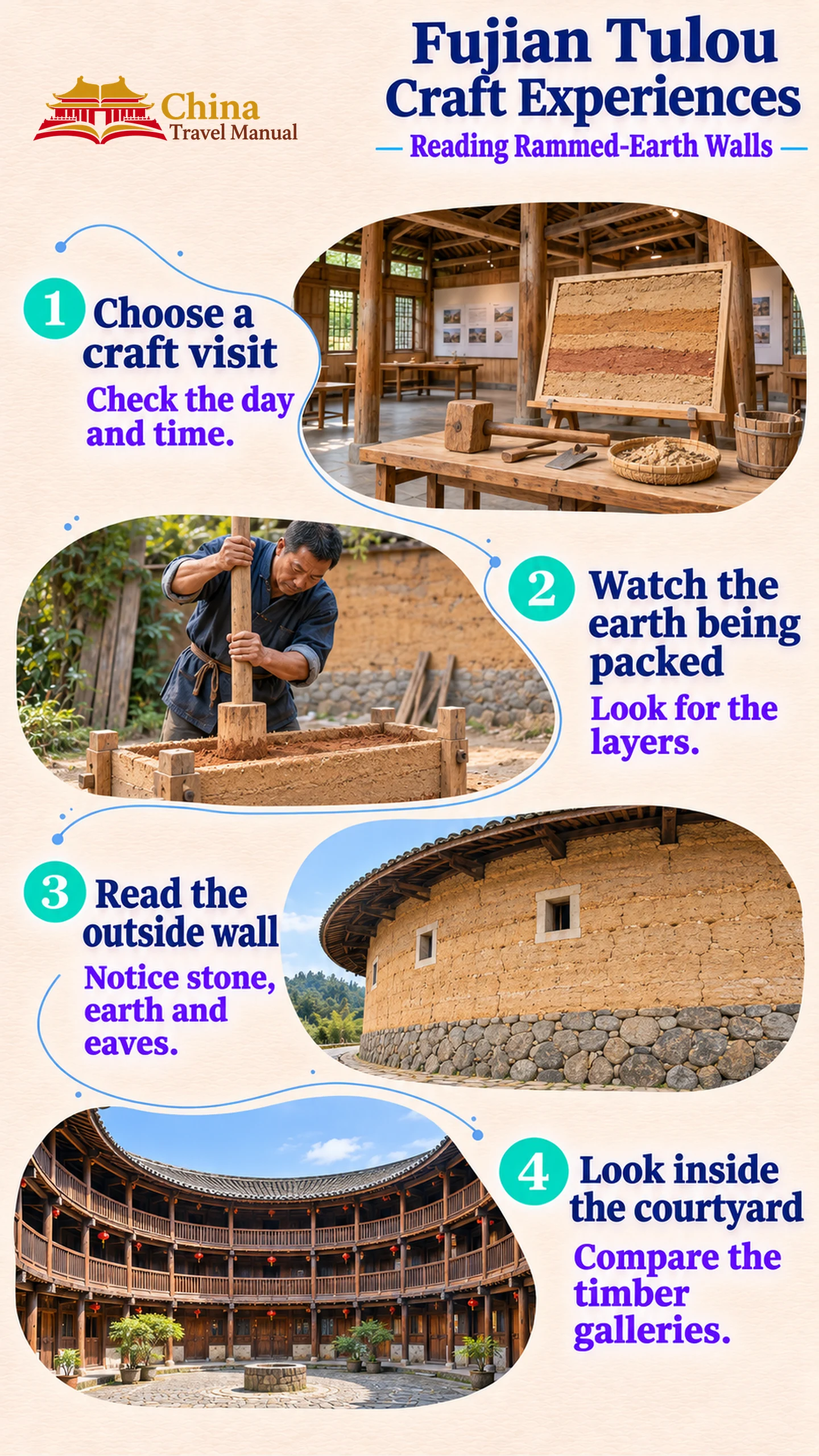
A few minutes at a demonstration frame can change how you notice a tulou. You can then look for the evidence of each material in the full-size building and ask questions about how people keep it in use.
Choose an Exhibit, Demonstration or Hands-On Session
| Experience | What you get | What to confirm |
|---|---|---|
| Exhibit or sample wall | Tools, drawings or blocks that help explain the technique | Opening, venue and interpretation language |
| Live demonstration | An artisan showing a form and how the soil is compacted | Date, start time and viewing arrangements |
| Supervised hands-on session | A chance to tamp a small sample with an instructor | Whether individual visitors can join, age limits and what the price includes |
The booking language matters. An itinerary may say it includes a heritage venue while setting aside hands-on activities for particular groups or packages. Ask for the activity name and a time before you pay for an experience.[3][5]
Understand What the Rammer Is Doing
A temporary form defines the faces of the wall while the soil is compacted in layers. At a demonstration, watch one layer go from loose material to a packed surface. Note when the artisan stops or moves to a new part of the form. Ask what the local earth looks like and what the builders do differently when repairing older fabric.[2][4][6]
Small samples show the process at a level you can see easily. A standing tulou has other elements to look for, including its base, floor structure, openings and roof. Different examples have different histories of construction and repair.[1][6]
Read the Materials in an Actual Tulou
From the outside, look at the wall just above the stone base, where a change of material is easiest to see. Many examples have a stone foundation below the earthen enclosure. Above it, you may be able to see horizontal bands, previous repairs and how a wide roof edge projects over the wall. Where a newer patch is visible, compare its color and surface with the surrounding wall without touching or scraping either.[1][6]
From the courtyard, look upward at the timber structure and balconies. A round tulou and a rectangular one can both turn inward around a courtyard. The contrast between an enclosed exterior and the circulation and rooms inside helps explain the building’s role as a shared home. UNESCO’s Fujian Tulou property includes 46 selected buildings across multiple locations. There are many other tulou in the region.[1][6][7]
Plan a Craft-Focused Visit in Nanjing or Yongding
In Nanjing’s Yunshuiyao area, search for Tulou Light Cultural Park (土楼之光文化园, Tǔlóu Zhī Guāng Wénhuàyuán). Xinhua documented visitors trying the craft there in April 2026. A local visitor listing also describes a heritage center in the area, and specific tour products distinguish sample activities from general visits. Check the name, entrance and date for the exact experience you are offered.[3][5][8]
Pair a confirmed session with a visit to an open courtyard or exterior. Hegui Lou (和贵楼, Héguì Lóu) and Huaiyuan Lou (怀远楼, Huáiyuǎn Lóu) are named UNESCO property components in Nanjing. In Yongding, provincial reporting documents ramming at a building-craft exhibition venue. Longyan’s 2026 tourism coverage describes continuing heritage displays, including rammed-earth craft. Ask which venue in Yongding is offering the activity on your date.[4][7][9]
Confirm Access Before You Book
Ask whether the activity and tulou ticket are separate, whether the instructor can explain the technique in a language you understand and where to meet. If a child wants to join, ask about age limits and how instructors supervise the sample work. A material panel, photographs and an open courtyard are a reasonable alternative if no demonstration runs.
Use the six-day Fujian itinerary to choose where a tulou visit fits. If traveling in and out on the same day, compare the day trips from Xiamen and leave time for the round-trip drive.
FAQs About Fujian Tulou Craft Experiences
Can I try ramming earth at a Fujian tulou?
Some programs have offered hands-on sample work under supervision. Check whether it is available to independent visitors on your date and whether it is included in your ticket.[3][5]
Are all Fujian tulou round?
The UNESCO property contains round and square or rectangular examples. Both can use an earthen exterior enclosure around shared courtyard space.[1][6][7]
Is a tulou visit worthwhile without a demonstration?
Yes. Compare the stone base, earth wall, roof edge and timber seen from a public courtyard. An exhibit can help you identify the materials before you look at them in the building.[1][6]
Sources
[1] UNESCO World Heritage Centre. Fujian Tulou property and shared courtyard layouts
[2] China Intangible Cultural Heritage Network. Hakka tulou building techniques and Nanjing safeguarding
[3] Xinhua. April 2026 observations of visitor craft activities in Nanjing
[4] Fujian Provincial Government. Yongding craft demonstration and conservation context
[5] Trip.com. Example of a venue visit and group-specific rammed-earth activity
[6] UNESCO World Heritage Centre and CRATerre proceedings. Earth, timber and stone in Fujian tulou construction
[7] Fujian Provincial Development and Reform Commission. Inscribed Fujian tulou groups and individual buildings
[8] Ctrip. Nanjing Fujian Tulou heritage craft center visitor listing
[9] Longyan Municipal Government. June 2026 coverage of Yongding conservation and living heritage displays





