
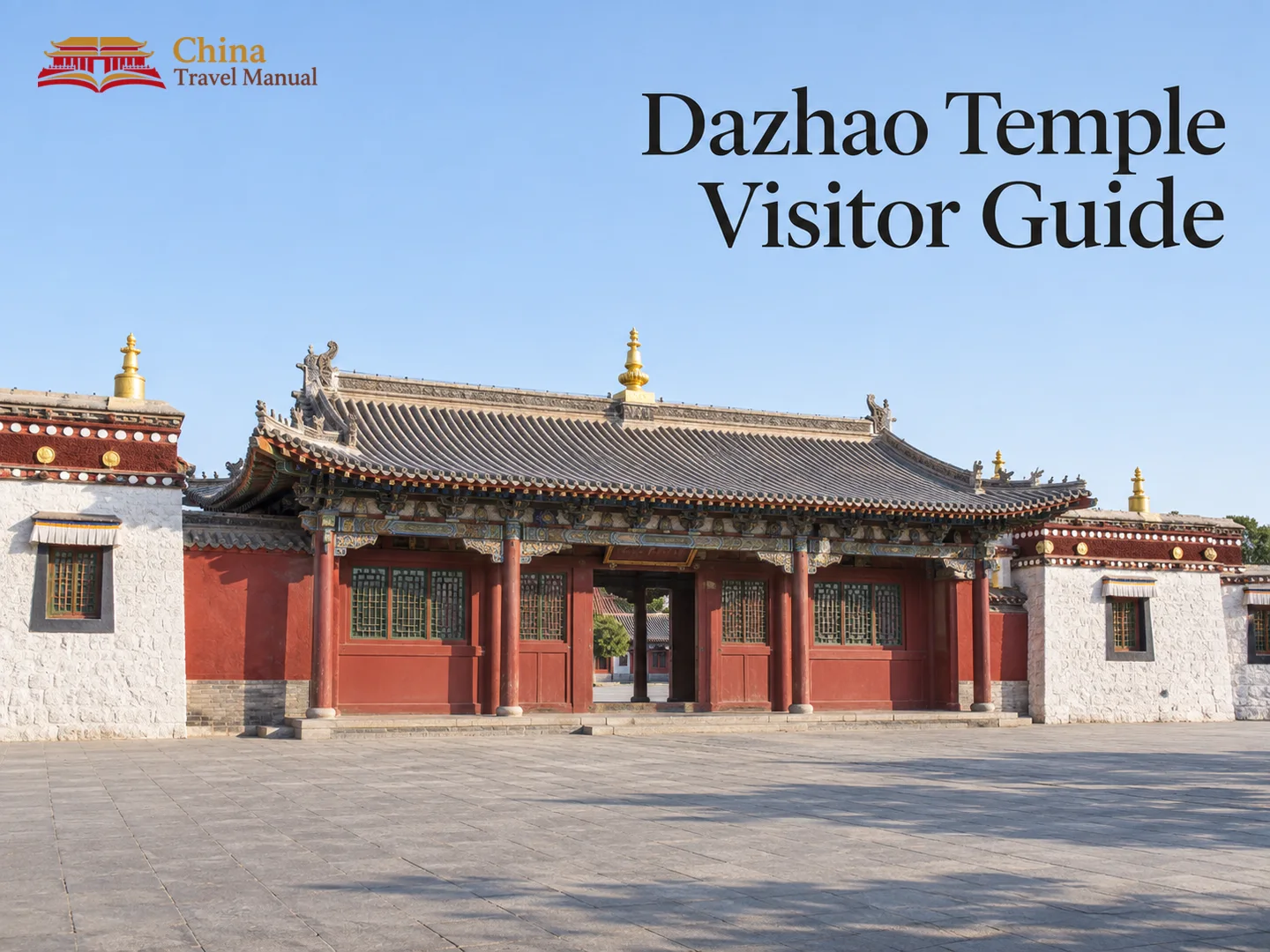
Quick Answer: How Should You Visit Dazhao Temple?
In Hohhot’s Yuquan District, allow about one to two hours for Dazhao Temple (大召寺, Dàzhào Sì). Look for the Silver Buddha (银佛, Yínfó), dragon carvings and murals, then continue through the old city if you have time.[1][2][3]
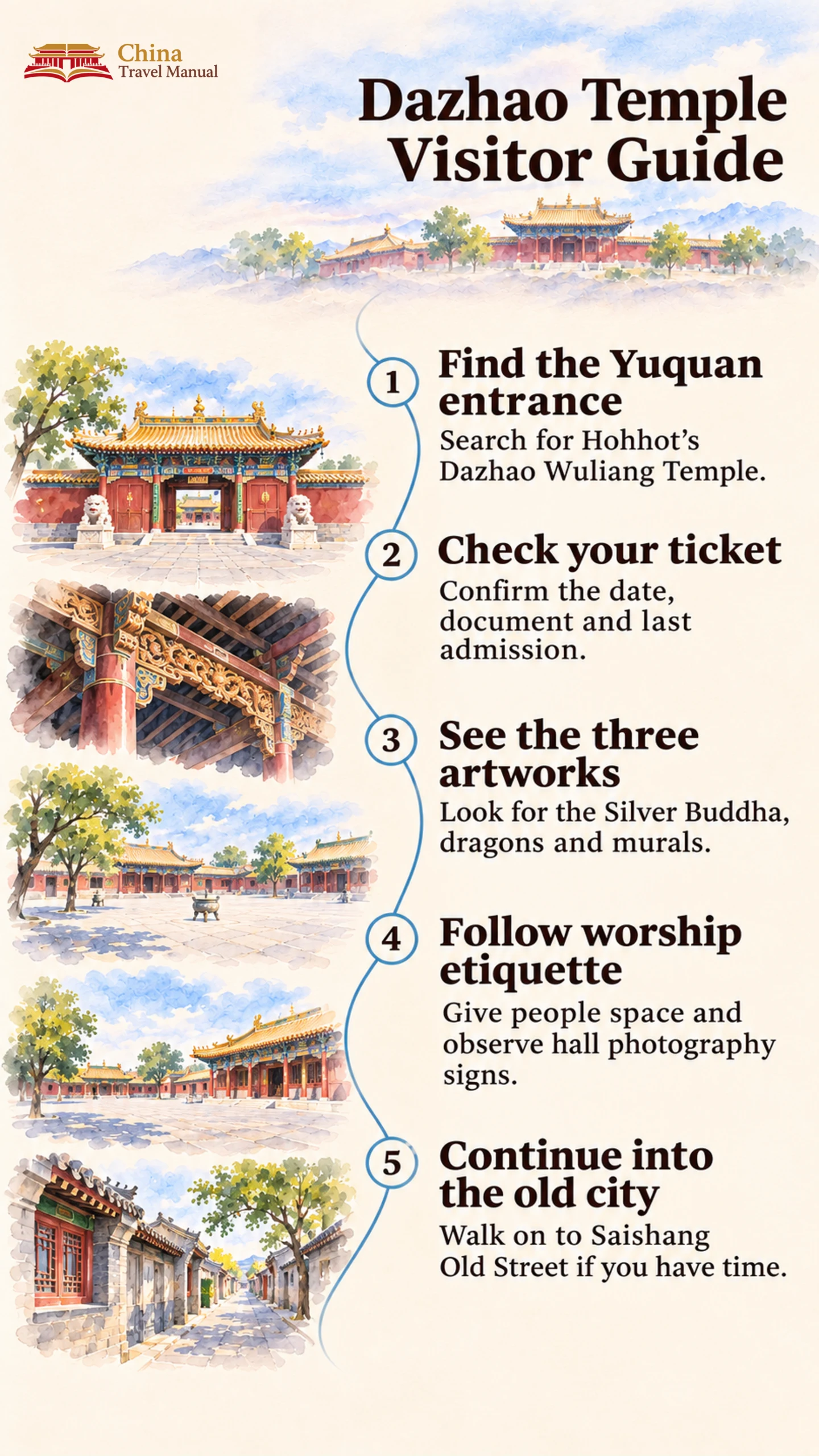
- Where to go: Use 大召无量寺 on Dazhao Front Street to find the Hohhot temple entrance.[1][3]
- Admission: The published standard adult price is ¥35. A current listing gives 08:30–17:30, with last entry at 17:00. Confirm the schedule for your date and ask about passport verification if needed.[2][3]
- Inside the halls: Follow signs on photography and restricted areas. Allow the people using the temple for worship room to pass.[1][3]
- After the temple: Continue to Saishang Old Street (塞上老街, Sàishàng Lǎojiē). Allow a separate stop for any other temple.[1]
Dazhao is the ticketed temple inside a wider historic area. You can plan the public square and street walk separately from its halls.[1][3]
Dazhao Temple is a Gelug Tibetan Buddhist temple in Hohhot’s old city. Built under the Mongol leader Altan Khan in the late sixteenth century, it uses a Chinese-style axial layout for a complex tied to Tibetan Buddhist worship. Its three well-known artworks give the visitor route a clear focus.[1][2][4]
Find the Right Temple and Ticket
Use 大召无量寺 as the map search and confirm the ticket matches the temple you want. Hohhot’s site and the similarly romanized Jokhang temple in Lhasa are different places. Xilitu Zhao (席力图召, Xílìtú Zhào) is another temple in the Hohhot old city and has its own entry arrangements.[1][3][4]
The visitor listing gives 0471-6303154 for ticket questions. Ask about your passport before depending on an app that only accepts a mainland ID. If you arrive later in the day, prioritize halls before the public street walk.[2][3]
Look for the Silver Buddha, Dragon Carvings and Murals
| Artwork | What to notice |
|---|---|
| Silver Buddha | The approximately 2.5-meter silver image of Shakyamuni in the main sanctuary |
| Dragon carvings | Two gold-colored dragons wrapping the pair of tall columns in front of the image |
| Murals | Buddhist narrative scenes painted on the sanctuary walls |
Use the main hall as your orientation point. Local guides place the three works together in the rear sanctuary, so check there before looking for them in other buildings. The Silver Buddha was consecrated by the Third Dalai Lama in 1586.[2][4][5]
Some halls are dim. Give your eyes time to adjust and view the objects from the marked visitor area. Leave a clear way through doorways and follow the hall’s instructions about cameras. If a service limits access, use the courtyard to read the sequence from the gate to the main buildings.[1][3][4]
Give the Old City a Separate Walking Block
After your visit, walk on to Saishang Old Street for the lane and shopfronts. If the temple interior matters most, see it first while you still have time before last admission. Check opening and entry separately if you want to add Xilitu Zhao.[1][3]
A driver can use the temple’s Chinese name to confirm the drop-off in Yuquan. See getting around Hohhot, things to do in Hohhot and the Hohhot two-day itinerary for the rest of the day.
FAQs About Dazhao Temple
Is the Dazhao square included with the temple ticket?
The visitor admission concerns the temple itself, within a broader historic area. A walk around the public square and adjacent street can be planned separately.[1][2][3]
What are the three famous artworks at Dazhao?
The Silver Buddha, dragon carvings and murals are traditionally grouped as the temple’s three exceptional artworks. Check which halls are accessible on your date.[1][2][3]
Can you visit Dazhao Temple and Xilitu Zhao together?
Yes. They are separate Yuquan visits. Check each venue’s last admission before deciding the order.[1][3]
Sources
[1] People’s Daily Online, Inner Mongolia. Dazhao’s old-city setting, layout, artwork and distinction from the Lhasa temple
[2] Hohhot Bendibao. Published admission, historical context and the three artworks
[3] Ctrip. Dazhao Front Street address, hours, ticket contact and visitor features
[4] TravelChinaGuide. English names, history and descriptions of the artworks
[5] Qunar Travel News. Placement of the three artworks in the inner hall and descriptions





