
Quick Answer
At an imperial palace in China, start with the approach. Watch what changes as you pass from a large ceremonial court into smaller residential compounds.
- Gates and sightlines: Stand off to one side, then compare that view with the one down the middle.
- Roofs and terraces: Compare nearby halls for changes in roof profile, ridge figures and platform height.
- Purpose: Beijing illustrates a capital palace, Shenyang an earlier Qing court, and Chengde a summer residence with a large garden landscape.
Choose one secondary courtyard or gallery for a closer look. Leave the rest for another visit if you have limited time.

Stand in the main courtyard of the Forbidden City and the first impression is space. Doors, platforms and the gaps between halls govern how you approach. By the time you reach the residential courts, the scale has changed. Those differences are some of the easiest clues to read on a palace visit.
Follow the Gates from Ceremony to Daily Life
In Beijing’s Forbidden City, the formal southern section is the Outer Court (外朝, wàicháo). Its three main halls occupy the central path. The northern section is the Inner Court (内廷, nèitíng), with central palaces and residential compounds to either side. The distinction is a good starting point. Individual halls had different functions at different times.[1]
Look back after you pass a gate. The width of the opening and the size of the next enclosure can change what you can see at once. Stay close to the permitted route, and pause at the edge of a courtyard where other visitors can pass. One view down the axis and another from the side often tell you more than another quick photograph of the building front.
The route through the palace is part of a larger idea. The Forbidden City stands along Beijing’s historic north–south Central Axis, a sequence that includes ritual, civic and imperial sites. The line on a city map extends well beyond the palace walls.[2]
To see how other historic Beijing institutions use courtyards, compare the palace with the temple and college in the guide to Confucian sites in China.
Read Rank in the Roofs and Terraces
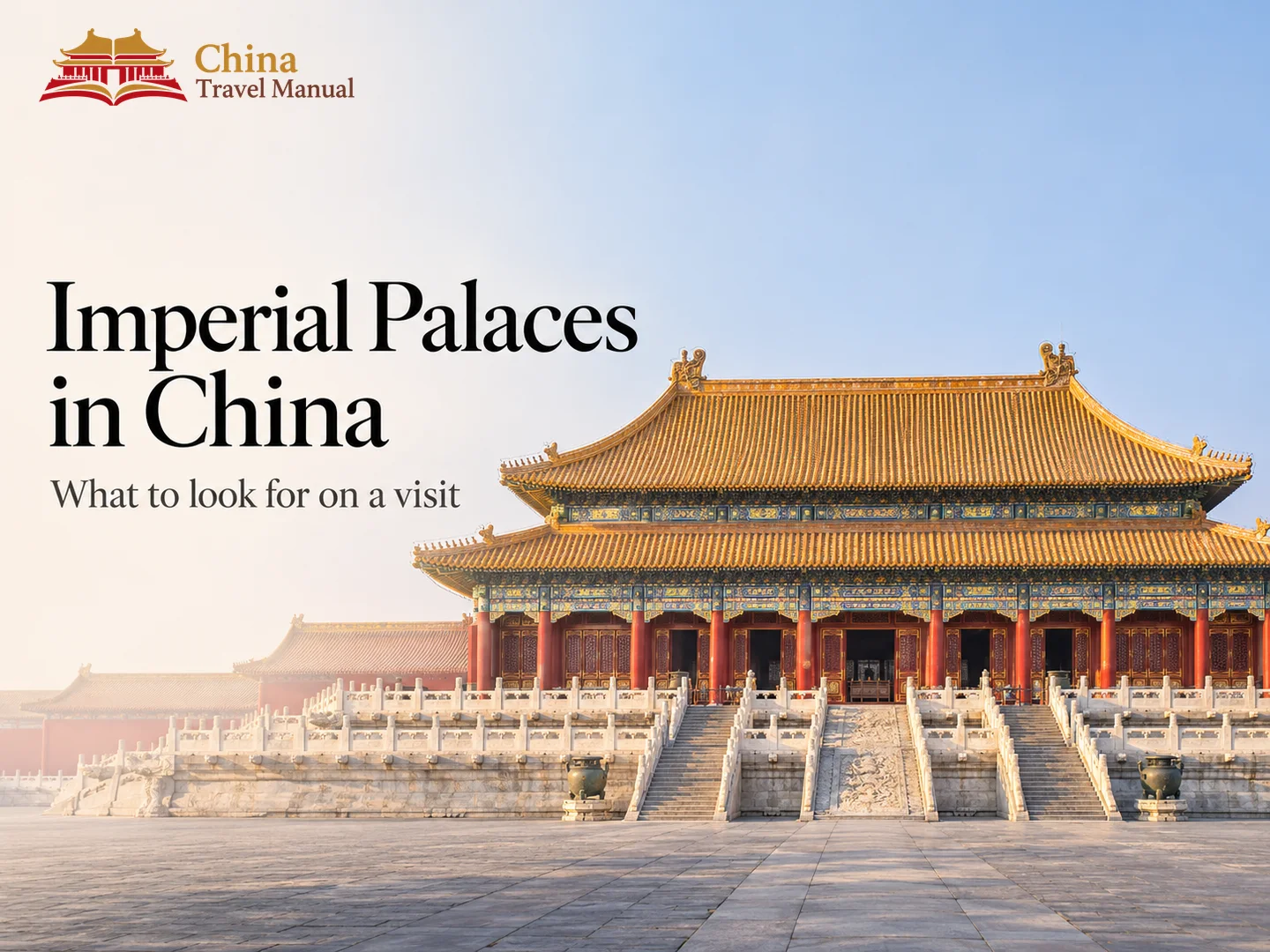
The Hall of Supreme Harmony (太和殿, Tàihé Diàn) is the first of the three main halls of the Outer Court. A three-tier terrace lifts its roof and hall high above the courtyard. Look for the row of ten small beasts on each sloping corner ridge. From the ground, use a zoom lens or look at the museum’s detail photographs to compare the sequence with one on a smaller hall.[3]
Notice three things from a point where you can see more than one building.
- Height: Look for how many terrace levels separate the hall from the courtyard. The approach is part of the building’s scale.
- Roof shape: Compare the profile and number of eaves before trying to identify individual figures.
- Ridge details: Look along the sloping edge for the small procession. On the main ridge, the larger end ornaments are a different feature.
Use a building label or a museum plan to work out purpose or occupant. The strongest reading comes from several clues together, such as the hall’s position on the axis and the scale of its approach. Glazed tiles alone cannot answer who used a building or what happened there.
How Beijing, Shenyang and Chengde Differ
| Site | Main thing to compare | Useful first viewpoint |
|---|---|---|
| Forbidden City in Beijing | The change from state ceremony to the residential court | The approach to the central halls |
| Shenyang Imperial Palace | A compact early Qing ceremonial and administrative layout | The open eastern forecourt and its flanking pavilions |
| Chengde Mountain Resort | The balance of court buildings and a large landscape | The transition from the palace area toward the gardens |
The Forbidden City in Beijing
This is the clearest place to see the full sequence of gates and formal courts. Start down the central route, then take an open side branch to compare the width and enclosure of a smaller court. The palace served Ming and Qing rulers. Its central route makes the planned progression especially easy to trace.[1][4]
Shenyang Imperial Palace
The Shenyang Imperial Palace reflects the early development of the Qing court in the northeast. In its eastern section, look for the Hall of Great Affairs (大政殿, Dàzhèng Diàn). Walk toward it through the open space flanked by ten pavilions historically linked to banner administration. The relationship between this hall and the low buildings around it offers a different reading of ceremony and authority from the one in Beijing.[4][5]
Chengde Mountain Resort
At Chengde, the Qing summer establishment combined palaces with gardens, lakes and hills. The outlying temples form part of the same World Heritage property. On the ground, consider them as a separate visit with its own distances and entry arrangements. Allow time beyond the palace area if you want the landscape itself to be part of your day.[6]
How to Plan a Visit Around What You Want to See
- Choose one main route. For a first Forbidden City visit, trace the central succession of gates and courts. If you have extra time, select one side court or an exhibition related to your interests.
- Check the visitor map for admission and exit. Beijing’s Meridian Gate is on the south side and the Gate of Divine Prowess is on the north. Confirm the current approach, open galleries and your meeting point so you can finish the visit where you need to be.[7]
- Match the reservation to each traveler. The Forbidden City ticket guide explains the booking process. Foreign passport holders should use the same passport details for their online reservation and bring that document. Check whether a separately ticketed exhibition is part of your plan.[7]
- Pick one detail to compare on site. Photograph a wide view first, then zoom in on the roof or railing. If a hall interior is inaccessible, use its label and the sightline from an open courtyard.
FAQs About Visiting Imperial Palaces in China
Where should I start if I have time for one palace?
The Forbidden City in Beijing gives you the clearest first look at the Ming and Qing capital palace. If you are already in Liaoning, start with Shenyang and focus on the eastern court and pavilion arrangement.
Can I go inside every hall?
Access depends on the room, current exhibitions and maintenance. Plan around views from the courtyards and check whether any gallery you want to enter has separate admission.[7]
How long should I allow for the Forbidden City?
The museum provides a two-hour trail, a half-day trail and a one-day trail. Use two hours for a focused central-route visit. Choose half a day or longer if you want to include side courts or galleries. Allow extra time for the approach and security checks.[7]
Sources
[1] The Palace Museum. About the Palace Museum
[2] UNESCO World Heritage Centre. Beijing Central Axis
[3] The Palace Museum. Hall of Supreme Harmony
[4] UNESCO World Heritage Centre. Imperial Palaces of the Ming and Qing Dynasties in Beijing and Shenyang
[5] China Daily. Imperial Palaces of the Ming and Qing Dynasties in Beijing and Shenyang
[6] UNESCO World Heritage Centre. Mountain Resort and Its Outlying Temples, Chengde
[7] The Palace Museum. Visit the Palace Museum





