
Quick Answer: Do Thai passport holders need a visa for China?
For an eligible short mainland trip, start with the 30-day visa exemption for ordinary Thai passports.[1][2]
- Short eligible trip: Check the 30-day single-stay limit and the rolling cap. Short holidays on an ordinary Thai passport can use the bilateral waiver when both fit.[1][2]
- Longer stay or different purpose: Apply for the visa required by your purpose before travel if the exemption does not cover your stay. Work and formal studies have separate requirements.[1][2]
- Before check-in: Keep your itinerary, onward or return transport and first mainland accommodation accessible. Complete the arrival card if required.[2][4]
Confirm the agreement and conditions again for your actual dates.[1][2]
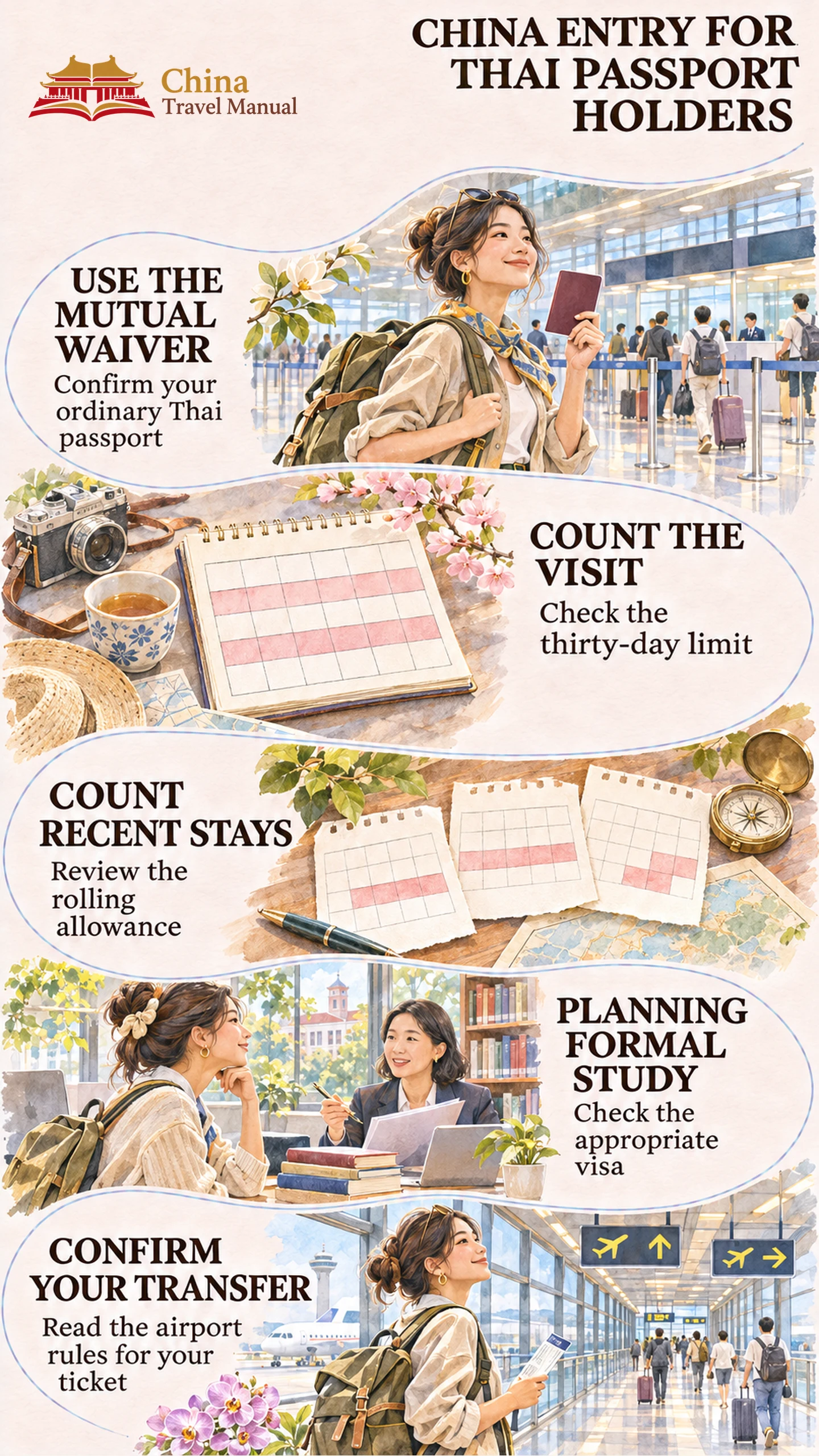
Holders of ordinary Thai passports can use the China–Thailand mutual exemption for eligible mainland visits under the agreement in force since March 1, 2024. A single stay may last up to 30 days, subject to a total of 90 visa-free days in any 180-day period. Use a suitable visa before traveling for residence, work, study, media or other activities requiring prior approval.[1][2][5]
Match your Thai passport and itinerary to an entry route
| Your trip | Entry basis | What to confirm |
|---|---|---|
| Ordinary passport, eligible short visit | Up to 30 days under mutual exemption, with a rolling 90-in-180-day limit.[1][2] | Check the departure day and the periods of your previous visa-free visits. |
| Stay beyond the exemption or work or formal study | Apply for the visa and approvals required for the actual activity.[1][2] | Check the application channel for where you live and what it requires. |
| Conditional 24-hour airside transit | A confirmed onward itinerary to a third country or region can qualify for a stay of up to 24 hours in a port’s restricted area. Leaving the area requires a temporary entry permit.[3] | Use a confirmed route and ask the airline how it will handle the transfer. |
If you will spend most of several months in mainland China, compare the planned length and purpose with the appropriate visa category before relying on short repeat trips.[1][2][5]
Check repeat trips, study plans and transfers from Thailand
For a Bangkok–Kunming–Bangkok holiday, a valid ordinary Thai passport can use the bilateral waiver if the purpose and both stay limits fit. For a group with Malaysian ordinary passport holders, confirm their terms separately in the Malaysian passport entry guide. Prepare an itinerary and keep your return ticket and first address accessible. If you stop in China on the way to another country, check whether you will pass immigration and whether a connecting ticket changes the entry basis.[1][3][5]
If you have relatives or a recurring project and plan another visit after several recent trips, write down each mainland arrival and exit. Check the rolling 180-day window for the new dates and keep extra time before your planned departure. If the remaining allowance is less than your planned stay, shorten the itinerary or check the appropriate visa before departure.[1][2]
A semester programme, employment assignment or reporting trip needs an appropriate visa or authorization. Check the China visa application channel guide and current Chinese consular instructions for your situation. A stay within 30 days still needs an eligible purpose.[1][5]
How to prepare your documents before departure
- Confirm your passport and purpose: Use the passport you will present to the airline and border officer. Check the validity requirement for your chosen entry route and verify permitted activities.[1][2]
- Have documents ready before check-in: Prepare your booking details, the address in China and recent travel dates. Keep entry and exit records available if you need to confirm your remaining bilateral allowance.[1][2]
- Complete the current arrival process: If an arrival card applies, fill it out free on the official channel or at the port. Use the China arrival card guide to prepare your trip and first-stay details before check-in.[4]
- Confirm your final day: Check the stay allowed at admission. If work or formal studies are part of your plans, verify your entry status before you agree to the activity.[1][5]
FAQs About China Entry for Thai Passport Holders
Can I stay for 30 days each time I use a Thai passport?
The single-stay maximum is 30 days. The rolling total can reduce the time available on a later visit.[1][2]
Can I apply the 240-hour rule on a Thai passport?
The current 240-hour nationality list does not include Thailand. The mutual visa exemption or the separate 24-hour restricted-area transit rules may apply, depending on your itinerary.[1][3]
Can I use the waiver for a study programme?
Formal study is outside the bilateral exemption. Check the appropriate study visa with the Chinese mission before paying for the programme or flight.[1][5]
Sources
[1] Thailand Ministry of Foreign Affairs. Thailand–China mutual visa exemption agreement and stay limits
[2] National Immigration Administration. How cumulative stays are calculated under mutual agreements
[3] National Immigration Administration. Visa-free transit policies and eligible passports and ports
[4] National Immigration Administration. Free official arrival card channels
[5] Chinese Embassy in Thailand. Exemption conditions and visa application options in Thailand





