
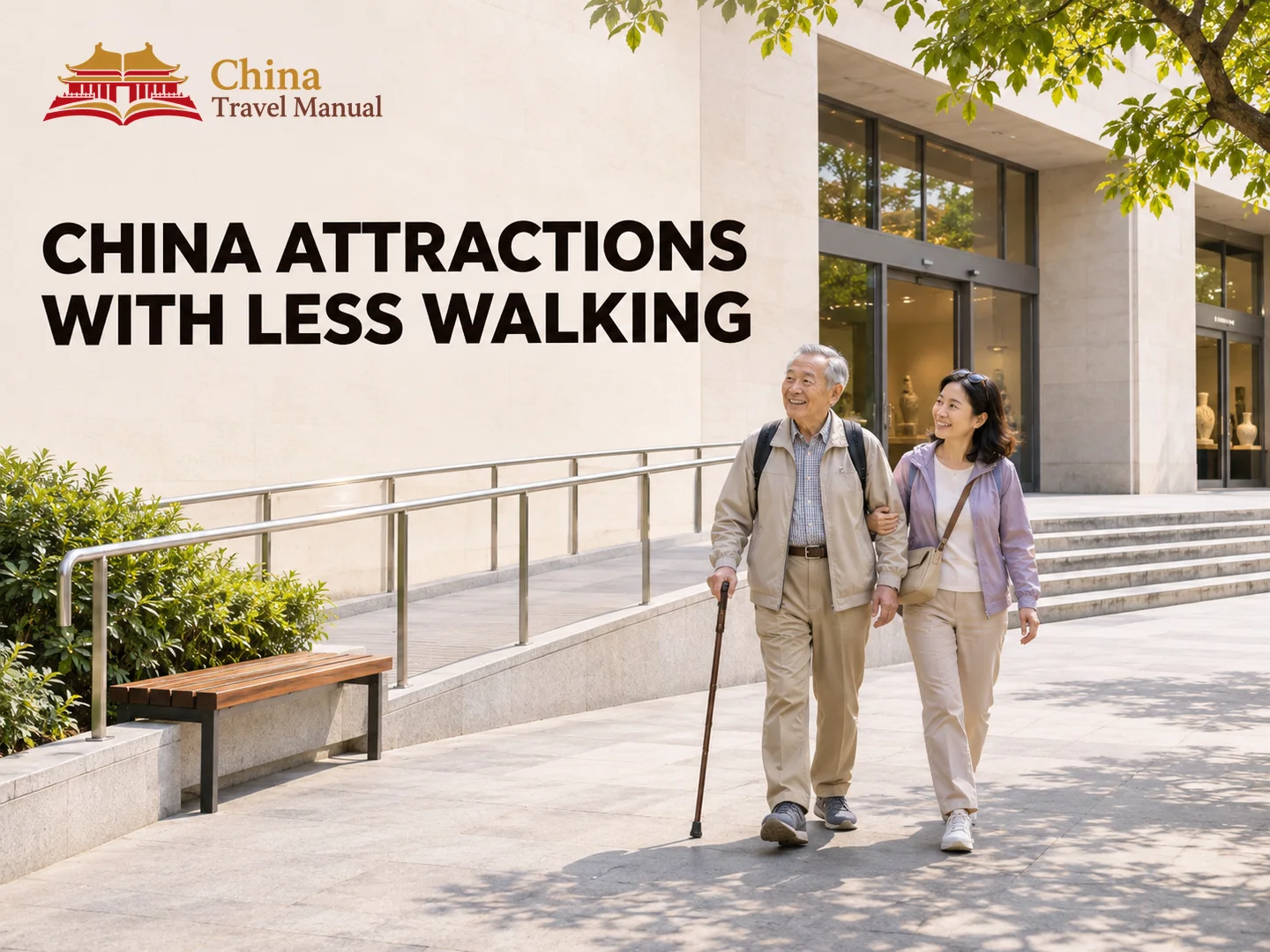
Quick Answer: How can you check whether a China attraction suits limited walking?
Verify the route from your vehicle or metro elevator to the ticket gate, the features you want to see and your exit pickup. Ask about steps, alternative doors, usable lifts and places to sit. Start with one priority stop and design an early exit if the indoor route, weather or crowding makes the visit harder.[1]
- Before booking: Ask the venue about the exact branch, entrance and exhibition you plan to visit.
- On site: Find the closest usable rest point and check the way out before taking a long loop.
- If information is unclear: Choose a shorter route or a venue that confirms a usable entrance and return.
Reduced walking and step-free access are distinct requirements. A visitor who can use a few steps may need frequent seating, while a wheelchair user may need a continuous route and usable lift.

An attraction can offer wheelchair service and still have a long approach from the street, a few steps to an exhibition or an exit far from your driver. Plan around the whole route rather than the amenity list. Verify the segments that matter to the person traveling, including how far they can walk between places to sit.
At a Glance
| Route segment | Confirm with the venue | Decision it supports |
|---|---|---|
| Street to entrance | Vehicle drop-off, crossing, curb and steps | Which address or gate to use |
| Ticket gate to landmark | Stairs, thresholds, slopes and lift openings | Whether you can reach your main stop |
| Between highlights | Surface, distance, seating and toilets | How much of the visit to attempt |
| Exit to transport | Last usable lift, return gate and vehicle pickup | How to leave if tired or if the venue changes the route |
Ask for the Exact Path and Your First Seat
Show the name of the venue, the entrance you plan to use and the one room, garden or viewpoint you especially want. Ask whether the path has steps, a steep slope or a threshold. Ask for a map or photographs and confirm whether the lift is working. The Chinese question “从入口到展厅有台阶吗?” means “Are there steps between the entrance and the gallery?”[1]
Check the walking distance to the first place to sit. A cafe seat, outdoor bench and queue waiting area serve different needs. Look for a toilet you can reach without retracing the whole route. If you rely on a borrowed wheelchair, ask where it is collected, whether quantity is limited and whether you can return it at your exit.
Use Two Verified Venue Examples
Shanghai Museum East lists an accessible elevator and wheelchair loans with conditions. That supports an indoor gallery choice. It still helps to confirm the street approach, the actual entrance and seating in the galleries you want. This also avoids confusing the Pudong museum branch with the People’s Square site.[2]
At Beijing’s Forbidden City, the Palace Museum uses a one-way route from the Meridian Gate to north or east exits. Decide where to meet your driver on the far side. Ask the visitor desk which alternate route works for your priorities, especially if steps or thresholds matter. A return from the same gate cannot be the basis of your usual route plan.[3]
Shorten the Visit Before It Becomes Difficult
Set a main stop and a clear optional one. For a museum, choose one gallery near an elevator that staff confirm is operating. For a long riverside attraction, decide where to turn around and have the pickup ready. A day with one main stop and time to sit can be easier to complete than several short but independent transfers. Use the low-walking Shanghai itinerary or central Beijing low-walking route for worked city examples.
Check Access Again on the Day
Look for closure notices, bad weather, lift maintenance or event diversions. When you arrive, show staff the specific place you want to reach and ask which entrance or exit they recommend that day. Keep the Chinese pickup address offline. If the rest point is closed or crowd controls extend the approach, shorten the visit while the exit is still easy to reach. Travelers combining sightseeing and rail can use the low-walking train transfer guide to plan that part of the day.
FAQs About Visiting China Attractions With Limited Walking
Does a wheelchair symbol mean I can reach every part of a site?
Check the specific route. A museum may list a lift or loan service while a particular gallery, historic room or approach still includes steps.
How do I find out whether there are places to sit?
Ask about seating on your actual route, including inside the queue and near your main stop. Identify a usable alternative in case the first rest point is full or closed.
What if the attraction has a different entrance and exit?
Plan the drop-off at the entry and the pickup near the expected exit. Save both pins before the visit and ask about current traffic controls or pedestrian-only streets.
Sources
[1] Chinese Museums Association. Guidelines on Museum Accessibility in China
[2] Shanghai Museum. East branch visitor services
[3] The Palace Museum. Current visitor routes and entrance and exit rules





