

Quick Answer: When Should You Visit Harbin?
Choose January for seasonal ice and snow shows, or May or September for a first trip centered on the city. A winter date is most useful once you have checked the opening of the attraction you came to see.[1][2]
- January: Give the seasonal ice park one main block and allow a second opportunity in case of changes.[2][3]
- Late December or February: Confirm your attractions separately before booking around the edges of winter.[2][4][5]
- May or September: Plan the historic streets, a river walk and Sun Island around a much milder daytime range.[1][6][7]
Use climate averages to compare months and your day’s forecast to decide how long to stay outside.[1]
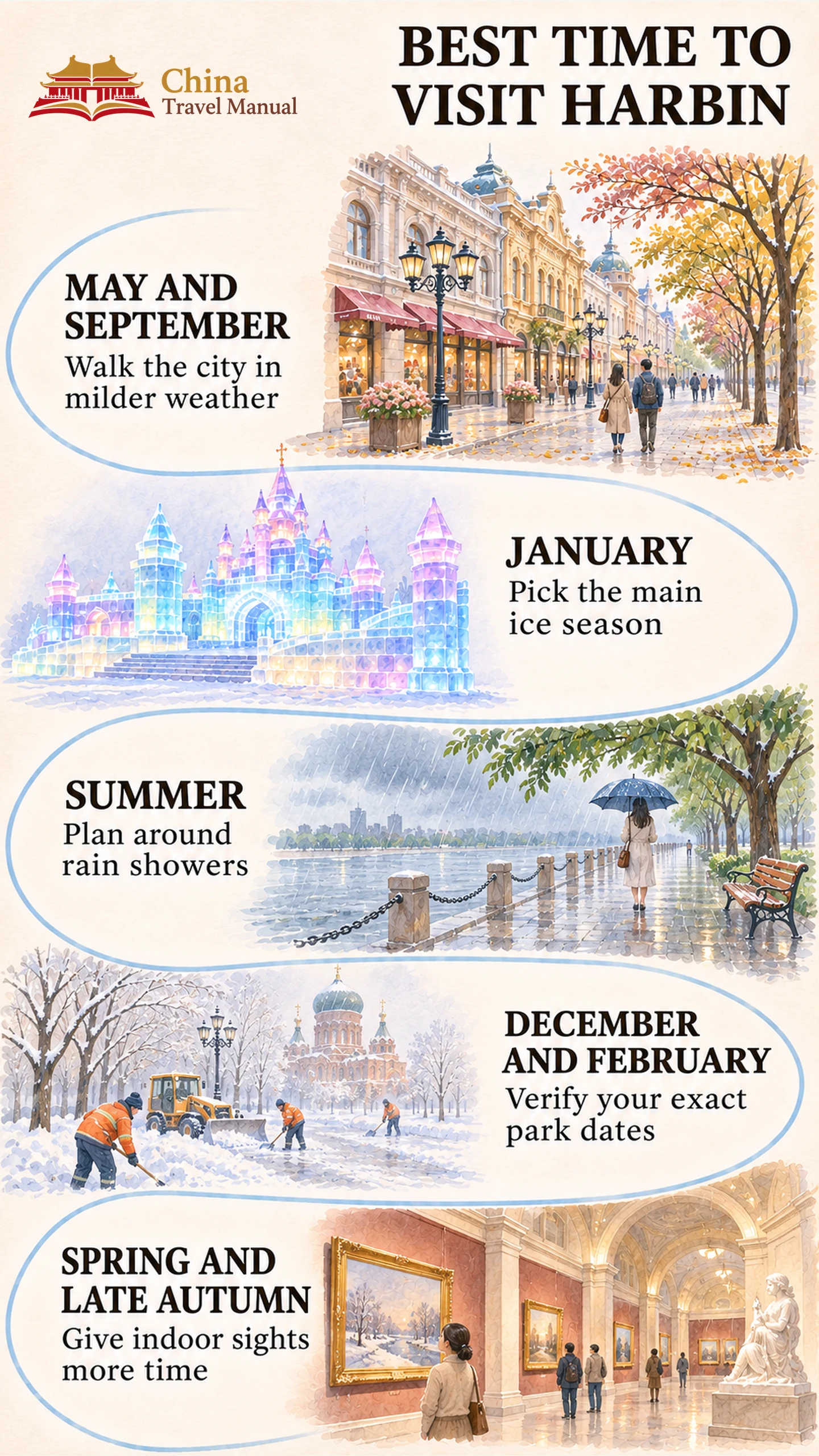
January is the best month to plan around Harbin’s outdoor ice and snow attractions. Choose May or September if you mainly want to walk through the historic neighborhoods and along the river in milder weather. Before booking a winter trip, check the period when your particular venue is open. The city’s broader winter program covers more dates than the outdoor ice park.[1][2][3]
Harbin Seasons at a Glance
The temperatures below are selected Harbin climate figures from the World Meteorological Organization service. Each range gives the mean daily minimum and mean daily maximum for that month. They help compare seasons but do not give the expected range for a particular day.[1]
| Travel period | Climate reference | Good fit |
|---|---|---|
| January | About −25 to −13°C.[1] | The midwinter outdoor ice attractions and shorter periods outside. |
| December and February | About −20 to −10°C in December and −21 to −9°C in February.[1] | Winter visits after checking the specific venue’s dates. |
| May and September | About 8 to 21°C in May and 9 to 21°C in September.[1] | Historic streets, outdoor cafés and riverfront or park walks. |
| June to August | About 18 to 28°C in July, the wettest month listed.[1] | Warm-weather visits with indoor stops for showers. |
| March, April, October and November | About 0 to 13°C in April and 0 to 12°C in October.[1] | A quieter architecture visit, with more time indoors during the colder shoulder weeks. |
January for Ice and Snow
Choose January if the outdoor winter park is your priority. It sits between the usual period when the sculptures are being finished and the later weeks when warmth can change operations. For context, the previous outdoor edition opened December 17, 2025 and closed February 21, 2026 after unusual warmth. The 2026–27 provincial preview targeted mid-December for the next opening. Check the latest visitor notice for your actual date.[2][4][5]
Use the Harbin Ice and Snow World visitor guide for that venue. Sun Island’s snow art, riverside events and the wider festival have separate openings. The city’s broader 2026–27 ice and snow program runs from November into March. A date inside that season can still miss the two largest outdoor exhibitions. The Harbin Ice Festival planning guide explains how to choose and check the events.[2][3]
January is also the coldest month in the WMO table. Decide how long you want to go between indoor breaks, and give yourself a short way back to a heated space. Carry the right layers for the actual forecast and use the Harbin winter packing guide to plan for exposed, slow-moving visits.[1][8]
Spring, Summer and Autumn for City Walks
By May, the climate normally suits a walking day more readily than early spring. September gives you a similar daytime average and another mild window for architecture and riverside walks. Use Harbin Central Street and Saint Sophia Cathedral for a first central route. When you want more time outdoors, visit the green spaces in the Sun Island visitor guide.[1][6][7]
Warm-weather trips in June, July and August spread the day’s walks over more daylight. July sees more rain in the city’s climate data than any other month in the table, so it helps to have an indoor choice you can move into a showery hour. Early spring and late autumn are better for a short architecture-led trip with a longer meal or museum stop. If the sky clears, use the things to do in Harbin guide for a flexible walk.[1][6]
How to Pick Your Dates for Harbin
- Choose the experience that matters most. Start with January for outdoor ice and snow, or compare May and September for walking.
- Verify the venue itself. Look for the park’s operating notice and the booking option for your date. Check adjacent venues separately.[2][3]
- Plan a fallback around the weather. Compare the three-day Harbin itinerary and leave one flexible outdoor block.
- Review hotel and transport conditions. Compare prices on the dates you can actually use and check change policies if you are traveling close to a seasonal opening or closing. The Harbin travel budget guide covers what to allow.
FAQs About the Best Time to Visit Harbin
Is December too early for the ice park?
Early December can be too early for the main outdoor park. The 2026–27 preview targeted a mid-December opening, but the actual operating notice and date-specific ticket availability are what matter.[2][4]
Is late February a good time to see the ice?
It is less dependable than January. The outdoor park can close earlier during a warm spell, as it did in February 2026. Book around confirmed dates and give yourself other sights to visit.[5]
What is the best month for Harbin without the cold?
May and September offer a historical mean daily maximum near 21°C, with cooler nights. Choose September if you prefer an early autumn visit or May for a late spring visit.[1]
Sources
[1] World Meteorological Organization. Harbin monthly climate data
[2] Heilongjiang Department of Culture and Tourism. 2026–27 Harbin winter attractions preview
[3] Heilongjiang Provincial Government. Harbin’s broader 2026–27 winter program
[4] Xinhua via China’s State Council Information Office. December 2025 opening of the outdoor ice park
[5] Heilongjiang Provincial Government. February 2026 park closure after warm weather
[6] Xinhua via the Heilongjiang Provincial Government. Central Street and Harbin’s architecture
[7] Heilongjiang Provincial Government. Sun Island Scenic Area profile
[8] US Centers for Disease Control and Prevention. Cold exposure in travelers





