

Quick Answer: How to Visit Shennongjia
Allow three days for Shennongjia if you want the sites around Muyu, the high ridges of Shennongding and Dajiuhu’s wetlands. Base yourself in Muyu for the first stops. Consider a night in Pingqian if you want an early wetland visit.[2][3][6]
- For Muyu: Compare trains to Xingshan and arrange the road connection.[4][6]
- For the high country: Choose the clearest day for Shennongding.[2][3]
- For Dajiuhu: Confirm the visitor transfer and return before booking lodging.[3][6]
Check roads and park notices, especially before a long transfer between bases.
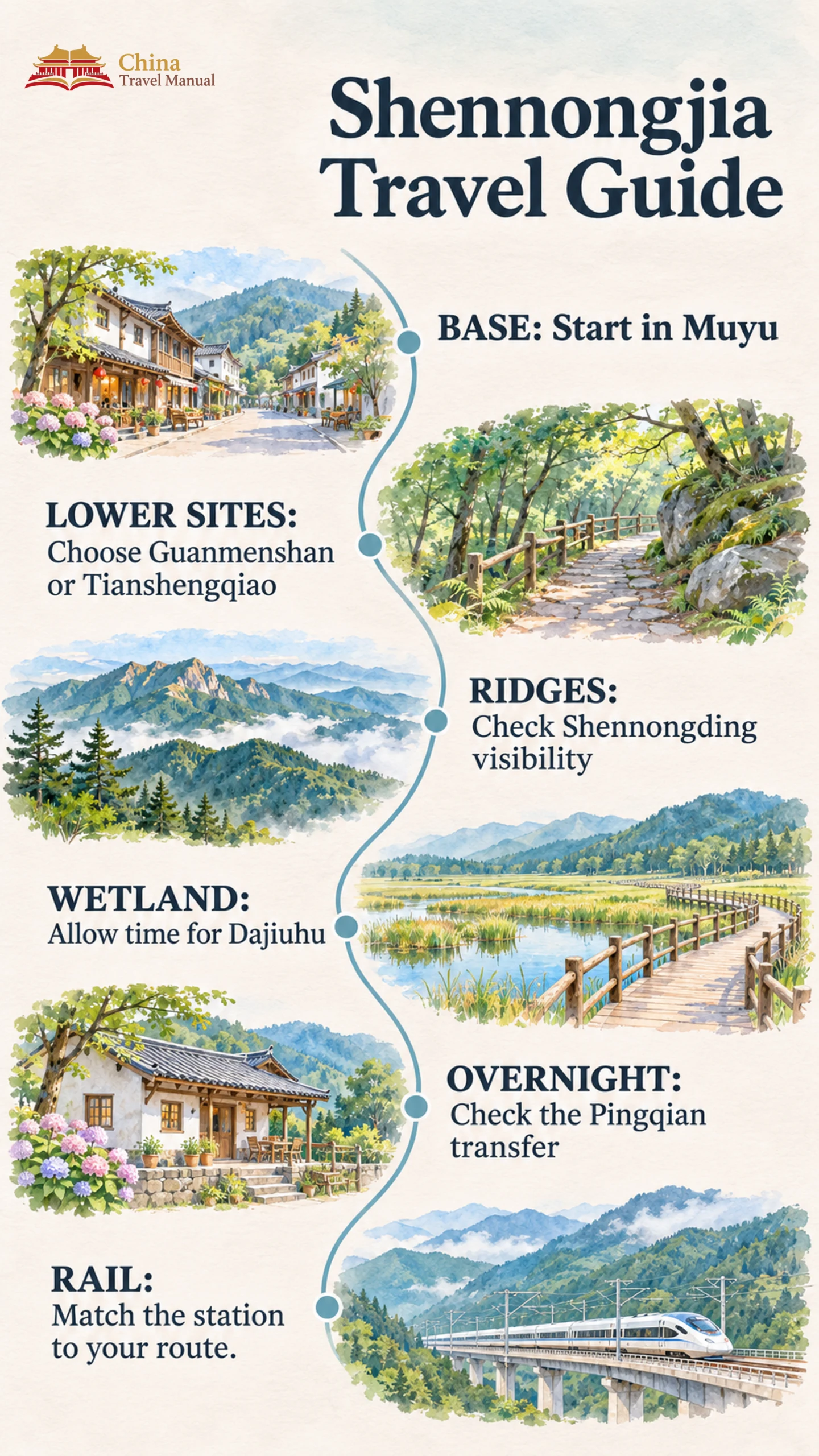
Shennongjia is a forest district in western Hubei. A place listed under the same district name can be several road legs from your hotel. Choose your first scenic area, then work out the train, road and park connections.
Use Muyu for the First Part of the Trip
Stay in Muyu (木鱼, Mùyú) for the southern visitor routes. Guanmenshan (官门山, Guānmén Shān) works well for an introduction to the district’s natural history. Tianshengqiao (天生桥, Tiānshēngqiáo) is a different outing with short scenic walks near water and rock. Check the current visitor entrance and the amount of walking. Pick one if you have just the arrival afternoon.[2][3]
Take the time to arrange the next day’s car or park shuttle before dinner. A Muyu hotel is convenient for meals, but you still need the appropriate transport for the main mountain or wetland routes.
Spend a Clear Day at Shennongding
Shennongding (神农顶, Shénnóngdǐng) is the high-country option. UNESCO’s Hubei Shennongjia listing covers protected mountain forests in more than one component. The scenic-area route reaches a group of named stops, including Shennong Valley and Banbiyan. Plan around the open route and your interest in shorter forest walks or exposed scenery.[1][2]
Ask which stops the shuttle or your arranged transport serves. Pack a layer for the higher stops and leave extra time for the return if visibility or traffic is poor. If the higher viewpoints are hidden, choose a lower walk that is open and keep the mountain route for clearer conditions.[2][3]
Give Dajiuhu and Pingqian Their Own Time
Dajiuhu (大九湖, Dàjiǔhú) is a separate wetland outing. Choose it for quieter boardwalk time, water views and a chance of morning mist. Stay in Pingqian (坪阡, Píngqiān) when the timing of an early visit matters, and ask your host which visitor center or transfer point serves your route.[3][6]
Confirm the operating shuttle and its last return. Keep to open viewing areas and treat wildlife sightings as a bonus. A full first day on the ridge and an early second morning at Dajiuhu work better when you can sleep near the wetland in between.
Choose a Railway Station and a Three-Day Route
For Muyu, check Xingshan Railway Station (兴山站, Xīngshān Zhàn). Shennongjia Railway Station (神农架站, Shénnóngjià Zhàn) is in Xinhua Township and can be useful for different approaches. Badong Railway Station (巴东站, Bādōng Zhàn) is another option if its onward connection fits Dajiuhu. Check that the road transfer operates at your actual arrival time.[4][5][6]
Use day one near Muyu, day two for Shennongding and day three for Dajiuhu if road access and visibility cooperate. With only two days, choose one full park day and a lower stop. The Hubei travel guide covers the wider route. Plan the Wudang part separately with the Shiyan travel guide.
FAQs About Visiting Shennongjia
Is Shennongjia Railway Station Near Muyu?
Shennongjia Railway Station is in Xinhua Township. For Muyu, compare the onward road ride from Xingshan before picking a train.[4][5][6]
Can You Visit Shennongjia Without Driving?
Yes, if your chosen rail or coach arrival has a suitable local transfer. Confirm road rides in both directions and the park’s own transport for your date.[3][4][5]
Should You Stay in Muyu or Pingqian?
Choose Muyu for Guanmenshan and nearby visitor stops. Choose Pingqian if you want an early Dajiuhu outing and have confirmed the wetland transfer.[3][6]
Sources
[1] UNESCO World Heritage Centre. Hubei Shennongjia
[2] Ministry of Culture and Tourism. Shennongjia ecological tourism areas
[3] Hubei Public Security Department. Holiday access and scenic-area route groups
[4] Hubei Department of Culture and Tourism. Rail and road approach to Muyu from Xingshan
[5] Shennongjia official transport notice. Railway arrivals and onward road routes
[6] Atlas of China. Shennongjia visitor routes and bases





