
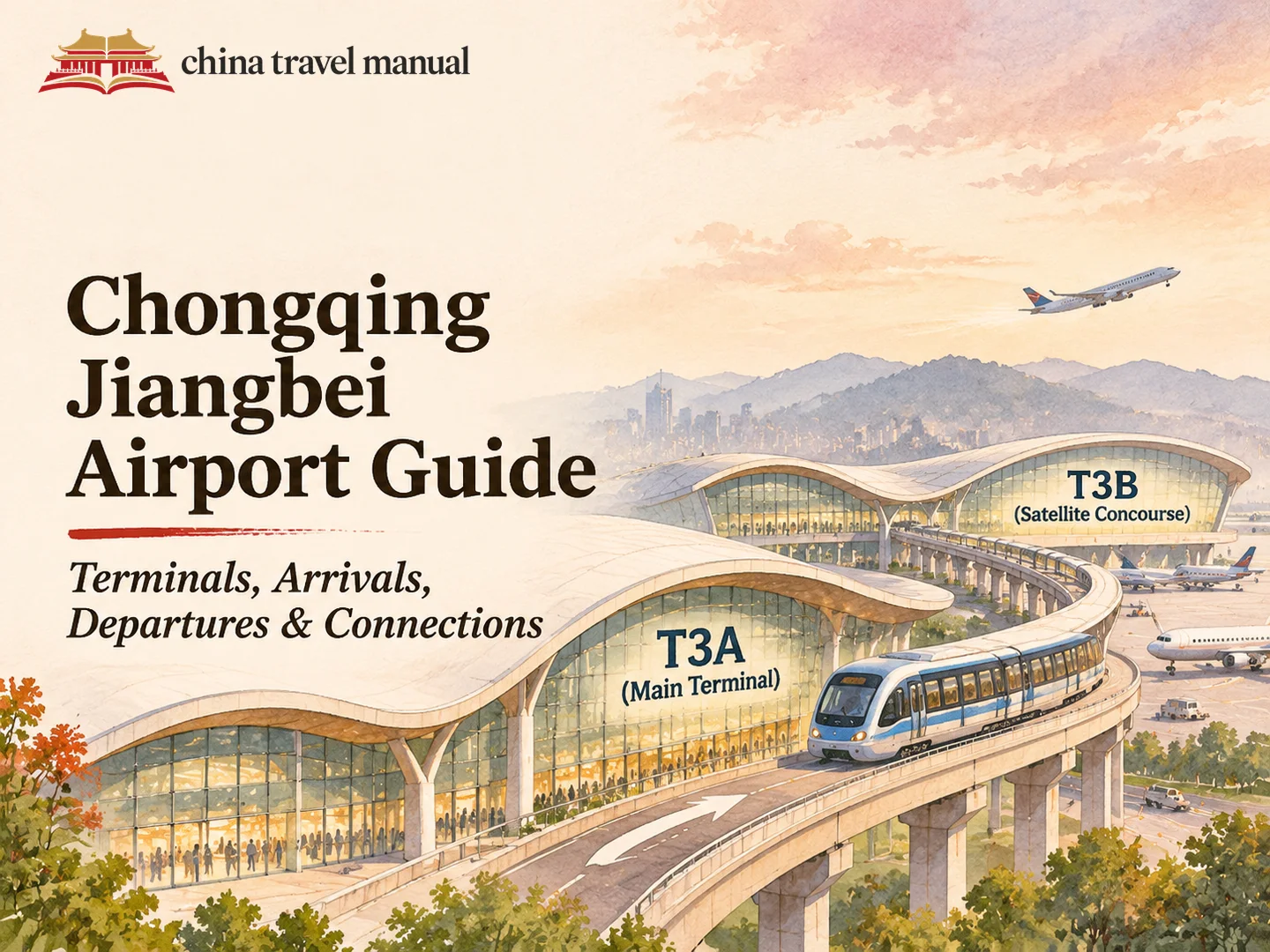
Quick Answer: What Travelers Need to Know About Chongqing Jiangbei Airport
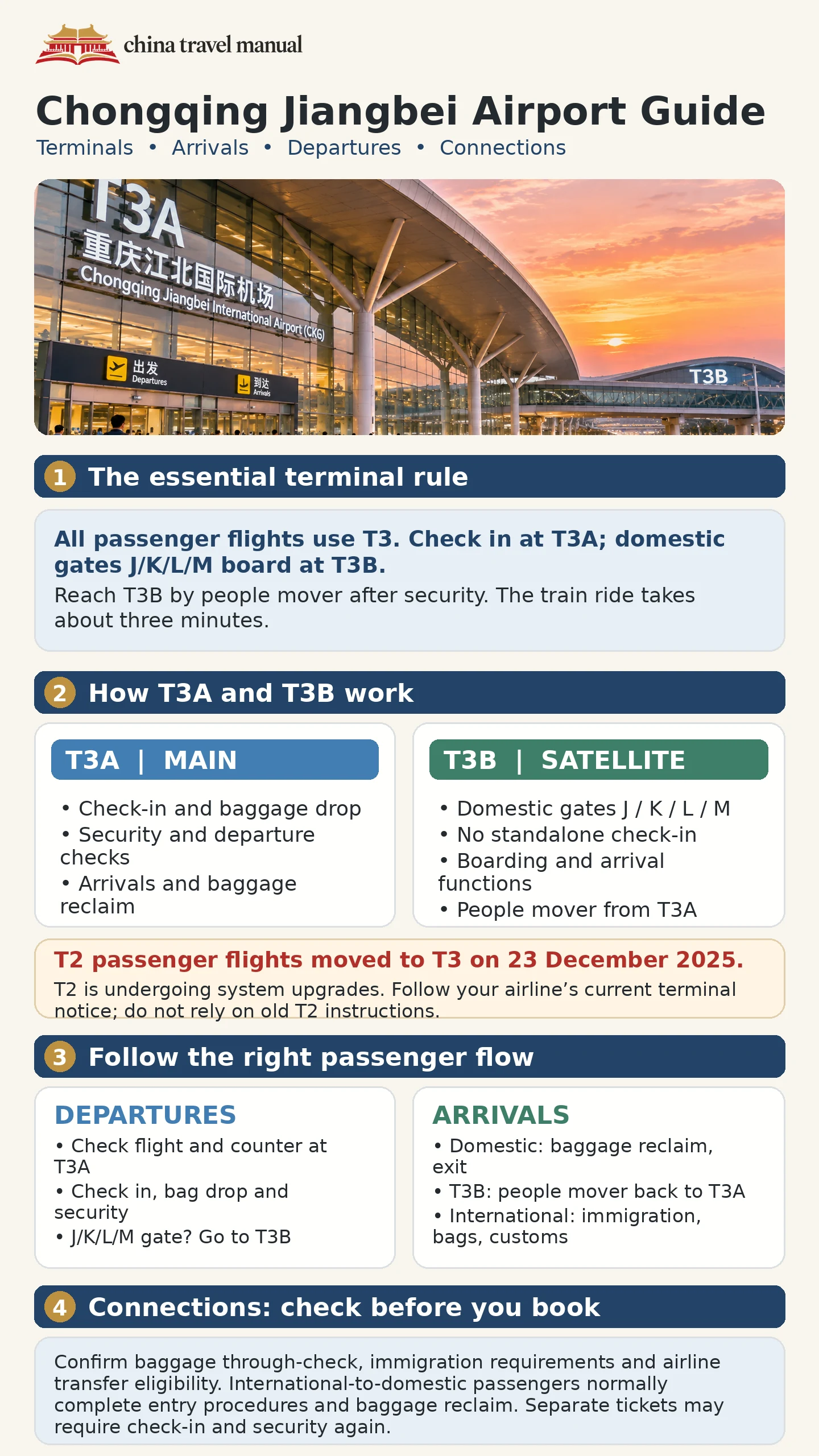
Chongqing Jiangbei International Airport (CKG) handles passenger flights through its T3 complex. T3A is the main terminal for check-in, baggage drop, security, immigration, customs and baggage reclaim. T3B is a domestic satellite concourse for gates J, K, L and M; passengers reach it from the secure area of T3A by the airport people mover, which takes about three minutes. T2 stopped handling passenger flights on 23 December 2025, so do not rely on older guides that direct you there. Always confirm your operating terminal, check-in counter and gate with your airline and the airport’s live displays before travelling.
- T3A is where passengers complete the main departure and arrival procedures.
- T3B is a domestic satellite concourse, not a separate check-in terminal.
- Gates J, K, L and M require the internal people mover after security.
- International arrivals and departures are handled through T3A.
- Separate tickets do not guarantee baggage transfer or a protected connection.
Before leaving, recheck the live flight display and your airline’s instructions; gate and counter assignments can change.
Chongqing Jiangbei International Airport (CKG) is the main air gateway for travelers visiting Chongqing and connecting through southwest China. Its terminal arrangements changed substantially in 2025: passenger flights moved into the T3 complex, which combines the T3A main terminal with the T3B satellite concourse. Knowing which building handles each step matters more than simply recognizing the airport code.
This guide explains how to identify the right terminal, check in, depart, arrive, transfer between flights and find essential passenger services. It focuses on what happens inside the airport. For the onward journey to hotels and city districts, use the separate Chongqing Airport to the City guide. Once in town, the broader Getting Around Chongqing guide and Chongqing Metro Guide cover local journeys rather than airport procedures.
Understanding Chongqing Jiangbei Airport Terminals
T3A: The Main Passenger Terminal
T3A is the main processing building for passenger flights. Travelers use it for check-in, baggage drop, security and the relevant immigration and customs procedures. It also contains the principal domestic and international arrival facilities and baggage reclaim areas. The airport’s published layout identifies the fourth floor as the main departure and check-in level, the second floor as the domestic arrival level, and the first floor as the international arrival level. Follow the live signs because counter assignments and service locations can change. [9]
T3A has separate domestic and international passenger flows. Domestic passengers proceed through domestic security to the domestic departure area. International and regional passengers follow the dedicated departure route for document checks, border procedures and security. The two departure areas are not interchangeable, so use the route shown for your flight rather than following another passenger’s queue.
T3B: The Domestic Satellite Concourse
T3B opened on 9 April 2025 as a satellite concourse integrated with T3A. It handles aircraft parking and passenger boarding and arrival, rather than acting as a standalone check-in terminal. Passengers whose boarding gates begin with J, K, L or M travel from the secure area of T3A to T3B on the dedicated airport people mover. The ride takes about three minutes; allow additional time to reach the platform, wait for the train and walk to the gate. [1]
For departures, complete check-in, baggage drop and security at T3A before following the signs to the people mover. For arrivals at T3B, follow the signs back to T3A for baggage reclaim and the public arrival hall. This people mover is an internal airport connection, not the Chongqing Metro. T3B also has passenger amenities and retail outlets, but the range of services is more limited than in the main terminal; complete essential procedures and allow time for meals or assistance in T3A.
What Changed at T1 and T2?
From 23 December 2025, all domestic and international passenger flights at Jiangbei Airport were consolidated in the T3 complex. T2 stopped handling those passenger flights and was scheduled for system-process upgrades and coordinated future use with T1. The official notice does not establish a public passenger reopening date for T1 or T2. Do not navigate to T2 for a current passenger flight unless your airline or the airport gives you a specific updated instruction. [2]
| Area | Current passenger role | Check-in and baggage drop | Gate guidance |
|---|---|---|---|
| T3A | Main terminal for domestic and international processing | Yes | Most gates; also the departure starting point for T3B |
| T3B | Domestic satellite concourse | No standalone check-in | J, K, L and M |
| T2 | No scheduled passenger-flight operations following the December 2025 transfer | No passenger check-in for those flights | No current passenger gate assignment |
| T1 | No passenger-flight role confirmed in the published transfer notice | Not applicable | Not applicable |
Before You Arrive: Check Your Flight and Terminal
Confirm the Terminal, Counter and Gate
Check your airline’s app, booking confirmation and messages before leaving for the airport. The airport advises passengers to confirm the terminal with the airline or airport and then use the flight information screens to find the correct check-in counter. The counter and boarding gate may not be assigned at the same time. Once you have a gate, check its letter: J, K, L or M means you will need the people mover to T3B after security. [3]
A booking that displays only CKG identifies the airport, not the exact check-in island or gate. Recheck the flight display when you enter T3A and follow staff instructions if your airline changes its counter or gate.
How Early Should You Arrive?
The airport’s passenger guidance recommends arriving at least two hours before a domestic flight and 2.5 to three hours before an international or regional flight. Its published guidance says domestic check-in closes 40 minutes before departure and international or regional check-in closes 60 minutes before departure. Airlines may impose earlier deadlines, so the operating carrier’s instructions take precedence. [3]
Allow extra time during major Chinese holidays, busy travel periods or when you need document checks, special assistance or an unusual baggage service. If your gate is in T3B, include the walk to the people-mover platform and the onward journey to the gate. Do not treat the three-minute train ride as the complete T3A-to-gate time.
Departures: Check-In, Security and Boarding
Domestic Flight Departures
- Confirm that your flight departs from the T3 complex and check the current counter on the flight information screens.
- At the assigned T3A counter or eligible self-service facility, obtain your boarding pass and check any baggage.
- Follow the domestic security signs and keep your identification and boarding pass available.
- After security, check the gate number again. Stay in T3A for gates outside J/K/L/M; follow the people-mover signs for J/K/L/M.
- At T3B, check the departure screens and proceed to the exact gate shown on your boarding pass.
The airport says domestic passengers with checked baggage can use staffed counters or eligible self-service baggage-drop facilities. Passengers without checked baggage may be able to use self-service check-in. Availability depends on the airline and equipment in service, so use a staffed counter if the machine cannot process your booking or travel document. [3]
International and Regional Departures
International and regional passengers should use the designated T3A check-in area. After check-in and baggage drop, follow the airport’s signs through any required customs declaration, exit border inspection and international security procedures. Keep your passport, visa or other required entry documents and boarding pass accessible. International departure passengers remain in the international departure flow at T3A; T3B’s J/K/L/M gates are for domestic flights. [4]
The airport’s passenger guidance currently states that international and regional flights do not support its standard self-service check-in and self-service baggage-drop process. Plan to use the airline counter unless your carrier explicitly confirms another arrangement. Customs declaration requirements depend on what you are carrying; check the current rules rather than assuming every passenger needs to make a declaration.
Arrivals: From the Aircraft to the Public Hall
Domestic Arrivals
After a domestic flight parks at T3A, follow the arrival signs to the baggage reclaim area on the domestic arrival level. Check the overhead screens for your flight number and carousel. If your aircraft arrives at T3B, follow the signs for T3A and baggage reclaim and take the internal people mover back to the main terminal. Once you have collected your bags, continue to the public domestic arrival hall. [5]
International Arrivals
International passengers follow the dedicated arrival route at T3A. Complete the required entry inspection, proceed to the international baggage reclaim area, and then follow the customs channel appropriate to your circumstances. If you have goods to declare, use the declaration route and ask customs staff if you are unsure. Keep your baggage claim tag until you have left the reclaim area and resolved any missing or damaged baggage issue. The airport’s published international-arrival guide describes border inspection before baggage reclaim, followed by customs and exit to the public hall. [5]
If Your Checked Baggage Is Missing or Damaged
Do not leave the baggage reclaim area before reporting a missing, delayed or damaged bag. Contact the airline’s baggage service desk or ground-handling representative, provide your baggage tag and flight details, and obtain a report or reference number. The handling airline is the correct first contact for tracing and compensation procedures; the airport’s general information desk can help direct you to the appropriate counter.
Connecting Flights at Chongqing Jiangbei Airport
A connection depends on more than the time between scheduled flights. Check whether both segments are on one ticket, whether the airline has confirmed baggage through-check, whether you must clear immigration, and whether either flight uses T3B. A short connection that works for a protected through-ticket may be unrealistic for separately booked flights.
Domestic-to-Domestic Connections
For a through-ticket with baggage checked to the final destination, follow the domestic transfer signs and ask the transfer desk or airline staff whether you can remain airside and whether a new boarding pass is required. If the first flight arrives at T3B, follow the marked transfer route and confirm whether your onward flight is handled at T3B or T3A. For separate tickets, assume you may need to collect baggage, exit to the public area, check in again and pass security unless both airlines confirm an accepted transfer arrangement.
A targeted T3B cross-agency transfer service was introduced for eligible passengers connecting between Air China, Chongqing Airlines and Sichuan Airlines. Airport staff coordinate transfer formalities and baggage handling in T3B, avoiding a return to T3A for qualifying itineraries. This is a carrier-specific service, not a general facility for every airline or ticket combination. [6]
Domestic-to-International Connections
If your domestic and international flights are on a through-ticket, ask the airline whether your baggage is checked through and follow the designated transfer route. You will still need to complete the applicable international departure formalities, including any required customs, exit border and security checks. With separate tickets, you may have to collect baggage, leave the secure area and check in again at the international counter. Allow substantially more time and confirm whether you meet the airline’s check-in deadline.
International-to-Domestic Connections
Passengers arriving internationally and continuing on a domestic flight should plan for China’s entry procedures. The normal process includes entry inspection, baggage reclaim, customs and then domestic check-in and security for the onward flight. Do not assume that a baggage-through arrangement removes the need to clear immigration or security. Confirm the exact process with the operating airlines before departure.
International-to-International Connections
Some eligible international connections may be handled through an airside transfer process, but eligibility depends on the itinerary, ticketing, baggage arrangements, nationality and applicable transit rules. Chongqing has introduced updated international transit facilities and digital coordination, but this does not mean every passenger can automatically remain airside or avoid border procedures. Confirm the route with both airlines and follow airport transfer staff rather than relying on a general connection-time estimate. [7]
| Connection type | What to confirm | Potential extra steps |
|---|---|---|
| Domestic → Domestic | Through-ticket, baggage through-check, onward gate | Transfer desk or baggage reclaim and re-check for separate tickets |
| Domestic → International | Through-check and international transfer eligibility | Exit procedures and international security; re-check baggage if required |
| International → Domestic | Entry eligibility and baggage arrangement | Entry inspection, baggage reclaim, customs, domestic check-in and security |
| International → International | Airside-transfer eligibility, ticket and baggage arrangements | Border procedures or baggage collection if the itinerary is not eligible |
If you are connecting to a train rather than another flight, check the correct station before booking: the Chongqing Railway Stations Guide explains the city’s different rail hubs, while the dedicated airport-to-Chongqing-West transfer guide covers that specific onward journey. There is no single minimum connection time that safely applies to every itinerary at CKG. Airlines publish their own transfer conditions and may distinguish same-airline, partner-airline and interline connections. For example, China Southern publishes different connection thresholds according to the airline combination and route, and notes that some international transfer services are not available through its Chongqing hub. Treat those figures as airline-specific, not as an airport-wide guarantee. [8]
Airport Facilities and Passenger Services
Information, Lost Property and Special Assistance
T3A has passenger information points in the departure, arrival and secure areas. Ask staff for directions to the correct airline counter, transfer desk, baggage service or assistance point. For lost property, use the airport’s designated lost-and-found service rather than relying on an unverified phone number copied from an old travel page. Passengers who need a wheelchair, unaccompanied-minor service or other assistance should request it from the airline in advance and reconfirm the meeting point before travel.
Luggage, Medical Help and Family Facilities
The airport lists baggage storage, baggage wrapping, ATMs, medical services, mother-and-baby rooms and temporary flight-document assistance among its passenger services. However, some service pages still display legacy T2 locations alongside T3A information. Treat the published page as a service directory, not proof that every old T2 counter remains open. Confirm the current T3A location with airport staff or the live airport directory before making a detour. [9]
For a medical emergency, use the nearest staffed assistance point or contact airport personnel immediately. For lost or damaged checked baggage, report it to the airline’s baggage representative before leaving the reclaim area. Keep your passport and boarding pass accessible when using any identity-related service.
Food, Shopping and Lounges
T3A offers the broadest range of dining, convenience shopping and passenger lounges, with facilities in both public and restricted departure areas. T3B also opened with retail and food outlets, although its range is more limited than the main terminal. If you need a full meal, medication, specialist assistance or a particular service, complete it in T3A before travelling to a remote gate where practical. Access to airside shops and lounges depends on having passed the relevant security checkpoint and meeting the provider’s entry rules.
Common Airport Mistakes and Practical Tips
- Do not navigate to T2 by default: Passenger flights moved to the T3 complex in December 2025. Follow your airline’s current terminal notice.
- Do not go straight to T3B to check in: Complete the required departure procedures in T3A first.
- Do not leave the people mover until the gate is confirmed: J/K/L/M gates use T3B; check the flight display in case of a change.
- Do not assume separate tickets are protected: Confirm baggage transfer and transfer eligibility with the airlines before booking a tight connection.
- Do not rely on old service listings: Some airport webpages retain historical T2 information. Verify the current location of a service before walking there.
Keep your passport, booking reference, boarding pass and baggage tags accessible. If you are unsure where to go, ask an airport employee at an information point; do not follow unsolicited offers from people claiming to provide special airport assistance. If your stopover is long enough to leave the airport, plan city sightseeing separately with the Chongqing Layover Itinerary; check your visa or transit eligibility and allow a generous return-to-airport buffer.
FAQs About Chongqing Jiangbei Airport
Which terminal should I use at Chongqing Jiangbei International Airport?
Current passenger flights use the T3 complex. Start at T3A for check-in and the main passenger procedures. Only passengers assigned to domestic gates J, K, L or M travel onward to T3B after security.
Is Terminal 2 still handling passenger flights?
No scheduled passenger flights have operated from T2 since the December 23, 2025 transfer to T3. The published plan is to upgrade T2’s systems and coordinate its future use with T1; check the airline’s latest notice before travel.
What is the difference between T3A and T3B?
T3A is the main terminal for check-in, baggage drop, security and domestic or international arrival processing. T3B is a domestic satellite concourse for gates J, K, L and M, connected to T3A by an internal people mover.
Do I need to collect my bags when changing flights at CKG?
It depends on the ticket, airline agreement and route. A through-ticket may allow baggage to be checked to the final destination, but separate tickets commonly require collection and re-check. International-to-domestic passengers should expect to complete entry procedures and baggage reclaim unless the airport and airlines confirm a specific alternative.
How much time should I allow for a connection?
There is no universal safe minimum for every connection. Check the operating airlines’ published minimum connection rules, whether baggage is through-checked, whether you must clear immigration, and whether you need to move between T3A and T3B. Leave extra time for separate tickets and busy travel periods.
Sources
[1] Chongqing Jiangbei International Airport. T3B Terminal Officially Opens
[2] Chongqing Municipal Government. Four Airlines Move to T3 from 23 December
[3] Chongqing Jiangbei International Airport. Passenger Instructions
[4] Chongqing Jiangbei International Airport. International Departures
[5] Chongqing Jiangbei International Airport. Domestic and International Arrivals
[6] Chongqing Municipal Government. One-Stop T3B Cross-Agency Transfer Service
[7] Chongqing State-owned Assets Supervision and Administration Commission. Airport International Transit Service System
[8] China Southern Airlines. Chongqing Hub Transfer Guidance
[9] Chongqing Jiangbei International Airport. Passenger Services and Facilities





