
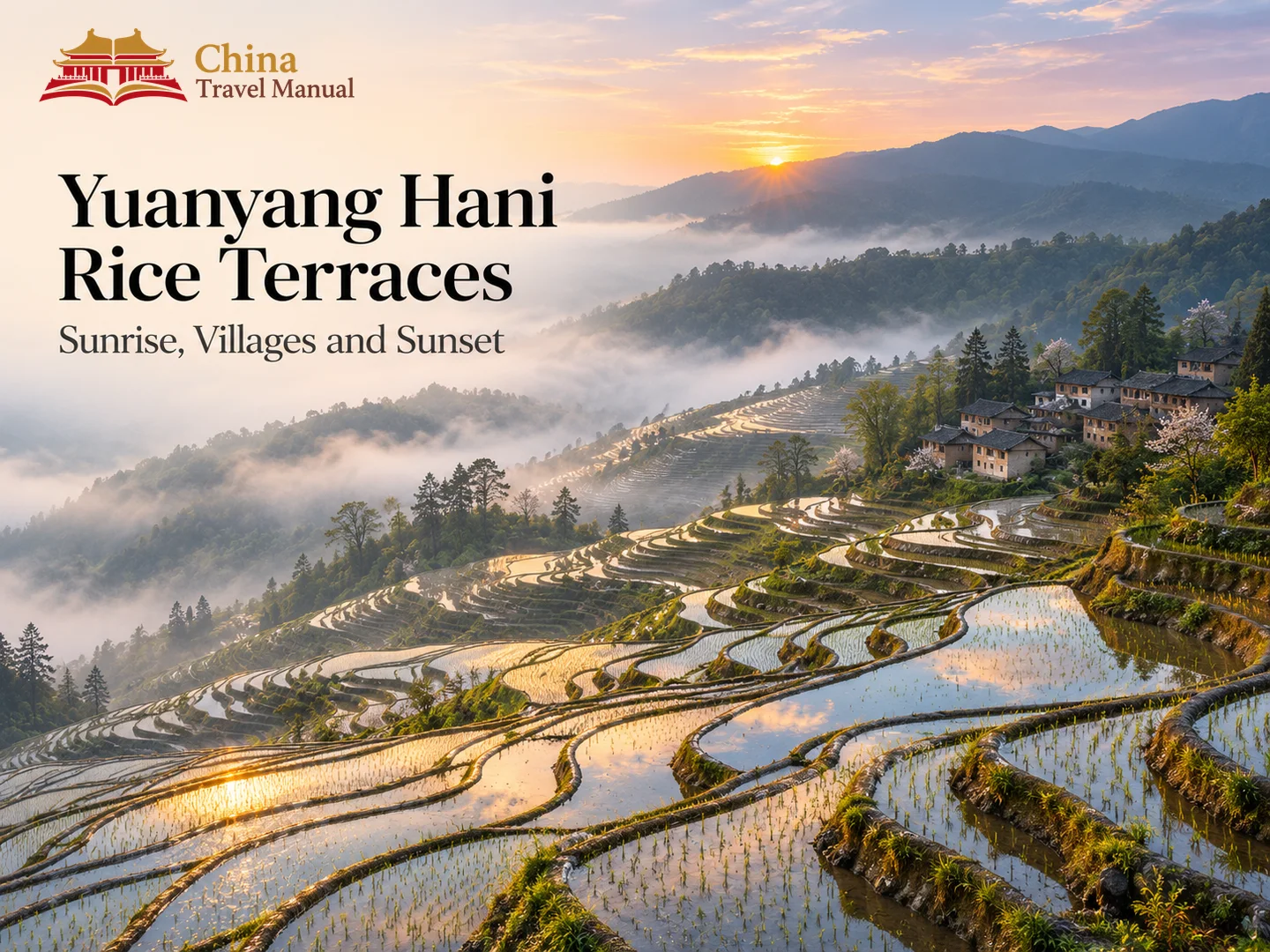
Quick Answer
For a first visit to the Yuanyang Hani Rice Terraces (元阳哈尼梯田, Yuányáng Hāní Tītián), stay near the terraces and plan your day around the morning and late afternoon light. Choose viewpoints on different slopes.[1][2][3]
- Sunrise: Use Duoyishu (多依树, Duōyīshù) if you have a nearby base or an early ride.[2][3][7]
- Daylight: Add the village of Azheke (阿者科, Āzhěkē) for Hani architecture and a view of the terraces in use.[3][5]
- Sunset: Choose Bada (坝达, Bàdá) for a broad look across multiple slopes and water-filled plots when conditions allow.[2][3][7]
- Optional viewpoint: Consider Laohuzui (老虎嘴, Lǎohǔzuǐ) if you have time to confirm its current access and arrange the extra road leg.[2][3]
Choose fewer viewpoints when fog or travel time cuts into the day. Viewing and village access depend on local conditions.[3][4]
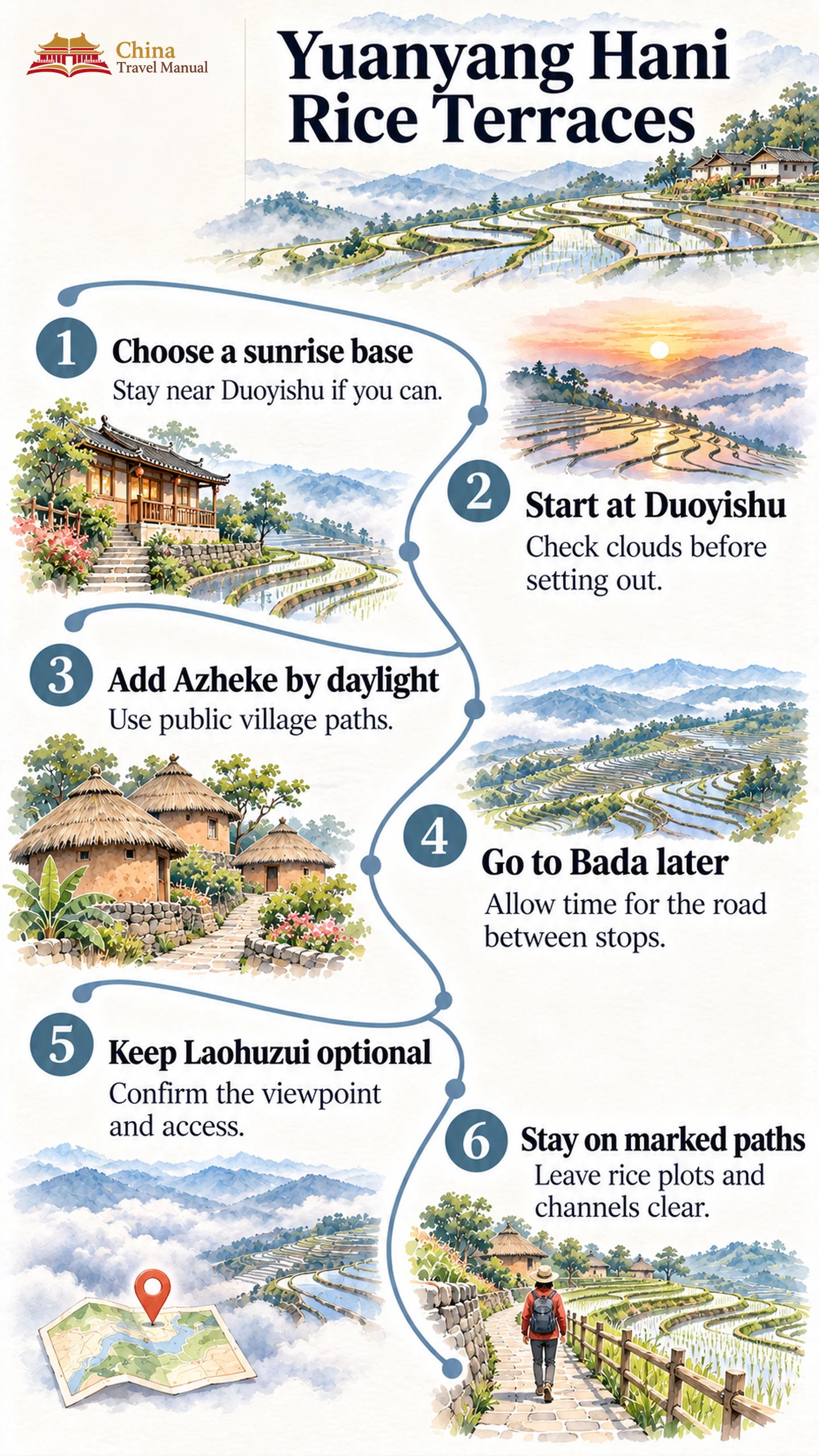
The terraces change with the direction of light, clouds and the farm calendar. Choose one place for dawn, keep the middle of the day flexible and plan your return from one sunset viewpoint. It is easier to appreciate the shapes of the fields when you spend time at a few platforms.
Choose Your Viewpoints by Time of Day
| Viewpoint | When to consider it | What you came to see |
|---|---|---|
| Duoyishu | Dawn and the early morning | Terraces below a ridge, with the chance of mist and reflections. |
| Azheke | Daylight between terrace stops | Houses, lanes and the connection between a village and its fields. |
| Bada | Late afternoon and sunset | A wide view with many plots spread over the slopes. |
| Laohuzui | A separate daylight or evening visit | Steep terrain and distinct terrace shapes, when the viewpoint is accessible. |
Choose the location you want most and make the remaining stops optional. Honghe’s tourism material names Duoyishu for sunrise and Bada for sunset, and its more recent planning response pairs them with Azheke. In an itinerary with just one sunset, choose Bada or Laohuzui in advance so you can stay through the change in light.[2][3][7]
Base Yourself Near the First View You Want
Ask your accommodation whether you can walk to your chosen dawn viewpoint on a safe public approach or need a car. A place listed broadly under Yuanyang can be far from the specific terrace platform. Check the exact pin and approach before booking. The prefecture’s visitor guide lists approach distances from Xinjie for both Bada and Duoyishu. Choose your accommodation by its proximity to the visit you have planned.[7]
For sunrise, a room near Duoyishu can shorten the earliest road leg. If you stay around Xinjie, agree on an early pickup and the return after sunset. Check whether the viewpoint is open at your planned arrival and what admission is required. Use where to stay in Yuanyang and the Yuanyang transportation guide to build the trip around the first and last stops.[3][7]
Plan One Sunrise, a Village Walk and One Sunset
- Give Duoyishu a morning block. Check the local forecast and visibility before leaving. If the ridge is clouded in, give the view time to change if you can do so comfortably and still make your next transfer.[2][4]
- Go to Azheke during the day. Look at the traditional Hani mushroom-roof houses from open lanes. Ask at the entrance about visitor routes and fees. Allow a village stop for observing the buildings, farm setting and water channels from public paths.[3][5]
- Arrive at Bada before the light changes. Give yourself time to pick a public viewpoint and see the slope before sunset. Agree on a place to meet your ride after dusk.[2][3][7]
Keep the morning and afternoon blocks on separate days if you are arriving from farther away or want a second chance at clear weather. The two-day Yuanyang itinerary and Jianshui to Yuanyang guide give you room for that approach.
Match Your Visit to the Terraces and the Weather
Visit Yunnan identifies roughly November through April as an irrigation period when you can look for water reflecting the sky. Actual conditions vary across fields. Other seasons bring different views, including green rice and harvest colors, as the local tourism bureau describes. In the days before arriving, ask your host what has been visible from the exact scenic cluster you hope to visit. If both ridges are obscured, give the village walk a longer daylight block and check the forecast again before changing your sunset plans.[3][4]
UNESCO describes how the Hani developed channels to lead water from the forested mountaintops to village and terrace systems farther down. The shape of the fields reflects that relationship between forests, settlements, water and rice cultivation. Look for each element from a public viewpoint, and keep off the cultivated plots and narrow working embankments. Ask permission before photographing someone working.[1][6]
FAQs About the Yuanyang Hani Rice Terraces
Where should you see sunrise in Yuanyang?
Duoyishu is the standard first choice. Stay close to its approach or arrange a ride, and check visibility and opening before setting out.[2][3][7]
Which terrace viewpoint is best for sunset?
Bada is a good first sunset choice for its wide terraces. Consider Laohuzui for a different slope and viewpoint if its approach is open.[2][3][7]
When are the Yuanyang terraces filled with water?
The Yunnan tourism guide describes November through April as the main irrigation period. Water coverage and visibility vary by field, weather and farming schedules.[3][4]
Can you visit the terraces without a car of your own?
Yes. Arrange local rides between clusters, especially before sunrise and after sunset. Confirm the pickup on both ends because the major viewpoints have different road approaches.[3][7]
Sources
[1] UNESCO World Heritage Centre. Forest and terrace irrigation across the Hani cultural landscape
[2] Honghe Culture and Tourism Bureau. Travel descriptions of Duoyishu, Bada and Laohuzui
[3] Honghe Culture and Tourism Bureau. Current sunrise, village and sunset visitor route
[4] Visit Yunnan. Seasonal landscape and irrigation months
[5] Sun Yat-sen University. Azheke conservation and community tourism
[6] Honghe Prefecture Government. Protection of the Hani terrace agricultural system
[7] Honghe Prefecture Government. Separate viewpoints and relative road destinations





