
Quick Answer: How Should You Visit the Bund?
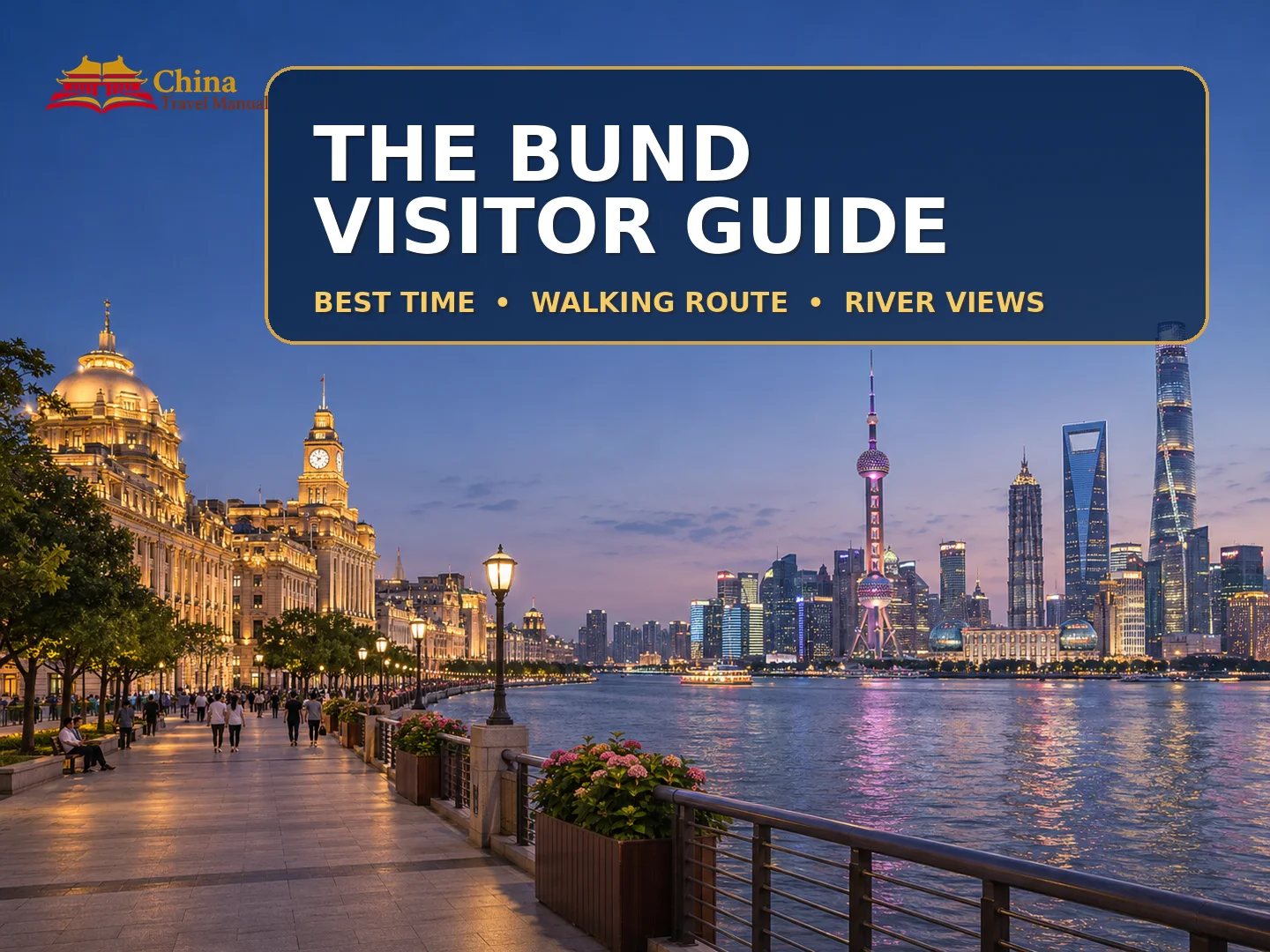
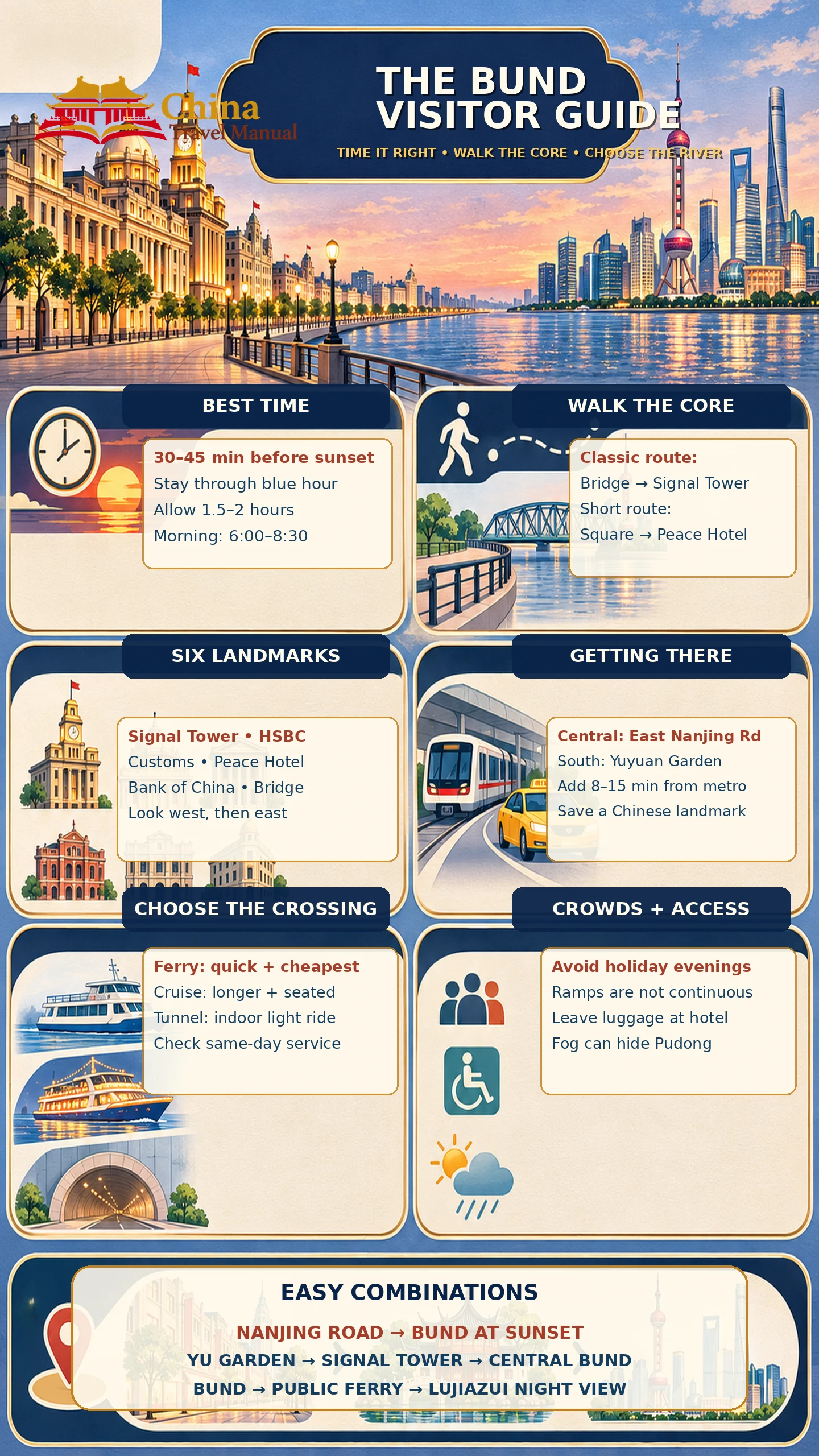
For a first visit, reach the Bund 30–45 minutes before sunset and stay until the historic façades and Lujiazui skyline are illuminated. This gives you daylight architecture, blue-hour color and the night view in one walk.
- Standard visit: Allow 1.5–2 hours for the central promenade, photos and short stops.
- Short visit: Spend 45–60 minutes between Chen Yi Square, the Customs House and the Peace Hotel.
- Best direction: Walk south from Waibaidu Bridge if you are continuing to Yu Garden, or north from the Gutzlaff Signal Tower if you are arriving from the Old City.
- Quietest light: Visit from 6:00–8:30 am for low crowds and clear architectural photographs, but no evening illumination.
- Avoid if possible: Midday heat, weekend night peaks and major public-holiday evenings.
The promenade is free and has no single gate. Lighting, metro access, ferry service and crowd controls can change for major events, so check same-day official notices.
The Bund is the place where Shanghai’s two most recognizable cityscapes face each other: a line of historic stone buildings on the west bank of the Huangpu River and the towers of Lujiazui on the east. It is not a single attraction behind a gate. It is a public waterfront walk, and the quality of the visit depends more on timing, direction and crowd conditions than on buying a ticket.
This guide is designed for a first-time visitor with a few hours, not for a complete history of every building. Use it to choose when to arrive, which section to keep, how to cross the river and what to do when crowds or weather change. For wider trip planning, see our Shanghai travel guide.
What Is the Bund and What Is Free to Visit?
The Bund is a protected historic waterfront district in central Shanghai. The official scenic area runs for about 1.5 kilometers along the west bank of the Huangpu River and faces the modern Pudong skyline. Fifty-two representative historic buildings line the western side.[1] It is a Shanghai heritage district, not a UNESCO World Heritage Site.
There is no unified entrance, opening gate or Bund admission ticket. You can enter the public promenade from different streets and stairways. The distinction that matters is between the free public waterfront and separately operated attractions or businesses.
| Free to visit | Separate charge or booking |
|---|---|
| Public riverside promenade and viewing platforms | Huangpu River sightseeing cruises |
| Street-level views of the historic façades | Bund Sightseeing Tunnel |
| Pedestrian crossing on Waibaidu Bridge when open | Ticketed exhibitions or guided interiors |
| Exterior of the Gutzlaff Signal Tower and its plaza | Hotel restaurants, bars and commercial experiences |
The public area is generally open all day, but temporary barriers, crowd-control routes and event closures can override normal access. Treat every paid river product as an optional add-on rather than part of a Bund ticket.
Best Time to Visit the Bund
The best time depends on whether your priority is changing light, low crowds or convenience. For most first-time visitors, late afternoon through early evening is the strongest single choice.
| Time | Advantages | Main trade-off | Best for |
|---|---|---|---|
| 30–45 minutes before sunset | Daylight façades, blue hour and night lights in one visit | Evening crowd builds quickly | Most first-time visitors |
| 6:00–8:30 am | Low crowds and clean architectural views | No night lighting; many interiors closed | Photographers and runners |
| 11:30 am–3:00 pm | Simple to fit between other sights | Hard light, heat and little shade | Cool or overcast days only |
| Weekend or holiday night | Full evening atmosphere | Highest crowd and transport-control risk | Visitors comfortable with dense crowds |
Late Afternoon to Night
Arrive while the carved stone, columns, domes and clock tower are still visible in natural light. Walk the building side first, then move to the elevated riverfront platform as the sky darkens. Waiting until it is completely dark sacrifices much of the architectural detail that makes the Bund more than a skyline viewpoint.
Do not plan around one permanent lighting time. In early November 2026, the normal published schedule was 6:00–10:00 pm, but the city extended or shifted it for the China International Import Expo.[2] Seasonal changes and major events can alter the schedule again. Check the latest Shanghai government or Huangpu district notice on the day you visit.
Early Morning
Between about 6:00 and 8:30 am, the waterfront is used by local walkers, runners and people doing morning exercise. This is the best window for uncluttered views of the historic buildings and Waibaidu Bridge. It is also cooler in summer.
The trade-off is simple: there is no night illumination, shops and indoor venues may not yet be open, and river haze can still reduce the clarity of Pudong. Early morning is a photography choice, not a substitute for the classic blue-hour experience.
Midday, Weekends and Public Holidays
Midday is the weakest default. The promenade has limited continuous shade, and summer heat reflects from stone paving and the river. If midday is your only option, shorten the walk to the central section and save a longer riverside visit for another evening.
Major holidays require a different plan. During the 2026 National Day period, police closed East Nanjing Road station at set evening times, suspended the Dongjin ferry for part of the day and used one-way circulation, phased release and temporary barriers along the waterfront.[3] These are event-specific measures, not permanent rules, but they show why a holiday visitor must follow staff directions rather than depend on a saved route.
Plan Your Bund Walking Route
The Classic 90-Minute Walk
The most complete first walk uses Waibaidu Bridge as the northern bookend and the Gutzlaff Signal Tower as the southern bookend. Walk north to south if you plan to continue toward Yu Garden; reverse it if you are arriving from the Old City.
- Start at Waibaidu Bridge: Look toward the confluence of Suzhou Creek and the Huangpu River, then walk south toward the Monument to the People’s Heroes.
- Pause near the monument: Use this wider northern section for views back to the steel bridge and forward to the historic skyline.
- Reach Chen Yi Square: This is the strongest central river view and a useful orientation point for Lujiazui.
- Cross your attention to the west: Identify the Customs House clock, the former HSBC Building, the Peace Hotel and the Bank of China Building.
- Finish at the Gutzlaff Signal Tower: The tower marks the southern end of the classic walk and creates the easiest onward connection toward Yu Garden or the East Jinling Road ferry area.
Allow about 90 minutes with photographs and short pauses. A brisk end-to-end walk without stops can be much faster, but it misses the point. If you enter from East Nanjing Road station, add the walk from the station to the river.
A Sunset and Night Route
Begin on the western, building side of Zhongshan East 1st Road while there is still daylight. Look up at the façades rather than walking immediately to the river rail. As the sky turns blue, use a legal crossing or managed pedestrian route to reach the waterfront platform, then photograph the Lujiazui skyline.
Once the lights have stabilized, either end near Chen Yi Square for East Nanjing Road, continue south for a ferry, or keep walking to the Signal Tower. Viewing platforms may close temporarily when crowd density rises, so the route needs to work without one exact photo position.
A Short Route for Limited Time or Mobility
Keep the 400-meter central section around Chen Yi Square, the Customs House and the Peace Hotel. It concentrates the best-recognized historic façades and a balanced view of the four main Pudong towers. Use East Nanjing Road station as the rail access point and follow current street signs east toward the river.
This is a shorter route, not a guaranteed step-free route. Some approaches to the elevated promenade use stairs, and lift or ramp access can be indirect or temporarily controlled. Travelers using wheelchairs or strollers should check the current accessible entry on arrival and stay at street level if the elevated platform is congested.
What to Look for Along the Bund
Historic Waterfront Buildings
You do not need to memorize all 52 historic buildings. These six landmarks give a first-time visitor a workable visual sequence.
| Landmark | How to recognize it | Why stop | Can you enter? |
|---|---|---|---|
| Gutzlaff Signal Tower | Small striped tower near the southern end | Historic weather and time-signal landmark; route bookend | Ground and first floors reopened as public cultural spaces; on-site access controls apply |
| Former HSBC Building | Large dome and monumental classical columns | One of the grandest façades on the Bund | Not a general walk-in attraction |
| Customs House | Clock tower beside the former HSBC Building | The easiest historic landmark to identify from a distance | Exterior viewing only for most visitors |
| Peace Hotel | Green pyramidal copper roof | Most recognizable hotel silhouette in the central section | Hotel access is subject to property policy and security |
| Bank of China Building | Vertical façade with Chinese-inspired details | Shows how later Chinese design joined the earlier bank row | Exterior viewing only |
| Waibaidu Bridge | Steel truss bridge over Suzhou Creek | Northern route marker and classic river-confluence view | Public pedestrian access is subject to traffic controls |
Lujiazui Skyline Across the River
Across the Huangpu River, the Oriental Pearl Tower is the structure with pink spheres. Jin Mao Tower rises in stepped tiers, the Shanghai World Financial Center has the rectangular opening near its top, and Shanghai Tower is the tallest twisting glass tower. These buildings are in Lujiazui, not on the Bund.
Chen Yi Square and the central promenade offer the easiest balanced view. Fog, humidity and pollution can erase the upper floors, so do not treat a clear skyline as guaranteed. Poor visibility is a reason to focus on the historic façades rather than abandon the visit.
Can You Enter the Historic Buildings?
Most historic buildings remain banks, offices, hotels or private commercial spaces. Their cultural value does not create a public right of entry. Do not walk into office floors or argue with security staff because an online list labels a building “open.”
The clearest current exception is the Gutzlaff Signal Tower, whose ground and first floors reopened as tourism and cultural spaces in October 2026.[4] Access is managed on site and may change with crowd levels. Other exhibitions should be treated as separate venues with their own opening hours, reservations and tickets.
Getting to and Leaving the Bund
For the central section, use East Nanjing Road station on Metro Lines 2 and 10. The station is not on the river: allow roughly 8–15 minutes to walk east, depending on the open exit, your pace and crowd controls. Exit status can change, so follow current station signs and navigation rather than relying on one saved exit number.
For the southern end and Gutzlaff Signal Tower, Yuyuan Garden station on Lines 10 and 14 is usually more useful. The official tourism page for the reopened tower recommends Yuyuan Garden station and a walk to the Bund.[4] On major holidays, either station can close or restrict selected exits.
| Method | Best use | Door-to-door issue |
|---|---|---|
| Metro | Most daytime and evening visits | No station opens directly onto the promenade; add the final walk |
| Taxi or Didi | Families, limited mobility or bad weather | Use a precise Chinese landmark, not only “The Bund”; roadside pickup may be restricted |
| Walking from East Nanjing Road | Combining shopping street and sunset | Heavy evening pedestrian flow |
| Walking from Yu Garden | Combining Old City and the southern Bund | Longer than it looks and crowded around major junctions |
For a driver, save one exact destination in Chinese: 和平饭店 (Peace Hotel), 陈毅广场 (Chen Yi Square) or 外滩信号台 (Gutzlaff Signal Tower). At night, walk away from the riverfront road to the app-designated pickup point before calling a car.
Ferry, River Cruise or Sightseeing Tunnel?
Choose by purpose, not by the word “sightseeing.” The public ferry is a crossing with a view, a river cruise is a paid leisure experience, and the sightseeing tunnel is an indoor light attraction beneath the river.
| Option | Core purpose | Best for | Time and cost | Main limitation |
|---|---|---|---|---|
| Public ferry | Crossing the river | Budget travelers and a quick skyline view | Shortest and cheapest; pedestrian fare was ¥2 in 2026 | Brief ride, no narration, schedules can change |
| Huangpu River cruise | Seated sightseeing | Visitors who want extended views of both banks | Longer and much more expensive | Different piers, boats and refund rules |
| Sightseeing tunnel | Indoor light-and-sound ride | Families who specifically want the attraction | Short paid ride | No open-river view; not the best-value transport choice |
The East Jinling Road–Dongchang Road Dongjin ferry is convenient for daytime visitors, but the published 2026 schedule ended before the main night-view period. The East Fuxing Road–Dongchang Road Dongfu line ran later and was better suited to night views.[5] Check the official Shanghai Ferry channel on the day of travel because weather, holidays and crowd controls can suspend service.
A river cruise is worth considering when sitting down and seeing a longer section of both banks matters more than cost. Confirm the exact pier, departure time, vessel and cancellation rules before paying. Street sellers are not a substitute for checking the ticket details.
How to Combine the Bund with Nearby Sights
The Bund works best as the evening anchor of a nearby route. Avoid crossing the city only to return later for sunset.
| Combination | Best order | Extra time | Where you finish |
|---|---|---|---|
| East Nanjing Road + Bund | Walk east along the shopping street, then reach the river before sunset | 1.5–2 hours beyond the Bund walk | Central Bund |
| Yu Garden + Bund | Visit the Old City first, then walk to the Signal Tower and north | 1.5–2.5 hours | Central or northern Bund |
| Bund + Lujiazui | See sunset from Puxi, then take a ferry across if service fits | 1–2 hours | Pudong riverfront |
| Bund + Suzhou Creek or North Bund | Continue north from Waibaidu Bridge | About 1.5 hours | North of the classic Bund |
| Bund + river cruise | Walk first, then board at the confirmed pier | Depends on cruise and boarding time | Cruise pier |
For most first-time visitors, East Nanjing Road followed by the Bund is the lowest-friction combination. Yu Garden is the stronger choice when you want an Old City-to-river contrast. Crossing to Lujiazui adds the reverse view back toward the historic façades, but only if the ferry or metro timing leaves a comfortable return.
Crowds, Accessibility and Common Mistakes
The Bund is not difficult because of ticketing. It becomes difficult when visitors underestimate the final walk, stairs, weather or crowd routing.
- Do not expect the metro to open at the river: Every station choice includes a street walk.
- Look west as well as east: The Pudong skyline is only half of the experience; the historic building row is behind you.
- Leave large luggage at the hotel: Stairs, barriers and dense evening flow make rolling cases stressful.
- Reject unclear street offers: Confirm the total price, pier and product before buying photography, cruise or guide services.
- Do not promise yourself a sunset: Rain, fog and humidity can hide the skyline; lighting can change for official events.
Wheelchair users and families with strollers should expect indirect routes to the elevated promenade. Ramps and lifts are not evenly distributed, and temporary crowd barriers can block the most convenient crossing. The street-level building side remains useful when river-platform access is difficult.
Older travelers and families should avoid the densest holiday evening windows. Winter wind beside the river feels colder than the city forecast, while summer midday heat can be severe. During rain or poor visibility, shorten the waterfront section and spend more time examining the historic façades or nearby indoor venues.
FAQs About Visiting the Bund
Is the Bund Free to Visit?
Yes. The public promenade, open viewing areas and exterior building views are free. Cruises, the sightseeing tunnel, ticketed exhibitions, guided tours and commercial venues charge separately.
How Long Should You Spend at the Bund?
Allow 1.5–2 hours for a first visit with photographs. A short central route takes about 45–60 minutes. Add more time for a ferry, cruise, indoor venue or East Nanjing Road.
Is the Bund Better During the Day or at Night?
If you can visit only once, arrive 30–45 minutes before sunset and stay through the lighting period. Morning is better for low crowds; arriving only after dark loses much of the façade detail.
Can You Walk from the Bund to Yu Garden or Nanjing Road?
Yes, but use different parts of the Bund. East Nanjing Road connects most naturally to the central section, while Yu Garden connects better to the southern end near the Gutzlaff Signal Tower.
Should You Stay Near the Bund?
It is convenient for a short first visit focused on night views and central walking. The trade-offs are higher prices, tourist crowds and traffic noise. Compare it with other central bases in our Where to Stay in Shanghai guide.
Sources
[1] Shanghai Municipal Government. The Bund
[2] Shanghai Municipal Government. Bund Lighting Hours Adjusted for CIIE
[3] Shanghai Municipal Public Security Bureau. 2026 National Day Traffic-Control Notice
[4] Shanghai Municipal Administration of Culture and Tourism. Gutzlaff Signal Tower Reopens to the Public
[5] Shanghai Municipal Government. Exploring Shanghai by Boat





