

Quick Answer: Where Should You Stay in Shanghai?
For a first Shanghai trip of two to five nights, stay in central Puxi unless you have a clear reason to base yourself in Pudong. Puxi puts the Bund, historic streets, restaurants and nightlife on the same side of the river and usually reduces daily travel.
- Classic first visit: Choose the Bund, East Nanjing Road or People’s Square.
- Food and nightlife: Choose Jing’an, Xintiandi or the Huaihai Road area.
- Historic streets and slower walks: Choose the Former French Concession.
- Skyline hotels or Pudong business: Choose Lujiazui.
- Early train, flight or two Disney days: Use a task-based base near Hongqiao, Pudong Airport or Shanghai Disney Resort.
Do not choose from a broad booking-platform label alone. Check the exact address, nearest useful metro entrance and real walking route before paying.
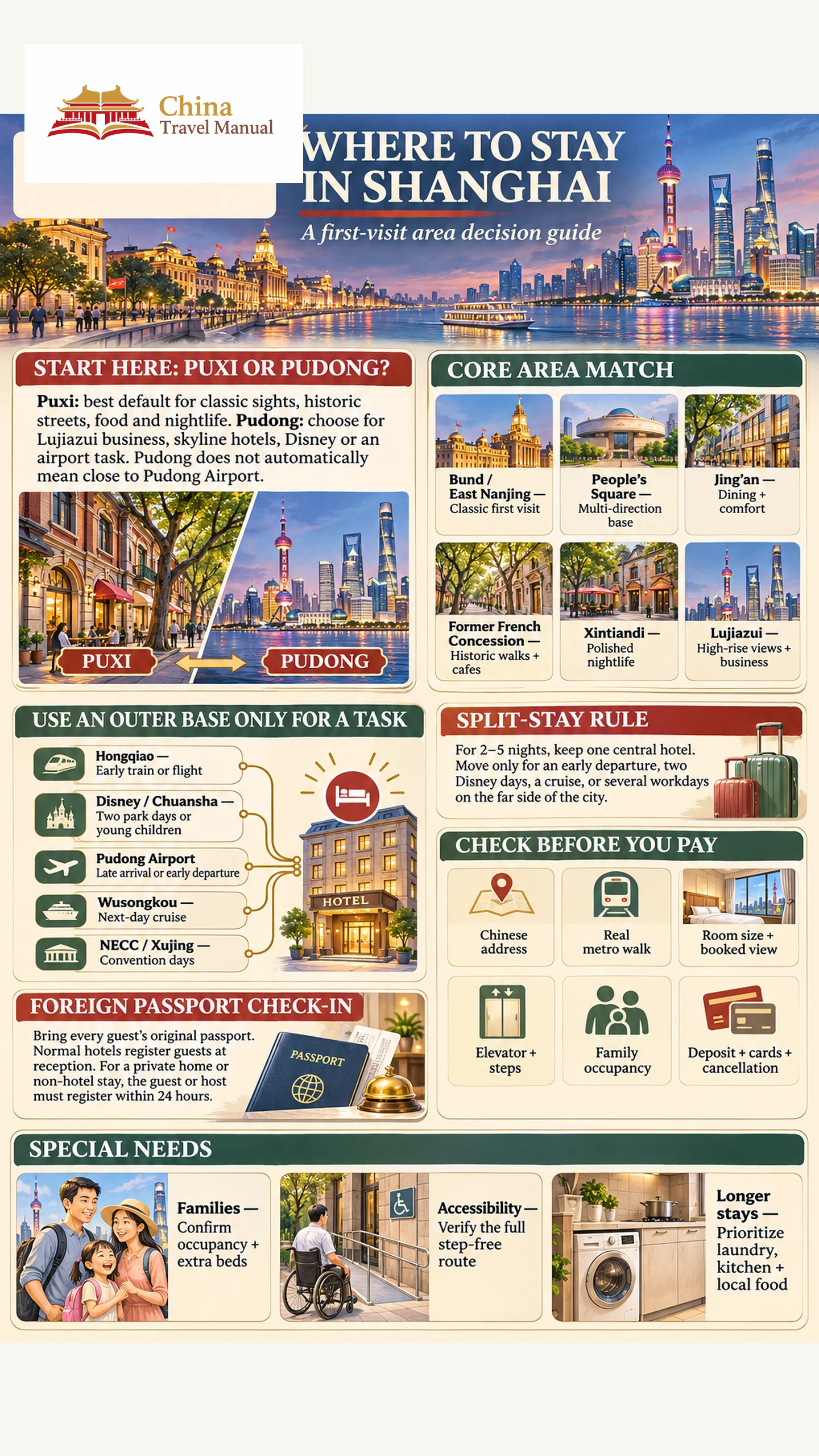
Choosing where to stay in Shanghai is less about finding one universally “best” neighborhood and more about choosing the right daily base. The city is large, the Huangpu River separates many classic sights from Pudong’s skyline district, and a hotel that looks central on a map can still require long walks through large blocks or metro interchanges.
This guide compares the areas that matter most to a first-time visitor. Use it to shortlist one or two neighborhoods, then check the exact property rather than booking from an area label. For a broader view of the city, start with our Shanghai travel guide.
Puxi or Pudong: Make This Decision First
Puxi is the default choice for most first visits. The Bund, People’s Square, East Nanjing Road, Jing’an, Xintiandi and the historic streets commonly called the Former French Concession are all west of the Huangpu River. Official city-walk routes also group these areas into distinct walking environments rather than one compact “downtown.”[1]
Pudong is a better fit when the trip centers on Lujiazui offices, a convention, a high-rise hotel, Shanghai Disney Resort or an airport-related task. Do not assume that a hotel in Pudong is close to Pudong International Airport. Lujiazui is a central business district, while the airport is roughly 30 kilometers from central Shanghai.[3]
| Question | Choose Puxi | Choose Pudong |
|---|---|---|
| Main trip | Classic sightseeing, historic streets, dining and nightlife | Lujiazui business, skyline hotel, Disney or airport task |
| Walking | More connected street life and mixed-use neighborhoods | Large modern blocks and longer distances between some buildings |
| Evenings | Wider choice of restaurants, bars and neighborhood walks | Strong hotel facilities but fewer historic street environments |
| Best short-stay rule | Default for most two-to-five-night first visits | Choose only when a specific Pudong purpose outweighs cross-river travel |
A river view is not the same as a convenient base. You can stay on the Bund side and look toward the Pudong skyline without sleeping in Lujiazui. For a short trip, daily convenience usually matters more than one night of elevated views.
Best Areas to Stay in Shanghai
The table below is a starting filter. Price tendency is relative: room rates change sharply with weekends, public holidays, exhibitions and the exact view or room type.
| Area | Best for | Walking and metro | Price tendency | Main trade-off |
|---|---|---|---|---|
| Bund and East Nanjing Road | Classic first visit and night views | Excellent sightseeing walks; check the actual metro entrance | High near the river | Crowds, noise and view premiums |
| People’s Square | Efficient multi-direction sightseeing | Strong metro access; large underground passages | Mid to high | Less neighborhood charm |
| Jing’an | Dining, nightlife and balanced comfort | Good metro access and city walks | Mid to high | Not walkable to the Bund |
| Former French Concession | Historic streets, cafes and slower stays | Excellent local walking; access varies by exact road | Mid to high | Fuzzy boundaries and older buildings |
| Xintiandi and Huaihai Road | Polished dining, shopping and nightlife | Central and easy to combine with nearby walks | High | Commercial atmosphere |
| Lujiazui | Skyline hotels and Pudong business | Good metro access but very large blocks | High | Cross-river travel for many historic sights |
| Yu Garden and Old City | Old-city atmosphere and short landmark access | Useful for nearby sights; very busy at peak times | Mixed | Tourist crowds and fewer all-purpose bases |
The Bund and East Nanjing Road
Choose this area when you want Shanghai’s most recognizable sights outside the hotel door. The Bund promenade, East Nanjing Road and evening views across the river can be combined on foot. It works especially well for a first visit of only two or three nights, when reducing sightseeing transfers matters more than finding a residential atmosphere.
The label “Bund area” needs careful checking. A true riverfront room, a hotel several blocks behind the Bund and a property placed inside a wide online booking radius are different products. Check the pin, the entrance address and the walking route to the promenade. A room category must explicitly promise a river or skyline view; the hotel’s address alone does not guarantee one.
The trade-offs are crowds, road noise and high premiums for views. Travelers who sleep lightly, want larger rooms for the same budget or prefer local cafes over major tourist streets may be happier in Jing’an or the Former French Concession.
People’s Square
People’s Square is the practical alternative to the Bund. It is well placed for trips that move in several directions, and East Nanjing Road, museums and central shopping are close. Shanghai’s metro is extensive, and eligible contactless Visa, Mastercard, American Express and JCB cards can be tapped at the gates, making a well-connected central base easier for many international visitors.[2]
The main weakness is street-level scale. Large junctions, malls and underground passages can turn a short map distance into a longer walk. Check which metro exit serves the hotel and whether luggage requires stairs or a long underground passage. Choose People’s Square for transport efficiency, not for quiet residential character.
Jing’an
Jing’an offers one of the best balances of restaurants, shopping, nightlife, hotel choice and metro access. It suits travelers who want a comfortable city base after sightseeing rather than a room directly beside one famous landmark. The Jing’an Temple area is especially useful for mixed business and leisure trips.
Do not book from the district name alone. Jing’an is a large administrative district, and a hotel far north of the temple core can have a very different commute. Check the exact station and road. The neighborhood is not a realistic walk from the Bund, and higher-end properties can be expensive during exhibitions and major events.
Former French Concession
The Former French Concession is best for tree-lined streets, historic residential architecture, cafes and unhurried city walks. It is a strong choice for couples, repeat visitors and anyone who would rather explore several streets deeply than move between headline sights all day.
It is not a current administrative district with fixed booking boundaries. Properties marketed under this label can sit near very different metro stations, from Huaihai Road and South Shaanxi Road to quieter parts of Xuhui. Verify the street rather than trusting the label.
Older lane houses and converted villas also require a property-level check. Some have stairs, small elevators, limited soundproofing or difficult luggage access. These features may add character for one traveler and create serious inconvenience for another.
Xintiandi and Huaihai Road
Xintiandi and the central Huaihai Road area suit travelers who prioritize polished restaurants, shopping, bars and easy evening walks. The location is central enough to combine modern commercial spaces with nearby historic streets, and it generally feels more organized and upscale than the broad Former French Concession label.
The price is usually high, and the atmosphere is deliberately commercial. Families seeking a large room, budget travelers and visitors who want a quiet residential street should compare Jing’an, People’s Square or locations slightly outside the core.
Lujiazui and Central Pudong
Lujiazui is the right base for finance-district meetings, high-rise hotel facilities and direct access to Pudong’s landmark towers. Modern hotels may provide larger public spaces, newer rooms and strong family facilities. It can also work for travelers who want a hotel-centered stay rather than late-night neighborhood exploration.
The area looks compact in skyline photographs but feels large on foot. Towers, elevated roads and shopping complexes can separate a hotel from the nearest useful entrance. Many classic sights remain across the river. Stay here because your work or preferred hotel experience is in Lujiazui, not because the word “Pudong” appears in the airport’s name.
When Should You Stay Outside Central Shanghai?
An outer base is worthwhile when it protects a fixed next-day task. It is rarely the best way to save money on a normal sightseeing trip.
| Base | Use it for | Typical stay | What you gain | What you give up |
|---|---|---|---|---|
| Hongqiao hub | Very early train or flight, late arrival, NECC event | One night | Lower missed-departure risk | Longer trip to classic sights |
| Disney or Chuansha | Two park days or young children | One to two nights | Shorter early-morning park trip | Weak central-city evenings |
| Pudong Airport | Late international arrival or early departure | One night | More flight buffer | Poor sightseeing base |
| Wusongkou cruise area | Next-day cruise embarkation | One night | Less cross-city traffic risk | Far from central neighborhoods |
| NECC and Xujing | Trade fair or convention | Event nights | Easy venue access | Not convenient for most tourism |
Shanghai Hongqiao Railway Station is served by Metro Lines 2, 10 and 17, but the hub is in western Shanghai rather than beside the Bund.[4] If an early train is the priority, see our Shanghai Hongqiao Railway Station guide. The National Exhibition and Convention Center is served by Lines 2 and 17, although major fairs can produce temporary access controls and very heavy station crowds.[8]
For Shanghai Disneyland, one park day usually does not justify moving. Two park days, very young children or a strong need to reach the entrance early can make a nearby base useful. The resort is served by Metro Line 11, but the trip still includes the walk from the station or vehicle drop-off to the park entrance.[5]
An airport hotel is a schedule tool, not a Shanghai sightseeing base. Pudong Airport is linked to central Shanghai by Metro Line 2, the maglev via Longyang Road and other ground transport, but every option still requires terminal, luggage and hotel-transfer time.[3] Check our Pudong Airport transfer guide before choosing the final night.
Should You Split Your Stay in Shanghai?
For a two-to-five-night city trip, keep one central hotel. Packing, checking out, storing luggage, crossing the city and waiting for the next room can consume much of a sightseeing day.
A split stay becomes reasonable when it solves a hard scheduling problem:
- Two consecutive Disney days: Move closer to the resort to protect early starts and tired children.
- Very early Hongqiao departure: Spend the final night near the correct terminal or railway station.
- Late arrival or early Pudong flight: Use an airport-area room when central transport would remove too much sleep.
- Next-day cruise: Move near the correct cruise terminal rather than gambling on morning cross-city traffic.
- Separated business and leisure zones: Split only when several workdays are concentrated far from the sightseeing base.
Do not move only for one Bund-view night, one Disney day or the idea of “experiencing both sides” during a three-night trip. You can visit both sides of the river without changing hotels.
Hotel Costs, Booking Priorities and Common Traps
Shanghai room prices are too date-sensitive for one reliable citywide range. A river-view Bund room, a high-floor Lujiazui room and a central Xintiandi property normally carry the largest location or view premium. Jing’an and Huaihai Road often remain mid-to-high priced but provide more variety. People’s Square and well-connected locations one or two metro stops outside the headline areas may offer better value.
Book scarce requirements before ordinary rooms. Family rooms, connecting rooms, verified accessible rooms, exact river-view categories and hotels needed for major exhibitions can sell out well before standard central-city inventory. Use a refundable rate until flights and long-distance trains are secure.
Before paying, check all of the following:
- Exact location: Save the Chinese hotel name, street address and map pin.
- Useful metro access: Measure the walking route to the correct entrance, not a straight line to the station label.
- Street barriers: Look for wide roads, underground passages, elevated walkways and malls between the hotel and station.
- Room facts: Confirm floor area, bed configuration, window, smoking status, noise risk and whether the booked category includes the advertised view.
- Building access: Confirm elevators, entrance steps, luggage handling and wheelchair access.
- Family rules: Check maximum occupancy, crib, extra-bed and child-breakfast charges.
- Payment: Ask about deposits, accepted international cards, preauthorization and cancellation deadlines.
The most common booking mistake is believing a broad marketing label. “One kilometer from the Bund” may still mean an unpleasant route with luggage. “Near the metro” may refer to the edge of a huge interchange. “River view” may describe selected rooms rather than the room you booked.
Foreign Passport Check-In and Accommodation Registration
Bring the original passport used for the booking. Shanghai accommodation providers must verify valid identification and register guest information at check-in; every guest should be included rather than only the person whose card paid for the room.[6]
There is no single legal category of “foreigner-only hotel.” The practical question is whether the property can complete the required registration correctly. A normal hotel handles registration through its front desk. Booking confirmation alone does not prove that a small guesthouse, private rental or serviced apartment understands the process, so ask before accepting a nonrefundable rate.
For a private home or other non-hotel accommodation, the visitor or host must complete accommodation registration within 24 hours of arrival. Shanghai provides online and in-person channels, but the host’s property information may still be needed.[7] Visa-free entry does not remove this requirement. Keep the passport available and save the registration record if your later travel or administrative plans may require it.
Choose for Families, Accessibility and Longer Stays
Families should verify occupancy before comparing neighborhoods. A standard twin room may not legally or comfortably hold two adults and two children. Confirm the number and ages of all guests, connecting-room availability, crib or extra-bed charges, breakfast rules and whether a late arrival affects the room guarantee.
Travelers with limited mobility should favor a modern property with confirmed step-free access. A hotel can be “near the metro” while the practical route still includes entrance steps, a long passage or an exit without an elevator. Converted lane houses and historic villas may have small elevators, narrow stairs, uneven pavements and limited vehicle access. Ask for the exact accessible route from the street to the room.
For a longer stay, daily living matters more than a postcard address. Laundry facilities, a refrigerator, a simple kitchen, supermarkets and neighborhood restaurants may be more valuable than a Bund view. Jing’an, Xuhui and areas just outside the Huaihai Road core can work well, but serviced apartments still need clear passport-registration, deposit and utility policies.
FAQs About Where to Stay in Shanghai
What Is the Best Area for a First-Time Visitor?
Central Puxi is the safest default. Choose the Bund or East Nanjing Road for classic sights, People’s Square for transport efficiency, Jing’an for dining and balanced comfort, or the Former French Concession for slower historic-street walks.
Should You Stay in Puxi or Pudong?
Choose Puxi for most first-time sightseeing. Choose Pudong when the trip centers on Lujiazui business, a specific high-rise hotel, Shanghai Disney Resort or an airport-related task. Pudong is large, so the exact sub-area matters.
Is It Better to Stay Near the Bund or in the Former French Concession?
Stay near the Bund for a short classic visit and easy evening skyline walks. Choose the Former French Concession for cafes, historic residential streets and a slower neighborhood experience. Check the exact road because the area label covers a wide zone.
Should You Move Hotels for Shanghai Disneyland?
Usually not for one park day. A move becomes useful for two consecutive park days, very young children or a strong preference for an early start. Keep a central base when Disney is only one part of a short city trip.
Can Foreign Tourists Stay in Any Shanghai Hotel?
Avoid absolute answers. Shanghai accommodation providers must register guests, and normal hotels generally handle this at reception. Confirm the process before booking a small guesthouse, private rental or serviced apartment, especially when the rate cannot be refunded.
Sources
[1] Shanghai Municipal Government. Urban Discovery: City Walk Routes
[2] Shanghai Municipal Government. How to Take Metro in Shanghai
[3] Shanghai Municipal Government. Traveling Between Shanghai’s Airports and City Center
[4] Shanghai Municipal Government. Guide to Railway Stations in Shanghai
[5] Shanghai Disney Resort. Transportation
[6] Shanghai Municipal Bureau of Justice. Provisions on Accommodation Registration by Hospitality Establishments
[7] Shanghai Municipal Public Security Bureau. Accommodation Registration
[8] Shanghai Municipal Commission of Transportation. How to Get to and Leave CIIE Venue by Metro





