

Quick Answer: Planning Your First Shanghai Trip
For a first visit, allow at least two full sightseeing days; three full days is the practical baseline. Count arrival and departure days separately. Base yourself in central Puxi unless your trip revolves around business, a specific Pudong hotel, or a Pudong attraction.
- Keep these three experiences: the Bund with the Pudong skyline, Yu Garden and the Old City, and one walkable historic neighborhood.
- Use three days well: combine riverfront Shanghai, a Puxi neighborhood day, and either museums/Pudong or a theme park.
- Add a fourth or fifth day: choose one full-day extension, such as Shanghai Disneyland, Suzhou, or Zhujiajiao.
- Cut in this order: extra day trips, a second observation deck, a theme park, then a distant water town.
Do not treat a fast metro or train time as the full trip. Station access, security, transfers, queues, and the final walk often add more time than expected.
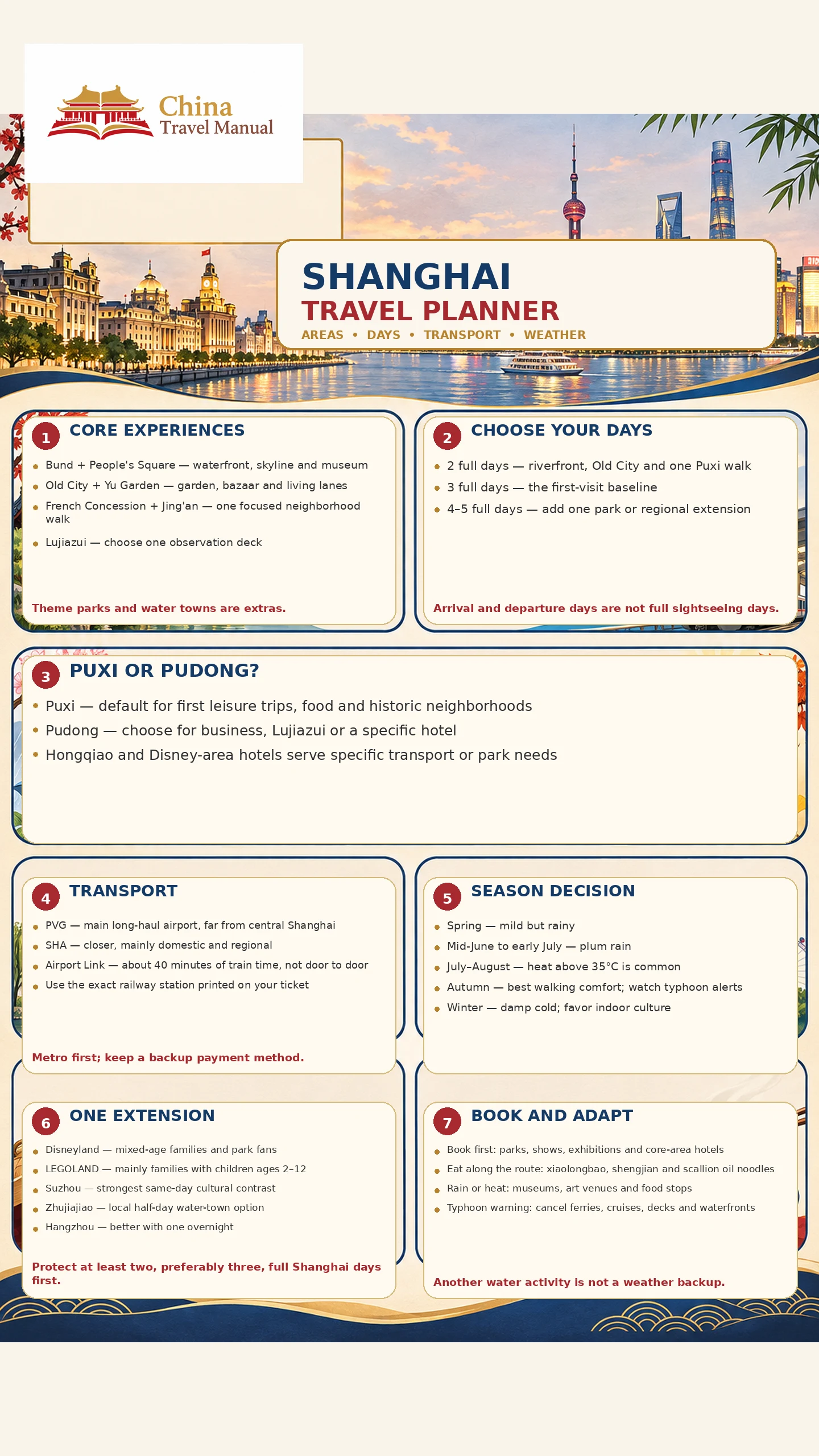
Shanghai is strongest for waterfront architecture, dense neighborhoods, food, museums, and modern skylines. It is not a substitute for Beijing’s imperial sites or Xi’an’s ancient monuments.
This guide helps a first-time visitor choose priorities, a base, and a realistic two-, three-, or five-day plan. Times are door to door, not just train time.
Confirm Your Entry Basis Before Booking
Confirm how you will enter China before paying for nonrefundable rooms, rail tickets, or tours. A regular Chinese visa, a national unilateral visa exemption, and the 240-hour transit visa exemption are different legal bases.
The 240-hour policy is for eligible passport holders transiting to a third country or region. Your confirmed onward itinerary must fit that pattern; a simple return trip to the place you arrived from does not. Hong Kong and Macao can count as separate regions for the routing test, but nationality, entry port, permitted area, passport validity, and onward-ticket conditions still apply. The current policy allows eligible travelers to stay for no more than 10 days, but immigration officers make the final admission decision.[1] Keep the onward ticket available.
Cruise passengers must apply the rule to their actual sequence of ports. Recheck the official policy shortly before departure because eligible nationalities and ports can change.
Where to Go in Shanghai
Shanghai works best as a set of experience clusters rather than a checklist of isolated landmarks.
| Area | Core experience | Best for | Useful time | Main trade-off | First-visit priority |
|---|---|---|---|---|---|
| Bund–People’s Square | Historic waterfront, skyline, museum access | Nearly every first-time visitor | Half to one day | Heavy crowds at peak times | Highest |
| Old City–Yu Garden | Classical garden, lanes, traditional commercial atmosphere | Culture and photography | Half day | Commercialized and crowded | High |
| Former French Concession–Jing’an | Neighborhood walks, lane houses, cafes, local dining | Slow urban exploration | One day | Sights are spread out | High |
| Lujiazui–Pudong waterfront | Modern skyline, observation deck, art museums | Architecture and city views | Half to one day | Paid viewpoints and river crossing | High |
| Disneyland or LEGOLAND | Full theme-park day | Families and park fans | One full day each | High cost and long commute | Interest-based |
| Outer water towns | Canals, bridges, Jiangnan streets | Longer stays | Half to one day | Transfer time | Optional |
The Bund, Nanjing Road and People’s Square
The Bund is the essential first-visit riverfront. Its main value is the line of historic commercial buildings on the Puxi bank and the direct view across the Huangpu River to Lujiazui. Arrive in late afternoon if you want to see facade details before the skyline lights come on. Lighting schedules and waterfront crowd controls can change, so do not build a tight evening connection around a fixed switch-on time.
East Nanjing Road is a highly commercial pedestrian link between People’s Square and the Bund. Use it for shopping or as a connector rather than automatically giving it several hours. People’s Square is a major metro interchange, a central hotel base, and home to the downtown Shanghai Museum. Individual visitors normally can enter without advance booking, but reservations may return during holidays, school breaks, and popular special exhibitions.[2] Check the current museum notice.
Old City, Yu Garden and the Huangpu River
Yu Garden is the ticketed classical garden. The surrounding Yuyuan Bazaar is a free commercial complex with reconstructed traditional-style architecture. The wider Old City is a lived urban district with surviving lanes and temples; the bazaar is not an intact Ming- or Qing-era neighborhood.
Visit Yu Garden on a weekday morning when possible. If time is short, give the garden two hours and use the bazaar mainly for a meal or brief evening walk. To cross the Huangpu, choose among a low-cost public ferry, a paid sightseeing cruise, and a metro ride. The ferry gives a short skyline experience; a cruise is longer and more expensive; the metro is usually best when speed matters. Shanghai’s official ferry information confirms that the system is a practical Puxi–Pudong crossing, but routes and operating hours must be checked on the day.[3] Verify the last sailing before an evening crossing.
Former French Concession, Xintiandi and Jing’an
The former French Concession is a broad historical urban area, not a gated attraction. Pick one slice: start near Wukang Mansion, continue around Wukang and Fuxing roads, and finish toward Xintiandi. If Wukang Road is crowded, Yuyuan Road is a calmer alternative.
Xintiandi is polished and commercial, but its adapted shikumen setting makes the lane-house form easy to recognize. Jing’an is a balanced base with restaurants, shopping, metro access, and a major temple. Many historic buildings are private homes: photograph from public space, avoid blocking doorways, and ask before taking close portraits.
Lujiazui, Museums and the New Waterfronts
Lujiazui supplies the modern skyline that defines most Shanghai postcards. For a first trip, pay for one observation deck, not Shanghai Tower, Jin Mao Tower, and Oriental Pearl Tower together. Shanghai Tower is the clearest single choice for height and a broad city view, but clouds and haze can erase the value of the ticket. Buy only after checking visibility when flexible tickets are available.
Shanghai Museum has two major sites. The People’s Square museum is central; Shanghai Museum East is a much larger Pudong venue with 13 permanent galleries and needs more travel and viewing time.[4] With only two or three full days, choose one. West Bund, North Bund, and Suzhou Creek suit a repeat visit or a slower fourth or fifth day.
Disneyland, LEGOLAND and Family Extensions
Shanghai Disneyland needs a full day and a dated ticket. Every foreign visitor should carry the original passport used for booking; a photo or digital copy is not accepted as the admission document.[5] It is the stronger general choice for mixed-age families and travelers who want large-scale rides, shows, and an evening spectacular.
LEGOLAND Shanghai Resort is in Fengjing, Jinshan District, far from the central sightseeing core. It opened in July 2025 and is designed mainly for families with children ages 2–12.[6] It also needs a full day, but its geography and transport are completely different from Disneyland. A standard three-day city trip should skip both parks unless the park is one of the trip’s main purposes.
How Many Days Do You Need in Shanghai?
Count full sightseeing days, not calendar days. A late arrival, an early departure, or a hotel-change day cannot carry the same load as a full city day.
| Full sightseeing time | Realistic scope | What to leave out |
|---|---|---|
| 1 day | One core route: Bund and Old City, or one neighborhood plus a museum | Theme parks, deep museum visits, all day trips |
| 2 days | Bund, Pudong skyline, Old City, and one Puxi walking district | Disneyland, Suzhou, Hangzhou |
| 3 days | First-time city essentials plus one interest module | Multiple day trips or both theme parks |
| 4–5 days | Slower city route plus one full-day park or regional extension | Repeated water-town stops |
| 6+ days | Deeper Shanghai plus one or two Yangtze Delta extensions | Daily hotel changes |
Three full days is the best baseline because it lets you separate the riverfront, historic neighborhoods, and one museum or family interest. If your flight lands at night and leaves early on day four, you have only two useful days and should plan accordingly.
Best Time to Visit Shanghai
Spring and autumn are usually the easiest seasons for long urban walks, but Shanghai does not have a guaranteed clear-weather window. The city has a humid subtropical climate, frequent spring drizzle, a plum-rain period from roughly mid-June to early July, summer days above 35°C, and a late-August to mid-September peak typhoon risk.[7] Forecasts matter more than averages.
| Season | What works well | Main cost or risk | Planning response |
|---|---|---|---|
| March–May | Neighborhood walks, gardens, outdoor dining | Changeable temperatures and rain | Carry a light layer and compact rain protection |
| Mid-June–early July | Indoor culture and food | Plum rain, humidity, prolonged wet weather | Reduce long walking days |
| July–August | Evening riverfront views | Extreme heat, thunderstorms, peak crowds | Put outdoor sights early and late |
| September–November | Best overall walking comfort | Early-autumn typhoon disruption; holiday crowds | Prefer late September or October outside holidays |
| December–February | Museums, food, lower visitor numbers | Damp cold and short daylight | Use shorter outdoor blocks |
Plane-tree color is usually strongest in November, but the exact week shifts with temperature. Avoid treating blossom or foliage dates as fixed. The May Day and National Day holiday periods bring heavier crowds and higher hotel rates. Large trade fairs can also tighten rooms. During a typhoon warning, cancel ferries, cruises, observation decks, and exposed waterfront plans instead of replacing one water activity with another.
Suggested Shanghai Itineraries
These are sequence frameworks, not hour-by-hour schedules. Keep one central Puxi hotel for the city portion.
2 Days: Shanghai Essentials Without a Day Trip
| Day | Area task | Base | Door-to-door load | Rain backup | First cut |
|---|---|---|---|---|---|
| 1 | Yu Garden and Old City; late-day Bund; public ferry or metro to Pudong skyline views | People’s Square or Xintiandi | Medium, with long walking | Museum or indoor exhibition | Paid river cruise |
| 2 | One former French Concession walk; People’s Square museum or Jing’an | Same Puxi hotel | Medium | Museum, mall, or covered food stop | Extra shopping streets |
This plan protects the three essential experiences without adding a remote attraction. If you arrive after lunch on the first calendar day, shift the Bund to that evening and begin the two-day count the next morning. Do not add Disney, Zhujiajiao, Suzhou, or Hangzhou.
3 Days: The Best First-Time City Route
| Day | Area task | Base | Door-to-door load | Rain backup | First cut |
|---|---|---|---|---|---|
| 1 | Yu Garden, Bund, and one Huangpu crossing for the Lujiazui skyline | Central Puxi | Medium-high | Shanghai Museum | Observation deck |
| 2 | Historic-neighborhood walk, local food, and People’s Square museum | Central Puxi | Medium | Museum or art venue | Long cafe detour |
| 3 | Choose Pudong museums/waterfront or Shanghai Disneyland | Central Puxi; park hotel optional | High | Indoor Pudong museums; park day follows park policy | Second viewpoint |
For most adults, choose Pudong on day three. Families or committed Disney fans can replace that day with Disneyland. Add Shanghai Museum East only when its collection is a priority.
5 Days: Add One Full-Day Extension
Keep the three-day city route, then use day four for exactly one major extension: Disneyland, Zhujiajiao, or Suzhou. Day five should remain flexible for a missed neighborhood, a food-focused half-day, shopping, or bad-weather recovery.
Suzhou is the most efficient first regional day trip when classical gardens are the goal, but station access, security, local transit, and garden entry make the day much longer than the high-speed train ride. Zhujiajiao is the easier half-day option without leaving Shanghai municipality. Hangzhou’s West Lake is too broad for a relaxed out-and-back visit; stay overnight if it matters. Do not use both extra days for two similar water towns.
Where to Stay in Shanghai
Most first-time visitors should stay in Puxi. It keeps the Bund, Old City, museums, historic neighborhoods, food, and evening walks on the same side of the river.
| Base | Best for | Advantage | Trade-off |
|---|---|---|---|
| People’s Square / East Nanjing Road | Short first visits and metro users | Central, excellent line connections | Crowds and possible street noise |
| West of the Bund | Higher budgets and landmark atmosphere | Walk to the waterfront | High room rates |
| Xintiandi / east former French Concession | Dining and evening neighborhood life | Strong street atmosphere | Hotel and metro access varies by block |
| Jing’an | Balanced city trips | Food, shopping, and transport | Longer ride to the Bund |
| Lujiazui | Business and Pudong-focused stays | Easy Pudong access | Less neighborhood life at night |
| Hongqiao | Early flight or high-speed train | Close to the transport hub | Poor sightseeing base |
| Disney area | Families with an early park start | Shorter park commute | Far from central Shanghai |
For a first trip with children or a late-night arrival, a well-connected People’s Square hotel is the simplest default. Budget travelers should move one or two metro stops away from the Bund rather than choosing a distant suburb. Hotels generally register foreign passport guests; you do not need a special category of “foreigner hotel.” Still, confirm passport check-in before paying for a small guesthouse, apartment, or rural property. If you stay in a private home rather than a hotel, separate accommodation registration rules apply.
Getting to Shanghai and Around the City
Choose Pudong or Hongqiao Airport Carefully
Shanghai Pudong International Airport (PVG) is the main long-haul international gateway and is far from central Shanghai. Shanghai Hongqiao International Airport (SHA) is closer to the city and is dominated by domestic and regional routes. Show the exact airport code to a driver; “Shanghai airport” is not enough.
The Maglev runs only between PVG and Longyang Road, not People’s Square. The Shanghai Airport Link Line connects Pudong Airport with Hongqiao Airport Terminal 2 in about 40 minutes of train time and serves seven stations, but a door-to-door airport transfer is much longer after walking, waiting, and terminal procedures.[8] For an arrival plan, use the dedicated Shanghai Pudong Airport transfer guide. Late at night, verify the last rail service before landing and keep a taxi or prearranged pickup backup.
Choose the Exact Railway Station
Shanghai Hongqiao Railway Station is the main high-speed hub and sits beside Hongqiao Airport Terminal 2, but rail and air use separate security systems. Shanghai Railway Station is closer to the central districts and is often convenient for Suzhou. Shanghai South Railway Station serves a different set of routes. Official station guidance lists them as separate facilities with different metro connections.[9] Use the ticket’s complete station name.
Follow the complete station name printed on the ticket. Do not navigate to “Shanghai station” based on a shortened translation. If your trip uses Hongqiao, review the Shanghai Hongqiao Railway Station guide and allow time for the large concourse and security queue.
Use Metro, Walking, Ferries and Taxis Together
Use the metro as the cross-city backbone, then walk only within one neighborhood cluster. Yu Garden, the Bund, Lujiazui, and Wukang Road do not form one seamless walking route. Their map pins look close at city scale but require transfers and substantial walking.
Eligible contactless UnionPay, Visa, Mastercard, American Express, and JCB cards can tap at Shanghai Metro gates. The card must meet the network and issuer conditions, so keep a single-journey ticket or transport card as a backup.[10] Each rider needs a separate payment medium and should use the same card to enter and exit.
Use ferries for the river experience, not automatically for the fastest transfer. Choose a licensed taxi or app-based ride for luggage, a late arrival, young children, or limited mobility. Driving is rarely useful for a central sightseeing trip because parking and traffic erase the benefit. Always save the Chinese name and full address of your hotel and station.
Shanghai Food and Urban Experiences
Build food into the neighborhood route instead of crossing the city for one famous shop. Xiaolongbao are steamed soup dumplings; shengjian are pan-fried buns with a crisp base. Scallion oil noodles are a simple, accessible meal, while red-braised pork and other benbang dishes show Shanghai’s sweeter, soy-rich local style.
Hairy crab is seasonal, usually an autumn specialty, so it should not appear on a year-round must-eat list. A lane-neighborhood breakfast, local wet market, cafe, or jazz bar adds daily-city context. Order smaller portions first when dining alone because several local dishes are designed for sharing.
Vegetarians should confirm that a vegetable dish contains no lard, meat stock, dried shrimp, or oyster sauce. Travelers with allergies should ask about shellfish, peanuts, sesame, soy, wheat, and pork. Keep the written Chinese names of serious allergens on your phone; “no meat” does not automatically mean vegan.
Should You Add a Day Trip from Shanghai?
Add a day trip only after protecting at least two, preferably three, full Shanghai days.
| Destination | Core experience | Best fit | Door-to-door cost | Skip when |
|---|---|---|---|---|
| Zhujiajiao | Canals, bridges, compact water-town streets | A local half-day without intercity rail | Metro plus local transfer | You already plan Suzhou |
| Suzhou | Classical gardens, canals, old-city lanes | First Jiangnan side trip | Station security, local transit, garden booking | Shanghai has under three full days |
| Hangzhou | West Lake, temples, tea culture | Travelers able to stay overnight | Large sightseeing area and long local transfers | You only want a rushed photo stop |
| Smaller water towns | Quieter canals and photography | Repeat visitors | Weak public transport | A short first trip |
If you can choose only one same-day destination, Suzhou usually offers the clearest contrast with Shanghai. Zhujiajiao is better when you want a shorter water-town taste without changing cities. Hangzhou is more rewarding with one night because West Lake is a landscape district, not a single attraction beside the station. Holiday high-speed rail tickets and popular garden slots can sell out, so book the transport and the key garden before building the rest of the day.
Booking Priorities, Costs and Weather Backups
Book in this order: theme parks, major performances and popular special exhibitions; core-area accommodation; intercity rail; then observation decks, cruises, and ordinary paid attractions. Do not assume all museums share one rule. Some allow walk-ins on normal days, while holidays or headline exhibitions can restore reservations.
Use these planning ranges rather than fixed price promises. They exclude international transport and assume two people share a room.
| Budget style | Room per night | Daily non-hotel spend per person | What raises the total |
|---|---|---|---|
| Economy | RMB 300–600 | RMB 180–350 | Long rides, paid viewpoints |
| Mid-range | RMB 700–1,400 | RMB 400–800 | Cruises, cocktails, better dining |
| High-end | RMB 1,800+ | RMB 1,000+ | Bund hotels, tasting menus, private transfer |
A theme-park day sits outside these ordinary city ranges. So can premium observation decks, river cruises, and high-end local dining. Recheck every current fare before payment and note whether a quote is per person, per vehicle, or per room.
For heavy rain or extreme heat, replace long walks with one museum, an art venue, a covered commercial area, or a food-focused block. For a typhoon warning, cancel ferries, sightseeing cruises, observation decks, and exposed waterfronts; official transport adjustments can include full ferry suspension.[11] A second water activity is not a weather backup. Keep the fifth day flexible if your trip includes an expensive outdoor booking.
FAQs About Shanghai Travel
Is Shanghai Worth Visiting on a First Trip to China?
Yes, if you value modern city life, waterfront architecture, neighborhood walks, food, museums, and easy Yangtze Delta connections. If imperial palaces, the Great Wall, or large ancient sites are your main goal, prioritize Beijing or Xi’an and add Shanghai only when your schedule permits.
Is Three Days Enough for Shanghai?
Three full sightseeing days covers the Bund and riverfront, Old City, one historic Puxi neighborhood, and one museum or Pudong interest. Arrival and departure days do not count. Disneyland or an intercity day trip needs an additional full day.
Should You Stay in Puxi or Pudong?
Stay in Puxi for a first leisure trip because most core walks, Old City sights, food districts, and central museums are there. Choose Pudong for business, a particular Lujiazui hotel, a Pudong-heavy museum plan, or a park-specific stay.
Can You Travel Around Shanghai Without a Private Driver?
Yes. Metro, walking, public ferries, and short taxi or app-based rides cover the main itinerary. A private transfer is most useful for airport travel, a late arrival, heavy luggage, young children, or mobility limits, not for ordinary central sightseeing.
Should You Visit Suzhou or Hangzhou from Shanghai?
Choose Suzhou for a same-day trip focused on classical gardens and old-city lanes. Choose Hangzhou when you can stay overnight and explore West Lake without racing back to the station. Skip both if Shanghai has fewer than three full sightseeing days.
Sources
[1] National Immigration Administration. Visa-Free Transit Policies
[2] Shanghai Municipal People’s Government. Shanghai Museum Drops Reservations at People’s Square Site
[3] Shanghai Municipal People’s Government. Ferry
[4] Shanghai Municipal People’s Government. A Guide to Visiting Shanghai Museum East
[5] Shanghai Disney Resort. Weather and Packing Information
[6] Merlin Entertainments. China’s First LEGOLAND Resort Officially Opens
[7] Shanghai Municipal People’s Government. Shanghai’s Weather: A Guide to the City’s Four Seasons
[8] Shanghai Municipal People’s Government. How to Take the Airport Link Line
[9] Shanghai Municipal People’s Government. Guide to Railway Stations in Shanghai
[10] Shanghai Municipal People’s Government. Shanghai Metro Expands Tap to Ride Pilot to Entire Network
[11] Shanghai Municipal People’s Government. Shanghai Adjusts Transport Services for Typhoon Dolphin





